Uganda |
|
| Still current at: 24 May 2012
Updated: 23 April 2012 |
| No restrictions in this travel advice | Avoid all but essential travel to part(s) of country | Avoid all but essential travel to whole country | Avoid all travel to part(s) of country | Avoid all travel to whole country |
This advice has been reviewed and reissued with a revised Health section. The overall level of the advice has not changed; we advise against all travel to Karamoja region except for trips to Kidepo Valley National Park.
(see travel advice legal disclaimer)
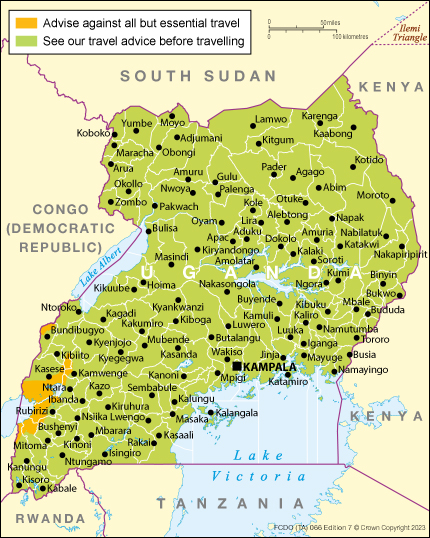
To see an enlarged version of this map, click here. (514 KB)
We advise against all travel to Karamoja region in north eastern Uganda (Kotido, Moroto, Nakapiripirit, Katakwi, Kaabong, Abim, Kapchorwa and Bukwa Distsricts) with the exception of trips to Kidepo Valley National Park, which we recommend should be made by air. See Safety and Security - Local Travel (North East Uganda) and National Parks.
We advise against travel by road outside of major towns at night except between Kampala and the airport at Entebbe.
There is a high threat from terrorism. Attacks could be indiscriminate, including in places frequented by expatriates and foreign travellers.
Around 15,000 British tourists visit Uganda every year (Source: Ugandan Immigration Department). Most visits are trouble-free. See General - Consular Assistance Statistics. See also Safety and Security - Crime.
You should take out comprehensive travel and medical insurance before travelling. See General - Insurance.
Safety and Security - Terrorism
There is a high threat from terrorism in Uganda. Attacks could be indiscriminate, including in places frequented by expatriates and foreign travellers. Large crowds of people and public places may also be targets.
The Islamic terrorist group Al-Shabaab, while based in Somalia, poses a threat across the East Africa region. On 11 July 2010 there were bomb attacks in Kampala (one explosion at a restaurant in Kabalagala (Tank Hill Road) and two at a rugby club in Lugogo (Jinja Road)), killing over 70 people, and injuring many more. Al-Shabaab claimed responsibility for the bombs, the first major terrorist attacks they have carried out outside Somalia. Al-Shabaab linked the attacks to Uganda’s military presence in Somalia as part of an African Union peacekeeping mission, and threatened further attacks in the region. The Ugandan security authorities remain alert to this continuing threat.
The Ugandan authorities remain concerned about the possibility of a further attack and have issued a number of alerts warning of a heightened risk of terrorism, most recently just before Christmas in December 2011. Most major hotels and large shopping malls operate security checks. There may also be additional security checks, including baggage searches, in operation on the approach to Entebbe Airport.
See our Terrorism Abroad page.
Safety and Security - Crime
Kampala is a relatively safe city. But opportunistic crime such as burglaries, muggings and drive-by bag snatches do occur. The Kololo Airstrip area of Kampala has a history of thefts from vehicles and muggings, some involving violence. Take extra security precautions when going out on foot after dark. Always be conscious of the risks of making yourself a target for muggers and pickpockets; for example by carrying large sums of cash in the streets or wearing expensive looking jewellery or watches.
In urban areas you should keep car doors locked and windows shut when driving. There have been a number of thefts of personal property from cars and taxis while stationary in traffic. Ensure that no valuables are left visible in vehicles, whether parked or while the vehicle is in use. If stopped by armed men, do not attempt to resist. We advise against all travel outside Uganda’s main towns after dark.
For more general information see the Road Travel Section.
Individuals have been drugged and robbed in Uganda, particularly when using public transport or in bars. Few such cases have been reported in recent years but you should be aware of this risk if you choose to travel by bus (see the Road Travel section of this Travel Advice) and when eating and drinking in bars and nightclubs.
Credit card fraud is commonplace in Uganda. There have been reported incidents of credit card fraud, even in international hotels. Wherever possible, use cash. US Dollars, Euros and Sterling can be readily exchanged. For more general information see the Money section.
Take care of your passport: replacing lost or stolen passports is our most common consular task.
See our Victims of Crime Abroad page.
Safety and Security - Local Travel
Safety and Security - Local Travel - North East Uganda
We advise against all travel to Karamoja (Kotido, Moroto, Nakapiripirit, Katakwi Kaabong, Abim, Kapchorwa and Bukwa Districts) in the north east. Lawlessness there is endemic (eg road ambushes). Tribal clashes are frequent and unpredictable. Small arms are widespread and deaths or injury from gunshot wounds occur regularly.
For advice on Kidepo Valley National Park please see the National Parks section of this Travel Advice.
Safety and Security - Local Travel - Northern and Western Uganda
If you are in northern Uganda or plan to visit the area you should take your personal safety and security seriously, particularly close to the border with DRC and southern Sudan where there have been some clashes. Travel outside of the main towns (Lira, Gulu, Kitgum, Pader, Arua) should be in the company of persons or organisations experienced in local conditions as travel can be difficult and dangerous. As in the rest of Uganda you should not travel outside of town after dark.
There is a risk of banditry in the region. On 1 November 2007 two NGO workers were killed in the Amuru district in northern Uganda, when their car was ambushed.
Safety and Security - Local Travel - West Uganda
Armed clashes occurred on Lake Albert in 2007, one of which resulted in the death of a British national. If travelling by boat on Lake Albert, please be aware that the border with the DRC passes through the lake. Avoid the border area unless all arrangements have been made in advance with both the Ugandan and DRC authorities. See our Travel Advice for the DRC.
There have been violent incidents involving Ugandan forces and Allied Democratic Forces (ADF) rebels in Bundibugyo District in western Uganda, most recently in April 2007 within the Semiliki National Park. Ugandan military activity brought the situation under control but a recurrence is possible and you should seek local advice before embarking on a journey to Bundibugyo District.
Safety and Security - Local Travel - South West Uganda
The Kivus region of the DRC immediately neighbouring southwest Uganda has a history of instability and violent conflict can flare up with little notice (see our Travel Advice for DRC). Fighting and refugees have, in the past spilled over the border, including into Mgahinga and Bwindi National Parks. While the situation in the DRC remains volatile, careful consideration should be given before travelling to the border areas of Kisoro and Kanugu Districts. Before travelling to the area please contact the Uganda Wildlife Authority and your lodge/hotel management for the latest advice and consult the FCO’s Travel Advice for DRC.
Safety and Security - Local Travel - National Parks
Use reputable, registered tour operators to Uganda’s National Parks. Before travel to any national park in Uganda, contact the Ugandan Wildlife Authority (UWA) for up to date security information before embarking on your journey. You can contact them by phone internationally on (00) (256) (414) 355000 or locally on (0) (414) 335000 or email them at mailto:info@ugandawildlife.org.
Mount Elgon National Park
In February 2008 there was an incident where a foreign national was killed whilst hiking in the Mount Elgon National Park. The victim was travelling with a UWA ranger and the culprits were reported to have been Kenyan nationals. Further reports indicate that a group of Kenyan nationals arrested in connection with the incident. Check with the UWA for up to date advice before embarking on travel.
Semiliki National Park
See West Uganda in Local Travel, above.
Murchison Falls National Park
There were armed attacks in the Murchison Falls National Park during the LRA conflict, most recently in late 2005. Visits to the northern sector of the Park should be undertaken in the company of an armed game warden who has functional communications equipment.
Kidepo Valley National Park
See the Karamoja section of Local Travel above. If you wish to visit Kidepo Valley National Park we recommend that you travel by air rather than road.
Mgahinga Gorilla National Park and Bwindi Impenetrable Forest National Parks
These parks are in the extreme south western corner of Uganda, which border the DRC and Rwanda. The neighbouring region of the DRC has a history of instability and problems may flare up with little notice (see section on south western Uganda). It is routine practice for security personnel accompany tourists on gorilla-tracking visits in south western Uganda.
Safety and Security - Local Travel - Gorilla Trekking
Some gorilla trekking operators cross into eastern DRC. We advise you not to take these tours. (See FCO Travel Advice for DRC).
Safety and Security - Local Travel - Road Travel
British nationals are permitted to drive in Uganda on their UK driving licence for a period of up to three months, after which a Ugandan driving licence should be obtained through the Uganda Revenue Authority. Alternatively, international driving licences are acceptable in place of a Ugandan licence.
Travelling on the roads in Uganda can be hazardous, particularly outside the main cities. Driving standards are poor, vehicles are often poorly maintained and the accident rate is high. Other road users may be driving without lights and livestock roam across the roads. The Jinja – Kampala and the Kampala – Masaka roads are particular accident black spots.
Speed limits in Uganda in built-up areas are generally 50km/h and out of town 80km/h. The police enforce this law and breaking speed limits can result in a fine, imprisonment or both.
We advise against travel outside of the main towns after dark, except on the road between Kampala and Entebbe International Airport for reasons of road safety and security (see the Crime section of this Travel Advice). Always keep vehicle doors locked.
There have been a number of serious accidents involving Ugandan long distance bus services, linking Kampala with other towns in Uganda and internationally with Nairobi, Kigali and Dar es Salaam. Many such accidents have resulted in significant numbers of casualties.. There have been incidents where overnight buses have been robbed after being forced to stop by roadblocks or by criminals posing as passengers. Take these risks seriously if considering travel by bus and seek safer options wherever possible.
Other common forms of public transport are matatus (minibus taxis following a particular route) and boda-bodas (motorbike taxis). Though cheap, matatus and boda-bodas are generally in poor condition, badly driven and often without proper insurance cover. Accidents are common. We advise great caution about their use.
See our Driving Abroad page.
Safety and Security - Local Travel - Marine Travel
On 2 August 2010 around 70 people are believed to have died when a passenger ferry capsized on Lake Albert in western Uganda. On 21 July 2010 50 people are believed to have drowned in a passenger ferry accident on Lake Victoria (near Wakiso district). Police believe that the accidents were caused by the overloading of passengers and merchandise. Exercise caution when considering any travel by passenger ferry in Uganda.
Safety and Security - Political Situation
We continue to advise caution around political demonstrations and rallies. There have in the past been instances of demonstrations on political issues becoming violent without warning, causing loss of life and injury. The most recent were opposition protests in October 2011. There was also serious rioting in Kampala in September 2009. We recommend that you exercise caution and avoid large demonstrations and rallies where possible.
Until 2006, the Lord's Resistance Army (LRA) was active in northern Uganda (covering the districts of Kitgum, Amuru, Oyam, Dokolo, Pader, Adjumani, Gulu, Apac, Lira, Benni, Arua, Moyo, Koboko, Maracha & Terego and Yumbe). At the peak of the conflict 1.8 million people were living in camps for internally displaced people (IDP) in northern Uganda. Since 2006 over 80% of the IDPs have left the camps for permanent settlements.
There has been no LRA activity in Uganda since 2006.
There is very little social tolerance of homosexuality, which is illegal. A Ugandan MP has proposed reactionary legislation that would further criminalise homosexuality and introduce the death penalty for some activity (currently going through the parliamentary process as a private member’s bill).
Penalties for drug trafficking are severe. Drug abuse is neither widespread nor accepted. Do not take photos of military, official or diplomatic sites, including Owen Falls Dam at the source of the Nile near Jinja. If taking photos of people it is best to ask their permission first as some may object.
See our Your Trip page.
Entry Requirements - Visas
British nationals need a visa to enter Uganda. This can be obtained from the Ugandan High Commission in London, or at Entebbe airport on arrival. For further information, please visit the Ugandan High Commission website at: www.ugandahighcommission.co.uk or contact them by email at: info@ugandahighcommission.co.uk. You can also visit the Ugandan Ministry of Internal Affairs website for information at: www.mia.go.ug or email them at info@mia.go.ug. If travelling by road, it is usually easier to get a visa from the Ugandan High Commission or Embassy before leaving the neighbouring country.
Entry Requirements - Passport validity
You must hold a valid passport to enter Uganda. Your passport must be valid for a minimum period of one year from the date of entry into Uganda.
Entry Requirements - Travelling with children
For information on exactly what will be required at immigration, please contact the Ugandan High Commission in London before travelling.
Entry Requirements – Yellow Fever
You must supply a yellow fever vaccination certificate if you have travelled from a country with yellow fever. If you do not have a valid certificate, you may be denied entry. Click here for further details.
Contact your GP around eight weeks before your trip to check whether you need any vaccinations or other preventive measures. Country specific information and advice is published by the National Travel Health Network and Centre, and useful information about healthcare abroad, including a country-by-country guide of reciprocal health care agreements with the UK, is available from NHS Choices.
Medical facilities in Uganda are limited, particularly outside Kampala. The capability to provide medical help at the scene of an accident is limited. In the case of serious accident or illness an evacuation by air ambulance may be required. Make sure you have adequate travel health insurance and accessible funds to cover the cost of any medical treatment abroad and repatriation.
You should ensure that your Yellow Fever vaccination is up to date before arriving in Uganda. You should also take a valid Yellow Fever vaccination certificate with you, as you may be asked to produce this when travelling onward from Uganda to other countries.
Drink or use only boiled or bottled water and avoid ice in drinks. If you suffer from diarrhoea or fever during a visit to Uganda you should seek immediate medical attention.
In the 2010 Report on the Global AIDS Epidemic the UNAIDS/WHO Working Group estimated that around 1,000,000 adults aged 15 or over in Uganda were living with HIV; the prevalence percentage was estimated at around 6.5 of the adult population compared to the prevalence percentage rate in adults in the UK of around 0.2%. You should exercise normal precautions to avoid exposure to HIV/AIDS. For more general information on how to do this see HIV and AIDS.
If you need emergency medical assistance during your trip, dial 999 and ask for an ambulance. You should contact your insurance/medical assistance company promptly if you are referred to a medical facility for treatment.
Our Travel Health offer further advice on how to stay healthy when overseas.
General - Insurance
You should take out comprehensive travel and medical insurance before travelling. This should include cover for unexpected losses such as cancelled flights, stolen cash cards, passport or luggage. Check for any exclusions and that your policy covers you for the activities you want to undertake. See our
Travel Insurance page.
If things do go wrong when you are oversees see our When Things Go Wrong page.
General - Registration with the British High Commission
Register with our LOCATE service to tell us when and where you are travelling abroad or where you live abroad so our consular and crisis staff can provide better assistance to you in an emergency. Once you register, your mobile contact details can be used through our SMS messaging system to contact you in the event of an emergency.
General - Money
Credit cards are not widely used in Uganda, and we advise against their use wherever possible. There have been reported incidents of credit card fraud, even in international hotels. We advise you to carry sufficient travellers’ cheques or cash (US $) to meet normal expenses. Travellers’ cheques can only be cashed in major towns, often at a much lower rate of exchange than cash. US dollars dated earlier than 2001 and notes smaller than US$50 are usually only exchanged at a less favourable rate and in some cases not accepted for exchange.
General - Consular Assistance Statistics
Around 15,000 British tourists visit Uganda every year (Source: Ugandan Immigration Department). Most visits are trouble-free. Twenty-three British nationals required consular assistance in Uganda in the period 01 April 2010 - 31 March 2011 for the following types of incident: five deaths; three hospitalisations; and five arrests for a variety of offences.