Uganda |
|
| Still current at: 15 March 2010
Updated: 03 March 2010 |
This advice has been reviewed and reissued with an amendment to the Summary. The overall level of the advice has not changed; we currently advise against all travel to some areas of Uganda.
(see travel advice legal disclaimer)
Serious landslides have occurred in the Bududa District, close to the Mount Elgon National Park in Eastern Uganda, with loss of life. Many from villages in the area have also been reported missing and rescue operations are continuing. We advise travellers already in the area or planning to travel to the area to exercise caution and seek advice on local conditions with the Uganda Wildlife Authority (www.uwa.or.ug), or telephone - international (00) 256 414 355000; local (0414) 335000, or email info@ugandawildlife.org. The British High Commission's Consular team in Kampala can be contacted on (00) 256 312 312000 internationally or (0312) 312000 locally.
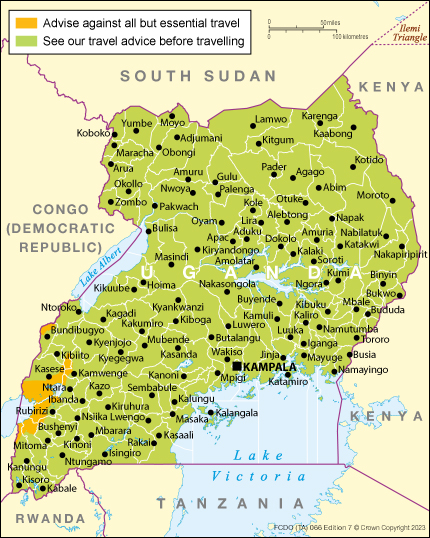
We advise against all travel to Karamoja region in north eastern Uganda (Kotido, Moroto, Nakapiripirit, Katakwi, Kaabong, Abim, Kapchorwa and Bukwa Distsricts) with the exception of trips to Kidepo Valley National Park, which should be made by air. See the Local Travel (North East Uganda) and National Parks section of this Travel Advice.
We advise against travel by road outside of major towns at night except between Kampala and the airport at Entebbe.
There is an underlying threat from terrorism. Attacks could be indiscriminate, including in places frequented by expatriates and foreign travellers.
Around 15,000 British tourists visit Uganda every year (Source: Ugandan Immigration Department). Most visits are trouble-free. The main types of incident for which British nationals required consular assistance in Uganda in 2009 were for arrest/detention (6 cases), death (5 cases), accidents (4 cases) and replacing lost or stolen passports (48 cases). See the Crime section of this Travel Advice.
We strongly advise that you obtain comprehensive travel and medical insurance before travelling. See the General (Insurance) section of this Travel Advice.
Terrorism
There is an underlying threat from terrorism in Uganda. Attacks could be indiscriminate, including in places frequented by expatriates and foreign travellers, large gatherings of people (e.g. concerts etc) and aviation. Somali insurgents have threatened to carry out attacks in Uganda in response to the Ugandan military presence in Somalia as part of an African Union peacekeeping force. In neighbouring Kenya there was a car bomb attack on a hotel near Mombasa in November 2002, in which at least 15 people died, and an unsuccessful attempt to shoot down an Israeli charter plane on the same day.
For more general information see our Terrorism Abroad page.
Crime
Kampala is a relatively safe city. By day you can walk the streets and visit local markets. But opportunistic crime such as burglaries, muggings and drive-by bag snatches do occur. The Kololo Airstrip area of Kampala has a history of thefts from vehicles and muggings, some involving violence. We advise that you take extra security precautions when going out on foot after dark. At all times you should be conscious of the risks of making yourself a target for muggers and pickpockets by carrying large sums of cash in the streets or wearing expensive looking jewellery or watches.
In urban areas we advise you to keep car doors locked and windows shut at all times. There have been a number of thefts of personal property from cars and taxis while stationary in traffic. You should ensure that no valuables are left visible in vehicles, whether parked or while the vehicle is in use. If stopped by armed men, do not attempt to resist. We advise against travel outside main towns after dark.
There have been incidents in which individuals have been drugged and robbed in Uganda, particularly when using public transport or in bars. A small number of such cases have been reported in recent years but you should be aware of this risk if you choose to travel by bus (see the Road Travel section of this Travel Advice) and when eating and drinking in bars and nightclubs.
Credit card fraud is commonplace in Uganda. There have been reported incidents of credit card fraud, even in international hotels. Wherever possible, you should use cash. US Dollars, Euros and Sterling can be readily exchanged; see the Money section of this Travel Advice.
Take care of your passport: replacing lost or stolen passports is our most common consular task.
For more general information see Victims of Crime Abroad
Political Situation
Uganda Country Profile
Uganda’s current Government has been in power since 1986, and was most recently re-elected in 2006. The next Presidential and Parliamentary elections are due in February 2011.
Demonstrations on national and international political issues occur in Kampala and other towns. Some demonstrations have, in the past become violent without warning. You should exercise caution and avoid demonstrations and rallies where possible. During September 2009, riots occurred in and around Kampala, and a number of deaths occurred.
Until 2006, the Lords Resistance Army (LRA) was active in northern Uganda (covering the districts of Kitgum, Amuru, Oyam, Dokolo, Pader, Adjumani, Gulu, Apac, Lira, Benni, Arua, Moyo, Koboko, Maracha & Terego and Yumbe). At the peak of the conflict 1.8 million people were living in camps for internally displaced people (IDP) in northern Uganda. Since 2006 over 80% of the IDPs have left the camps for permanent settlements.
There has been no LRA activity in Uganda since 2006, although the group has continued to attack civilians in the Democratic Republic of the Congo (DRC), Central African Republic and southern Sudan. Ugandan has been conducting military operations against the LRA in those countries with the agreement of the host governments since a peace process broke down in December 2008.
There is a risk of banditry in the region. On 1 November 2007 two NGO workers were killed in the Amuru district in northern Uganda, when their car was ambushed.
Travelling on the roads in Uganda can be hazardous, particularly outside the main cities. Driving standards are poor, vehicles are often poorly maintained and the accident rate is high. Other road users may well be driving without lights and livestock roam across the roads. The Jinja – Kampala and the Kampala – Masaka roads are particular accident black spots. British nationals were killed on these roads in September 2006 and February 2007.
Speed limits in Uganda in built-up areas are generally 50km/h and out of town 80km/h. The police enforce this law and breaking speed limits can result in a fine, imprisonment or both.
We advise against travel outside of the main towns after dark, except on the road between Kampala and Entebbe International Airport for reasons of road safety and security (see the Crime section of this Travel Advice). Always keep vehicle doors locked.
There have been a number of serious accidents involving Ugandan long distance bus services, linking Kampala with other towns in Uganda and internationally with Nairobi, Kigali and Dar es Salaam. There have been many such accidents with significant numbers of casualties. These vehicles are often poorly maintained, and driven at excessive speed even on badly maintained roads. There have been incidents where overnight buses have been robbed after being forced to stop by roadblocks or by criminals posing as passengers. You should take these risks seriously if considering travel by bus and we advise you to seek safer options wherever possible.
Other common forms of public transport are matatus (minibus taxis following a particular route) and boda-bodas (motorbike taxis. Though cheap, matatus and boda-bodas are generally in poor condition, badly driven and often without proper insurance cover. Accidents are common. We advise great caution about their use.
For more general information see our Driving Abroad page.Ugandans are generally welcoming people. But Ugandan culture is socially conservative.
Homosexuality is illegal and social tolerance of it is low.
Penalties for drug trafficking are severe. Drug abuse is neither widespread nor accepted. Do not take photos of military, official or diplomatic sites, including Owen Falls Dam at the source of the Nile near Jinja. If taking photos of people it is best to ask their permission first as some may object.
For more general information for different types of travellers see our Your Trip page.
Visas
British nationals need a visa to enter Uganda. This can be obtained from the Ugandan High Commission in London, or at the International airport. For further information, please visit the Ugandan High Commission website at: www.ugandahighcommission.co.uk or contact them by email at: info@ugandahighcommission.co.uk. You can also visit the Ugandan Ministry of Internal Affairs website for information at: www.mia.go.ug or email them at info@mia.go.ug. If travelling by road, it is usually easier to get a visa from the Ugandan High Commission or Embassy before leaving the neighbouring country.
Passport validity
You require six months’ remaining validity on your passport to enter Uganda.
Travelling with children
Single parents or other adults travelling alone with children should be aware that some countries require documentary evidence of parental responsibility before allowing lone parents to enter the country, or in some cases, before permitting the children to leave the country. For further information on exactly what will be required at immigration, please contact the Ugandan High Commission in London before travelling.
You should ensure that you have a valid Yellow Fever vaccination certificate with you on arrival at ports of entry into Uganda.
Medical facilities in Uganda are limited, particularly outside Kampala. The capability to provide medical help at the scene of an accident is limited. In the case of serious accident or illness an evacuation by air ambulance may be required.
Insurance
We strongly advise that you obtain comprehensive travel and medical insurance before travelling. This should include cover for unexpected losses such as cancelled flights, stolen cash cards, passport or luggage. You should check any exclusions, and that your policy covers you for the activities you want to undertake. For more general information see our Travel Insurance page.
If things do go wrong when you are oversees see our When Things Go Wrong page.
Registration with the British High Commission
Register with our LOCATE service to tell us when and where you are travelling abroad or where you live abroad so our consular and crisis staff can provide better assistance to you in an emergency. More information about registering with LOCATE can be found here. Once you register, your mobile contact details can be used through our SMS messaging system to contact you in the event of an emergency.
Money
Credit cards are not widely used in Uganda, and we advise against their use wherever possible. There have been reported incidents of credit card fraud, even in international hotels. We advise you to carry sufficient travellers’ cheques or cash (US $) to meet normal expenses. Travellers’ cheques can only be cashed in major towns and often at a significantly lower rate of exchange than cash. US dollars dated earlier than 2001 and notes smaller than US$50 are usually only exchanged at a less favourable rate and in some cases not accepted for exchange.