Togo |
|
| Still current at: 14 March 2010
Updated: 12 March 2010 |
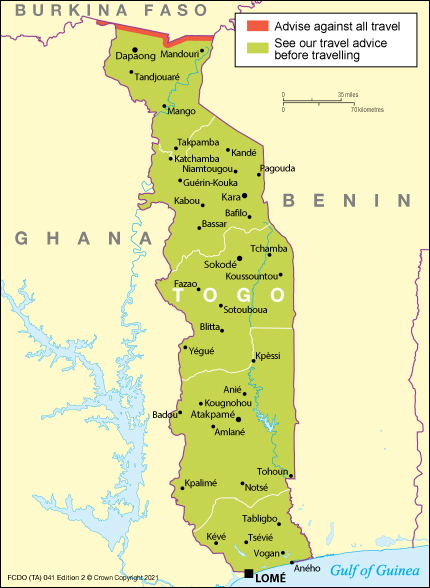
This advice has been reviewed and reissued with an amendment to the Summary and the Political Situation section (update on pass Presidential elections 4 and reports of demonstrations planned for Saturday 13 March). The overall level of the advice has not changed; there are currently no travel restrictions in place in Togo.
(see travel advice legal disclaimer)
Terrorism
The threat from terrorism is low but you should be aware of the global risk of indiscriminate terrorist attacks, which could be against civilian targets, including places frequented by foreigners.
For more general information see Terrorism Abroad.
Crime
The sea front area in Lomé, particularly around the Hotel Sarakawa is dangerous and you should avoid this area as far as possible. Walking is not advisable in this area. Pick-pocketing and theft are common, especially along the beach and in the market areas of Lomé. Some taxis are poorly maintained, and you should take particular care when seeking to use one. Attacks on pedestrians happen in broad daylight as well as at night. You should enter and exit public places such as restaurants in groups rather than on your own. Crime is increasing in Lomé. Local authorities warn of a rise in violent robberies and car-jacking incidents targeting both foreigners and Togolese alike. Togolese authorities have also warned motorists to only stop for individuals in uniform, particularly after dark. You are advised to avoid travelling alone where possible even within Lomé city limits, especially after dark.
British nationals resident in the UK and European nationals are increasingly becoming targets by scam artists operating in West Africa. The scams come in many forms: romance & friendship, business ventures, work and employment opportunities, the facilitation of money (for internet dating scams see below), and can pose great financial loss to victims. Relatives or friends in the UK should first check with the person who has travelled to West Africa before becoming involved in the transfer of money. If you are concerned about a British national who has travelled to Togo you should contact the Consular Section of the British High Commission. Schemes in operation by West African criminal networks are designed to facilitate victims parting with money.
British nationals are also being targeted by West African scam artists through internet based dating sites. The scam artists assume the false identity of a foreign national (sometimes British) working and living in West Africa. In some instances the impostor has informed their foreign friend that they have been hospitalised or arrested and need money quickly. In other cases foreigners have come to Togo to meet the person with whom they have been in contact only to be kidnapped and become the victim of financial extortion.
You will wish to treat with considerable caution any requests for funds, a job offer, a business venture or a face to face meeting from someone you have been in correspondence with over the internet who lives in West Africa. For further information on advance fee fraud please see: http://www.met.police.uk/fraudalert.
For more general information see Victims of Crime & Abroad.
For more general information for different types of travellers see Your Trip.
Visas
British passport holders require visas to enter Togo. Although visas are available on arrival in Togo we recommend, where possible, you obtain your visa prior to your visit. There is no Togolese Embassy in the UK.
Travelling with children
Single parents or other adults travelling alone with children should be aware that some countries require documentary evidence of parental responsibility before allowing lone parents to enter the country or, in some cases, before permitting the children to leave the country. For further information on exactly what will be required at immigration please contact the Togolese Embassy to Paris at 8 Rue Alfred–Roll, 75017 Paris. Tel: (00) (33 1) 43 80 12 13, Fax: (00) (33 1) 43 80 06 05.
Medical facilities are poor in Togo. Emergency facilities are extremely limited. For serious medical treatment, medical evacuation would be necessary.
Malaria and water-borne diseases are common to Togo. Since December 2008 an outbreak of Cholera in Lome has affected over 400 people, with three reported deaths. You should drink or use only boiled or bottled water and avoid ice in drinks. Food purchased from local street vendors may not meet adequate hygiene standards. If you suffer from diarrhoea during a visit to Togo you should seek immediate medical attention.
In the 2006 Report on the Global AIDS Epidemic the UNAIDS/WHO Working Group estimated that around 120,000 adults aged 15 or over in Togo were living with HIV; the prevalence rate was estimated at around 3.3% of the adult population. This compares to the prevalence rate in adults in the UK of around 0.2%. You should exercise normal precautions to avoid exposure to HIV/AIDS. For more general information on how to do this see HIV and AIDS.
You should seek medical advice before travelling to Togo and ensure that all appropriate vaccinations are up-to-date. For further information on vaccination requirements, health outbreaks and general disease protection and prevention you should visit the websites of the National Travel Health Network and Centre (NaTHNaC) and NHS Scotland's Fit For Travel or call NHS Direct on 0845 46 47.
For more general health information see Travel Health.
Insurance
You should ensure that you have comprehensive medical & travel insurance, which covers a provision for medical evacuation. You should check any exclusions, and that your policy covers you for the activities you want to undertake. For more general information see Travel Insurance.
If things do go wrong when you are overseas see When Things Go Wrong.
Registration
Register with our LOCATE service to tell us when and where you are travelling abroad or where you live abroad so our consular and crisis staff can provide better assistance to you in an emergency. More information about registering with LOCATE can be found here.
The number of British visitors to Togo is low. The main type of incident for which British nationals require consular assistance in Togo is for replacing lost and stolen passports. You should keep a photocopy of your passport separate from your passport. This will help to speed up the process of issuing a new one.
Money
The Central Bank (BCEAO) has issued the following new CFA notes and coins in Togo: 10000, 5000, 2000 and 1000 CFA notes; 500 and 200 CFA coins. The old notes ceased to be legal on 31 December 2004.
UK Representation in Togo
There is no formal UK representation in Togo. In case of an emergency you should contact the British High Commission in Accra, Ghana.
Contact Details
The is no British Embassy in Togo. The British Ambassador to Togo resides in Accra. Our Honorary Consul, Mr Rodney Wade, can only offer limited consular assistance in an emergency. His contact details are:
Mr Rodney Wade
Honorary Consulate of the UK
Rue Canaris
Be Chateau, Lome BP 13956
Togo
Tel: +228 2222714
Mobile: +228 837 77 11
Email Address: rodney129@yahoo.co.uk
The Consulate is on the same street as the Hotel Marmite D'Or and near the supermarket at Be Château. Alternatively use the large water tower (which has a navigational lighthouse on top of it) as a landmark - the Consulate is 200 metres due east of this tower.
Website: http://www.britishhighcommission.gov.uk/ghana