Advanced search
image
Travel & living abroad

Sub Saharan Africa

Sudan

Flag of Sudan
Still current at: 11 February 2012
Updated: 12 January 2012
No restrictions in this travel advice Avoid all but essential travel to part(s) of country Avoid all but essential travel to whole country Avoid all travel to part(s) of country Avoid all travel to whole country


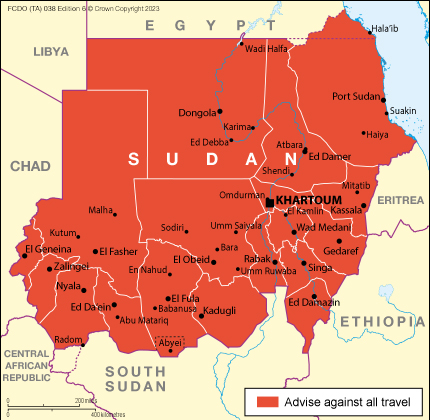
This advice has been reviewed and reissued with amendments to the Travel Summary and the Safety and Security - Terrorism section (there is a general threat from terrorism). The overall level of the advice has not changed. We continue to advise against all travel to Blue Nile State, to other specific parts of Sudan, including all of Darfur, and against all but essential travel to other specific parts of Sudan.

(see travel advice legal disclaimer)

Travel advice for this country

  • We advise against all travel to the following parts of Sudan: Darfur, the Red Sea State border with Eritrea; the Abyei region; Southern Kordofan and Blue Nile states. See Safety and Security - Local Travel.

  • We advise against all but essential travel to the following parts of Sudan: areas west of the towns of an-Nahud and al-Fula in North Kordofan up to the Darfur border. See Safety and Security - Local Travel.

  • On 9 July 2011 South Sudan seceded from Sudan. There are political tensions and unresolved issues between the two countries.

  • Local laws reflect the fact that Sudan and the capital Khartoum are predominantly Muslim. You should respect local traditions, customs, laws and religions at all times and be aware of your actions to ensure that they do not offend other cultures or religious beliefs, especially during the holy month of Ramadan or if you intend to visit religious areas. For more general information see Travelling during Ramadan.

  • There is a general threat from terrorism.  Attacks could be indiscriminate, including in places frequented by expatriates and foreign travellers.

  • Rallies and demonstrations occur sporadically throughout the country often at short notice. We advise those currently in Sudan to maintain a high level of vigilance, to keep a low profile and avoid crowds. As a precaution, people based in Sudan are advised to maintain several days' stock of food and water and to stay indoors until any demonstration or rally in your locality has passed. See Safety and Security - Political Situation.

  • 23 British nationals required consular assistance in Sudan in the period 01 April 2010 - 31 March 2011. See General - Consular Assistance Statistics. 

  • You should take out comprehensive travel and medical insurance before travelling.  See the General - Insurance.

  • Those currently in or considering travel to Sudan should keep abreast of the latest situation, check the Travel Advice regularly, and register using our LOCATE service. See the Safety and Security section of this travel advice for more details. You should be aware that the capacity of the Embassy to assist in times of crisis will be limited and we recommend that you consider your own travel arrangements should there be the need to leave at short notice, ensuring you have up-to-date travel documents and visas.

Safety and Security - Terrorism

There is a general threat from terrorism in Sudan. Attacks could be indiscriminate, including in places frequented by expatriates and foreign travellers. Statements by terrorist groups have called for a 'jihad' in Sudan and have specifically mentioned Western interests.

In August 2007 and January 2008, Sudanese authorities made a series of arrests to disrupt a terrorist cell suspected of targeting specific western interests in Khartoum.

On 1 January 2008, a US Diplomat and a US Embassy driver were shot and killed in the Riyadh area of Khartoum. The perpetrators were arrested later in January. Two were sentenced to the death penalty on June 24, 2009 but have since escaped.

If you intend to travel in or around Khartoum, you should exercise caution, especially at night, and regularly change your patterns of movement. You should bear this in mind when considering attending prominent social events on predictable dates.

See our Terrorism Abroad page.

Safety and Security - Crime

The incidence of street crime in Khartoum and other major northern Sudanese cities, with the exception of Darfur, is low compared to many parts of Africa. However, you should exercise caution, particularly after dark.  

See our Victims of Crime Abroad page.

Safety and Security - Local Travel

Safety and Security - Local Travel - General
 

Permits, obtained locally, are required for all travel to many destinations outside Khartoum, including to Darfur. 

Please note
the following specific localised warnings.

Safety and Security - Local Travel - Khartoum

Demonstrations can occur at short notice in Khartoum, Omdurman and elsewhere. Visitors and residents are advised to be aware of the potential for demonstrations and keep away from any that occur.

On 10 May 2008, Darfuri rebels launched an attack on Omdurman, a city close to Khartoum on the west bank of the Nile. The attack was repelled by Government forces.

Safety and Security - Local Travel - Darfur States

We advise against all travel to the three Darfur states (North Darfur, West Darfur and South Darfur).

The security situation in Darfur is volatile and unstable. Banditry and lawlessness are widespread, and there are frequent violent confrontations between rebel and government forces, and tensions within camps for internally displaced people (IDPs) which have sometimes resulted in violence and fatalities (e.g. in Kalma camp near Nyala in July/August 2010). Fighting between government and rebel forces has previously resulted in the closure of the airport in El Fasher.

There continue to be instances of attacks on and detention of humanitarian workers and clearly identified humanitarian vehicles throughout Darfur. There are regular reports of attacks, looting and detention of humanitarian convoys and premises. Armed groups in Darfur may target people associated with the joint AU/UN peacekeeping mission (UNAMID) but also civilians. On 17 March 2011 a routine UNAMID patrol was ambushed outside Nyala resulting in the death of one soldier. The collapse of a pyramid selling scheme in El Fasher in May 2010 affected the economy badly and resulted in public disorder and violence.

There have been a number of kidnaps of expatriate and Sudanese NGO employees and peace keepers since 2009 in all three states of Darfur and the bordering areas of Chad and of the Central African Republic (CAR). On 19 May 2010, several aid workers were abducted 40km south-west of Nyala, and on 22 June 2010, two aid workers were kidnapped in Nyala, South Darfur and three were kidnapped in November 2010. All have subsequently been released without harm. In addition there have been three instances of aid workers being kidnapped in Eastern Chad, close to the border with Darfur (one in June 2010, one in August 2009, one in November 2009) and one instance in CAR, again, close to the Darfur border, in November, all of whom were released without harm. On 7 October 2010 a UNAMID official was abducted from a private residence in El Fasher by armed men; he was released without harm on 5 January 2011.

An Italian NGO worker was kidnapped on 14 August 2011 in South Darfur and was rescued unharmed on 16 December 2011. Five Turkish engineers were kidnapped on 9 September 2011 in North Darfur and remain in detention. This brings the total number of international staff kidnapped in Darfur since March 2009 to 33.

You should be aware that the long-standing policy of the British Government is not to make substantive concessions to hostage takers. The British Government considers that paying ransoms and releasing prisoners increases the risk of further hostage taking.

If, despite this advice, you are in Darfur, you should respect any curfews that are imposed and ensure that you have co-ordinated your movements with UN Security and that all necessary parties have been notified. The Sudanese Government requires that anyone seeking entry to the Darfur area, for whatever purpose, must first obtain a special permit.

Safety and Security - Local Travel - Rest of Sudan


North Kordofan State

We advise against all but essential travel to areas west of the towns of an-Nahud and al-Fula in North Kordofan, which borders Darfur.

Southern Kordofan, Blue Nile and Abyei
We advise against all travel to the Abyei Administrative Area. Heavy fighting in Abyei occurred most recently in March 2011. On 21 May 2011 the Sudanese Armed Forces took control of the Abyei Administrative Area, and there is potential for further violence there.

The threat of further attacks on oil and gas industry targets in the area remains. You must be vigilant at all times and exercise caution when travelling or working in the area.  

Due to continuing conflict between the Sudanese Armed Forces (SAF) and Sudanese People’s Liberation Army (SPLA) in Southern Kordofan since 5 June 2011 we advise against all travel to Southern Kordofan.

This conflict spread to Blue Nile on 2 September 2011. Accordingly, we also advise against all travel to Blue Nile State.

Kassala and Red Sea States
We advise against all travel to the Sudanese border with Eritrea in the Red Sea State. The area has been subject to instability due to high poverty levels and high level of smuggling across the border. The situation is calm at present, but we currently advise against travel to the border as the situation could deteriorate rapidly.

Travel to eastern Sudan, particularly the major cities, is currently possible. There have not been any recent security incidents. If travelling by road in Kassala State we advise that you remain on the major roads. 


Safety and Security - Local Travel - Road Travel

You are at risk of involvement in traffic accidents when using public transport, as many vehicles are unsafe.

The driving conditions and standards in Sudan are below those in the UK and other European countries. Only major roads are tarred. Residential areas usually have unsurfaced roads. At night, there is generally no street lighting and many vehicles have no lights. Roads are used by pedestrians, donkey-carts and rickshaw-style cabs, as well as motor vehicles.

Outside Khartoum, some major routes between towns have good roads. Off the beaten track, roads may consist of a rough track and in many areas. Any journeys not following a major route or road should include a local guide with experience of the area. Many areas south of Khartoum become inaccessible by road during the rainy season from July to October. The wadis (dry riverbeds) are subject to dangerous flash floods and many are not passable during the rains unless travelling on a major road.

Although drivers need a licence and insurance, many do not have these. You should ensure that you obtain adequate insurance. You can drive in Sudan using a full UK driving licence for a maximum period of three months. You can obtain local driving licences from the police traffic department. There are no restrictions on women driving in Sudan.

Sudanese law prohibits the use of mobile phones whilst driving. 

See our Driving Abroad page.

Safety and Security - Local Travel - Air Travel

As at 20 April 2011, all airlines registered in Sudan were banned from operating in the EU. For further details see http://ec.europa.eu/transport/air-ban/list_en.htm. UK Government staff have been instructed to use alternatives to domestic services in Sudan

The International Civil Aviation Organisation reported in October 2008 that there had been 21 known major accidents to Sudan airline operators during the previous five years, nine of which resulted in fatalities; and that there had been 16 known major accidents to foreign airline aircraft in Sudan in the previous five years, two of which resulted in fatalities.

You should ensure that onward or return flights are reconfirmed with the airline at least 72 hours before departure.

See Airline Security.

Safety and Security - Local Travel - Sea Travel

Mariners should be aware that incidents of piracy have been reported in the Red Sea and Gulf of Aden and are advised to exercise vigilance and seek local advice.

See our River and Sea Safety page.

Safety and Security - Political Situation

Rallies and demonstrations occur periodically, often at short notice, in Khartoum and in other major cities. There are sometimes protests in response to international events, such as issuance of arrest warrants by the International Criminal Court (ICC) against President Bashir in 2009 and 2010. Visitors and residents are therefore advised to be aware of the potential for demonstrations, to keep a low profile, to avoid crowds, to maintain their awareness of the local situation by monitoring the local media and to keep away from any demonstrations that do occur. As a precaution, you are advised to maintain several days’ stock of food and water and to stay indoors until any demonstration or rally in your locality has passed.

The humanitarian and security situation in Darfur remains dire, with millions displaced by fighting.  Since January 2008, the African Union (AU) and United Nations (UN) has deployed a joint peace support operation (UNAMID).  International pressure on the Government of Sudan to address the situation in Darfur is resented in some parts of Sudan, and there have been demonstrations against international actions.

Local laws reflect the fact that Sudan and the capital Khartoum are predominantly Muslim. You should respect local traditions, customs, laws and religions at all times and be aware of your actions to ensure that they do not offend other cultures or religious beliefs, especially during the holy month of Ramadan or if you intend to visit religious areas. For more general information see Travelling during Ramadan

The Republic of Sudan operates Islamic Sharia Law. Alcohol is not permitted. Although the constitution specifies that in the national capital, Khartoum, non-Muslims shall not be subject to Sharia law, at present this has not resulted in any practical changes and you should expect Sharia law to apply. 

Non-Muslim women are not expected to wear a veil or cover their heads, but should dress modestly and respect local customs and sensitivities.  

Homosexual practices and extra marital relations are illegal and subject to severe penalties under Islamic Sharia law. Sudanese society is not tolerant of homosexual relationships.

There is no legal requirement to carry identification documents but we recommend that you carry a form of photo identification with you at all times.

There are severe penalties for drug trafficking in Sudan.

All photography in Sudan, requires a formal photographic permit. A permit can be obtained following an application to the External Information Centre in Khartoum (part of the Ministry of Information). We advise against taking photographs close to Government Buildings, military installations, public utilities (including petrol stations), and other sensitive areas (e.g. bridges, airports etc). Many plain clothes public security officers operate.. We advise extreme care using a mobile camera phone in public, especially near government buildings, sensitive sites or utilities.

See our Your Trip page.

Entry Requirements - Visas

British nationals require visas to visit Sudan. These should be obtained in advance of travel. Please contact the Sudanese Embassy in London.

There are strict exit visa requirements and you must ensure that your travel documents are up to date before you attempt to leave the country.

If you do not hold a diplomatic passport you are required to register with the Aliens Department within three days of your arrival in the country (two passport size photos are needed and the fee is the Sudanese Pound equivalent of around £35). Once registered, you are not required to obtain an exit visa to leave the country. You are required to pay US$20 per person airport tax.

As stated above, you must obtain a permit before travelling outside of Khartoum but within Sudan. You must also register with the police at your new destination within 24 hours of arrival.   If your passport has an Israeli visa or Israeli entry/exit stamps you will not be allowed to enter Sudan.

Visitors intending to travel by land to neighbouring countries should first check the visa requirements for entry at border crossings. At the time of writing, it is not clear how immigration procedures between the Republic of Sudan and the Republic of South Sudan will be implemented. These may be different to when entering via an international airport.

British nationals wishing to enter Ethiopia from Sudan in their own vehicles require a letter from the British Embassy in Addis Ababa - providing details of the passengers (names, passport details) and vehicle (s) (make, model, registration number, engine and chassis numbers). You should contact the British Embassy in Addis Ababa (+251 11 66 141 56) well in advance of your journey to request a copy of the letter and present it to officials of the Ethiopian Revenue and Customs Authority at the border.

Entry Requirements - Passport Validity

You must hold a valid passport to enter Sudan. Your passport must be valid for a minimum period of six months from the date of entry into Sudan.

Entry Requirements - Travelling with children

For information on exactly what will be required at immigration please contact the Sudanese Embassy in London.

As a general rule, GP facilities in Khartoum are adequate but the hospitals are not suitable for elective problems and only suitable for stabilisation of serious medical problems prior to evacuation.

Water and food-borne diseases are common to Sudan. These include salmonella, typhoid, shigella, giardia, hepatitis A and amoebiasis. You should drink or use only boiled or bottled water and avoid ice in drinks.  If you suffer from diarrhoea during a visit to Sudan you should seek immediate medical attention.

The World Health Organisation (WHO) has reported cases of meningitis in the northern states of Sudan, including Khartoum.

In October 2007 an outbreak of Rift Valley fever was reported: this disease is transmitted by mosquitoes. As of January 2008, the number of cases was declining.

In the 2010 Report on the Global AIDS Epidemic the UNAIDS/WHO Working Group estimated that around 250,000 adults aged 15 or over in were Sudan living with HIV; the prevalence percentage was estimated at around 1.1 of the adult population compared to the prevalence percentage rate in adults in the UK of around 0.2%. You should exercise normal precautions to avoid exposure to HIV/AIDS. For more general information on how to do this see HIV and AIDS.

You should seek medical advice before travelling to Sudan and ensure that all appropriate vaccinations are up-to-date. For further information on vaccination requirements, health outbreaks and general disease protection and prevention you should visit the websites of the National Travel Health Network and Centre NaTHNaC and NHS Scotland's Fit For Travel or call NHS Direct on 0845 46 47.

See our Travel Health pages.

Sudan suffers from both drought and flash flooding. If you are planning to travel overland to remote areas during the rainy season, you should note that flooding can make areas inaccessible by road.

General - Insurance

You should take out comprehensive travel and medical insurance before travelling. This should include cover for medical evacuation by air ambulance. Check for any exclusions and that your policy covers you for all the activities you want to undertake.  See our Travel Insurance page.

If things do go wrong when you are overseas then see our When Things Go Wrong page.

General - Registration

You should register with our LOCATE service to tell us when and where you are travelling abroad or where you live abroad so our consular and crisis staff can provide better assistance to you in an emergency. More information about registering with LOCATE can be found here.

General - Money

Credit cards and travellers' cheques are not usually accepted in Sudan. It is not possible to obtain cash against credit cards at banks, and credit cards are not accepted at hotels to settle bills.  You should ensure that you have sufficient hard currency, preferably US Dollars (dated 2006 onwards - older ones will not be changed), to cover expenses during your stay.

General - Consular Assistance Statistics

23 British nationals required consular assistance in Sudan in the period 01 April 2010 - 31 March 2011 for the following types of incident: two deaths; one hospitalisation; and four arrests.

Contacts

Sudan, Khartoum, British Embassy

Address:

British Embassy
off Sharia Al Baladia
Khartoum East
(PO Box No 801)

Email: information.khartoum@fco.gov.uk

Fax:

(249) (183) 776457
(249) (183) 775562

Office hours:

Embassy opening hours: Sunday to Wednesday 08:00 – 16:00, Thursday 08:00 – 14:30
Consular Opening Hours:Sunday 10:00 to 12:00
Monday 10:00 to 13:00  
Tuesday 10:00 to 13:00
Wednesday 9;00 to 11:00
Thursday 9:00 to 11:00

Visa Opening Hours: Sunday – Thursday 08:30 – 13:30 (acceptance of applications), 13:30 – 14:30 for Enquiries except Thursday which is 13:00 -14:00

Website: http://ukinsudan.fco.gov.uk/en/

register
 
register
 
 
Facebook - British abroad
 
 
Overseas Business Risk