South Sudan |
|
| Still current at: 24 May 2012
Updated: 27 April 2012 |
| No restrictions in this travel advice | Avoid all but essential travel to part(s) of country | Avoid all but essential travel to whole country | Avoid all travel to part(s) of country | Avoid all travel to whole country |
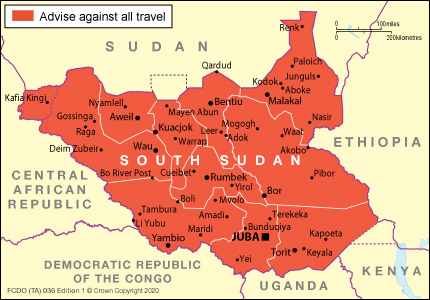
This advice has been reviewed and reissued with amendments to the Travel Summary and the Safety and Security section (increased Sudanese Armed Forces offensives across the border from Sudan). The overall level of the advice has changed; we now advise against all but essential travel to Unity State; we continue to advise against all travel to within 40km of South Sudan’s northern border with the Republic of Sudan.
(see travel advice legal disclaimer)
Safety and Security - Terrorism
There is a general threat from terrorism. Attacks could be indiscriminate, including in places frequented by expatriates and foreign travellers.
Kidnapping: you should be aware that the long-standing policy of the British Government is not to make substantive concessions to hostage takers. The British Government considers that paying ransoms and releasing prisoners increases the risk of further hostage taking.
See our Terrorism Abroad page.
Safety and Security - Crime
See our Victims of Crime Abroad page.
Safety and Security - Local Travel - South Sudan
The security situation in South Sudan is volatile with regular outbreaks of violence and lawlessness. Violent crime is also a problem, both in population centres and rural areas. There is widespread ownership of small arms across the population. Tribal conflicts and armed militia violence and attacks regularly occur. In 2012 there have been incidents of violence emanating from armed rebel groups, particularly in Unity, Upper Nile and Jonglei States. We recommend that you get an up to date security briefing before visiting any of these areas.
Travel across South Sudan should be attempted only if you are fully equipped and experienced. The cross country transport network is made up of dirt roads and these quickly become impassable during the rainy season. South Sudan is a vast and remote country with sparse, basic medical care and no ambulance service.
Please note the following specific localised warnings.
Safety and Security - Local Travel - Juba
Juba is a rapidly growing city and levels of criminal activity are increasing. Small arms proliferate and criminals can be armed. On 8 October 2011, two international UN staff were violently robbed by a gang of men outside a hotel in the Hai Amarat area popular with foreigners. A British national was robbed by thieves on a motorcycle on 13 October 2011, and there have been other instances of this type of theft more recently, outside restaurants popular with internationals in the Hai Malakai area. Theft from vehicles has been increasing markedly since September 2011. At night there are few street lights in Juba and you should take precautions when travelling – including letting people know when and where you are travelling, not travelling alone and parking in a lit area and as close to your destination as possible.
There is a high security presence (police in military type uniforms) in Juba, especially at night, and particularly around road junctions and Government buildings. You will come across security checkpoints and you should be prepared to respond to these in a calm, patient and deferential manner.
Safety and Security - Local Travel - Border Areas with Sudan
We advise against all travel to within 40km of South Sudan’s northern border with Sudan. Parts of South Sudan’s border with Sudan remains disputed and is not clearly demarcated. The presence of military forces in the border poses a security risk, even with pre-agreed local security clearances. A number of armed militia groups operate across and in the border areas and military operations against them are ongoing. Since 08 November 2011, there have been increased tensions along the border between the Republic of South Sudan and the Republic of Sudan, which have broken out into conflict.
Safety and Security - Local Travel – Upper Nile and Unity states
We advise against all but essential travel to Unity state. This is as a result of increased Sudanese Armed Forces offensives across the border from Sudan into the state, including aerial bombardments around Bentiu and Mayom. Most recently this has included an attack on a market which led to civilian casualties on 23 April.
Safety and Security – Local Travel - Western and Central Equatoria States
The Lord’s Resistance Army (LRA) are thought to be responsible for a number of attacks on villages in Western Equatoria in 2010, which have resulted in a small number of fatalities. There have been no recent reports of LRA attacks against aid workers or westerners. Some attacks on villages have taken place in daylight hours and close to population centres; even major towns like Yambio are vulnerable to attack. If you are in the region you should continue to exercise extreme caution, think carefully about your security and whether you need to remain.
Travel is not straightforward, particularly during the rainy season when many roads become impassable, and parts of the country become inaccessible and cut-off (from July to October/November). As well as the logistical challenges in travelling around, there is also the problem of insecurity: attacks are frequent, even on major routes (e.g. the Juba to Bor road).
Safety and Security - Local Travel - Road Travel
You are at high risk of involvement in traffic accidents when using public transport, as many vehicles are unsafe.
The driving conditions and standards in South Sudan are well below those in the UK and other European countries. Very few roads are surfaced and maintained. Residential areas usually have dirt roads. At night, there is street lighting only on a few main roads and many motorbikes, cars and trucks have no lights. Roads are used by pedestrians, donkey-carts and rickshaw-style cabs, as well as motor vehicles.
Roads may consist of a rough track and in many areas, not even that in rainy season. Any journeys not following a major route or road should include a local guide with experience of the area. You should be aware of the technical capability of your vehicle and be confident in your ability to safely operate it, including 4-wheel drive and low ratio driving.
Although drivers need a licence and insurance, many do not have these. You should ensure that you obtain adequate insurance. There are no restrictions on women driving in South Sudan.
See our Driving Abroad page.
Safety and Security - Local Travel - Air Travel
As at 3 April 2012, all airlines registered in Sudan were banned from operating in the EU. For further details see http://ec.europa.eu/transport/air-ban/doc/list_en.pdf. UK Government staff have been instructed to use alternatives to these airlines for regional travel and domestic travel within South Sudan.
You should ensure that onward or return flights are reconfirmed with the airline at least 72 hours before departure.
See Airline Security.
Safety and Security - Political Situation
South Sudan faces huge state-building and developmental challenges. It still needs to resolve outstanding issues with Sudan, and ensure good neighbourly relations. Tensions exist along the border and a new UN peacekeeping mission has been deployed.
South Sudan will continue its recovery from twenty two years of civil war. It still has some way to go to provide a secure and stable environment within its borders. Armed violence whether from rebel militia groups or tribal conflicts, will continue for some time.
You should respect local traditions, customs, laws and religions at all times and be aware of your actions to ensure that they do not offend other cultures or religious beliefs, especially if you intend to visit religious areas.
Homosexual practices and extra marital relations are not culturally accepted.
We recommend that you carry a form of photo identification with you at all times, including colour copies to hand over to e.g. immigration or traffic police if required.
There are severe penalties for drug trafficking in South Sudan.
All photography in South Sudan requires a formal photographic permit from the Government. A permit can be obtained by applying to the GoSS Ministry of Information. We advise against all photography close to Government Buildings, military installations, public utilities (including petrol stations), and other sensitive areas (e.g. bridges, airports etc). Many plain clothes public security officers operate across South Sudan. Recently two cases were reported of foreign nationals being followed, harassed and arrested by the authorities in Juba when they were perceived to be photographing a petrol station. We advise extreme care using a mobile camera phone in public, especially near government buildings, sensitive sites or utilities.
See our Your Trip page.
Entry requirements - Visas
The visa process is new, and still under development. We advise you to contact the RoSS embassy in London before your departure to double-check the visa application process. They are located at: Hamilton House, Mabledon Place, London, WC1H 9BB.
Visitors to the Republic of South Sudan (RoSS) will require a visa. Currently these can only be obtained at the Republic of South Sudan Embassies in Nairobi, Kampala and Addis Ababa. Visas cannot yet be issued in London.
We recommend that visitors apply for their visa before arriving in Juba. There are daily flights from Nairobi to Juba and the embassy of the RoSS is well established in issuing visas.
Visas can only be obtained in person and are stuck inside your passport. They take one page. It can take two days to obtain a visa at the RoSS embassy in Nairobi (please factor this into your trip). It may be possible for the visa to be issued on the same day, but there is no guarantee of this. Please queue at the RoSS embassy in Nairobi before it opens and be prepared to pay in US Dollars for your visa.
Multiple entry visas valid for frequent visitors are not currently available, although this may change in the near future. Visa prices and rules are available on the websites of South Sudan missions overseas.
The RoSS embassy in Nairobi is located at: Bishops Gate, 6th Floor, 5 Ngong Avenue, Bishops Road, Nairobi, PO BOX 736 99 (Opening Hours 09:00 – 17:00).
If at all possible, you should request a covering note from your sponsor/parent organisation to present to the RoSS embassy in Nairobi along with your application form, passport, and passport-sized photos.
Entry Requirements - Travelling on from South Sudan by land
Visitors intending to travel by land to neighbouring countries should first check the visa requirements for entry at border crossings. These may be different to when entering via an international airport.
British nationals wishing to enter Ethiopia from South Sudan in their own vehicles require a letter from the British Embassy in Addis Ababa - providing details of the passengers (names, passport details) and vehicle (s) (make, model, registration number, engine and chassis numbers). You should contact the British Embassy in Addis Ababa (+251 11 66 141 56) well in advance of your journey to request a copy of the letter and present it to officials of the Ethiopian Revenue and Customs Authority at the border.
Entry Requirements - Passport Validity
You must hold a valid passport to enter South Sudan. Your passport must be valid for a minimum period of six months from the date of entry into South Sudan.
Contact your GP around eight weeks before your trip to check whether you need any vaccinations or other preventive measures. Country specific information and advice is published by the National Travel Health Network and Centre, and useful information about healthcare abroad, including a country-by-country guide of reciprocal health care agreements with the UK, is available from NHS Choices.
In South Sudan, health facilities are extremely limited - especially outside Juba. Most serious medical problems would require a medical evacuation to Nairobi or Kampala. Visitors should be aware that during the rainy season flights are often forced to remain on the ground for hours. Therefore those with medical problems should carefully consider these limitations before travelling. Make sure you have adequate travel health insurance and accessible funds to cover the cost of any medical treatment abroad and repatriation.
In the 2010 Report on the Global AIDS Epidemic the UNAIDS/WHO Working Group estimated that around 250,000 adults aged 15 or over in Sudan were living with HIV; the prevalence percentage was estimated at around 1.1% of the adult population compared to the prevalence percentage rate in adults in the UK of around 0.2%. You should exercise normal precautions to avoid exposure to HIV/AIDS. For more general information on how to do this see our HIV and AIDS page.
Our Travel Health pages offer further advice on how to stay healthy when overseas.
South Sudan suffers from both drought and flash flooding. If you are planning to travel overland to remote areas during the rainy season, you should note that flooding can make areas inaccessible by road.
General - Insurance
You should take out comprehensive travel and medical insurance before travelling. This should include cover for medical evacuation by air ambulance. Check for any exclusions and that your policy covers you for all the activities you want to undertake. See our Travel Insurance page.
If things do go wrong when you are overseas then see our When Things Go Wrong page.
General - Registration
British nationals should visit http://www.ukinsouthsudan.fco.gov.uk for more information on how to register with our Embassy in Juba.
General - Money
Credit / debit cards and travellers' cheques are not accepted in South Sudan. It is not possible to obtain cash against credit cards at banks, and credit / debit cards are not accepted at hotels to settle bills. You should ensure that you have sufficient currency in US Dollars (clean, undefaced, untorn notes dated 2006 onwards - older ones will not be changed), to cover expenses during your stay. Juba is comparatively expensive; one night’s accommodation can be up to $200 and vehicle rental can be from $150 per day.
General – Consular Assistance Statistics
44 British nationals required consular assistance in South Sudan in the period 01 December 2011 – 31 March 2012 for the following reasons: victims of crime; death/repatriation; detainment/incarceration; visa and passport assistance.