Advanced search
image
Travel & living abroad

Sub Saharan Africa

Somalia

Flag of Somalia
Still current at: 12 February 2012
Updated: 01 December 2011
No restrictions in this travel advice Avoid all but essential travel to part(s) of country Avoid all but essential travel to whole country Avoid all travel to part(s) of country Avoid all travel to whole country


This advice has been reviewed and reissued with an amendment to the Safety and Security Terrorism/Security section (explosions in Mogadishu on 28 November). The overall level of the advice has not changed; we continue to advise against all travel to Somalia.


(see travel advice legal disclaimer)

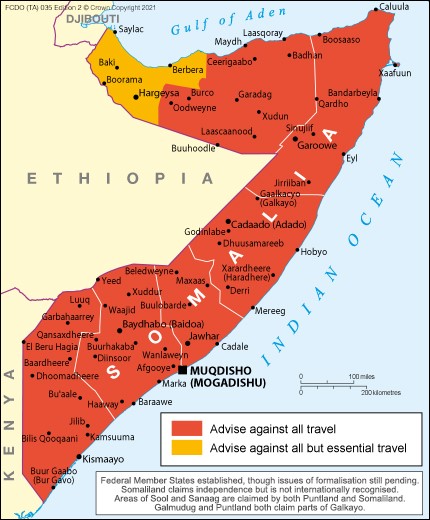
To see an enlarged version of this map, click here. (298 KB)

Travel advice for this country

  • We advise against all travel to Somalia, including Somaliland. In the southern and central regions, there is ongoing serious violence, dangerous levels of criminal activity and general internal insecurity. We advise any British citizens in Somalia to leave.

  • There is a high threat from terrorism throughout Somalia. Attacks could be indiscriminate, including in places frequented by expatriates and foreign travellers. Following the death of Osama Bin Laden terrorist groups operating in Somalia have made threats against Westerners and those working for Western organisations in Somalia, including Somaliland. See Safety and Security - Terrorism/Security.

  • Westerners and those working for western organisations have been targeted in the past and this threat is ongoing. On 14 October 2010, two people working with the NGO Save the Children Fund were kidnapped in the town of Adado, near the Ethiopian border. See Safety and Security - Terrorism/Security.

  • All areas across Somalia are suffering food shortages resulting in the displacement of thousands of Somali people.  See Safety and Security - Local Travel.

  • The Somali President declared a state of emergency on 22 June 2009. Insurgent activity and political tension remain high. There are ongoing reports of deaths and casualties in continued fighting in Mogadishu and elsewhere in South and Central Somalia. There is also tension on the Somaliland/Puntland border in the Sool and Sanaag regions.

  • Piracy is a significant threat in the Gulf of Aden and Indian Ocean, especially for shipping which does not take appropriate precautions or follow agreed shipping industry best practice guidelines. Sailing vessels are particularly vulnerable to attack.  See Safety and Safety - Sea Travel.

  • There is no British representation in any part of Somalia and we are unable to provide consular assistance there. Should you need consular assistance please travel to the British Embassy in Addis Ababa or the British High Commission in Nairobi.  See General section - Registration.

  • Should you decide to travel to Somalia against this Travel Advice, you should take out comprehensive travel and medical insurance before travelling. See General - Insurance.

Safety and Security - Terrorism / Security
We advise against all travel to Somalia. There is a high threat to western, including British, interests from terrorism in Somalia, including Somaliland. Attacks could be indiscriminate, including in places frequented by expatriates and foreign travellers. Since the death of Osama Bin Laden terrorist groups operating in Somalia have made threats against Westerners and those working for western organisations in Somalia, including Somaliland. There is ongoing serious violence between opposing factions.

Al Shabaab, a proscribed terrorist group, and other groups opposed to the Somali government continue to carry out attacks in and around Mogadishu. Unconfirmed numbers of civilians of all ages have been killed in the serious fighting, which often involves heavy weapons. Fighting is intense with occasional peaks, such as during the so called Ramadan Offensive in 2010. There was renewed intense fighting in Mogadishu during March 2011.

There is a high threat of maritime terrorism in the territorial and international waters off Somalia. We continue to advise against all travel to the area. See Safety and Security - Local Travel - Sea Travel.

The incidents below highlight the threat posed by terrorism in Somalia and the capacity of terrorist groups to carry out attacks:

  • On 28 November, two explosions occurred in Mogadishu. One bomb exploded at Sanca Junction and one in Yaaqshiid District. At least 11 people were killed and others injured.
  • On 22 November 2011 an explosion occurred in Wadajir District, Mogadishu. Eight people are reported to have been killed and others injured.
  • On 18 October 2011, a vehicle-borne bomb exploded outside the Ministries of Planning and Foreign Affairs in Mogadishu. Several people are reported to have been killed.
  • On 4 October 2011, a vehicle-borne bomb exploded in front of the Ministry of Education in Mogadishu. Over 70 people were killed and many more injured. Al Shabaab have claimed responsibility for the attack.
  • On 6 August 2011, al-Shabaab announced a tactical withdrawal from Mogadishu. In light of this announcement the militant group have declared their intentions to use more guerrilla tactics throughout the capital.
  • On 10 June 2011, the Somali Minister of Interior Abdi Shakur Sheikh Hassan was killed along with several civilians by a suicide bomber in the capital Mogadishu.
  • On 21 February 2011 an explosion at a police training camp in Mogadishu killed around 10 people and injured around 25 more. Al-Shabaab claimed responsibility for the attack.
  • On 9 September 2010 an explosion outside the main gates of Mogadishu airport killed two African Union soldiers and a number of civilians. Al-Shabaab claimed responsibility for the attack.
  • On 24 August 2010 armed individuals attacked a hotel near the Presidential Palace in Mogadishu killing six Transitional Federal Parliamentarians and a number of civilians.
  • On 1 May 2010 explosions in a mosque in Mogadishu killed an estimated 45 and injured many more. A separate explosion in a mosque in Kismaayo on 2 May 2010 killed two people and injured 13 more.
  • On 13 April 2010 heavy fighting and shelling caused the death of an estimated 30 civilians and injured more than a hundred.
  • On 25 January 2010 a bomb hidden near a mosque in Laas Caanood (Somaliland) killed four policemen and severely injured two others.
  • On 3 December 2009 a suicide bomb attack at a graduation ceremony in a Mogadishu hotel killed three Transitional Federal Government Ministers and approximately 30 civilians, including journalists and a number of medical graduates.
  • On 17 September 2009 a double suicide attack on an African Union base in Mogadishu killed 21 people including peace-keepers from the African Union Mission in Somalia and their Deputy Force Commander. At least 30 others were injured including a British national.
  • On 18 June 2009, Security Minister, Omar Hashi was killed in a suicide bomb attack at a hotel in Beledweyne, which claimed the lives of more than 30 other officials and civilians.
  • On 29 October 2008 there were three explosions in Hargeisa (Somaliland). The explosions occurred at the United Nations Development Programme (UNDP) office, the Ethiopian-Trade Office and the President’s Villa. Deaths were reported at both the UNDP offices and the Ethiopian Embassy. Exact numbers of injured and dead are not clear.
  • Also on 29 October 2008 there were two explosions in Bossaso (Puntland). These explosions reportedly took place near security institutions. Deaths were reported, but exact numbers of injured and dead are not clear.


The incidents below highlight the threat of kidnap to Westerners and those working for western organisations. Somalis working for international organisations, including the UN, continue to be victims of targeted attacks.


  • On 14 October 2010, two people working with the NGO Save the Children Fund were kidnapped from a guesthouse compound in Adado, approximately 500km north of Mogadishu near the border with Ethiopia. Both were later released.
  • On 23 October 2009, two British nationals were taken hostage while sailing in the Indian Ocean. They were approximately 60 nautical miles from the Seychelles’ main island of Mahé, but were taken by a pirate group to the Somali mainland. They were released in November 2010. While the couple were not taken hostage in Somalia itself, their detention within Somalia demonstrates that kidnappers operate within the country.
  • On 14 July 2009, two French personnel were kidnapped from a hotel in Mogadishu.
  • On 26 November 2008, one Briton and one Spaniard were kidnapped from Bosasso on their way to the airport.
  • In June 2008, a Somali national working for the BBC was murdered in the port city of Kismayo.
  • On 1 April 2008, one Briton and one Kenyan were kidnapped on the road between Saakow and Bu'aale in the southern region of Juba and continue to be held.


You should be aware of the global risk of indiscriminate terrorist attacks, which could be against civilian targets, including places frequented by foreigners.

See our Terrorism Abroad page.


Safety and Security - Crime
There is a dangerous level of criminal activity by numerous bodies of armed militia throughout Somalia. As a result there have been murders, armed robbery and a number of incidents of kidnapping. There are regular outbreaks of inter-clan violence throughout Somalia.

See our Victims of Crime Abroad page.

Safety and Security - Local Travel
On 20 July 2011, the UN Office for the Co-ordination of Humanitarian Affairs (OCHA) declared two regions in southern Somalia: southern Bakool and lower Shabelle, to be in famine. On 4 August 2011, famine was declared in additional areas of southern Somalia: middle Shabelle, Afgoye and the internally displaced communities in Mogadishu. All areas across Somalia are suffering food shortages resulting in the displacement of thousands of Somali people. The displacement and overpopulated refugee camps may lead to a significant increase in disease, increased risk of crime surrounding food security and a heightened security threat to foreigners.

Safety and Security - Local Travel - Sea Travel
Piracy is a significant threat in the Gulf of Aden and the Indian Ocean and has occurred in excess of 1,000 nautical miles from the coast of Somalia. Attacks of piracy and armed robbery against vessels continue to affect only a very small proportion of overall shipping. However, these attacks are frequent and continuing, proving successful almost exclusively against shipping which has not complied with agreed shipping industry best practice on self-defence measures, including on routing.

We advise against all travel by yacht and leisure craft in the territorial waters of Somalia. There have been a number of attacks and attempted attacks on yachts in recent months. Sailing vessels are particularly vulnerable to attack due to their low speed and low freeboard. All mariners intending to sail through high risk areas should consider the necessity of their travel and alternatives, such as transporting the vessel by yacht carrier. See our Indian Ocean travel advice for more information.

There is a high threat of maritime terrorism in the territorial waters and international waters off Somalia. We continue to advise against all travel to the area. There have been acts of Maritime Terrorism in the seas off Somalia and Yemen. In October 2000 the USS Cole was attacked by suicide bombers in the port of Aden using motor vessels and which resulted in the death of 17 American sailors. Al Qaeda subsequently claimed responsibility. There is a risk that more attacks may take place. See Indian Ocean Piracy.


The TFG has adopted Shari’a law but is yet to implement it throughout the country. Al-Shabaab and other insurgent groups often have an extreme view on the implementation of Shari’a law.

See our Your Trip page.

There are basic hospital facilities in Hargeisa. Elsewhere medical facilities are extremely limited or non-existent.

There have been numerous confirmed cases of Acute Watery Diarrheal Syndrome in the Lower Shebelle Region of Somalia and Cholera in Banaadir Region.

Polio remains a major problem in Somalia. With cases occurring outside of the capital there remains the risk of continued spread of wild polio both in Somalia and to neighbouring countries.

In the 2010 Report on the Global AIDS Epidemic the UNAIDS/WHO Working Group estimated that around 32,000 adults aged 15 or over in Somalia were living with HIV; the prevalence percentage was estimated at around 0.7% of the adult population compared to the prevalence percentage in adults in the UK of around 0.2%. Exercise normal precautions to avoid exposure to HIV/AIDS. See our HIV and AIDS page.

If, despite our advice, you travel to Somalia, seek medical advice before doing so to ensure that all appropriate vaccinations are up-to-date. For further information on vaccination requirements, health outbreaks and general disease protection and prevention visit the websites of the National Travel Health Network and Centre (NaTHNaC) and NHS Scotland's Fit For Travel or call NHS Direct on 0845 46 47.

See our Travel Health page.

General - Insurance
If, despite our advice, you travel to Somalia, you should ensure that you take out adequate medical insurance before arrival and carry a comprehensive medical pack when travelling. Medical insurance should cover the cost of air ambulance evacuation out of Somalia in the event of serious accident or illness. Check for any exclusions, and that your policy covers you for the activities you want to undertake. See our
Travel Insurance page.

If things do go wrong when you are oversees then see our When Things Go Wrong page.

General - British Representation
There is no British representation in Somalia.

British nationals planning to visit Somaliland in spite of our advice not to do so should register their presence with the British Embassy in Addis Ababa. This can be done by either contacting the
Embassy direct or through the Africa Educational Trust (AET) office in Hargeisa; (tel:  +252 213 4534; fax + 252 213 4501). 

Address: British Embassy
Fikre Mariam Abatechan Street
Addis Ababa
Postal address:
PO Box 858  

Telephone: (251) (1) 612354

Facsimile: (251) (1) 610588  
(251) (1) 614154 Consular/Visa Section  

Email: BritishEmbassy.AddisAbaba@fco.gov.uk  


British nationals planning to visit South and Central Somalia in spite of our advice not to do so should register their presence with the British High Commission in Nairobi.

Address:  British High Commission
Upper Hill Road
Nairobi
PO Box 30465 - 00100 Nairobi

Consular Dept: PO Box 48543 - 00100 Nairobi  

Telephone: (254) (020) 2844000 (15 lines)  

Email: ConsularSection.nairobi@fco.gov.uk Consular Section  

Website:  http://ukinkenya.fco.gov.uk/en/ 

British nationals may also wish to register with our LOCATE service so our consular and crisis staff can provide better assistance in an emergency.

General - Money
Credit cards are not accepted in Somalia and it is not possible to obtain currency advances against a credit card. If, despite our advice, you travel to Somalia, you should take hard currency, normally US dollars.

register
 
register
 
 
Facebook - British abroad
 
 
Overseas Business Risk