Advanced search
image
Travel & living abroad

Sub Saharan Africa

Nigeria

Flag of Nigeria
Still current at: 08 November 2009
Updated: 29 September 2009

This advice has been reviewed and reissued with amendments to the Summary (consular assistance figures).  The overall level of the advice has not changed.

(see travel advice legal disclaimer)


Travel advice for this country

Travel Summary


  • There is as yet no proven case of Swine Flu in Nigeria. Visitors to Nigeria are advised to contact the local health authority by telephone or call a doctor if they experience Flu like symptoms and have recently been to areas where cases of Swine Flu have been reported. A list of doctors can be accessed by clicking on this link http://ukinnigeria.fco.gov.uk/en. Tami flu is available for treatment of confirmed cases. It is also advisable to maintain a high standard of hygiene such as regular hand washing to minimise risk of infection.

  • There is increased tension in parts of northern Nigeria following clashes between militants and security forces in Bauchi State on 26 July 2009 which has extended to parts of Kano, Yobe, Katsina and Borno States on 27 July. A curfew is in force in Maiduguri between 21.00 and 06.00. If you are travelling in northern Nigeria you should take extra precautions and avoid crowds. Violence could erupt quickly and without warning.  See the political section of this advice for more details if you intend travelling to these areas.

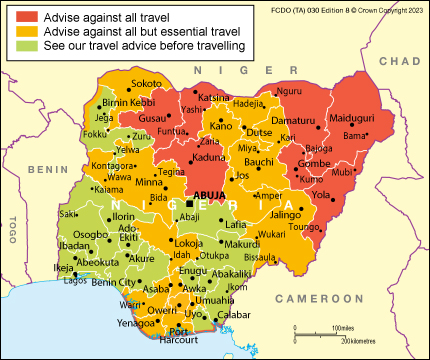
  • We advise against all travel to the Niger Delta States of Bayelsa, Delta and Rivers (including Port Harcourt) and advise British nationals in these States to leave.  This is because of the very high risk of kidnapping, armed robbery and other armed attacks in these areas.

  • We advise against all travel to riverine areas of Akwa Ibom State (i.e., the river and swamp locations on or close to the coast accessible only by boat, but not by road). We advise British nationals in these areas to leave. We also advise against all but essential travel to other areas of Akwa Ibom State because of the high risk of kidnapping, armed robbery and other armed attacks. We advise against all travel to the area bordering Cameroon in the region of the Bakassi Peninsula. If, despite this advice, you decide to travel to, or remain in these areas, you do so at your own risk.  See the Terrorism/Security section of this advice for more details.

  • International events, particularly in the Middle East, can lead to demonstrations and unrest. British Nationals are advised to remain vigilant.

  • There is a high risk of kidnappings and other armed attacks in the Niger Delta to ships and oil rigs at sea off the coast of the Delta.  Since 2007, there has been an increase in attacks offshore. There is also a risk of kidnapping in other States in Nigeria.  A British Citizen was kidnapped in June 2009 just outside Benin City and a Canadian citizen was kidnapped in Kaduna, in April 2009 by suspected criminals; both have subsequently been released. These cases demonstrate that there is a risk of kidnapping in all States. See the Terrorism/Security and Sea Travel sections of this advice for more details.

  • There have been reports of clashes between demonstrators and police in the northern town of Zaria.  The situation is now calm and those wishing to visit any of the Durbars over the next few days should be vigilant and, if necessary, be willing to change their travel plans.

  • Localised outbreaks of civil unrest can occur at short notice. You are advised to avoid large crowds, demonstrations and obvious political gatherings.  Trouble on the streets can be spontaneous, and can quickly lead to violence. Details and advice are circulated via the British High Commission's Community Liaison Officers' network.  We advise British nationals staying in Nigeria for three months or more to register with the British High Commission.  See the General (Registration) section of this advice for more details.

  • There is a high threat from terrorism in Nigeria.  Attacks could be indiscriminate, including in places frequented by expatriates and foreign travellers.

  • 4 British nationals required consular assistance in Nigeria in the period 01 April 2008 – 31 March 2009 for the following types of incident; deaths (4 cases). During this period assistance was also requested with regard to lost or stolen passports (4 cases).  Violent crime is also prevalent in the south of the country, including Lagos.

  • Outbreaks of Avian Influenza (Bird Flu) in Nigeria have led to a small number of human fatalities. The last fatality was in 2007. See the Health (Avian Influenza) section of this advice and Avian and Pandemic Flu for more details.

  • We recommend that you obtain comprehensive travel and medical insurance before travelling.   You should check that your insurance company provides personal insurance cover for you in Nigeria, and that your policy covers you for all the activities you want to undertake; check any exclusions.  Please see the General (Insurance) section of this advice and Travel Insurance for more details.

Safety and security

Terrorism/Security

There is increased tension in parts of northern Nigeria following clashes between militants and security forces in Bauchi State on 26 July 2009 which has extended to parts of Kano, Yobe, Katsina and Borno States on 27 July. A curfew is in force in Maiduguri between 21.00 and 06.00. If you are travelling in northern Nigeria you should take extra precautions and avoid crowds. Violence could erupt quickly and without warning.  See the political section of this advice for more details if you intend travelling to these areas.

We advise against all travel to the Niger Delta States of Delta, Bayelsa and Rivers (including Port Harcourt) and advise British nationals in these States to leave.  We also advise against all travel to riverine areas of Akwa Ibom State (i.e. the river and swamp locations on or close to the coast accessible by boat, but not by road).  We advise British nationals in these areas to leave. We also advise against all but essential travel to other areas of Akwa Ibom State.  This is because of the very high risk of kidnapping, armed robbery and other armed attacks in these areas.  Since January 2006, 43 British nationals (including two children) and more than 200 other foreign nationals have been kidnapped in the Niger Delta area, with one British national being killed. The most recent kidnapping is of a British national from a bar on the outskirts of Port Harcourt on 5 April 2009; he was freed after three weeks. Before this two other British nationals were kidnapped from a vessel off the coast of Rivers State on 9 September 2008; both have now been released.

On 19 July 2009, the Government of Nigeria announced an amnesty for militants in the Niger Delta. On 12 July, the Movement for the Emancipation of the Niger Delta (MEND) attacked an oil facility in the Atlas Cove Jetty area of Lagos. The attack was reported in the Nigerian press as having killed up to nine Nigerian nationals. On 15 July MEND announced a 60 day ceasefire in its activities. It is possible that armed groups may still be planning attacks on oil and gas industry targets in the Delta, and on other non-oil and gas industry targets and individuals throughout the country.  
 
The high risk of further kidnappings by armed militants around the oil and gas facilities in the Niger Delta also applies to ships and oil rigs at sea off the coast of the Niger Delta.  Since 2007 there has been an increase in attacks offshore.  On 19 June, an oil production platform 120km offshore was attacked, and a US citizen abducted from a nearby support vessel. The recent fighting has further raised tensions and increased the level of risk.

We advise against all travel to the area bordering Cameroon in the region of the Bakassi Peninsula.  Nigeria and Cameroon have reached an agreement on the future of Bakassi, which was handed from Nigeria to Cameroon on 14 August 2008, but the area and local feelings remain sensitive.

If you decide to travel to or remain in these areas it would be reckless to do so unless and until you have taken full, appropriate professional security advice and have acted on it.  You must be vigilant at all times and make sure that your local host and family know your travel plans and timings.  You should register with the British Deputy High Commission in Lagos on arrival (see the General (Registration) section of this advice for more details). Limit your movements to only essential journeys.  Vary your routines.  If travelling by road you should only travel in fully protected transport and aim to complete your journey well before nightfall.  Keep your car doors locked and windows closed and maintain telephone or radio communications to report your movements.  You should consider permanent armed protection, but be aware that even this cannot guarantee your safety. The government has heightened its security presence in Port Harcourt. Many companies have introduced strict restrictions on travel.  If you are a resident British national, you should follow your employer’s local security guidelines.

On 1 January 2008 there were nineteen reported fatalities in Port Harcourt when armed militants attacked two police stations and a hotel.

You should be aware that the long-standing policy of the British Government is not to make substantive concessions to hostage takers.  The British Government considers that paying ransoms and releasing prisoners increases the risk of further hostage taking.

A curfew (2200-0600) in Okrika Local Government Area remains in place.  A three month dusk-to-dawn curfew was declared on 5 October 2008 in Ebonyi State following clashes over land rights between people from the Ezza and Ezillo communities.
 
You should avoid going to public places in Port Harcourt frequented by expatriates, including bars and restaurants. If you encounter a threatening or intimidating situation do not try to make your way through it, turn around and go home.

We have received reports of an attempt to try to lure an expatriate to a meeting at a remote location near Port Harcourt.   It is believed that this was an attempted kidnap.   When arranging meetings in Nigeria you should ensure that the contact is known to you, and that the meeting is held at a secure location.

Due to the regular increases in the level of violence in Port Harcourt, the High Commission Liaison Office and British Council are subject to closure at short notice Closure and reopening of the offices will be reflected in this travel advice.

There is also a risk of politically or financially motivated kidnapping throughout south eastern Nigeria.
 
A British citizen was kidnapped in June 2009 outside Benin City and a Canadian citizen was kidnapped in Kaduna, northern Nigeria, in April 2009 by suspected criminals; both have subsequently been released.

There is a high threat from terrorism in Nigeria.  Attacks could be indiscriminate, including in places frequented by expatriates and foreign travellers.

You should also be aware of the global risk of indiscriminate terrorist attacks, which could be against civilian targets.  For more general information see Terrorism Abroad.

Crime

Violent street crimes e.g. muggings, kidnappings, car-jackings and especially armed robberies are on the increase in the south of the country.  Hitherto comparatively safe areas of Lagos have seen a rise in these crimes recently.  Most attacks happen after dark from 10pm onwards. You should therefore avoid non-essential road travel in Lagos after 10pm. There is little sign of law-enforcement activity to combat this increase.  British Citizens should act upon any security advice given by their employers or, if visiting, their hosts.  Avoid carrying large amounts of cash and wearing valuable watches, jewellery or items of sentimental value.  Remain alert to your surroundings and the actions of local people around you.  If you suspect danger, move away to a safer area. Do not try to resist.

There has recently been an increase in the number of robberies and kidnappings in Abia, Edo and Anambra States, in the latter particularly along the Enugu-Awka-Onitsha expressway. Travellers should exercise caution when driving outside cities, consider travelling in convoy, and avoid making any journeys that would involve travel after dark.

Experience has shown that, should you be unlucky enough to be caught up in an armed robbery, you should immediately comply with the attackers' demands. Those who have suffered injury or worse during such attacks have been perceived as not complying fully or quickly enough.  The vast majority of those who endure such attacks, and follow this advice, do so without lasting physical harm.

For more general information see Victims of Crime Abroad.

Scams

Foreign visitors and residents can be targeted by scam artists.  The scams come in many forms, and can pose great financial loss to victims.  If you or your relatives or friends are asked to transfer money to Nigeria you should make absolutely sure that it is not part of a scam and that you have properly checked with the person receiving the money that they are requesting it.
 
Scam artists are also targeting individuals in the UK.  There are a myriad of schemes in operation by West African criminal networks designed to facilitate victims parting with money, known as advance fee or 419 fraud.  Nigerian scam artists are also known to be targeting internet dating/personal sites with the intention of soliciting money from victims.  For further information on advance fee fraud please see West African advance fee Fraud Alert.

Foreign visitors and residents are also targeted by scam artists who they have never met in person on internet chat room and on-line dating agencies.  When trust has been established, sometimes over a period of months or years, the victim of the scam is informed that their on-line friend in Nigeria, who they believe is British, is in trouble and in immediate need of funds.  The reasons that the scam artists give for needing cash vary, but include being robbed or mugged, problems with airline tickets, being arrested at an airport for illegal immigration, being held against their will, being involved in a road accident (frequently on the airport road), hospitalisation, illness and advance payment for medical treatment.  Many victims are persuaded to part with large amounts of money before they start to suspect anything.  If you are asked to transfer funds to Nigeria to help with a crisis you should ask the caller whether they have reported the incident (by phone or e-mail) to the British Deputy High Commission in Lagos.  We are also aware of a scam involving a fictitious "Basic Travel Allowance" fee requirement, which has become common.  This is where it is alleged that the person trying to travel needs a certain amount of money before they will be allowed to travel.  People have also received scam e-mails using commercial e-mail accounts (e.g. Yahoo, Hotmail, MSN etc.) allegedly from a British High Commission office in Nigeria requesting personal bank details, or for money to be transferred to High Commission staff.  If you receive a report of a British national in Nigeria in distress or a request from any British High Commission office in Nigeria for bank details or money, you should immediately contact Consular Section, Lagos to investigate.

Political Situation

Nigeria Country Profile

You should take care to avoid large crowds, demonstrations or disturbances, especially if you are driving.

Demonstrations and outbreaks of localised civil unrest and violence can occur with little notice throughout the country.  The security situation may deteriorate rapidly in the vicinity of political gatherings.  If you encounter a threatening or intimidating situation do not try to make your way through it.  Turn round and go home.
 
Before planning any official or recreational travel, particularly by road, you should check whether any political rallies or demonstrations are planned for a particular area, or on your route.  See the Terrorism/Security section of this travel advice for other important security measures.

Local Travel


There is increased tension in parts of northern Nigeria following clashes between militants and security forces in Bauchi State on 26 July 2009 which has extended to parts of Kano, Yobe, Katsina and Borno States on 27 July. A curfew is in force in Maiduguri between 21.00 and 06.00. If you are travelling in northern Nigeria you should take extra precautions and avoid crowds. Violence could erupt quickly and without warning.  See the political section of this advice for more details if you intend travelling to these areas.

We advise against all travel to the Niger Delta States of Delta, Bayelsa and Rivers (including Port Harcourt) and to the riverine areas of Akwa Ibom State (i.e. the river and swamp locations on or close to the coast accessible by boat, but not by road).  We advise British nationals in these areas to leave.  We also advise against all but essential travel to other areas of Akwa Ibom State.  This is because of the very high risk of kidnapping, armed robbery and other armed attacks in these areas.  We also advise against all travel to the area bordering Cameroon in the region of the Bakassi Peninsula .  Nigeria and Cameroon have reached an agreement on the future of Bakassi, which was handed from Nigeria to Cameroon on 14 August 2008, but the area and local feelings remain sensitive.

Localised outbreaks of civil unrest can occur at short notice.  Details and advice are circulated via the British High Commission’s Community Liaison Officers’ network.

Road Travel

Traffic in many of Nigeria's major cities can be chaotic and slow moving.  Serious traffic jams in Lagos are not uncommon.  Short journeys that normally take minutes can sometimes take hours.  We advise you to take a mobile telephone with you when travelling by car so that you can stay in touch with family, friends and employers.  We also advise you to have a supply of bottled water in your vehicle at all times.

There are authorised as well as unauthorised vehicle checkpoints throughout Nigeria.  Some are for security checks, others to extort small payments of money.  You should slow down at any type of checkpoint and use common sense at all times.

There are frequent reports of robberies and car-jackings, some involving armed gunmen, on Nigeria's urban and rural road network. If you are involved in a car-jacking, experience has shown that victims who comply immediately and fully with the attackers’ demands are left unharmed.

You should:

  • be vigilant when travelling on all major roads within Nigeria.
  • avoid any travel after dark outside city centres.
  • take care after dark within cities, avoiding secondary roads and areas where other traffic is light.
  • be particularly vigilant when sitting in traffic jams or at traffic lights at night, and where street lighting is poor.
  • keep your car windows and doors locked and valuables out of sight.
  • if you feel your vehicle is being followed, you should drive to the nearest place of safety - e.g. to the nearest police station.
  • See the Terrorism/Security section of this advice for other important security measures.
 
Public transport is dangerous.  Taxis and long distance buses are poorly maintained and are often uninsured and driven by fraudulent drivers.  Most major hotels offer cars for hire with drivers.  We would recommend that you use these where possible.

If you are expecting a greeter or driver to collect you at any of Nigeria’s international airports you should ensure that he/she can properly identify themselves, as bogus greeters are a problem.

Road travel in Abuja and Lagos is banned between 07:00 and 10:00 on the last Saturday of every month for municipal road clean up; police vigilantly enforce the ban. 

Air Travel

The EU has published a list of air carriers that are subject to an operating ban or restrictions within the EU.  You should check the following link to see whether this will affect your travel - European Commission Transport - Air.

Airlines flying between Nigeria and London can occasionally become severely overbooked.  As a result, airlines advise travellers to reconfirm their return booking at least 48 hours before they are due to depart, and to check in early.

Following a series of crashes, there are also concerns about the safety and reliability of some airline compaies operating domestic flights within Nigeria.

For more general information see Airline Security.
 
Sea Travel

There have been attacks of piracy/armed robbery against ships at anchor in Nigerian waters and at many of the rivers and harbours in the Niger Delta area.  We advise mariners to take appropriate precautions.

For more general information see River and Sea Safety

Local laws and customs

Nigeria has the largest Muslim population in sub-Saharan Africa.  You should exercise discretion in behaviour and dress, particularly in the north and during the Holy month of Ramadan and when visiting religious sites. For more general information see Travelling during Ramadan.
 
The Sharia penal code has been introduced in 12 northern states (Sokoto, Zamfara, Kebbi, Kano, Yobe, Borno, Katsina, Jigawa, Bauchi, Kaduna, Niger and Gombe).  Homosexuality by Muslims in those states can attract a sentence of 100 lashes if the defendant is unmarried or stoning if married or divorced.  Alcohol consumption, infidelity and theft can attract harsh sentences including stoning, amputation, lashings or long prison terms.  Non-Muslims are not bound by Sharia law.
 
Homosexuality is illegal under Federal law, covering the whole of Nigeria, but individuals are rarely prosecuted.
 
Possession, use of or trafficking in illegal drugs is a serious offence and can result in lengthy prison sentences and heavy fines.

It is illegal to import beer, mineral water, soft drinks, sparkling wine, fruits, vegetables, cereals, eggs, textile fabrics, jewellery, and precious metals.  It is illegal to export pieces of African art, particularly antiques, without written authorisation from the Department of Antiquities.   You should contact the Nigeria High Commission in London for specific information regarding customs requirements.

Photography in airports may lead to arrest.

For more general information for different types of travellers see Your Trip.

Entry requirements

Visas

All British nationals travelling to Nigeria must hold a valid visa before entering the country.  British nationals planning to work in Nigeria must obtain the correct visa before doing so. For further information on entry requirements, we advise visitors to contact the Nigeria High Commission in London.
 
Passport validity

It is recommended that you obtain a new passport if your passport has less than six months validity remaining otherwise you may be refused a visa or turned away by airlines.

Travelling with children

Single parents or other adults travelling alone with children should be aware that some countries require documentary evidence of parental responsibility before allowing lone parents to enter the country or, in some cases, before permitting the children to leave the country.  For further information on exactly what will be required at immigration please contact the Nigeria High Commission in London.

Health

Basic, limited medical facilities are available in some parts of Nigeria.

Malaria and polio are common to Nigeria and there are also regular outbreaks of cholera and measles.  In the first 11 months of 2008 there were 768 confirmed cases of polio compared with 285 cases in 2007.  The Global Polio Eradication Initiative reports that Kano, Katsina and Jigawa States have been classified as “very high risk” for polio.  An outbreak of cerebro-spinal meningitis occurred in Katsina State in February 2009.

Severe, but localised flooding, has been known to occur in some parts of Nigeria during the rainy season.  This may increase the threat of water-borne diseases. You should drink or use only boiled or bottled water and avoid ice in drinks.  If you suffer from diarrhoea during a visit to Nigeria, you should seek immediate medical attention.

In the 2008 Report on the Global AIDS Epidemic the UNAIDS/WHO Working Group estimated that around 2,400,000 adults aged 15 or over in Nigeria were living with HIV; the prevalence rate was estimated at around 3.1% of the adult population. This compares to the prevalence rate in adults in the UK of around 0.2%.  You should exercise normal precautions to avoid exposure to HIV/AIDS. For more general information on how to do this see the HIV and AIDS.

You should seek medical advice before travelling to Nigeria and ensure that all appropriate vaccinations are up to date. For further information on vaccination requirements, health outbreaks and general disease protection and prevention you should visit the websites of the National Travel Health Network and Centre NaTHNaC and NHS Scotland's Fit For Travel or call NHS Direct on 0845 46 47.
 
For more general health information Travel Health.

Avian Influenza (Bird Flu)

Outbreaks of Avian Influenza (Bird Flu) in Nigeria have led to a small number of human fatalities.  The last fatality was in 2007.

The first confirmed case of Avian Influenza (Bird Flu) in Nigeria was announced by the World Organisation for Animal Health on 8 February 2006.   The outbreak occurred on a commercial chicken farm at Jaji in Kaduna State.   Since then, bird flu has been detected at other farms in Kaduna and in Kano, Plateau, Katsina, Bauchi, Nassarawa, Yobe, Rivers, Benue, Anambra, Ogun, Lagos, Taraba, Jigawa, Kwara, Delta, Borno, Sokoto, Adamawa, Edo, Enugu, Gombe, Kebbi and the Federal Capital Territory (Abuja and surrounds).  
 
The first human case confirmed by the World Health Organisation was that of a 22-year-old Lagos woman who died on 16 January 2007.   Since the end of 2003, a number of human deaths have also occurred in Azerbaijan, Cambodia, China, Egypt, Indonesia, Iraq, Laos, Pakistan, Thailand, Turkey and Vietnam.
 
The risk to humans from Avian Influenza is believed to be very low.  However, as a precaution you should avoid visiting live animal markets, poultry farms and other places where you may come into close contact with domestic, caged or wild birds; and ensure poultry and egg dishes are thoroughly cooked.
 
The World Health Organisation (WHO) has warned of the possibility that the Avian Influenza outbreaks could lead at some point to a human flu pandemic, if the virus mutates to a form which is easily transmissible between people.
 
British nationals living longer term in an Avian-Influenza affected region should take personal responsibility for their own safety in the event of a future pandemic, including considering their access to adequate healthcare and ensuring travel documents are up to date.

See Avian and Pandemic Flu for more details.

General

Insurance

We recommend that you obtain comprehensive travel and medical insurance, including a provision for medical evacuation, before travelling.  You should check and exclusions, that you insurance company provides a personal insurance cover for you in Nigeria, and that your policy covers you for all the activities you want to undertake. For more information see Travel Insurance.

If things do go wrong when you are overseas then this is How We Can Help

Registration


We advise British nationals staying in Nigeria for three months or more to register at the British High Commission in Abuja, the British Deputy High Commission in Lagos, our Liaison offices in Kaduna and Port Harcourt, or with the Honorary Consuls in Kano and Warri.
 
Register with our LOCATE service to tell us when and where you are travelling abroad or where you live abroad so our consular and crisis staff can provide better assistance to you in an emergency. More information about registering with LOCATE can be found here.

Passports
 
As many crimes involve the theft of British passports, you should keep a photocopy of your passport, separately from the passport itself.  This will speed up the process of issuing a new one.

Money

Nigeria is a cash economy.  You should ensure that you bring enough currency (Sterling, US Dollars or Euros) to cover your costs.  Travellers' cheques are difficult to cash in Nigeria.  It is illegal to change money on the street.  We advise against the use of credit cards throughout Nigeria.
 
Contact Details
 
Please note that all consular enquiries should be directed to the Deputy British High Commission in Lagos.
 
Abuja
 
British High Commission (Trade/Investment and Visa Sections)
Dangote House,
Aguyi Ironsi Street
Wuse
Abuja
 
Telephone:  (00 234) (9) 413 2010/2011/3885-7
Facsimile:  (00 234) (9) 413 4565 or 3552
 
Office Hours: GMT:  07:00-14:30 Monday-Friday
                    Local:  08:00-15:30 Monday-Friday
 
Lagos
 
Deputy British High Commission
11 Walter Carrington Crescent
Victoria Island
Lagos
 
Telephone:  (00 234) (1) 2619531, 2619537, 2619541
Duty Officer: (00 234) (0) 8034022765
Facsimile: (00 234) (1) 2614021 or 2625940
 
E-mail:  consular.lagos@fco.gov.uk
 
Office Hours:  GMT 07:00-14:30
                     Local:  08:00-15:30
 
Port Harcourt
 
British High Commission Liaison Office
300 Olu Obasanjo Road
Port Harcourt
Rivers State
 
Telephone:  (00 234) (84) 237173
Facsimile:  (00 234) (84) 237172
 
E-mail:  liaison@bhcph.com
 
Kano
 
Honorary Consulate - The Kano Honorary Consulate is temporarily closed. Please contact the Consular offices in Kaduna, Lagos or Abuja.
 
Warri
 
Honorary Consulate
Unit 6, Jefia Estate
62 Enerhen Road
Warri
Delta State
 
Tel/Fax:  (00 234) (53) 245523 or 255929
 
E-mail:  melhenthorn@hyperia.com
 
Kaduna
 
British High Commission Liaison Office
3 Independence Way
Kaduna
 
Telephone: 002347057312993 or 07057312993 from inside Nigeria
Facsimile:  (00 234) (62) 237267
 
E-mail:  bhc.kad@patmoengr.com

Website: http://ukinnigeria.fco.gov.uk/en

Share this with:

See Also


Contacts

Nigeria, Lagos, British Deputy High Commission

Address:

Deputy British High Commission
11 Walter Carrington Crescent
Victoria Island
Lagos

Telephone:

Duty Officer - (00 234) (0) 8034022765

Fax:

(00 234)(1) 4613660 and 4613661

Email: consular.lagos@fco.gov.uk

Email: commercial.lagos@fco.gov.uk

Office hours:

GMT: Mon-Thurs: 0630-1430 and Fri 0630-1130
Local Time: Mon-Thur 0730-1530 and Fri 0730-1230

Website: http://ukinnigeria.fco.gov.uk/en/

Sign-up for travel alerts

Subscribe to receive email alerts for the country of your choice


LOCATE: Register with us