Nigeria |
|
| Still current at: 10 February 2012
Updated: 08 February 2012 |
| No restrictions in this travel advice | Avoid all but essential travel to part(s) of country | Avoid all but essential travel to whole country | Avoid all travel to part(s) of country | Avoid all travel to whole country |
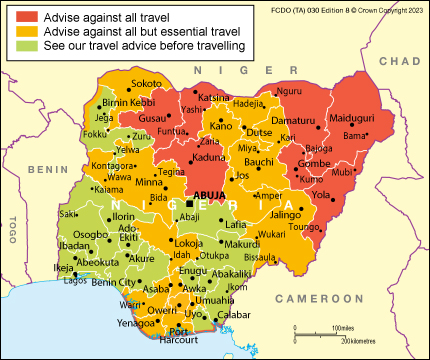
This advice has been reviewed and reissued with amendments to the Travel Summary and the Safety and Security - Terrorism section (update on security situation). The overall level of the advice has not changed. We advise against all travel to some areas of Nigeria and against all but essential travel to other areas.
(see travel advice legal disclaimer)
To see an enlarged version of this map, click here. (448 KB)
We advise against ALL travel to:
We advise against ALL BUT ESSENTIAL travel to:
Other advice:
Safety and Security - Terrorism
There is a high threat from terrorism in Nigeria. You are advised to exercise caution and observe vigilance at all times, particularly in areas where there are political or other large public gatherings. Attacks could be indiscriminate, including government and security institutions, international organisations as well as public areas such as markets, hotels, shopping centres, places of worship and other areas frequented by expatriates and foreign travellers.
Boko Haram
The main terrorist threat in northern Nigeria comes from the Islamist extremist group Boko Haram. Although the majority of attacks occur in Borno State and Yobe State where we advise against all travel. The last year has seen a significant increase in attacks occuring across other Nigerian states, mainly in the north.
Boko Haram aspires to establish Islamic law in Nigeria and primarily launches attacks against Nigerian targets including government institutions, police stations and places of worship. Public places have also been targeted and attacks could be indiscriminate, including in places frequented by expatriates and foreign travellers.
Boko Haram publicly delcared its loyalty to Al Qaeda in 2010 and has aligned itself to the jihadist ideology. The attack against the UN building in Abuja in August 2011, which killed 23 people shows that international and western interests could be targeted.
On 28 January, Boko Haram threatened to attack Sokoto. The group have previously carried out co-ordinated and large scale attacks, including the attacks on Kano on 20 January which killed 185 people. We cannot rule out their intent to attack other northern Nigerian states.
MEND
MEND (Movement for the Emancipation of the Niger Delta) is a militant group seeking to assume control of Nigeria's energy resources in the Niger Delta region. A faction of the group was responsible for the 1 October 2010 attack in Abuja, demonstrating an ability and willingness of this faction to operate away from their usual base in the south. On 6 February 2012, MEND threatened to carry out renewed attacks on major oil and gas assets in the Niger Delta.
Current State of Emergency
On 31 December, following the recent bombings claimed by the Islamist group, Boko Haram, the Nigerian Government declared a State of Emergency in some areas of the country. The State of Emergency covers the following:
Five Local Government Areas (LGAs) in Borno State - Maiduguri, Gamboru-Ngala, Banki-Bame, Biu, Jere;
Five LGAs in Yobe State - Damaturu, Geidam, Potiskum, Buniyadi-Gujiba, Gasua-Bade;
Four LGAs in Plateau State - Jos North, Jos South, Barkin-Ladi, Riyom;
Suleja LGA in Niger State (which includes Madalla).
The exact ramifications of the State of Emergency remain unclear but it is reported that international borders of these states have been closed.
Recent Attacks:
Kidnapping
There is a threat of kidnapping throughout Nigeria for financial, political or criminal motives. Recent kidnappings of British nationals include:
Historically most kidnaps have occurred in the Niger Delta where there is a high threat of kidnapping and other armed attacks targeting oil and gas facilities and workers. This also applies to ships and oil rigs at sea off the coast of the Niger Delta.
Since January 2007, we are aware of at least 24 British nationals and more than 200 other foreign nationals who have been kidnapped in the Niger Delta area, with one British national being killed. Two British nationals kidnapped in September 2008 were held for a number of months. One was released in April 2009 and one in June 2009. Although there have been no reported kidnaps of Britons in the Niger Delta in the past year the threat remains. A US National was kidnapped in January 2012. Please see the local travel section for advice to help you ensure your own security while travelling in Nigeria.
It is important to note that this threat exists outside of the Delta region; there is a threat of politically or financially motivated kidnapping throughout Nigeria.
You should be aware that the long-standing policy of the British Government is not to make substantive concessions to hostage takers. The British Government considers that paying ransoms and releasing prisoners increases the risk of further hostage-taking.
Maritime Security
There have been attacks of armed robbery against ships at anchor in Nigerian waters and at many of the rivers and harbours in the Niger Delta area. We advise mariners to take appropriate precautions.
See our Terrorism Abroad page
Violent street crimes e.g. muggings, kidnappings, car-jackings and especially armed robberies continue at high levels in the south of the country. The prevailing situation even in comparatively safe areas of Lagos can change quickly, with periodic reports of street and car-related crimes. Most attacks happen after dark from 22:00 onwards. You should therefore limit road travel at night in Lagos as far as possible, especially away from the city centre - keep alert at all times. You should act upon any security advice given by their employers or, if visiting, their hosts. Avoid carrying large amounts of cash and wearing valuable watches, jewellery or items of sentimental value. Remain alert to your surroundings and the actions of local people around you. If you suspect danger, move away to a safer area. Do not try to resist.
There have been a number of robberies and kidnappings in Abia, Edo and Anambra States, in the latter particularly along the Enugu-Awka-Onitsha expressway. Travellers should exercise caution when driving outside cities, consider travelling in convoy, and avoid making any journeys that would involve travel after dark.
Experience has shown that, should you be unlucky enough to be caught up in an armed robbery, you should immediately comply with the attackers' demands. Those who have suffered injury or worse during such attacks have been perceived as not complying fully or quickly enough. The vast majority of those who endure such attacks, and follow this advice, do so without lasting physical harm.
See our Victims of Crime Abroad page.
Scams
Foreign nationals are frequently defrauded by scam artists. The scams come in many forms, and can pose great financial loss to victims. If you or your relatives or friends are asked to transfer money to Nigeria you should make absolutely sure that it is not part of a scam and that you have properly checked with the person receiving the money that they are requesting it.
Scam artists are also targeting individuals in the UK. There are a myriad of schemes in operation by West African criminal networks designed to facilitate victims parting with money, known as advance fee or 419 fraud. Nigerian scam artists are also known to be targeting internet dating/personal sites with the intention of soliciting money from victims. For further information on advance fee fraud please see the West African advance fee Fraud Alert page on the website of the Metropolitan Police.
Foreigners, including Britons, are also targeted by scam artists they have met on internet chat rooms and on-line dating agencies. The scammer assumes the identity of an expatriot westerner and when trust has been established, sometimes over months or years, the victim of the scam is informed that their on-line friend in Nigeria is in trouble and in immediate need of funds. The reasons that the scam artists give for needing cash vary, but include being robbed or mugged, problems with airline tickets, being arrested at an airport for illegal immigration, being held against their will, being involved in a road accident (frequently on the airport road), hospitalisation, illness and advance payment for medical treatment. Many victims are persuaded to part with large amounts of money before they start to suspect anything. If you are asked to transfer funds to Nigeria to help with a crisis you should ask the caller whether they have reported the incident (by phone or e-mail) to the British Deputy High Commission in Lagos. We are also aware of a scam involving a fictitious "Basic Travel Allowance" fee requirement, which has become common. This is where it is alleged that the person trying to travel needs a certain amount of money before they will be allowed to travel. People have also received scam e-mails using commercial e-mail accounts (e.g. Yahoo, Hotmail, MSN etc.) allegedly from a British High Commission office in Nigeria requesting personal bank details, or for money to be transferred to High Commission staff. If you receive a report of a British national in Nigeria in distress or a request from any British High Commission office in Nigeria for bank details or money, you should immediately contact Consular Section, Lagos to investigate.
Safety and Security - Local Travel
There is an ongoing risk of demonstrations and rallies in Nigeria following the general strike that took place from 9 to 16 January. Some of these have resulted in clashes between the police and demonstrators, with fatalities reported. You are advised to avoid all such demonstrations. You should follow news reports and be alert to developments that might trigger public disturbances.
A number of curfews are being enforced across Nigeria. Curfews are used on a regular basis in Nigeria following incidents and unrest, and can be imposed with short notice. You should be aware and take notice of any curfews. We advise that you pay attention to local media to find out about curfews that are being enforced. British nationals are urged to comply with all curfews. The Nigerian authorities have announced that the curfew in Kano city will be in force from 18:00 until 06:00.
Nigeria experiences heavy rainfall during the wet season (June - September) and flash flooding can occur.
If you are travelling in Nigeria you should take extra precautions and avoid crowds. Violence could erupt quickly and without warning.
There has been an increase in terrorism in Nigeria since Boko Haram publicly declared its support for Al Qaeda in 2010. The group has been responsible for a number of terrorist attacks in the north.
Where we advise against all but essential travel, it would be reckless to travel to or remain in these areas unless and until you have taken full, appropriate professional security advice and have acted on it. Many companies have introduced strict restrictions on travel. If you are a resident British national, you should follow your employer’s local security guidelines. In addition:
Curfews are used on a regular basis in Nigeria following incidents and unrest, and can be imposed with short notice. You should be aware and take notice of any curfews. We advise that you pay attention to local media to find out about curfews that are being enforced.
Northern Nigeria
We advise against ALL travel to:
Borno State and Yobe State where there has been an increase in terrorist attacks by Boko Haram. Recent attacks have increasingly focused on public places, including bars and restaurants, resulting in a large number of injuries and deaths.
We advise against all but essential travel to:
The city of Kano, which was the scene of a major terrorist attack by Boko Haram on 20 January, and Bauchi State and Plateau State (including Jos), where violence can break out at short notice, in particular in Jos and surrounding districts. There remains a heavier than normal security presence, and communal tensions exist. You should exercise extra caution and vigilance, and avoid public gatherings.
The Niger Delta States
We advise against all travel to:
The Niger Delta States of Delta, Bayelsa and Rivers (including Port Harcourt) and to the riverine areas of Akwa Ibom State (i.e. the river and swamp locations on or close to the coast accessible by boat, but not by road). We advise British nationals in these areas to leave.
We advise against all but essential travel to:
Non-riverine areas of Akwa Ibom State. We also advise against all travel to the area bordering Cameroon in the region of the Bakassi Peninsula, where local feelings remain sensitive after the resolution of a border dispute in 2008.
You should avoid going to public places in Port Harcourt frequented by expatriates, including bars and restaurants. If you encounter a threatening or intimidating situation do not try to make your way through it; turn around and go home. We have received reports of an attempt to try to lure an expatriate to a meeting at a remote location near Port Harcourt. It is believed that this was an attempted kidnap. When arranging meetings in Nigeria you should ensure that the contact is known to you, and that the meeting is held at a secure location.
The High Commission Liaison Office and British Council in Port Harcourt are subject to closure at short notice. Closure and reopening of the offices will be reflected in this travel advice.
Safety and Security - Local Travel - Road Travel
Traffic in many of Nigeria's major cities can be chaotic and slow moving. Serious traffic jams in Lagos are not uncommon. Short journeys that normally take minutes can sometimes take hours. We advise you to take a mobile telephone with you when travelling by car so that you can stay in touch with family, friends and employers. We also advise you to have a supply of bottled water in your vehicle at all times.
There are authorised as well as unauthorised vehicle checkpoints throughout Nigeria. Some are for security checks, others to extort small payments of money. You should slow down at any type of checkpoint and use common sense at all times.
There are frequent reports of robberies and car-jackings, some involving armed gunmen, on Nigeria's urban and rural road network. If you are involved in a car-jacking, experience has shown that victims who comply immediately and fully with the attackers’ demands are left unharmed.
You should:
Public transport is dangerous. Taxis and long distance buses are poorly maintained and are often uninsured and driven by fraudulent drivers. Most major hotels offer cars for hire with drivers. We would recommend that you use these where possible.
If you are expecting a greeter or driver to collect you at any of Nigeria’s international airports you should ensure that he/she can properly identify themselves, as bogus greeters are a problem.
On 28 June the Ministry of the Federal Capital Territory put in place new security measures in Abuja, including parking restrictions in the Central Business District, a closing time of 2200 for recreational facilities (cinemas, clubs and bars) and 1800 for parks and gardens that admit children
Road travel in Abuja and Lagos is banned between 07:00 and 10:00 on the last Saturday of every month for municipal road clean up; police vigilantly enforce the ban. See our Driving Abroad page.
Safety and Security - Local Travel - Air Travel
The EU has published a list of air carriers that are subject to an operating ban or restrictions within the EU. You should check the following link to see whether this will affect your travel - European Commission Transport - Air.
Airlines flying between Nigeria and London can occasionally become severely overbooked. As a result, airlines advise travellers to reconfirm their return booking at least 48 hours before they are due to depart, and to check in early.
Following a series of crashes, there are also concerns about the safety and reliability of some airline companies operating domestic flights within Nigeria.
For more general information see Air Travel.
Safety and Security - Local Travel - Sea Travel
There have been attacks of piracy/armed robbery against ships at anchor in Nigerian waters and at many of the rivers and harbours in the Niger Delta area.
We advise mariners to take appropriate precautions.
See our River and Sea Safety page.
Safety and Security - Political Situation
Nigeria Country Profile
Demonstrations and outbreaks of localised civil unrest and violence can occur with little notice throughout the country. The security situation may deteriorate rapidly in the vicinity of political or other gatherings. If you encounter a threatening or intimidating situation do not try to make your way through it. Turn round and go home.
Before planning any official or recreational travel, particularly by road, you should check whether any political rallies or demonstrations are planned for a particular area, or on your route. See the Terrorism/Security section of this travel advice for other important security measures.
Homosexuality is illegal under Federal law, covering the whole of Nigeria.
Possession, use of or trafficking in illegal drugs is a serious offence and can result in lengthy prison sentences and heavy fines.
It is illegal to import beer, mineral water, soft drinks, sparkling wine, fruits, vegetables, cereals, eggs, textile fabrics, jewellery, and precious metals. It is illegal to export pieces of African art, particularly antiques, without written authorisation from the Department of Antiquities. You should contact the Nigeria High Commission in London for specific information regarding customs requirements.
Nigeria has the largest Muslim population in sub-Saharan Africa. You should exercise discretion in behaviour and dress, particularly in the north and during the Holy month of Ramadan and when visiting religious sites. See our Travelling during Ramadan page.
Photography in airports may lead to arrest. Your Trip.
Entry Requirements - Visas
All British nationals travelling to Nigeria must hold a valid visa before entering the country. British nationals planning to work in Nigeria must obtain the correct visa before doing so. For further information on entry requirements, we advise visitors to contact the Nigeria High Commission in London.
Entry Requirements - Passport validity
You must hold a valid passport to enter Nigeria. Your passport must be valid for a minimum period of six months from the date of entry into Nigeria.
Entry Requirements - Travelling with children
Single parents or other adults travelling alone with children should be aware that some countries require documentary evidence of parental responsibility before allowing lone parents to enter the country or, in some cases, before permitting the children to leave the country. For further information on exactly what will be required at immigration please contact the Nigeria High Commission in London.
Basic, limited medical facilities are available in some parts of Nigeria.
You should seek medical advice before travelling to Nigeria and ensure that all appropriate vaccinations are up to date. For further information on vaccination requirements, health outbreaks and general disease protection and prevention you should visit the websites of the National Travel Health Network and Centre (NaTHNaC) and NHS Scotland's Fit For Travel or call NHS Direct on 0845 46 47.
Malaria is very common in Nigeria and prophylaxis is recommended in all areas of the country. Travellers should also protect themselves from insect bites. It is estimated that 25% of all malaria cases in the world happen in Nigeria. It is therefore essential for all travellers to take appropriate precautions.
Cholera, measles, meningitis and other communicable diseases do occur in Nigeria – and most years there is an outbreak. Water-borne disease poses a greater risk during the rainy season; there have been reports of cholera. It is recommended that travel health information services are consulted before travel. Nigeria is also one of last countries in the world with wild circulating polio virus. This can be prevented through immunisation prior to arrival. Most ill health can be prevented by following good hygiene practices and following advice of health professionals.
It is estimated that 3.1 million Nigerians are living with HIV; the prevalence rate is estimated at around 3.6% of the adult population. This compares to the prevalence rate in adults in the UK of around 0.2%. You should exercise normal precautions to avoid exposure to HIV/AIDS. See our HIV and AIDS page.
For more general health information see Travel Health.
General - Insurance
You should take out comprehensive travel and medical insurance, including a provision for medical evacuation, before travelling. You should check and exclusions, that you insurance company provides a personal insurance cover for you in Nigeria, and that your policy covers you for all the activities you want to undertake. See our Travel Insurance page.
If things do go wrong when you are overseas then see our When Things go Wrong page.
General - Registration
British nationals staying in Nigeria for three months or more should register at the British High Commission in Abuja, the British Deputy High Commission in Lagos, our Liaison offices in Kaduna and Port Harcourt, or with the Honorary Consuls in Kano and Warri.
Register with our LOCATE service to tell us when and where you are travelling abroad or where you live abroad so our consular and crisis staff can provide better assistance to you in an emergency.
General - Passports
As many crimes involve the theft of British passports, you should keep a photocopy of your passport, separately from the passport itself. This will speed up the process of issuing a new one.
General - Consular Assistance Statistics
52 British nationals required consular assistance in Nigeria in the period 01 April 2010 - 31 March 2011 for the following types of incident: 15 deaths; two hospitalisations; and four arrests.
General - Money
Nigeria is a cash economy. You should ensure that you bring enough currency (Sterling, US Dollars or Euros) to cover your costs. Travellers' cheques are difficult to cash in Nigeria. It is illegal to change money on the street. We advise against the use of credit cards throughout Nigeria.
General - Contact Details
Please note that all consular enquiries should be directed to the Deputy British High Commission in Lagos.
Abuja
British High Commission (Corporate Services and Visa Sections)
No. 33, Dangote House,
Aguiyi Ironsi Street
Wuse
Abuja
Telephone: (00 234) (9) 462 3200
Facsimile: (00 234) (9) 462 3223 (Corporate Services);
462 3303 (Visa Section)
Office Hours: GMT: 07:00 -15:00 Monday-Thursday
07:00 -12:00 Friday
Local: 08:00-16:00 Monday-Thursday
08:00-1300 Friday
British High Commission (Chancery)
No 19, Torrens Close
PMB 4808
Maitama
Abuja
Telephone: (00 234) (9) 462 2200
Facsimile: (00 234) (9) 462 2263
Office Hours: GMT: 07:00 -15:00 Monday-Thursday
07:00 -12:00 Friday
Local: 08:00-16:00 Monday-Thursday
08:00-1300 Friday
Lagos
Deputy British High Commission
11 Walter Carrington Crescent
Victoria Island
Lagos
Telephone: (00234) (0) 1 277 0780/0781/0782
Facsimile: (00234) (0) 1 2770789
E-mail: consular.lagos@fco.gov.uk
Office Hours: GMT 07:00-14:30 Local: 08:00-15:30
Port Harcourt
British High Commission Liaison Office
300 Olu Obasanjo Road
Port Harcourt
Rivers State
Telephone: (00 234) (84) 237173
Facsimile: (00 234) (84) 237172
E-mail: liaison@bhcph.com
Kano
Honorary Consulate (British Council)
10 Emir's Palace Road,
PMB 3003
Kano
Tel: (00234) (0) 7034171351
Ben.Fisher-HonCon@fconet.fco.gov.uk
Warri
Honorary Consulate
Unit 6, Jefia Estate
62 Enerhen Road
Warri
Delta State
Tel/Fax: (00 234) (53) 245523 or 255929
E-mail: melhenthorn@hyperia.com
Kaduna
British High Commission Liaison Office
3 Independence Way
Kaduna
Telephone: 002347057312993 or 07057312993 from inside Nigeria
Facsimile: (00 234) (62) 237267
E-mail: bhc.kad@patmoengr.com
Website:
http://ukinnigeria.fco.gov.uk/en