Kenya |
|
| Still current at: 19 March 2010
Updated: 18 March 2010 |
There are incidents of car-jacking and armed robbery involving foreign nationals in and around Nairobi.
You should remain vigilant at all times, particularly at night and on the roads that link Nairobi city centre to residential areas. You should avoid stopping at the side of the road and should drive defensively, with vehicle doors locked and windows closed at all times.
Cases of kidnapping have increased recently in Nairobi and some other major towns. Some have been opportunist crimes linked to car-jackings, while others appear to have been more organised. A resident British citizen was kidnapped on 29 October 2009 and two other recent incidents involved resident European nationals. Although there is no evidence of the expatriate community being specifically targeted, both resident and visiting British citizens should remain vigilant at all times. See the Terrorism section of this advice for the British Government's policy on concessions to hostage takers including payment of ransoms.
Muggings and armed attacks by gangs can occur at any time, particularly in Nairobi and Mombasa. Avoid walking around after dark as attacks can occur anywhere, but especially in isolated areas such as empty beaches. There have been a number of armed attacks on golf courses around Nairobi, be extra vigilant while playing in remote areas away from the Club House of any golf courses. Be alert at all times. Do not accept food or drink from strangers as it may be drugged. Only stay in tourist camps with good perimeter security. If in doubt, seek advice from your tour operator or the Kenya Tourist Federation (Tel: + 254 20 604730). Do not carry valuables or wear jewellery in public places. Do not carry credit cards or cash cards unless you must: people have been forced by thieves to withdraw cash. Beware of thieves posing as police officers; always ask to see identification.
In August 2009 a British resident was attacked and killed near Voi. Another British resident was killed in Thika in October and one in Nairobi in November. Two British visitors were killed during their stay in Mombasa in October.
We advise against all but essential travel to low income areas of Nairobi, including all township or slum areas, which experience high crime levels. Such areas include, but are not limited to, Kibera, Mathare, Huruma, Kariobangi and Kawangware.
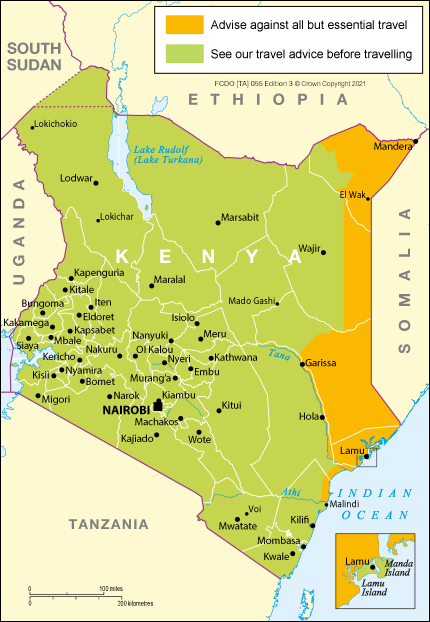
We advise against all but essential travel to within 30 kilometres of the border with Somalia. There remains a high threat of clashes between the Kenyan military and armed Somali groups along the border. There have been recent attacks on the border town of Mandera by Somali militias.
Incidents of armed car-hijackings are more prevalent in Nairobi and Mombasa but can occur in any area of the country. Do not attempt to escape from hijackers or resist their demands (See Local Travel for more information).
You should take precautions for your personal and vehicle safety and travel in convoy in remote areas.
If you are involved in any security incident you should insist with both the Kenyan authorities and your tour operator that the British High Commission be informed straight away.
For more general information see Victims of Crime Abroad.
Large public gatherings and demonstrations occur from time to time and should be avoided. Any rallies, even if advertised as peaceful, could potentially turn violent. You should check local media reports for information on future demonstrations.
Rural areas, and in particular the arid north and north eastern parts of Kenya experience sporadic cattle rustling, banditry and ethnic clashes which regularly cause fatalities. Whilst foreigners are not usually the targets of localised violence and banditry, travel in the north and north east should only be undertaken with care and after seeking the advice of the police and in convoy with at least two vehicles to ensure back-up. You should be alert and avoid demonstrations and gatherings of people in these areas, which could turn violent.
Most visits to game reserves and other tourist areas are trouble-free. Since May 2009 there has been an influx of armed herdsmen with large numbers of cattle into some game parks. Operations by the authorities to remove them, particularly in the Shaba and Buffalo Springs reserves in the Isiolo area of Eastern Province, have given rise to tension and resultant insecurity in the area. Whilst there is no evidence that tourists are deliberately targeted, there have been isolated incidents of tourists being caught in clashes. There have also been reports of bandits attacking vehicles travelling on the road from Isiolo to Archer's Post towards the reserves. Travellers planning to use this road should travel in convoy or by air.
Robberies of visitors to other game parks, including the Masai Mara have also occasionally been reported. A robbery within the park on 8 October 2009 involved two British nationals. Security at camps within the Masai Mara has been stepped up as a result of recent incidents. If you wish to visit reserves you should use reputable tour operators and arrive at your destination in daylight hours. You are advised not to buy safari tours from touts but only through reputable agencies or from your hotel. You should always follow park regulations and wardens' advice, but be aware that there are risks associated with viewing wildlife, particularly on foot or at close range. Bathing in rivers and lakes is forbidden National Parks and is best avoided elsewhere due to the dangers from both wildlife and from water-borne diseas.
The area of Mount Elgon in Western Kenya (next to the Ugandan border) has been the site of armed clashes since December 2006. A large-scale security operation in early 2008 has stabilised the area but a large security force presence remains and there continues to be a risk of further incidents. You should seek local advice if intending to travel in the area of Mount Elgon.
The border with Somalia has been closed since 3 January 2007. In addition landmines have in the past been used in attacks around Moyale, close to the main A2 road south. Vehicles crossing the Kenya-Ethiopia border at this point should stay on the A2, avoid staying at the rest house at Sololo, and travel directly to Marsabit Town before breaking the journey.
If you visit Lamu Island, do so by air if possible. This is for security reasons and also because of the bad road conditions. Buses and other vehicles on the road to Lamu have been attacked by armed robbers in the past and overland travel from Lamu to Malindi should only be undertaken in an armed police convoy.
Although there are no strict dress codes, you should note that the coastal areas are predominantly Muslim in tradition. You should dress conservatively away from the tourist resorts and hotels, especially in Mombasa town, to avoid offending local sensitivities. You should respect local traditions, customs, laws and religions at all times and be aware of your actions to ensure that they do not offend other cultures or religious beliefs, especially during the holy month of Ramadan or if you intend to visit religious areas. For more general information see travelling during ramadan.
Smoking in all public places (except in designated areas) is prohibited throughout Kenya. This applies to areas such as hotel grounds, lounge areas and entrances. If you wish to smoke in your hotel room please confirm first with hotel management that it is permitted. Smoking outdoors in open places, including any public street, beaches and open areas is not banned under the Act. Offences attract fines ranging from 50,000 to three million Kenya shillings and/or imprisonment for six months to three years. If in doubt about whether smoking is permitted in a certain place, it is recommended that you should check before doing so or refrain from smoking.
The use and trafficking of illegal Class A drugs in Kenya carries heavy fines and jail sentences. The penalty for possession is ten years imprisonment.
You must obtain a valid work permit before taking up any paid or volunteer work in Kenya; the penalties for not doing so can be a fine, jail or deportation depending on the nature of the offence.
The taking of photographs of official buildings, including Embassies, is not recommended and can lead to detention. If in any doubt about what a building is used for, do not photograph it or film around it.
Permission to carry any kind of firearm must be obtained from the local authorities prior to entry.
It is illegal to destroy Kenyan currency whatever the denomination.
Homosexual activity is illegal in Kenya.
For more general information for different types of travellers see Your Trip.
Visas
Adults who hold a British passport need a visa to enter Kenya. Kenyan authorities state that you need sufficient space in your passport for your visa. If you arrive with a passport that is full you will be refused entry. We advise that you have two blank pages in your passport on arrival.
For a single entry business / holiday visa, the fee is currently $25, £20 or 20 Euros.
For a transit visa, the fee is currently $10, £10 or 10 Euros.
Children under the age of 16 who hold a British passport do not currently require a visa to enter Kenya but will receive a gratis stamp in their passport on arrival.
Visas may be obtained on arrival by air (using any of the currencies above) or in advance (using Sterling only) from the Kenya High Commission
Passport validity
You require six month's remaining validity on your passport to enter Kenya.
Airport Departure Tax
In Kenya there is an airport departure tax of 20 US Dollars. Payment is also accepted in Kenyan Shillings. This tax is normally included in the price of airline tickets but if you are unsure, you should check with the airline or travel company.
Work permits
If you are coming to live and work in Kenya, you should be aware that there can be delays in obtaining work permits. It is illegal to work without a permit and this also applies to voluntary work and to the self-employed. British nationals living in Kenya are advised to register with the British High Commission in Nairobi: Kenya: British High Commission Nairobi.
Travelling with children
Single parents or other adults travelling alone with children should be aware that some countries require documentary evidence of parental responsibility before allowing lone parents to enter the country or, in some cases, before permitting the children to leave the country. For further information on exactly what will be required at Immigration, please contact the Kenya High Commission in London.
Cholera & Malaria
Cholera and malaria occur in Kenya. The latter is found outside of Nairobi and in areas below 1,800 metres above sea level.
In March 2009 an alert was issued by the Kenyan Ministry of Health, following an outbreak of cholera. There have been thousands of cases and a significant number of deaths. The outbreak has so far affected Nyanza, Western, Rift Valley, Eastern and North Eastern provinces. Cases of cholera continue to be reported in these areas. You should drink or use only boiled or bottled water and avoid ice in drinks. Food prepared by unlicensed vendors should be avoided at any time. If you suffer from diarrhoea during a visit to Kenya you should seek immediate medical attention.
Kenya lies on an active fault line and tremors occur from time to time. The last significant earth tremor to affect the region was a magnitude 5.2 tremor on 20 August 2007. The epicentre was 180-km south west of Nairobi.