Ethiopia |
|
| Still current at: 10 February 2012
Updated: 07 February 2012 |
| No restrictions in this travel advice | Avoid all but essential travel to part(s) of country | Avoid all but essential travel to whole country | Avoid all travel to part(s) of country | Avoid all travel to whole country |
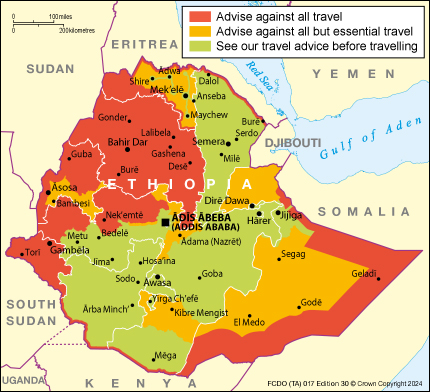
This advice has been reviewed and reissued with amendments to the Safety and Security and Local Laws and Customs sections(conviction of two Swedish journalists). The overall level of the advice has not changed; we advise against all travel to specific areas of Ethiopia and against all but essential travel to other specific areas.
(see travel advice legal disclaimer)
The map has been temporarily removed for updating.
- the Danakil desert area bounded by the Dessie-Adigrat road; the Dessie-Djibouti road
- the four woredas (districts) (Akobo, Wantawo, Jikawo and Lare) of the Nuer zone and the Jore woreda of the Agnuak zone of the Gambella region
Safety and Security - Terrorism/Security
There is a general threat from terrorism in Ethiopia; attacks could be indiscriminate including in places frequented by expatriates and foreign travellers. Visitors and expatriates should remain vigilant at all times, especially in crowded areas and places frequented by foreigners, including hotels, restaurants and bars. Check this Travel advice regularly. There is security around all major hotels, key government offices and major Western Embassies in Addis Ababa. Security is occasionally increased around these sites, reflecting spikes in the threat.
The terrorist group Al-Shabaab, although based in Somalia, poses a threat across the East Africa region. In July 2010, Al Shabaab claimed responsibility for attacks in Uganda. The group linked the attack to Uganda’s military presence in Somalia as part of an African Union peacekeeping mission.
Ethiopia may be seen as a legitimate target by Al Shabaab because of its military intervention in Somalia. Al Shabaab has previously issued public threats against Ethiopia.
Explosive devices, such as grenades, are readily obtainable throughout Ethiopia and are occasionally used during local disputes. There is a risk of British nationals and other foreigners becoming indiscriminately caught up in attacks. Remain extremely vigilant at all times in public places, particularly at transport hubs, and check this travel advice at regular intervals. Recent attacks include:
Safety and Security – Local Travel - Traffic accidents:
Traffic accidents are a regular occurrence in Ethiopia and Addis Ababa specifically. If you are involved in a traffic accident you should remain with your vehicle and call the local police. You should avoid confrontation and await the arrival of the police to resolve the matter.
The Ethiopian Highlands are predominantly Orthodox Christian with ‘fasting’ each Wednesday, Friday and during Lent when only vegetarian dishes are available (except in larger hotels). The Julian calendar is used and the current year is 2002. Christmas is celebrated on 7 January and New Year on 11 September. Some Ethiopians set their clocks from dawn to dusk and there is a six-hour difference between Ethiopian time and Western time i.e. 6 o’clock can mean 12 o’clock. So take care when making appointments.
There is a large Muslim population and generally Ethiopians dress in a conservative manner. You should respect local traditions, customs, laws and religions at all times and be aware of your actions to ensure that they do not offend other cultures or religious beliefs, especially during the holy month of Ramadan or if you intend to visit religious areas. See our Travelling During Ramadan page.
On 27 December 2011, two Swedish journalists were found guilty of supporting terrorism and entering Ethiopia illegally. They were arrested in Ethiopia’s Somali region by members of the Ethiopian army, in the company of fighters from the Ogaden National Liberation Front (ONLF), having crossed into Ethiopia illegally from Somalia. Any journalist wishing to operate legitimately in Ethiopia should ensure they have the necessary accreditation and follow the country’s laws, including the Anti-Terrorism Proclamation and Mass Media Proclamation. Any journalist entering Ethiopia illegally risks a long prison sentence.
Ethiopian antiques need an export certificate to be taken out of the country. Major tourist outlets in Addis Ababa can offer assistance in obtaining one. Customs authorities are known to have confiscated items where visitors have not produced an export certificate. In certain cases, criminal prosecutions have been brought against visitors found in possession of antiques without an export certificate.
Owning ivory is strictly prohibited in Ethiopia. A number of visitors who have been found with ivory jewellery have had their items confiscated by authorities and been made to pay fines of between 5,000 – 25,000 birr.
Homosexual acts (applying to both sexes) are illegal, and carry penalties of between one and fifteen years imprisonment.
Drug offences are treated seriously in Ethiopia. You should not become involved with drugs of any kind.
Travellers should be aware that it is illegal to carry more than 200 birr when entering or departing Ethiopia. If you are found to be carrying in excess of 200 birr when passing through immigration you may be subject to prosecution. The penalties are tough - the money will be seized and a prison sentence is possible.
Visitors to Ethiopia must declare to customs officials at their point of entry any cash in excess of $3000 (or the equivalent in other foreign currencies). This must be done by completing a customs declaration form. Travellers departing Ethiopia in possession of more than $3000 must present a bank advice notice to customs officials if the currency was purchased from a local bank. Alternatively, the traveller must present a valid customs declaration form obtained at their point of entry. Travellers should be aware, however, that a bank advice notice or customs declaration form becomes invalid if 45 days or more have elapsed since the date of issue. For more detailed information please visit: http://www.erca.gov.et/TRAVELERSDOLLARS.pdf.
See our Your trip page.
Entry Requirements - Visas
British nationals require a visa to enter Ethiopia. If you are flying into Ethiopia for as a tourist you may obtain your visa on arrival at Addis Ababa (Bole) and Dire Dawa International airports. If you are arriving by other means, or at another airport, you must obtain a visa prior to arrival, even when travelling from countries without an Ethiopian Embassy or Mission. Visa applicants in the United Kingdom should contact the Embassy of the Federal Democratic Republic of Ethiopia in London. Penalties for overstaying your visa can be severe (see below - Immgration Status).
Entry Requirements – Road Travel from Sudan into Ethiopia
British nationals wishing to enter Ethiopia from Sudan in their own vehicles require a letter from the British Embassy in Addis Ababa providing details of the passengers (names, passport details) and vehicle(s) (make, model, registration number, engine and chassis numbers). They should contact the British Embassy in Addis Ababa (addis.consular@fco.gov.uk) well in advance of their journey to request a copy of the letter and provide full details of their vehicle, passengers and voyage. This letter should be presented to officials of the Ethiopian Revenue and Customs Authority at the border.
Entry Requirements - Passport validity
You must hold a valid passport to enter Ethiopia. Your passport must be valid for the proposed duration of your stay. No additional period of validity beyond this is required. However, it is always sensible to have a short period of extra validity on your passport in case of any unforeseen delays to your departure. You do not have to wait until your old passport expires to apply to renew it. Any time left on your old passport when you apply will be added to your new passport, up to a maximum of nine months. For passport applications in the UK, you should apply to the Identity and Passport Service.
Entry Requirements - Yellow Fever Certificate
Yellow Fever vaccination certificates may be required for visitors from countries where it is endemic. Visitors to Ethiopia may be required to produce a yellow fever certificate upon arrival in a third country, following a stay in Ethiopia.
Entry Requirements - Travelling with children
For information on exactly what will be required at immigration, please contact the Embassy of the Federal Democratic Republic of Ethiopia in London.
Entry Requirements- Immigration status
Visitors to Ethiopia should be aware that they cannot change their immigration status once in Ethiopia. If visitors to Ethiopia have any concerns regarding their immigration status they should contact the local immigration authorities at
Security, Immigration and Refugee Affairs Authority
P.O.Box 5741
Addis Ababa
Ethiopia
Tel: (+251-11) 1553899
Fax: (+251-11) 1553209
Tourist visitors to Ethiopia should be aware that they will be unable to take employment, including voluntary employment, whilst visiting Ethiopia on a tourist visa. If visitors are caught in breach of their immigration status they may face severe fines or possible imprisonment.
There are a number of hospitals in Addis Ababa but only private hospitals offer a reasonable standard of basic care for minor health problems. Elsewhere medical facilities (including dentistry) are extremely poor.
Water-borne diseases and malaria are common to Ethiopia, the latter in areas of the country below 2000 metres. Bilharzia is present in the majority of lakes in Ethiopia.
Since August 2006 there have been approximately 60,000 reported cases of Acute Watery Diarrhoea resulting in about 600 deaths. Drink or use only boiled or bottled water and avoid ice in drinks. If you suffer from diarrhoea during a visit to Ethiopia you should seek immediate medical attention.
Addis Ababa sits at 2,400 metres above sea level. Adjusting to the altitude may take several weeks. If you have a heart condition you should seek medical advice before travelling to Addis Ababa.
You should exercise normal precautions to avoid exposure to HIV/AIDs. See our HIV and AIDS page.
Seek medical advice before travelling to Ethiopia and ensure that all appropriate vaccinations are up to date. For further information on vaccination requirements, health outbreaks and general disease protection and prevention you should check the websites of the National Travel Health Network and Centre NaTHNaC and NHS Scotland's Fit For Travel or call NHS Direct on 0845 46 47.
See our Travel Health page.
General - Insurance
Ensure that you obtain adequate medical insurance before arrival. You should also carry a comprehensive medical pack when travelling out of Addis Ababa. Medical insurance should cover the cost of air ambulance evacuation out of Ethiopia in the event of serious accident or illness. Check any exclusions, and that your policy covers you for the activities you want to undertake. See our Travel Insurance page.
If things do go wrong when you are overseas then see our When things go wrong page.
General - Consular registration
If you are visiting Ethiopia either on a long or short-term basis you should register with the British Embassy in Addis Ababa on arrival so our consular and crisis staff can provide better assistance to you in an emergency. Full details are on the Embassy website.
General - Money
Credit cards are accepted at only a very few outlets in Addis Ababa. It is not normally possible to obtain currency advances against a credit card in Ethiopia. Ensure you have an adequate supply of hard currency or travellers-cheques.
General - Consular Assistance Statistics
Approximately 20,000 visited Ethiopia in the period 1 April 2010 and 31 March 2011 (source: Ethiopian Ministry of Culture and Tourism). During this period 21 British nationals required consular assistance in Ethiopia, for the following types of incident: four deaths; two hospitalisations; and six arrests for a variety of offences.