Advanced search
image
Travel & living abroad

Sub Saharan Africa

Ethiopia

Flag of Ethiopia
Still current at: 07 November 2009
Updated: 29 September 2009

This advice has been reviewed and reissued with amendments to the Summary (consular assistance figures).  The overall level of the advice has not changed.


(see travel advice legal disclaimer)


Travel advice for this country

Travel Summary

  • The World Health Organisation (WHO) has raised its Pandemic Threat Alert Phase to Level 6. The World Health Organisation website has further details. Check the dedicated FCO page on Swine Flu for further information.

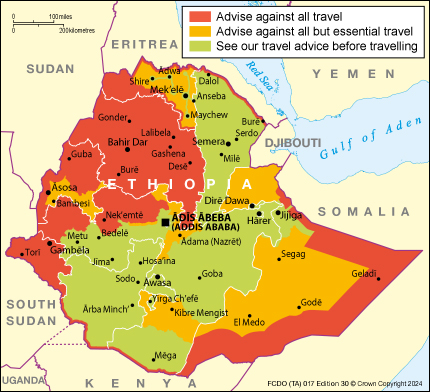
  • The Ethiopia-Eritrea border remains closed.  Several security incidents have taken place along the border, particularly in the Humera region.  The risk of cross-border tensions increasing and the security situation deteriorating very rapidly continues.  With the exception of the main road through Axum and Adigrat, we advise against all travel within 50 kms of the border areas with Eritrea because of the risk of landmines and banditry.  See the Local Travel (North and East Ethiopia) section of this travel advice for more details.

  • We also advise against all travel to areas off the principal roads/towns within 50 kms of the borders with Sudan and Kenya; to the Danakil desert area bounded by the Dessie-Adigrat road, the Dessie-Djibouti road and to the Gambella region outside of Gambella town itself. This is because armed groups hostile to the Government of Ethiopia operate in several of these border areas.  See the Terrorism/Security and Local Travel sections of this advice for more details.

  • We advise against crossing the Ethiopia/Somalia or Somaliland border by road. We also advise against travel to the Fik, Degehabur, Gode, Korahe and Warder zones of the Somali region where rebels groups are active and the situation remains volatile. This is because of ongoing military activity and lawlessness in the region.  We also advise against all but essential travel to Jijiga town.  See the Terrorism/Security section and the Local Travel (North & East Ethiopia) section of this advice for more details.

  • There is a high threat from terrorism in Ethiopia; attacks could be indiscriminate including places frequented by expatriates and foreign travellers. As of the beginning of December 2008 the Ethiopian authorities remain on alert following their announcement in November 2008 that they had information about plans to carry out a terrorist attack in Ethiopia. As a result security has been increased around government buildings and major hotels in the capital Addis Ababa and Embassies, including the British Embassy.  British nationals are advised to remain extremely vigilant at all times in public places checking this Travel Advice for updates at regular intervals.

  • Most visits to Ethiopia are trouble-free.  There is a low level of crime but you should avoid any public demonstrations.  We do not advise against travel to the main tourist destinations including Bahir Dar, Gonder, Lalibela, Axum and the rift valley lakes and the Omo Valley.

  • Around 16,000 people visit Ethiopia from Britain each year (source: Ethiopian Ministry of Culture and Tourism). 26 British nationals required consular assistance in Ethiopia in the period 01 April 2008 – 31 March 2009 for the following types of incident; deaths (13 cases); hospitalisations (2 cases); and arrests, for a variety of offences (4 cases). During this period assistance was also requested with regard to lost or stolen passports (25 cases). See the Crime section of this advice for more details.

  • We recommend that you obtain comprehensive travel and medical insurance before travelling.  You should check any exclusions, and that your policy covers you for all the activities you want to undertake.  See the General (Insurance) section of this advice and  Travel Insurance  for more details.

Safety and security

Terrorism/Security


There is a high threat from terrorism in Ethiopia, including in Addis Ababa.  Attacks could be indiscriminate, including in places frequented by expatriates and foreign travellers. These include government buildings, major hotels and Addis Ababa and Embassies.
 
  • Since the beginning of December 2008 the Ethiopian authorities remain on alert following their announcement that they had information about plans to carry out a terrorist attack in Ethiopia.  As a result security has been increased around government buildings and major hotels in the capital Addis Ababa and Embassies, including the British Embassy.
  • On 15 January 2009 at 7.05am there was an explosion reported at the main bus station in the Mercato Market area of western Addis Ababa.  Thirty two people were reported injured.
  • On 28 September 2008 Ethiopian police reported that there had been an explosion in the "Musna Sefer" area of Jijiga, the capital of the Somali Region. This took place at a taxi terminal near the Andinet Hotel. Four people were killed and eight injured.
  • On 22 September 2008 two international staff members of Medicines du Monde were kidnapped by armed gunmen near the town of Lascanood in the Warder Zone of the Somali Region, near the border of Somalia. They were released in early January 2009 in Somalia.
  • On 28 May 2008 Ethiopian police reported two explosions in hotels in Negelle Borena, in the Oromiya region, a town 595 kilometres (320 miles) south east of the capital Addis Ababa.  Several people were reportedly killed with others injured.  A Somali Islamic militant Group claimed responsibility for the attack.
  • On 20 May 2008, a bomb exploded on a local minibus travelling from Arat Kilo to Meskel Square near the Ethiopian Mapping Agency in the Kirkos sub-city district of the capital Addis Ababa.  Six people were reported killed and seven people seriously injured.
  • On 14 April 2008 there were two explosions at the petrol stations near the Gergi Imperial and Lem hotels (eastern Addis Ababa).  Four people were reported killed and 15 people injured.  You should remain extremely vigilant at all times in public places checking this Travel Advice for updates at regular intervals.

You should remain extremely vigilant at all times in public places, particularly at transport hubs, checking this Travel Advice at regular intervals. There remains a risk of similar attacks on petrol stations.

Explosive devices, such as grenades, are readily obtainable throughout Ethiopia and are occasionally used during local disputes.  There is a risk of British nationals and other foreigners becoming indiscriminately caught up in attacks.

Because of ongoing military activity and lawlessness in the Somali region, we advise against all travel to the Fik, Degehabur, Gode, Korahe and Warder zones. We also advise against all but essential travel to Jijiga town, due to the risk of being caught up in a bomb attack following a number of incidents in the last 24 months, and recommend against overnight stays unless in secure accommodation.  Recent incidents (in addition to those above) include:


  • On 5 August 2007 there were two bomb explosions in the town of Jigga – one near the Protestant church the other in a market area - which reportedly killed one and injured around a dozen.
  • On 28 May 2007, there was an explosion in the Jijiga stadium.  At least five people were killed and 52 wounded in the blast.
  • On 24 April 2007, a terrorist group attacked an oil exploration facility in Obele, resulting in civilians, including foreign workers being killed and kidnapped.


There has been continuing unrest, sporadic violence, banditry and inter-tribal clashes in the West and South of the Gambella region.  Although the situation is improving, it remains unpredictable and we advise against all travel outside of Gambella town.

In the past, groups affiliated with terrorist organisations have also been active in other border states, including Tigray, Oromiya, and Afar. On 13 March 2008 eight people were killed and 11 seriously injured when a bomb exploded on a public bus travelling from Humera to Shire.  On 1 March 2007, a group of western tourists and their tour guides were abducted by an armed group in the Danakil Depression. They were subsequently released.  On 20 February 2008 the Ethiopian government reported that the police had foiled the attempted kidnap of a group of foreign tourists travelling in the region (see Local Travel below for further details).

You are reminded to remain vigilant with your personal security and to exercise caution.

For more general information see Terrorism Abroad.

Crime

Petty theft/mugging is common particularly in the Piazza or Mercato areas of Addis Ababa and is on the increase in other areas. You should exercise particular caution when visiting crowded public places and keep valuables, particularly cameras and passports out of sight.  Be aware of bag and jewellery snatching, pick-pocketing and opportunistic snatching from vehicles stopped at traffic lights in Addis Ababa.

For more general information see Victims of Crime.

Political Situation


Ethiopia Country Profile


There were serious disturbances in Addis Ababa and other towns across Ethiopia following disputed elections in 2005. Since then the security situation has been generally calm although politically-motivated violence, whether in Addis Ababa or elsewhere in Ethiopia, could flare up again.  Universities in Addis and elsewhere are often a source of tension and there were a number of violent incidents in April 2006.

You are advised to remain prudent and keep a low profile, avoid public demonstrations and remain vigilant in public places throughout the country.

Local Travel


Independent travellers should keep themselves abreast of local and international news.  You should avoid driving after dark in rural areas: vehicles often have no lights and livestock may be roaming the roads.  This also presents a risk to pedestrians, who should remain vigilant at all times.

North & East Ethiopia


The Danakil desert: We advise against all travel to the Danakil desert bounded by the Dessie-Adigrat road, the Dessie-Djibouti road and the Ethiopian-Eritrean border. A number of landmines have exploded in the Danakil in April 2009, including on the road between Afdera and Logia. In the latest incident a tourist vehicle travelling to Erta Ale (the active volcano) hit a landmine on 15 April, killing two Ethiopians and injuring a foreign tourist.

On 1 March 2007, a group of western tourists and their tour guides were abducted by an armed group near lake Asele in the Danakil Depression region in North Eastern Ethiopia. Five of those abducted were released on 13 March. The others were released on 23 April 2007.  On 20 February 2008 the Ethiopian government reported that the police had foiled the attempted kidnap of a group of foreign tourists travelling in the region.

Tigray and Afar: With the exception of the main roads through Axum and Adigrat, we advise against all travel within 50kms of the Eritrean border in the Tigray and Afar regions, which remain a predominantly military zone. On 13 March eight people were killed and 11 seriously injured when a bomb exploded on a public bus travelling from Humera to Shire.  Tensions between Ethiopia and Eritrea are high and the border remains closed.  Since the relocation out of Eritrea of the UN Peacekeeping Mission (UNMEE) in March 2008, the risk of cross-border tensions increasing and the security situation deteriorating very rapidly has sharpened.  You should exercise extreme caution if you intend to travel on the road from Addis Ababa to Djibouti, including travelling via Asaita, due to its historically high number of road traffic accidents.

Somali Region: We advise against crossing the Ethiopia/Somalia or Somaliland border by road. Since the mid-1990's, insurgent groups, some affiliated with terrorist organisations, have clashed with government forces in the Somali Region, particularly in the Ogaden. Since April 2007 there has been an increase in the violence. We advise against travel to the Fik, Degehabur, Gode, Korahe amd Warder zones of the region where rebels groups are active and the situation remains volatile. We also advise against all but essential travel to Jijiga town and recommend against overnight stays unless in secure accommodation.  (See Terrorism/security section above). On 20 September 2006, ICRC confirmed that two aid workers were kidnapped near Gode who were subsequently released.  It is not clear who was responsible for the abduction.

South & West Ethiopia


We advise against all travel to areas off the principal roads/towns within 50 kms of the areas bordering Sudan and Kenya.  Along the border with Kenya cross-border banditry related to the drought in the region have increased.  Armed groups hostile to the Government of Ethiopia operate in several areas near the border with Kenya.

If crossing into Kenya or Sudan, keep to the main road and seek advice from local authorities about travelling in convoy. If travelling overland to Kenya via Moyale, we recommend that you also consult the FCO Travel Advice for Kenya.

Gambella: For the time being we continue to advise against all travel outside of Gambella town  due to the risk of banditry and inter-tribal clashes in the West and South of Gambella region. The situation is improving but remains unpredictable (see Terrorism/Security section above).

Beneshangul-Gumuz:  During May and June 2008 there has been an increase in inter-tribal clashes in the region, including along the main road from Nekemte, Oromiya Region. On 16 April 2008 a commercial bus was set alight on the road from Shokole to Kurmuk resulting in numerous casualties.  We advise against all but essential travel along this road at the current time.

Air Travel


Since 1 November 2005, all airport departure taxes for international flights departing Ethiopia and for internal flights within Ethiopia are included in the price of airline tickets.

For more general information see Airline Security.

Local laws and customs

The Ethiopian Highlands are predominantly Orthodox Christian with ‘fasting’ each Wednesday, Friday and during Lent when only vegetarian dishes are available (except in larger hotels).  The Julian calendar is used and the current year is 2000.  Christmas is celebrated on 7 January and New Year on 11 September.  Some Ethiopians set their clocks from dawn to dusk and there is a six-hour difference between Ethiopian time and Western time i.e. 6 o’clock can mean 12 o’clock.  So take care when making appointments.
 
There is a large Muslim population and generally Ethiopians dress in a conservative manner. You should respect local traditions, customs, laws and religions at all times and be aware of your actions to ensure that they do not offend other cultures or religious beliefs, especially during the holy month of Ramadan or if you intend to visit religious areas.  For more general information see Travelling During Ramadan.
 
Ethiopian antiques need an export certificate to be taken out of the country.  Major tourist outlets in Addis Ababa can offer assistance in obtaining one.
 
Male homosexual behaviour is illegal and carries a penalty of up to five years imprisonment.  Although there is no provision under Ethiopian law for lesbianism there is the presumption that the punishment would be the same.
 
Drug offences are treated seriously in Ethiopia.  You should not become involved with drugs of any kind. 
 
For more general information for different types of travellers see Your trip.

Entry requirements

Visas


British nationals require a visa to enter Ethiopia.  If you are flying into Ethiopia for as a tourist you may obtain your visa on arrival at Addis Ababa (Bole) and Dire Dawa International airports.  If you are arriving by other means, or at another airport, you must obtain a visa prior to arrival, even when travelling from countries without an Ethiopian Embassy or Mission.  Visa applicants in the United Kingdom should contact the Embassy of the Federal Democratic Republic of Ethiopia in London. Penalties for overstaying your visa can be severe.
 

Passport validity

 
There is no minimum passport validity requirements for Ethiopia.

Yellow Fever Certificate


Yellow Fever vaccination certificates may be required for visitors from countries where it is endemic.

Travelling with children


Single parents or other adults travelling alone with children should be aware that some countries require documentary evidence of parental responsibility before allowing lone parents to enter the country, or in some cases, before permitting the children to leave the country. For further information on exactly what will be required at immigration, please contact the Embassy of the Federal Democratic Republic of Ethiopia in London.

Health

A (H1N1) - Swine Flu

Ethiopia has had six confirmed cases of swine flu.  Each confirmed case had caught swine flu whilst outside Ethiopia.  There have been no cases of in-country transmission or deaths due to swine-flu.  Those arriving on flights from infected areas and those displaying symptoms are screened on arrival in Ethiopia.

The World Health Organisation (WHO) has raised its Pandemic Threat Alert Phase to Level 6. The World Health Organisation website has further details. Check the FCO's dedicated Swine Flu page for further information.  Guidance on Pandemic Flu can be obtained on the UK Department of Health website.

General

There are a number of hospitals in Addis Ababa but only private hospitals offer a reasonable standard of basic care for minor health problems. Elsewhere medical facilities (including dentistry) are extremely poor.  The British Embassy has its own clinic, which tourists may consult in an emergency only.  If you intend to take up residence in Ethiopia for a period of more than one year you may officially register your family with the Clinic.
 
Water-borne diseases and malaria are common to Ethiopia, the latter in areas of the country below 2000 metres.
 
Bilharzia is present in the majority of lakes in Ethiopia. Since August 2006 there have been approximately 60,000 reported cases of Acute Watery Diarrhoea resulting in about 600 deaths.  You should drink or use only boiled or bottled water and avoid ice in drinks.  If you suffer from diarrhoea during a visit to Ethiopia you should seek immediate medical attention.
 
Addis Ababa sits at 2,400 metres above sea level.  Adjusting to the altitude may take several weeks.  If you have a heart condition you should take advice.
 
In the 2008 Report on the Global AIDS Epidemic the UNAIDS/WHO Working Group estimated that around 890,000 adults aged 15 or over in Ethiopia were living with HIV; the prevalence rate was estimated at around 2.1% of the adult population. This compares to the prevalence rate in adults in the UK of around 0.2%.  You should exercise normal precautions to avoid exposure to HIV/AIDS. For more general information on how to do this see HIV and AIDS.
 
You should seek medical advice before travelling to Ethiopia and ensure that all appropriate vaccinations are up to date.  For further information on vaccination requirements, health outbreaks and general disease protection and prevention you should check the websites of the National Travel Health Network and Centre NaTHNaC and NHS Scotland's Fit For Travel or call NHS Direct on 0845 46 47.
 
For more general information see Travel Health.

General

Insurance


You should ensure that you obtain adequate medical insurance before arrival. You should also carry a comprehensive medical pack when travelling out of Addis Ababa.  Medical insurance should cover the cost of air ambulance evacuation out of Ethiopia in the event of serious accident or illness.  You should check any exclusions, and that your policy covers you for the activities you want to undertake.  For more general information see Travel Insurance.

Here's how we can help if things go wrong.

Consular registration


If you are visiting Ethiopia either on a long or short-term basis you should register with the British Embassy in Addis Ababa on arrival.  Full details are on the Embassy website, see below.  Please ensure that you keep your entry up to date.
 
Register with our LOCATE service to tell us when and where you are travelling abroad or where you live abroad so our consular and crisis staff can provide better assistance to you in an emergency.
 

Money

 
Credit cards are accepted at only a very few outlets in Addis Ababa.  It is not normally possible to obtain currency advances against a credit card in Ethiopia.  You should ensure you have an adequate supply of hard currency or travellers-cheques.

Share this with:

Contacts

Ethiopia, Addis Ababa, British Embassy

Address:

British Embassy
Comoros Street
Addis Ababa
Postal address:
PO Box 858

Fax:

(251) (11) 6610588
(251) (11) 6614154 Consular/Visa Section

Email: BritishEmbassy.AddisAbaba@fco.gov.uk

Office hours:

GMT:
Mon-Thurs: 0500-1330
Fri: 0500-1000
Consular/Visa Section: Mon-Fri 0530-0900

Local Time:
Mon-Thurs: 0800-1630
Fri: 0800-1300
Consular/Visa Section: Mon-Fri: 0830-1200

Website: http://ukinethiopia.fco.gov.uk/en/

LOCATE: Register with us

Sign-up for travel alerts

Subscribe to receive email alerts for the country of your choice