Advanced search
image
Travel & living abroad

Sub Saharan Africa

Eritrea

Flag of Eritrea
Still current at: 23 November 2009
Updated: 13 October 2009

This advice has been reviewed and reissued with an amendment to the Local Travel section (attack on an International Mining Company vehicle).  The overall level of the advice has not changed.

(see travel advice legal disclaimer)


Travel advice for this country

Travel Summary

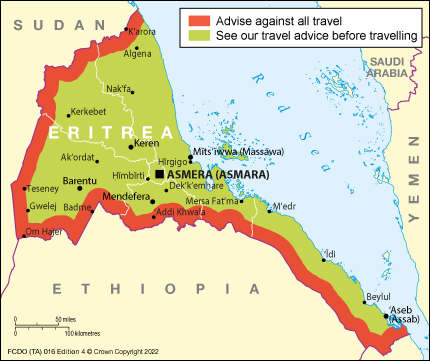
  • We advise against all travel within 25 kms of Eritrea’s border with Ethiopia and Djibouti.  We also advise against travel to Eritrea's border with Sudan, including the town of Tesseney; and in the area north and west of Nakfa, Agordat and Barentu. See the Local Travel section of this advice for more details.

  • The Ethiopia-Eritrea border remains closed and unmarked.  Several security incidents have taken place in recent months along the border, particularly in the areas of Humera, Tsorona and Zalambessa.  Since the relocation out of Eritrea of the UN Peacekeeping Mission (UNMEE) in March 2008 the risk of cross-border tensions increasing and the security situation deteriorating very rapidly remains.  See Local Travel section of this advice for more details.

  • All foreign nationals, including resident diplomats, are required to apply ten days in advance for travel permits to leave Asmara – these are not always granted.  This means that diplomatic staff from the British Embassy are unable to offer emergency assistance to British nationals outside Asmara quickly.  Eritrean authorities have not always informed the relevant Embassy when a foreign national is in need of consular assistance - this potential lack of any assistance outside Asmara is something to take into account fully before travelling.  See the Local Travel (Travel Permits) section and General sections of this advice for more details.

  • Dual British/Eritrean nationals should be aware that, under the Vienna Convention on Consular Relations, the British Embassy is unable to offer assistance in Eritrea.  The Eritrean authorities consider all British nationals holding either Eritrean or PFDJ identity documents (including out of date documents) as Eritrean nationals.

  • 4 British nationals required consular assistance in Eritrea in the period 01 April 2008 – 31 March 2009 for the following types of incident; deaths (1 cases); hospitalisations (0 cases); and arrests, for a variety of offences (0 cases). During this period assistance was also requested with regard to lost or stolen passports (2 cases).

  • The World Health Organisation (WHO) Pandemic Threat Alert Phase has been raised to Level 6. The World Health Organisation website has further details. You should monitor local media reports for any developments and advice. There is a dedicated Swine flu page on the FCO website.  Guidance on Pandemic Flu can be obtained on the UK Department of Health website.  Please see the Health section of the travel advice for further information.

  • There is an underlying threat from terrorism in Eritrea. Attacks could be indiscriminate, including in places frequented by expatriates and foreign travellers.

  • All British nationals travelling to Eritrea should register with the British Embassy in Asmara on arrival.

  • We recommend that you obtain comprehensive travel and medical insurance before travelling.  You should check any exclusions, and ensure that your policy covers you for the activities you want to undertake.  See the General (Insurance) section of this advice and Travel Insurance for more details.

Safety and security

Terrorism


There is an underlying threat from terrorism.  Attacks could be indiscriminate, including in places frequented by expatriates and foreign travellers.  For more general information see Terrorism Abroad.

A number of terrorist incidents have been reported along the border with Ethiopia.

Crime


Street crime such as theft and robbery is relatively rare in Asmara and other cities and towns, but appears to be on an upward trend.  You should take normal and sensible precautions with regard to personal safety. We advise against walking around any town, late at night alone. Valuables, particularly cameras and passports should be kept out of sight.
 
Away from the main towns, crime is also rare but the usual precautions should be taken. 

For more general information see Victims of crime.

Political Situation


Eritrea Country Profile

Local Travel

We advise against all travel within 25 km of the border with Djibouti.  From 10 to 12 June 2008 there was fighting between Djibouti and Eritrea after an incursion of Eritrean forces into the disputed Djibouti border region.  This led to casualties on both sides.  The situation remains unresolved.

We advise against all travel within 25 km of Eritrea’s border with Ethiopia.  It is important to note that in most places the border is neither marked nor obvious.

The Ethiopia-Eritrea border remains closed.  Several security incidents have taken place in recent months along the border, particularly in the areas of Humera, Tsorona and Zalambessa.  Since the relocation out of Eritrea of the UN Peacekeeping Mission (UNMEE) in March 2008 the risk of cross-border tensions increasing and the security situation deteriorating very rapidly remains.

We advice against all travel to Eritrea's border with Sudan, including the town of Tesseney; and the area north and west of Nakfa, Agordat and Barentu.  In October 2009, an attack on  a International Mining Company vehicle to a road 35km north of Keren caused the deaths of one employee and two contractors. A British national was killed in the area west of Agordat in April 2003.  In August 2003, an attack on an NGO vehicle north of Nakfa led to the deaths of two aid workers.

There are extensive mine fields in Eritrea, particularly near the border with Ethiopia. Driving on main roads outside of the border areas is generally safe, though a landmine killed eight and injured several people along the same road in November 2008.  We advise against driving on non-metalled roads and off-road driving.  We also advise against walking or hiking in the countryside for the same reason.

We advise against travelling after dark in rural areas, where road signage/road barriers are scarce and steep drops common.  You should be aware that in many parts of the country roads are difficult or impassable during the rainy season.

Telephone (including mobile) networks are often unreliable and may only work for limited periods a day outside Asmara and larger towns.  You should take this into account when travelling, particularly in rural areas.

Travel Permits

 
All foreign nationals are required to have a travel permit to leave Asmara.  This includes Embassy officials and other foreign nationals resident / working in Eritrea.  Those working outside Asmara are also required to have a travel permit to leave their area of residence or work.  Applications for such travel permits in Asmara are handled by the Department of Protocol of the Ministry of Foreign Affairs (or relevant ministry).  Applications outside Asmara are handled by the local Zoba (Region) Administration Offices.  Permission may take several days to be granted and is sometimes refused or delayed.

Tourists seeking to travel outside Asmara should apply for travel permits at the Ministry of Tourism located on Harnet Avenue in Asmara.  Such permits usually take around 24 hours to process.  There is no guarantee that permits will be issued.

This also means that diplomatic staff from the British Embassy are unable to offer emergency assistance to British nationals outside Asmara quickly. If travel permits were not granted, the British Embassy is unlikely to be able to offer any Consular assistance outside Asmara. The potential lack of any assistance outside Asmara is something you should take into account fully before travelling.
 

Air Travel


There are currently international flights (some direct) from Asmara to Cairo (Egyptair), Frankfurt (Lufthansa), Sana’a (Yemenia), Khartoum (Sudan Airways) and Dubai (Nasair).  Please see the airline websites for specific details on flight schedules, ticketing and other information.

There is currently an airport departure tax of US$20 per passenger, it cannot be paid in Nakfa, unless you hold resident’s permit.  You are advised to convert any excess Nakfa back to hard currency at one of the “Himbol” exchanges in town, as there are limits to what can be converted at the “Himbol” branch at the airport.  To convert Nakfa back to hard currency you will need the original currency transaction receipt.  Nakfa are not convertible outside Eritrea.  The Nakfa is currently pegged at the rate of 15 Nakfa to one US dollar.

For more general information see Airline Security.
 

Sea Travel

 
There have been attacks of piracy and armed robbery against ships in the Horn of Africa area.  Mariners are advised to be vigilant and to take appropriate precautions.
 
Mariners should be aware that permissions and entry visas must be sought in advance before seeking to land in Eritrea. 
 
For more general information see River and Sea Safety.

Local laws and customs

Photography of government buildings and military installations is not allowed.  If in doubt, ask first. 

You are advised to dress modestly, especially in lowland and predominantly Muslim areas. Shorts and T-shirts are likely to draw attention. 

Homosexual behaviour is illegal, although the penalties are unclear. Discretion is advised.

For more general information for different types of travellers see Your trip.

Entry requirements

Visas

 
British nationals need a visa to enter Eritrea. 
 
You should ensure that any necessary travel documentation (including exit visas) remain valid for the duration of your stay.  The Eritrean authorities take breaches of their immigration laws seriously and travellers who have overstayed can face lengthy delays in regularising their position before departure or even detention.
 

Dual Nationals

 
Dual British/Eritrean nationals who enter Eritrea will be classed as Eritrean nationals by the Eritrean authorities.  The British Embassy is unable to gain consular access to or obtain information on such dual nationals if they are detained by the authorities or otherwise in need of assistance.
 
Dual nationals who enter Eritrea on an Eritrean identity card rather than an Eritrean passport should be aware that they are required to obtain an exit visa from the Immigration Office in Asmara before they are able to leave Eritrea.
 

Foreign currency


All foreign visitors are required to declare all foreign currency upon entering the country – filling in a form and showing funds.  There is no limit on the amount that can be brought in. You should ensure that you have had your completed foreign currency declaration form approved and stamped before you leave the airport.

On departure, you will have to show (using your foreign currency declaration form) that any foreign currency missing was exchanged at a branch of “Himbol”, the State foreign currency exchange.  You may face prosecution leading to a heavy fine, as well as a delay to your departure from Eritrea, if you fail to comply with these regulations.

Yellow Fever vaccination certificate


Yellow Fever Vaccination certificates are an entry requirement for all visitors over the age of one year arriving from a country where the disease is present.

Health

A (H1N1) - Swine Flu


Currently there are no reported cases of Swine Flu in Eritrea, however there are cases in neighbouring countries (Ethiopia/Sudan).  Our Embassy in Asmara receives regular updates from local WHO representative.

There is screening on arrival at Asmara airport and all arriving passengers are required to complete a health questionnaire.  If any passenger declares or exhibits flu-like symptoms they are quarantined at the nominationed isolation hospital, Villagio, whilst tests are done to check for the A (H1N1) virus.  There have been a few suspected cases but so far all have been declared infection free and released from isolation.  Currently the swabs are sent back to the UK for testing as there are no facilities to test for the virus in-country.  There are limited stocks of anti-viral medication (Tamiflu) in-country but it is unclear if passengers would have access to these.  The Embassy would not able to provide Tamiflu.

There is no screening on departure.

The World Health Organisation (WHO) has raised its Pandemic Threat Alert Phase to Level 6. The World Health Organisation website has further details. You should monitor local media reports for any developments and advice. There is a dedicated Swine flu page on the FCO website.  Guidance on Pandemic Flu can be found on the UK Department of Health website.

General


There is one private and three public hospitals in Asmara.  Public hospitals here and in other towns are often poorly equipped.  Elsewhere medical facilities are even more limited. If you are travelling away from the large towns, we advise that you carry a comprehensive medical pack with you.

If you are taking prescription medicines, you should ensure that you have a sufficient supply for the length of your stay in Eritrea.

In the 2008 Report on the Global AIDS Epidemic the UNAIDS/WHO Working Group estimated that around 35,000 adults aged 15 or over in Eritrea were living with HIV; the prevalence rate was estimated at around 1.3% of the adult population. This compares to the prevalence rate in adults in the UK of around 0.2%.  You should exercise normal precautions to avoid exposure to HIV/AIDS. For more general information on how to do this see HIV and AIDS.

You should seek medical advice before travelling to Eritrea and ensure that all appropriate vaccinations are up-to-date. For further information on vaccination requirements, health outbreaks and general disease protection and prevention you should visit the websites of  NaTHNaC and NHS Scotland's Fit For Travel or call NHS Direct on 0845 46 47.

For more general health information see Travel Health.

General

Insurance

 
We recommend that you obtain comprehensive travel and medical insurance before travelling.  You should check any exclusions, and ensure that your policy covers you for the activities you want to undertake. You should ensure that your medical insurance covers the cost of air ambulance evacuation out of Eritrea in the event of a serious accident or illness. 
 
Here's how we can help if things go wrong.
 

Consular assistance outside Asmara

 
There are limits to what the British Embassy can do to assist British nationals outside Asmara.   All diplomatic staff in Asmara are required to apply for permission to travel 10 days in advance.  This means that diplomatic staff from the British Embassy are unable to offer emergency assistance to British nationals outside Asmara.  You are advised to take this into account before deciding whether or not to travel to Eritrea.
 
You should be aware that the Eritrean authorities have not always informed the relevant Embassy if a foreign national is in need of consular assistance (for example, if they have been taken into detention or are in need of medical attention).  This applies inside Asmara as well as more widely in the country.
 

Consular registration


Register with our LOCATE service to tell us when and where you are travelling abroad or where you live abroad so our consular and crisis staff can provide better assistance to you in an emergency. 
 

Passports

 
Applications for British passports can be lodged at the British Embassy in Asmara.  However, because all applications are forwarded to the High Commission in Nairobi for processing, the issuing of a full passport usually takes three-four weeks.
 
Emergency passports, good for a single trip back to the United Kingdom, can usually be issued by the British Embassy Asmara within two working days.  You will need to provide satisfactory proof of nationality: we advise that all travellers keep a photocopy of the biodata (photograph and personal details) page of their passport in a safe place or with friends or family in the UK.
 

Money

 
The economy is completely cash-based.  There are no ATMs in Eritrea.  Credit cards are not accepted anywhere except a few hotels such as the Asmara Palace, Sunshine and Crystal hotels.  It is illegal to exchange currency other than at a branch of “Himbol”.  It is illegal to attempt to use foreign currency to make purchases in Eritrea.
 
For more information on bringing currency into and out of Eritrea see the Entry Requirements section of this travel advice.

Share this with:

Contacts

Eritrea, Asmara, British Embassy

Address:

British Embassy
66-68 Mariam Ghimbi Street
Zip Code 174
PO Box 5584
Asmara
Eritrea

Telephone:

(00)(291) 1 20 28 38
(00)(291) 1 20 28 39 
(00)(291) 1 12 22 42

Fax:

(00) (291) 1 12 01 04

Email: Asmara.Enquiries@fco.gov.uk

Office hours:

GMT:
Mon-Thur: 0500-1330
Fri: 0500-0930

Local Time: (GMT + 3  hours)
Mon-Thur: 0800-1630
Fri: 0800-1230
Out of office hours, answering machine gives duty officers contact number

LOCATE: Register with us

Sign-up for travel alerts

Subscribe to receive email alerts for the country of your choice