Advanced search
image
Travel & living abroad

Sub Saharan Africa

Djibouti

Flag of Djibouti
Still current at: 07 November 2009
Updated: 19 August 2009

This advice has been reviewed and reissued. The overall level of the advice has not changed.

(see travel advice legal disclaimer)

Travel advice for this country

Travel Summary

  • The World Health Organisation (WHO) has raised its Pandemic Threat Alert Phase to Level 6. The World Health Organisation website has further details. Check our Swine Flu page for further information.

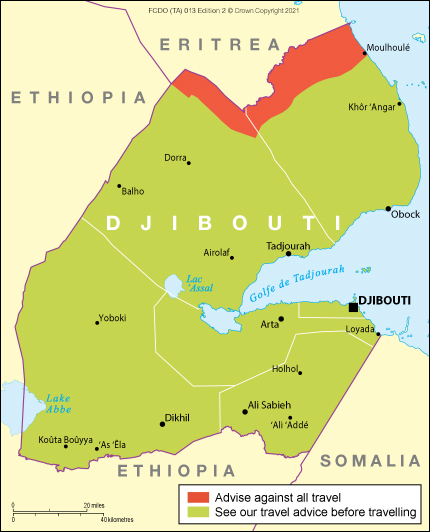
  • We advise against all travel to the border with Eritrea.  From 10 to 12 June 2008, there was fighting between Djibouti and Eritrea after an incursion of Eritrean forces into the disputed Djibouti border region.  This led to casualties on both sides. The situation remains fragile.

  • There is a general threat from terrorism.  Attacks could be indiscriminate, including in places frequented by expatriates and foreign travellers.

  • There is no British Embassy in Djibouti and the Honorary Consul can offer only limited assistance. See the General (Consular assistance) of this advice for more details.

  • The main type of incident for which British nationals required consular assistance in Djibouti in 2008 was replacing lost or stolen passports.  You should be aware of the risk of banditry if travelling outside the capital city.

  • We recommend that you obtain comprehensive travel and medical insurance before travelling. You should check any exclusions, and that your policy covers you for all the activities you want to undertake. See General (Insurance) section of this advice and Travel Insurance for more details.

Safety and security

Terrorism


There is a general threat from terrorism.  Attacks could be indiscriminate, including in places frequented by expatriates and foreign travellers.

For further information see Terrorism Abroad.

Crime


Incidences of petty crime are not uncommon in Djibouti.  We advise against walking around town alone, late at night.  Valuables, particularly cameras and passports should be kept out of sight.

You should be aware of the risk of banditry if travelling outside the capital city.

For more general information see Victims of crime.

Political Situation


Djibouti Country Profile

Local Travel


We advise against all travel to the border with Eritrea.  From 10 to 12 June 2008, there was fighting between Djibouti and Eritrea after an incursion of Eritrean forces into the disputed Djibouti border region.  This led to casualties on both sides. The situation remains fragile.

You should avoid travelling outside of the city after dark, as vehicles often have no lights and livestock may be roaming the roads.

Rail Travel


Sabotage and derailment on the Djibouti/Ethiopia railway occasionally occur. If you intend to travel into the Republic of Djibouti by rail you should check with the British Embassy in Addis Ababa on the current situation before setting off.

Sea Travel


Mariners should be aware that incidents of piracy have been reported in the Red Sea and Gulf of Aden and are advised to exercise vigilance and seek local advice.

For more general information see River and Sea Safety.

Local laws and customs

Djibouti has a predominantly Muslim population and visitors should dress in a conservative manner in the city.  However, it is far less strict than other Islamic countries and use of swimwear at the swimming pool at The Sheraton Hotel and on the islands is unrestricted. Homosexual behaviour is illegal.

French, Arabic and Somali are widely spoken.

For more general information for different types of travellers see Your trip.

Entry requirements

Visas


British nationals require a visa to enter Djibouti. Tourist visas for up to one month can be obtained on arrival at the airport. Visas can also be obtained from the French Embassy in London.

British nationals applying for a Djibouti visa in Ethiopia generally require a letter from the British Embassy in Addis Ababa for presentation at the Djibouti Embassy.  There is a fee for this service payable in local currency.

Travelling with children


Single parents or other adults travelling alone with children should be aware that some countries require documentary evidence of parental responsibility before allowing lone parents to enter the country, or in some cases, before permitting the children to leave the country.  For further information on exactly what will be required at immigration, please contact the French Embassy in London.

Departure Tax


There is a 20 US Dollars departure tax at the airport.

Health

You should drink or use only boiled or bottled water and avoid ice in drinks.  If you suffer from diarrhoea during a visit to Djibouti you should seek immediate medical attention.

HIV/AIDS is widespread in Djibouti. See HIV and AIDS.

You should seek medical advice before travelling to Djibouti and ensure that all appropriate vaccinations are up-to-date. For further information on vaccination requirements, health outbreaks and general disease protection and prevention you should visit the websites of the National Travel Heath Network and Centre NaTHNaC and NHS Scotland's Fit For Travel or call NHS Direct on 0845 46 47.

For more general health information see Travel Health

Avian Influenza


Since early April 2006, Djibouti has had three confirmed cases of poultry deaths from Avian Influenza (Bird Flu).  There has also been one confirmed case of human infection and two further suspected cases.  No human deaths have been reported.

The risk to humans from Avian Influenza is believed to be very low.  As a precaution you should avoid visiting live animal markets, poultry farms and other places where you may come into close contact with domestic, caged or wild birds; and ensure poultry and egg dishes are thoroughly cooked.

The World Health Organisation (WHO) has warned of the possibility that the Avian Influenza outbreaks could lead at some point to a human flu pandemic, if the virus mutates to a form easily transmissible between people.

British nationals living longer term in an Avian Influenza affected regions should take personal responsibility for their own safety in the event of a future pandemic, including considering their access to adequate healthcare and ensuring travel documents are up to date.

You should read this advice in conjunction with Avian and Pandemic Influenza, which gives more detailed advice and information.

General

Insurance


Ensure that you take out adequate medical insurance before arrival and carry a comprehensive medical pack.  Medical insurance should cover the cost of air ambulance evacuation out of Djibouti in the event of serious accident or illness.  You should check any exclusions, and that your policy covers you for all the activities you want to undertake. Read Travel Insurance for more details.

Here is how we can help when things go wrong.

Consular assistance


There is no British Embassy in Djibouti.  The British Embassy in Addis Ababa, Ethiopia is responsible for Britain's relations with Djibouti.

The Honorary Consul in Djibouti, Mr Alain Martinet, can offer only limited assistance.  Most consular cases and renewals of passports are handled by the British Embassy in Addis Ababa, however the Honorary Consul can accept passport applications and forward them to Addis Ababa.

Registration


British nationals living and working in Djibouti should register with the Consulate on first arrival.  Those who are already registered should make sure that their details are kept up to date.

Consular Registration


Register with our LOCATE service to tell us when and where you are travelling abroad or where you live abroad so our consular and crisis staff can provide better assistance to you in an emergency.

Money


Credit cards are accepted at only a very few outlets in Djibouti and it is not possible to obtain currency advances against a credit card.  Visitors should ensure they have an adequate supply of hard currency or travellers' cheques.

Share this with:

Contacts

Djibouti, British Honorary Consul

Address:

British Honorary Consul
P O Box 169
Rue de Djibouti
Djibouti

Telephone:

(00253) (3) 85007

Fax:

(00253) (3) 52543

Email: martinet@intnet.dj

Office hours:

(GMT) Sun – Thurs: 12:00 – 01:00
Local Time: 0900 - 1200

LOCATE: Register with us

Sign-up for travel alerts

Subscribe to receive email alerts for the country of your choice