Advanced search
image
Travel & living abroad

Sub Saharan Africa

Congo (Democratic Republic)

Flag of Congo (Democratic Republic)
Still current at: 11 February 2012
Updated: 27 January 2012
No restrictions in this travel advice Avoid all but essential travel to part(s) of country Avoid all but essential travel to whole country Avoid all travel to part(s) of country Avoid all travel to whole country

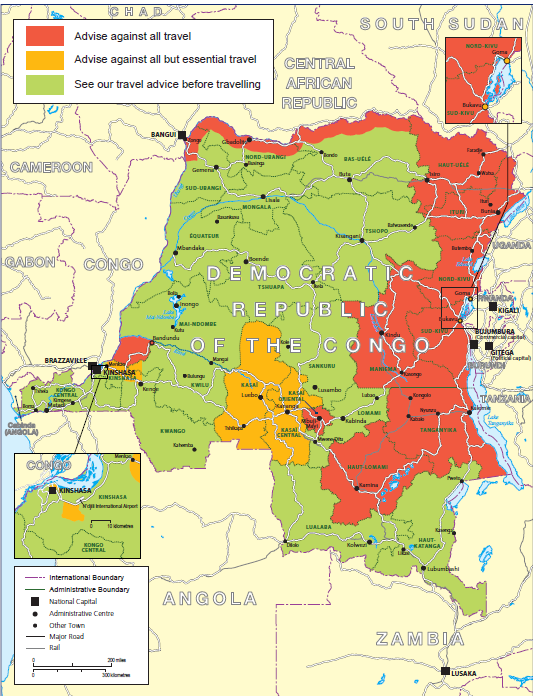
The overall level of the advice has not changed; we advise against all travel to specific regions of DRC and against all but essential travel to the rest of the country.

(see travel advice legal disclaimer)

Travel advice for this country

  • We advise against all travel to eastern and north eastern Democratic Republic of Congo (DRC). We advise against all but essential travel to Kinshasa and the rest of DRC because of continuing tension and insecurity. The situation can deteriorate at very short notice. See Safety and Security - Local Travel.

  • We advise you to be cautious, keep a low profile and avoid any large crowds and demonstrations. Stay alert to local political developments by monitoring local and international media for information about planned demonstrations or any other events which may affect the local security situation.

  • We strongly advise you to register with the British Embassy in Kinshasa so that we can give you better assistance in the event of an emergency. See General - Registering with the British Embassy.

  • You should carefully consider your current security arrangements to   ensure that you and/or your organisation have a comprehensive security plan and adequate guarding. It is strongly advised that you have a stock of food, water, fuel, medicine and other essential items should it be necessary to ‘lock down’ in a safe location for several days.

  • You should have a good understanding of your exit routes and ensure that your passport and other travel documentation is up to date. However in the event of escalating tensions and civil unrest, commercial flights may be suspended at short notice leaving your ability to depart the DRC severely restricted. It is also possible that some airlines will restrict flights over the election period. We therefore advise that you check with the airline before travelling to the airport.

  • Local authorities may impose curfews without warning. Travellers are advised to follow the directives of the local authorities at all times.

  • We advise against all travel to eastern and north eastern Democratic Republic of Congo (DRC). This includes entering DRC from Uganda, Burundi and Rwanda. The only exceptions to this are within the town of Bukavu and Goma, where we advise against all but essential travel. You should avoid entering or leaving DRC overland except via Goma or Bukavu. This is due to continued insecurity and lawlessness in these areas.

  • Military operations by the Congolese army against armed groups in North and South Kivu provinces have led to high numbers of civilians being displaced. See Safety and Security - Local Travel.

  • There is a low threat from terrorism.  But you should be aware of the global risk of indiscriminate terrorist attacks which could be in public areas, including those frequented by expatriates and foreign travellers.

  • Twelve British nationals required consular assistance in Congo (Democratic Republic) in the period 01 April 2010 - 31 March 2011. See General - Consular Assistance Statistics. Robbery, including by individuals posing as plainclothes police, is also common. You should be aware of gangs promising you cut price gold and diamonds. We have received reports of crime targeting international non-governmental organisations (NGOs) in Goma.

  • Take out comprehensive travel and medical insurance before travelling. See General - Insurance.

Safety and Security - Terrorism
There is a low threat from terrorism. But you should be aware of the global risk of indiscriminate terrorist attacks which could be in public areas, including those frequented by expatriates and foreign travellers.

See our Terrorism Abroad page.

Safety and Security - Crime
The global economic downturn has resulted in an increase in crime in DRC. Be alert to the risk of street crime and armed robbery at all times, including being targeted by armed gangs when driving. Foreigners are at particular risk of street robbery in Kinshasa, often in the vicinity of hotels and supermarkets, particularly in the centre of town. Robberies by gangs of street children are increasingly common and becoming more aggressive.

Ensure you lock vehicle doors and keep windows closed when driving. Do not drive off the main thoroughfares or park in unsupervised areas. Some gangs and confidence tricksters use girls to lure the unwary into traps; others promise cut-price gold and diamonds or pose as police or security forces to rob foreigners, including in daylight. Westerners have been robbed of money and mobile telephones in Kinshasa and elsewhere in DRC. There is also a risk of arbitrary arrests of foreigners by security authorities who demand payment for release.

There have been violent and well planned attacks on foreign nationals, including aid workers, in Goma. Take security precautions. Do not walk in the streets alone at any time. Safeguard and avoid displaying valuables and cash. Deposit them in a hotel safe, where practical. Keep copies of documents, including your passport, separately.

See our Victims of Crime Abroad page.

Safety and Security - Local Travel
We advise against all travel to eastern and north eastern DRC. The only exceptions to this are within the towns of Bukavu and Goma, where we advise against all but essential travel. Avoid entering or leaving DRC overland from Uganda, Rwanda or Burundi except via Goma or Bukavu. However, care should still be exercised at these crossing points. Ensure that you have the correct paperwork for entrance. All foreign nationals, including UK nationals, will need a visa issued by the embassy in their country of residence. It is no longer possible to buy a short-term pass to enter the country. See the Entry Requirements section below for more details on applying for a visa.

Although the Congolese insurgent groups in North and South Kivu signed a peace accord with the government in March 2009, some groups remain outside the process and a threat to stability. The Congolese army has been carrying out military operations against armed groups present in North and South Kivu since April 2009. This means that outside of Bukavu and Goma, the security situation remains volatile. Banditry by armed men against NGO convoys travelling out of Goma and Bukavu is a regular occurrence. Even in these two towns, tensions remain and the situation can deteriorate rapidly.

Although gorilla trekking in the Virunga National Park (North Kivu) and Kahuzi Behega National Park (South Kivu) has now re-opened to tourists and Nyiragongo volcano (in Virunga National Park) has also recently re-opened for trekking, we continue to advise against all travel in these areas. Armed groups are still present in both parks. If you do decide to travel, a government permit is essential to enter the Park. You must go through the ICCN (Institute Congolais pour la Conservation de la Nature), who monitor the security situation and accompany visitors in the Park. The ICCN may decide to close the Park to visitors at short notice, depending on the security situation. The ICCN in Virunga Park currently provides an armed escort from the outskirts of Goma to the gorilla trekking site.

The north eastern district of Ituri, near the frontier with Uganda, remains an area of continued inter-factional conflict.  Despite the presence of the UN and the Congolese army violence continues sporadically.

The Lord’s Resistance Army (LRA), a rebel group originating in northern Uganda, is currently operating in north eastern DRC. Military action is ongoing and the situation remains unpredictable and dangerous.  We advise against all travel to north eastern DRC.

Safety and Security - Local Travel - Road Travel
An international driving permit is required to drive in DRC. Car hire with international companies is possible in Kinshasa although self-drive options are limited. Most car hire companies will only rent a car with a chauffeur.

There is no reliable public transport system in DRC. Over-crowded and unroadworthy vans serve as buses in Kinshasa. There are few taxis, available from the large hotels, but these do not meet western safety standards.  Outside Kinshasa and other main cities, most roads are barely drivable even with a 4x4, especially during the rainy season (September to May).

In DRC, be aware of vehicle theft and car-jacking, and take sensible precaution. There has been a spate of car-jackings in Goma in June 2011. You are advised to drive with the doors of your vehicle locked and windows closed at all times. DRC’s security forces operate roadblocks, particularly after dark. If you are asked to produce documents for inspection at a check point, remain in your vehicle and show them through closed windows.

See our Driving Abroad page.

Safety and Security - Local Travel - Rail Travel
The dilapidated state of the railways means that rail travel should be avoided.

Safety and Security - Local Travel - Air Travel
The European Commission has published a list of air carriers that are subject to an operating ban or restrictions within the European Union. This is regularly updated. Check the following link to see whether this will affect your travel - European Commission Transport - Air. The list bans all air carriers certified in the DRC from operations within the EU due to safety concerns. You should avoid flying on these airlines. If you already have a flight booked with any DRC airline you should consult your travel agent.

On 8 July 2011, a Hewa Bora flight crashed on landing at Kisangani airport, killing over 85 people.

On 30 March 2009, the DRC authorities introduced a departure tax of $50 per passenger on international flights and $10 per passenger on domestic flights. Payment of this tax should be made at the time of check-in, before boarding. Passengers and visitors also have to pay $12 to enter the car park at the international airport of N’djili.

For more general information see Airline Security.

Safety and Security - Local Travel - River Travel
The ferry service between Kinshasa and Brazzaville is currently operating, but is subject to cancellation at little notice. It stops running in the late afternoon, and there is no service on Sundays.

Be aware that the boats and ferries, which serve the rivers and lakes, are poorly maintained and often overloaded. Strong currents, shifting sandbanks and poor maintenance contribute to the poor safety record of these services.

See our River and Sea Safety page.

Safety and Security - Political Situation
Democratic Republic of Congo Country Profile

Five years of civil war in DRC officially ended on 29 June 2003, when the Congolese parties to the conflict signed accords sharing military and political responsibilities in a transitional government.  Democratic elections were held on 30 July and 29 October 2006 and the newly elected President was inaugurated on 6 December 2006. During the election period there was armed conflict in Kinshasa, which resulted in civilian casualties. In the months following the elections, there were further public demonstrations related to the political process, some of which turned violent . Protests have in the past spilled over into attacks on international targets. Avoid crowds and popular gathering points, and contact the Embassy if there are signs of trouble.

Following the Presidential and parliamentary elections on 28 November 2011, there is a general risk of further political demonstrations and politically motivated violence. These can turn violent and we advise you to be cautious and avoid any large crowds and demonstrations. Monitor local and international media for further information about planned demonstrations or any other events which may affect the local security situation. The BBC world service broadcasts on 92.6 FM in Kinshasa and 92 FM in Kisangani and Lubumbashi. Radio Okapi broadcasts in French on 103.5 FM. You should also register with the British Embassy in Kinshasa so that we can give you better assistance in the event of an emergency. See General - Registering with the British Embassy.

A heavy United Nations peace keeping presence is deployed in eastern DRC. Since April 2009, the Congolese army has been carrying out operations against foreign and armed groups operating in North and South Kivu province. Large numbers of civilians remain displaced as a result of the conflict and the current military operations in the Kivus. Acts of violence, including killing, rape and looting continue against the civilian population.

Taking photographs in public places (particularly of borders or military installations) risks arrest and detention. Journalists should not conduct interviews or film without the necessary local permits.

For more general information for different types of travellers see our Your Trip page.

Entry Requirements - Visas

All British passport holders need a valid visa to travel to DRC. This must be obtained before travelling. To arrange this, contact the Embassy of the Democratic Republic of the Congo:

45-47 Great Portland Street
London
W1W 7LD

Telephone no: 0207 580 3931

A Rwandan or Ugandan immigration stamp in your passport should not prohibit admission, but you may still experience difficulties on arrival in the DRC via Kinshasa if you do have them. Visitors arriving from the UK have recently experienced problems on arrival at N’djili airport, Kinshasa.

Political instability in eastern DRC can mean that the DRC’s borders with Uganda, Burundi and Rwanda close at short notice. Consult the British Embassy in Kinshasa or the British High Commissions in Kampala and Kigali if in doubt.

The border with Angola can also be subject to closure at short notice. Obtaining visas for Angola in DRC is difficult. You are advised to arrange them before travelling to DRC.

Entry Requirements - Passport Validity
You must hold a valid passport to enter DRC. Your passport must be valid for a minimum period of six months from the date of entry into DRC.

Entry Requirements - Satellite phones, GPS receivers or Military clothing
Be aware that if you are travelling with satellite phones, GPS receivers or military clothing, this could lead to difficulties with the security authorities.

Entry Requirements - Yellow Fever vaccination certificate
A yellow fever vaccination certificate is mandatory and you will be asked to produce one on arrival. You are advised to produce your yellow fever vaccination certificate when applying for your visa to enter DRC.

Medical care in the DRC is extremely limited. The Centre Prive d'Urgence (CPU) clinic in Kinshasa is able to cope with basic health problems and to stabilise a patient after most serious accidents. Outside Kinshasa, western standard medical facilities are practically non-existent. Medical evacuation to South Africa (or elsewhere) is advisable as soon as possible. Ensure that you have comprehensive medical and travel insurance, to include specifically the very high costs of evacuation by air ambulance. Minimum turnaround time for evacuation by air ambulance is 10 hours. If you regularly take medication, bring in a properly-marked supply, sufficient for the time you will be in DRC, with you. You may find it difficult to locate the medicines you need in the country.

Malaria, rabies, polio, meningitis and cholera are common in DRC.  Since June 2011, an outbreak of cholera has been reported in Kinshasa, South Kivu and Bandundu. If you suffer from diarrhoea during a visit to the DRC seek immediate medical attention. Further information can be found on the NaTHNaC website.

Since September 2010, over 67,000 cases of measles have been reported across the DRC including South Kivu, Katanga, Bas-Congo, Equator, Orientale, Kasai Occidental and Kasai Oriental.  

On 7 July 2010, the first case of polio in the DRC for over a year was reported; this case was recorded in the south west of DRC, near the Angolan border. The World Health Organisation verified this report.

An outbreak in of African Sleeping Sickness (Trypansomiasis) has been reported by Medecins Sans Frontieres in the Haute- Uele district of North Eastern DRC. Sleeping Sickness is spread by the Tsetse Fly, insect bite avoidance measures are essential if travelling to North Eastern DRC. The symptoms of sleeping sickness include confusion, poor coordination, and disturbance of the sleep cycle. If left untreated this disease is fatal. Since September 2010, over 300 cases of measles have been reported in South Kivu and Katanga.

Plague is endemic in North Eastern Province Orientale. There have been recent reports of incidents of plague in Djugu territory.

In December 2008 and January 2009, an outbreak of Ebola haemorrhagic fever was reported in West Kasai province (southern DRC).  Ebola is a severe and often fatal disease. The likelihood that you will contract Ebola is low unless there has been direct contact with the blood or body fluids of an infected person, or with objects, such as needles, that have been contaminated with body fluids.  Avoid all contact with infected patients and avoid any contact with ill or dead animals.  

Large numbers of cases of acute watery diarrhoeal syndrome were reported among people living in camps for internally displaced people in North Kivu province (east DRC) since September 2008. In many instances these have been fatal.  

A suspected case of viral haemorrhagic fever has been reported in the Isiro district in March 2011.

Monkey pox occurs in DRC.  The monkey pox virus is usually transmitted to humans from infected ground squirrels and rodents.  Symptoms include a fever, the appearance of pus-filled blisters all over the body, and lymph node swelling. You should avoid contact with people suffering these symptoms and with animals.

You should exercise normal precautions to avoid exposure to HIV/AIDS. See our HIV and AIDS page.

Seek medical advice before travelling to DRC and ensure that all appropriate vaccinations are up-to-date. For further information on vaccination requirements, health outbreaks and general disease protection and prevention you should visit the websites of the National Travel Heath Network and Centre NaTHNaC and NHS Scotland's Fit For Travel or call NHS Direct on 0845 46 47.

See our Travel Health page.

Natural Disasters - Volcanoes
In January 2002, Mount Nyiragongo volcano in the north east of the country (20 km from Goma) erupted.  A lava flow reached populated areas in Goma, killing 47 people and leaving over 120,000 people homeless.  

Mount Nyiragongo is still live and local authorities, the UN and local NGOs continue to monitor its activity. If you are in the area (against our travel advice) then you should follow local advice.

Natural Disasters - Earthquakes
Earthquakes occasionally occur in DRC. The last occurred in Eastern DRC on 9 June 2009 and measured approximately 5.0 on the Richter scale.

General - Insurance

You should take out comprehensive travel and medical insurance before travelling. The cost of medical repatriation from DRC to the UK is extremely high. You should check any exclusions, and that your policy covers you for all the activities you want to undertake. See our Travel Insurance page.

If things do go wrong when you are overseas see our When Things Go Wrong page.

General - Consular Assistance
The lack of reliable air transport and continued insecurity may prevent the British Embassy in Kinshasa from being able to extend normal levels of consular assistance to British nationals anywhere in DRC other than Kinshasa.

If you do decide to visit or work in DRC you should have your own evacuation plan, to regularly review its viability in the light of changing circumstances, and to provide details of it to the British Embassy at ambrit@fco.gov.uk. You should factor in the possibility that, in the event of escalating tensions and civil unrest, commercial flights may be suspended at short notice leaving your ability to depart the DRC severely restricted.

You should carefully consider your current security arrangements. You should ensure that you and/or your organisation have a comprehensive security plan with adequate guarding and other security arrangements.  

You should ensure that your passport and other travel documentation are up to date.  

You should also ensure you have a stock of food, water, fuel, medicine and other essential items should it be necessary to ‘lock down’ in a safe location for several days.

General - Consular Assistance - Statistics
Twelve British nationals required consular assistance in Congo (Democratic Republic) in the period 01 April 2010  31 March 2011 for the following types of incident; four deaths and three arrests.

General - Registering with the British Embassy
We strongly advise you to register with the British Embassy in Kinshasa if you are visiting or are resident anywhere in the DRC. You can do so in person or, if you prefer, via our secure online registration service at: Consular Online Registration on the FCO website or with our LOCATE service. Notwithstanding our inability to guarantee consular assistance and advice against travel in the east, we would strongly recommend you to register and give us your contact details if you intend to visit DRC, so that we can pass on information that may be of use to you concerning the security situation in your area. You should also consider having a residents visa for the Democratic Republic of Congo if you are planning to stay in the DRC for a considerable period of time. British passport holders do not require a visa for Rwanda.

General - Emergency Passport service

The British Embassy in Kinshasa offers only an Emergency Passport (EP) service. EPs are issued for emergency travel only and are valid for a single journey back to your destination. EPs are not recognised in all countries, so refer to the Embassy for further information. The Embassy provides a full replacement passport service via the British High Commission in Nairobi. This can take up to six weeks, unless you are prepared to meet courier costs. Details on forthcoming changes to passport processing can be found on our website: www.ukindrc.fco.gov.uk.


General - Mobile phones and internet

DRC has a GSM network on which most dual-band (or better) UK mobile phones will work. And 3G coverage in many of the main towns, on which some Blackberries will work. Coverage is not complete. If in doubt, contact your UK service provider. Local ‘pay as you go’ SIM cards are available.  Internet cafes are common in the main towns and cities, although dependent on electricity supply.

General - Money
The British Embassy cannot provide emergency cash advances to UK nationals. You are should have arrangements in place before leaving the UK to have funds sent to you in case of need. Some brands of credit cards are accepted in Kinshasa. If you have a card which can be used in the country, consider bringing it with you. The currency in DRC is the Congolese Franc but US Dollars are widely used. US Dollars should be presented in good condition and issued post-2001 or they will not be accepted or changed at  banks. There are a number of ATMs that dispense US dollars in Kinshasa. Please take normal security precautions when withdrawing money. Western Union and other money transfer agencies are present in most main towns across the DRC.

Contacts

Congo (Democratic Republic), Kinshasa, British Embassy

Address:

British Embassy
Kinshasa
Democratic Republic of the Congo
BFPO 5319

Telephone:

+243 (0) 815566200

Fax:

(243) 813 46 4291

Email: mailto:ambassade.britannique@fco.gov.uk

Office hours:

GMT:
Mon-Thur: 0630-1500
Fri: 0630-1300

Local Time:
Mon-Thur: 0730-1600
Fri: 0730-1400
Out of hours, Embassy answer machine gives a contact number

Website: http://ukindrc.fco.gov.uk/en/

register
 
register
 
 
Facebook - British abroad
 
 
Overseas Business Risk