Chad |
|
| Still current at: 12 February 2012
Updated: 17 January 2012 |
| No restrictions in this travel advice | Avoid all but essential travel to part(s) of country | Avoid all but essential travel to whole country | Avoid all travel to part(s) of country | Avoid all travel to whole country |
Safety and Security - Terrorism
There is an underlying threat from terrorism and kidnapping. Attacks could be indiscriminate, including in places frequented by expatriates and foreign travellers. There have been a number of kidnappings in eastern Chad involving NGO workers and business people. You should exercise a high level of vigilance and extreme caution at all times
You should be aware that the long-standing policy of the British Government is not to make substantive concessions to hostage takers. The British Government considers that paying ransoms and releasing prisoners increases the risk of further hostage taking.
See our Terrorism Abroad page.
Safety and Security - Crime
Incidents of petty theft and theft from vehicles occur. You should take sensible personal security precautions. We recommend that you avoid carrying valuables or wearing jewellery in public and avoid isolated or poorer areas of towns. You should avoid walking around and travelling at night.
There are also reports of armed robbery, sometimes targeting expatriates. Highway bandits are known to operate in Chad. There is a high level of banditry, often involving excessive violence, throughout eastern Chad.
See our Victims of Crime Abroad page.
Safety and Security - Local Travel
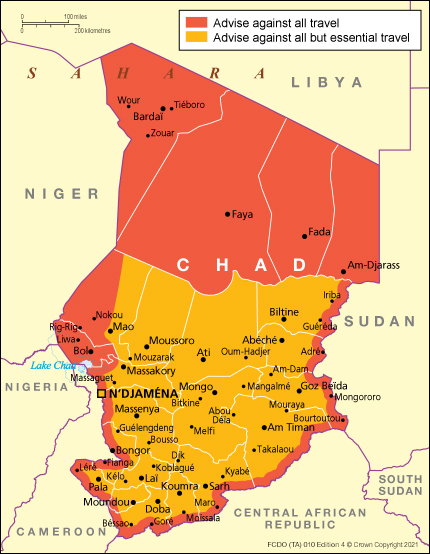
We advise against all but essential travel to the capital, N'Djamena and against all travel to other regions in Chad. If you decide to travel to Chad, you should exercise caution, seek local advice regularly, where possible, check this travel advice regularly and ensure you register with the British High Commission in Yaoundé, Cameroon. If you are in Chad you should remain vigilant at all times and in particular, avoid travelling at night. There is no British Embassy in Chad. If you are not registered with the British High Commission in Yaoundé, Cameroon, you should register on-line at LOCATE or contact the the main switchboard, 00 237 22 22 05 45.
As a result of the conflict in Darfur and inter-ethnic violence in the region, over 280,000 Sudanese refugees and 180,000 internally displaced persons (IDP) live in and around camps in eastern Chad. Whilst the humanitarian situation is still grave and the security situation remains unpredictable, there is increased stability in the east due to the improved security by the Joint Border Force between Sudan and Chad. There has been a steady increase of voluntary IDP returns (nearing 50,000) as a result of this improved stability. However, banditry in eastern Chad, with acts of violent crime being committed including robbery, rape, kidnap and murder, whilst lessening, still exists. The border between Chad and Sudan is subject to closure at little notice.
The area bordering Libya is subject to closure, heavily land-mined and the Borkou-Ennedi-Tibesti provinces in the north remain unsafe. As a result of the conflict in Libya an influx of almost 100,000 Chadian citizens fleeing back into Chad has created a new humanitarian and security situation. The border areas with Central African Republic (CAR) in the south are to be avoided, and the tri-border area where Chad, Sudan and CAR meet is particularly dangerous.
Safety and Security - Local Travel - Road Travel
You should avoid all travel to eastern Chad, where there has historically been rebel activity and there is a risk of indiscriminate banditry. The area is also renowned for its roadblocks, which are frequently used to facilitate car-jackings, some of which have proved fatal.
For travel outside the capital, you require authorisation from the Ministry of the Interior, which is normally granted without difficulty after a few days. But roads are poor and often impassable during the rainy season (July-October), especially in the south. Heavy rains can result in major flooding in many areas, particularly in the south and east. You should travel in convoy, keep doors locked and carry spare fuel and supplies. Due to the activity of highway bandits, you should not travel by road after dark. Police checkpoints are common: you may be asked to show your passport, driving licence and vehicle registration documents.
See our Driving Abroad page.
Safety and Security - Local Travel - Sea Travel
The European Commission has published a list of air carriers that are subject to an operating ban or restrictions within the European Union. You should check the following link to see whether this will affect your travel - European Commission Transport - Air.
For more general information see Airline Security.
Safety and Security - Political Situation
Chad Country Profile
Sudan and Chad had maintained diplomatic relations even throughout their proxy war. The last clashes were in 2009 between the Chadian army and armed rebels, around Am-Dam and the Goz-Beida area in eastern Chad. However, on 15 January 2010, the two countries signed agreements to normalise relations and jointly police their common border. The Chadian leader, President Deby, visited Sudan in February as a sign of commitment to the new pact.
Following the closer co-operation between the two Governments, including joint border patrols, the risk of organised rebel activity has diminished but the threat of indiscriminate banditry has increased in eastern Chad. Although the likelihood of significant rebel activity has fallen, the political and security situation remains uncertain, and could change rapidly.
Throughout the country but in particular the capital N’Djamena, you should exercise caution and vigilance, and avoid political rallies or other large public gatherings.
Local laws reflect the fact that Chad is a predominantly Muslim country. You should respect local traditions, customs, laws and religions at all times and be aware of your actions to ensure that they do not offend other cultures or religious beliefs, especially during the holy month of Ramadan or if you intend to visit religious areas. See Travelling during Ramadan page.
Penalties for the use and possession of drugs are severe and usually include a prison sentence.
Homosexuality is not widely accepted in central African society and some sexual acts between members of the same sex are illegal.
Photography of military sites, government buildings and airports is prohibited. Other photography requires a government permit.
You should carry identification at all times (either a residence permit and/or a certified copy of your passport). Failure to produce such identification can lead to detention by the police, or delays with nationality identification should you have to leave the country.
For more general information for different types of travellers see Your trip.
Entry Requirements - Passport validity
Your passport must be valid for six months from the date of entry into Chad.
British nationals require a visa to visit Chad. To apply for a visa and to obtain further information on entry requirements, please contact the Chadian Embassy in Belgium at 52 Boulevard Lambermont, 1030, Brussels, Tel: +32 2 215 1975, Fax: +32 2 216 3526, Email: ambassade.tchad@chello.be; or the Chadian Embassy in France at 65 rue des Belles Feuilles, 75116, Paris, Tel: +33 (0)1 45 53 36 75, Fax: +33 (0)1 45 53 16 09.
Entry Requirements - Yellow Fever vaccination certificate
You will be asked to produce a yellow fever vaccination certificate on arrival in the country. Failure to do so may result in a further vaccination being administered, for which a charge is made.
Entry Requirements - Travelling with children
For information on exactly what will be required at immigration please contact the Chadian Embassy in Belgium at 52 Boulevard Lambermont, 1030, Brussels, Tel: +32 2 215 1975, Fax: +32 2 216 3526, Email: ambassade.tchad@chello.be; or the Chadian Embassy in France at 65 rue des Belles Feuilles, 75116, Paris, Tel: +33 (0)1 45 53 36 75, Fax: +33 (0)1 45 53 16 09.
Medical facilities in Chad are poor. Hospitals in N’Djamena are sometimes affected by strikes by Government workers. You need to keep in mind the possibility that medical services, stretched at the best of times, may be even less responsive than usual.
Malaria and water-borne diseases are common in Chad and the country is continuing to suffer from a Cholera outbreak with over 10,000 reported cases and over 300 deaths so far in 2011. Meningitis outbreaks can occur throughout Chad, and are especially common in the south of the country, which lies within the African meningitis belt stretching from Senegal to Ethiopia.
You should drink or use only boiled or bottled water and avoid ice in drinks. Food purchased from local street vendors may not meet adequate hygiene standards.
If you suffer from diarrhoea during a visit to Chad you should seek immediate medical attention.
In the 2010 Report on the Global AIDS Epidemic the UNAIDS/WHO Working Group estimated that around 180,000 adults aged 15 or over in Chad were living with HIV; the prevalence percentage was estimated at around 3.4% of the adult population compared to the prevalence percentage in adults in the UK of around 0.2%. You should exercise normal precautions to avoid exposure to HIV/AIDS. See our HIV and AIDS page.
You should seek medical advice before travelling to Chad and ensure that all appropriate vaccinations are up-to-date. For further information on vaccination requirements, health outbreaks and general disease protection and prevention you should visit the websites of the National Travel Health Network and Centre (NaTHNaC) and NHS Scotland’s Fit for Travel or call NHS Direct on 0845 46 47.
The World Health Organisation (WHO) Pandemic Threat Alert Phase has been raised to Level 6. The WHO website at http://www.who.int/csr/disease/swineflu/en/index.html has further details. Check the FCO Swine Flu page for further information.
See our Travel Health and Pandemic and Avian Influenza pages.
General - Insurance
You should take out comprehensive travel and medical insurance before travelling. Check for any exclusions, and that your policy covers you for all the activities you want to undertake. See our Travel Insurance page.
See our
When Things Go Wrong
page.
General - British representation
There is no British Embassy in Chad. In an emergency, you can obtain consular assistance from the British Honorary Consul in N’Djamena:
Steve Banks
Honorary Consul
N’Djamena, Chad
Tel: +235 90546447 (during working hours)
Email: sbanks@pmbx.net
The nearest diplomatic mission is in Yaoundé, Cameroon – British High Commission in Yaoundé, Cameroon.