Advanced search
image
Travel & living abroad

Sub Saharan Africa

Central African Republic

Flag of Central African Republic
Still current at: 11 February 2012
Updated: 23 December 2011
No restrictions in this travel advice Avoid all but essential travel to part(s) of country Avoid all but essential travel to whole country Avoid all travel to part(s) of country Avoid all travel to whole country

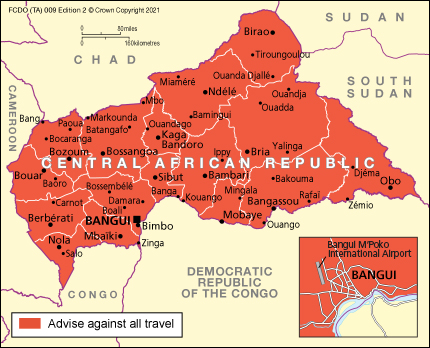
This advice has been reviewed and reissued with amendments to the Travel Summary and the Health section (cholera outbreaks).The overall level of the advice has not changed; there are no travel restrictions to the capital, Bangui, but we advise against all travel to Vakaga and Bamingui-Bangoran provinces in the north east and Mbomou and Haut Mbomou provinces in the south east. We advise against all but essential travel to Ouham Péndé, Ouham and Nana-Gribizi provinces in the west and Haute-Kotto province in the north.


(see travel advice legal disclaimer)

Travel advice for this country


  • We advise against all travel to Mbomou and Haut Mbomou provinces in the south east of CAR and Bamingui-Bangoran and Vakaga provinces in the north east due to the ongoing threat from armed groups. See Safety and Security - Local Travel .

  • We advise against all but essential travel to Ouham Péndé, Ouham and Nana-Gribizi provinces in the West and Haute-Kotto province in the north of CAR due to rebel activity and rivalry between armed groups. See Safety and Security - Local Travel .

  • There are no travel restrictions for the capital Bangui. However, early June 2011 saw outbreaks of violence in Bangui resulting in government-imposed curfews in the city. We advise you to take care and be vigilant when in crowded places and observe any local curfews or movement restrictions.

  • Recent outbreaks of cholera were reported in villages along the Oubangui River, 80 kilometres south of Bangui. For more details see Health.

  • There is no British Embassy in the CAR. There is an Honorary Consul, based in Bangui who will be able to offer consular assistance. See General - British Representation .

  • There is a low threat from terrorism  in the Central African Republic (CAR). You should be aware of the global risk of indiscriminate terrorist attacks which could be in public areas, including those frequented by expatriates and foreign travellers.

  • You should take out comprehensive travel and medical insurance before travelling. See General - Insurance .

Safety & Security - Terrorism
There is a low threat from terrorism.  But you should be aware of the global risk of indiscriminate terrorist attacks which could be in public areas, including those frequented by expatriates and foreign travellers. See our Terrorism Abroad page.

Safety and Security - Crime
Recently in Bangui there have been attacks on some Europeans on the scenic walk up on the hill past the French Lycée. These attacks have been initiated by one man (although he may have an accomplice) which resulted in robbery and physical injury to the victims. Extra care and vigilance must be taken in this area, preferably staying closer in a group. Please be mindful on what you need to carry when out jogging or hiking.

Incidents of theft and robbery occur regularly and armed gangs are known to operate in the outlying areas of Bangui. Take personal security precautions and maintain a high level of vigilance in public places. You should avoid carrying valuables or wearing jewellery in public. You should avoid isolated or poorer areas of towns and walking alone at night.

In the past there have been strikes and demonstrations in Bangui. Even peaceful protests have the ability to turn violent. You should avoid all political rallies, demonstrations and large public gatherings.

See our Victims of Crime Abroad page.

Safety and Security - Local Travel
There are no travel restrictions to the capital Bangui. If you must travel outside Bangui, you should first check on the current situation in the areas through which you plan to travel.

In early June 2011 there were outbreaks of violence in north western Bangui. Media reports suggested that violence against the Muslim community was committed in response to the deaths of two children. This included the burning, and looting of Muslim homes in Bangui and the deaths of 11 local inhabitants. The authorities imposed curfews between 17:00 and 06:00 local time in the 3eme, 5eme and 6eme arrondissements (districts). British nationals should take extra care and to be vigilant when moving around Bangui. They should also obey any local authority travel restrictions such as curfews, and in the event of violence monitor state radio announcements.

We advise against all travel to:

Vakaga Province: There was renewed violence in the North East centred on the regional Capital Birao in November 2010, which saw rebels briefly take control of the town.  Despite government forces resuming  control, we advise against all travel to the region due to the deteriorating security situation. In March 2008 a well marked NGO vehicle travelling in convoy was fired upon by armed assailants, killing one patient. In November 2009 two French aid workers were abducted from Birao at gunpoint.

Bamingui-Bangoran province: Heavy fighting broke out in November 2009 when rebel forces attacked the town of Ndele. During the course of the attack there are reports of violence against the civilian population by rebels. Ndele and the surrounding province remain unstable with fighting between rebel groups and government forces.

Mbomou & Haut Mbomou Province: Since March 2008, there continue to be credible reports of periodic incursions into South East of CAR by the Lord's Resistance Army (LRA). There have been reports of LRA raids on towns and roads around the provincial capital Obo despite government troops present there. On 21st September 2009 a truck carrying aid workers was attacked on the road between Mboki and Obo and 8 passengers were killed. On 19th February 2010 a raid was carried out in Rafäi abducting around 30 people. There were reports of attacks carried out by the LRA in Birao, north of the country in October 2010.

We advise against all but essential travel to Ouham, Ouham-Péndé, Nana-Gribizi and Haute-Kotto provinces as there are ongoing media reports of rebel activity and hostage-taking.

There is an Honorary Consul in Bangui, should you require assistance during an emergency you can contact him using the details shown under the British Representation section.

You should be aware that the ability of the nearest British High Commission, in Yaoundé, Cameroon, to assist you in the event of an incident would be constrained by the remoteness of the region and the lack of communications.

Safety and Security - Road Travel

You may find local travel difficult especially during the wet season May to November. Roads are poorly maintained and most require a four-wheel drive vehicle. You should keep a private supply of fuel available if possible and carry supplies with you if travelling outside Bangui.

Illegal road blocks operate in remote areas where you may be forced to hand over money or possessions in order to continue your journey. You should also be aware of indiscriminate and violent attacks on travellers in remote areas. There are reports of vehicles being fired upon and passengers killed or injured. In many of these cases victims have been robbed or taken hostage and vehicles taken or burnt.

You should seek local advice before travelling and we recommend that you do not travel after dark.

See our Driving Abroad page.

Safety and Security - Air Travel
The EU has published a list of air carriers that are subject to an operating ban or restrictions within the community.  You should check the following link to see whether this will affect your travel plans - European Commission Transport - Air.

There is a Departure Tax of 10.000 CFA per person when leaving the Central African Republic (CAR) on International flights from Bangui airport.

For more general information see Airline Security.

Safety and Security - Political Situation

Central African Republic (CAR) Country Profile
In May 2005, General François Bozizé Yangouvounda was elected as President, having taken power in a coup in 2003. The elections were widely accepted as representative of the will of the people. An inclusive political dialogue in December 2008 between the government, rebels and political opposition led to a unity government being formed in January 2009. Despite this the security situation in CAR is unstable with sporadic fighting between armed groups and government forces across the country. There remains an absence of state authority or rule of law outside of the capital, Bangui.

Elections took place in January 2011, which saw Francois Bozize retain his Presidency. There has seen some contest to the election results by opposition groups, which although non-violent has heightened political tensions in Bangui. You should remain abreast of local political conditions and avoid all political rallies, demonstrations or large public gatherings.

British nationals in CAR who have not registered on LOCATE or have not made contact with the Honorary Consul should do so now.


You should carry identification at all times (either a residence permit or a certified copy of your passport).  Failure to produce such identification can lead to detention by the police.

Penalties for the use and possession of drugs are severe.

The purchase of diamonds or precious stones is prohibited except through those agents authorised by the government.  All cultural artefacts are subject to an export tax.

Caution and discretion must be used in the taking of photographs in public places, as permission is often required.  Taking photos of government property, uniformed law and enforcement Officers, military installations and personnel, may lead to detention, subsequent fines and the impounding of cameras.  The taking of any photographs which the Central African Republic (CAR) authorities deem as damaging the image of Central African Republic (CAR) (such as street urchins, people with handicaps/deformities) is also not permitted.  The situation is more relaxed outside of the capital, where people are generally open to having their picture taken, but it is always advisable to ask first.  A permit may be obtained for the more serious photographer from the Ministry of Tourism.

Satellite telephones should be registered [fee applicable] with the Bangui or regional Agence chargée de la Régulation des Télécommunications (ART) Government Telecommunication offices.

Homosexuality is not widely accepted in Central African society and some sexual acts between members of the same sex are illegal.

See our Your trip page.

Entry Requirements - Visas
British nationals need a visa to visit Central African Republic (CAR).  To apply for a visa and to obtain further information on entry requirements, please contact the Embassy of Central African Republic in Paris at 30 rue des Perchamps, 75116 Paris.

Entry Requirements - Yellow Fever vaccination certificate
You will be asked to produce a yellow fever vaccination certificate on arrival in the country.  Failure to do so may result in a further vaccination being administered, for which a charge is made.

Entry Requirements - Passport validity
Your passport must be valid for six months from the date of entry into Central African Republic.


Entry Requirements - Travelling with children

For information on exactly what will be required at immigration please contact the Embassy of the Central African Republic in Paris.

Medical facilities are extremely limited and strikes by government workers have affected medical services and hospitals. You should ensure that you are covered for medical evacuation by air ambulance.

Outbreaks of cholera were reported in villages along the Oubangui River, 80 kilometres south of Bangui during October. Malaria and water-borne diseases to occur in CAR and meningitis outbreaks occur during the six-month dry season that starts in December, especially in the country's north, which lies within the African meningitis belt stretching from Senegal to Ethiopia.

You should drink or use only boiled or bottled water and avoid ice in drinks. Food purchased from local street vendors may not meet adequate hygiene standards. If you suffer from diarrhoea during a visit to Central African Republic (CAR) you should seek immediate medical attention.

In the 2010 Report on the Global AIDS Epidemic the UNAIDS/WHO Working Group estimated that around 110,000 adults aged 15 or over in Central African Republic were living with HIV; the prevalence percentage was estimated at around 4.7% of the adult population compared to the prevalence percentage in adults in the UK of around 0.2%. You should exercise normal precautions to avoid exposure to HIV/AIDS. See our HIV and AIDS page.

Seek medical advice before travelling to Central African Republic (CAR) and ensure that all appropriate vaccinations are up-to-date. For further information on vaccination requirements, health outbreaks and general disease protection and prevention visit the websites of the National Travel Health Network and Centre (NaTHNaC) or NHS Scotland’s Fit for Travel or call NHS Direct on 0845 46 47.

See our Travel Health page.

General - Foreign Currency
In CAR the Euro currency [rather than US Dollars] is preferred and easily exchangeable at a fixed rate to the Central African Franc – CFA. Travellers cheques may be exchanged at the banks.

There are no international ATM machines and very few premises including hotels accept major international credit or debit cards.

General - Insurance
You should take out comprehensive travel and medical insurance before travelling. Check for any exclusions and that your policy covers you for all the activities you want to undertake. See our Travel Insurance page.

If things do go wrong when you are overseas then see our When Things Go Wrong page.

General - Registration
You should register with our LOCATE service to tell us when and where you are travelling abroad or where you live abroad so our consular and crisis staff can provide better assistance to you in an emergency.


General - British Representation
There is no British Embassy in the CAR.  However, there is an Honorary Consul, based in Bangui,
 

Mr Mark Pearson
Honorary Consul Central African Republic
Cell: + 236 75 561 456
Home: + 236 75 563 536
E-mail: Mark.LindsayPearson-HonCon@fconet.fco.gov.uk


The nearest British diplomatic mission is the British High Commission in Yaoundé, Cameroon.
 
In an emergency, the French Embassy in Bangui may also be able to offer some consular assistance (tel +236 613 000; +236 610 584).

register
 
register
 
 
Facebook - British abroad