Cameroon |
|
| Still current at: 12 February 2012
Updated: 17 January 2012 |
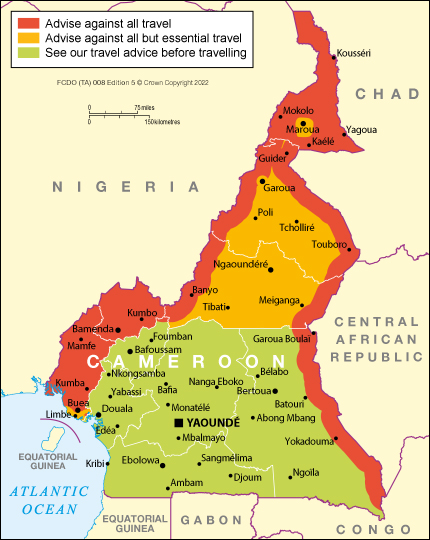
| No restrictions in this travel advice | Avoid all but essential travel to part(s) of country | Avoid all but essential travel to whole country | Avoid all travel to part(s) of country | Avoid all travel to whole country |
There have been attacks on commercial shipping vessels in the Gulf of Guinea, including the coastline of Cameroon around the Douala port. Extreme caution should be exercised in these areas when travelling in coastal waters. We advise mariners to take appropriate precautions.
There has been an outbreak of meningitis in the Far North with an unconfirmed 1,500 cases reported. For more details see Health.
Most visits to Cameroon are trouble-free, only a small number of British nationals have required consular assistance in the past year, mostly for lost or stolen passports. However, we are aware of an increase in violence in the Limbe area of Cameroon and incidents of armed robbery involving taxis hailed from the roadside in Yaoundé. You should remain vigilant at all times. See Safety and Security - Crime.
There is a low threat from terrorism. But you should be aware of the global risk of indiscriminate terrorist attacks which could be in public areas, including those frequented by expatriates and foreign travellers.
You should take out comprehensive travel and medical insurance before travelling. See General - Insurance.
Safety and Security - Terrorism
There is a low threat from terrorism. But you should be aware of the global risk of indiscriminate terrorist attacks which could be in public areas, including those frequented by expatriates and foreign travellers. See our Terrorism Abroad page.
On 16 November 2010 at least five people were killed in an attack on an offshore oil platform off the Bakassi Peninsula. On 7 February 2011 the Mbanjo Maritime Gendarmerie Brigade post was attacked from the sea killing two people and injuring a third. We advise against all travel to this region.
Incidents of mugging and banditry, often armed, are a serious problem throughout Cameroon but of prevalence in Yaoundé, Douala and Limbé.. There have been attacks in the Mont Febe area of Yaoundé; we do not advise going there alone. Avoid isolated or poorer areas of town (for example in Yaoundé, La Briquetterie and Mokolo; in Douala, Akwa, Bonaberi and Village.) Take personal security precautions, for example by avoiding the streets at night, and as far as possible, go out in the company of others. Trouble could flare up unexpectedly, for example at football matches, so vigilance in public places should be maintained. Ensure car doors are locked when travelling; avoid wearing jewellery; and carry the minimum in cash and valuables with you.
There have been reports of criminal gangs, some armed, operating in Douala, Yaoundé and Limbe and in the nearby towns of Buea and Tiko.
Close and lock all residential doors and windows, including those above ground level, particularly at night. It is advised that burglar proof metal bars be installed in rented homes before signing contracts. Identify callers through spy holes before opening doors, especially late at night.
Petty theft is common on trains, coaches and bush taxis and around bus stations. Take precautions when using city taxis as many do not comply with basic safety procedures such as seatbelts or general road worthiness. There have also been reports of violent assaults and robberies on taxi passengers. Only use authorised taxis. Many hotels or restaurants are able to call a private authorised taxi for customers.
Car jackings and robberies, often armed and sometimes accompanied by violence have occurred along roads close to Cameroon’s eastern border with Central African Republic (CAR) and Chad, and along Cameroons north-western border with Nigeria. There have been serious incidents of car hijacking and robbery, resulting in deaths, along the Bamenda-Banyo and Bafoussam-Banyo roads in the north-west. Attacks have also occurred on the Bafoussam-Doula and Bafoussam-Yaounde roads. Thefts from vehicles have been reported in Limbé, Douala, Yaoundé, Kribi, and Maroua. There have been incidents of kidnapping and hostage taking in the North and Far North of Cameroon although foreigners do not appear to have been targeted. You should be aware that the long-standing policy of the British Government is not to make substantive concessions to hostage takers. The British Government considers that paying ransoms and releasing prisoners increases the risk of further hostage taking. You should plan your journey carefully and travel in convoy, where possible. Since mobile phone coverage is limited you should consider taking a VHF radio or satellite phone.
Foreign visitors and residents in Cameroon are often targets of scam artists. The scams come in many forms, and victims can be subject to significant financial loss. Scammers are also targeting individuals in the UK via websites, chat-rooms and by email with the intention of soliciting money from victims. . Cases involving the alleged adoption of children have also been reported. Be very cautious about sending money or travelling to Cameroon to adopt a child where the information has come from a website or through emails. Cameroon does not have adoption agencies. Many victims are persuaded to part with large amounts of money before they start to suspect anything. Schemes in operation by West African criminal networks are designed to facilitate victims parting with money, known as advance fee or 419 fraud. For further information on advance fee fraud please see Metropolitan Police Service - Fraud Alert.
If you are concerned about someone who has travelled to Cameroon you should contact the Consular Section of the British High Commission, Yaoundé: (consularenq.yaounde@fco.gov.uk).
See our Victims of Crime Abroad page.
Safety and Security - Local Travel
Register with the British High Commission in Yaoundé if you intend to stay longer than one month.
Safety and Security - Local Travel - Bakassi
We advise against all travel to the area bordering Nigeria in the region of the Bakassi Peninsula. Cameroon and Nigeria reached an agreement on the future of Bakassi, which was handed from Nigeria to Cameroon on 14 August 2008, but the area and local feelings remain sensitive. There have been a number of armed attacks in the region over the past few years: in November 2010 at least five people were killed in an attack on an offshore oil platform. Pirate attacks on 6/7 February 2011 left two dead, one wounded and 13 kidnapped - all locally based Cameroonians. The attacks followed a Greentree Peace Agreement monitoring mission to the area. Security in the area has been increased.
Safety and Security - Local Travel - North Cameroon
Exercise extreme care if travelling to the north of Cameroon by road. The eastern route via Garoua-Boulai and Meiganga involves driving close to the border with CAR. The western route requires travel along the Bamenda-Banyo axis (please see crime section above). The central route via Yoko requires travel on very poorly maintained and largely uninhabited roads and requires passage over a number of bridges in a poor state of repair. There is no fuel on the route. If you must attempt this route, carry plenty of water and sufficient fuel to enable you to turn back if necessary. We advise a satellite phone or VHF radio to summon assistance if required.
Safety and Security - Local Travel - Lake Chad
If you intend to visit the Lake Chad area in the Far North Province you should report to the local authorities (the Prefet or Sous-Prefet) on arrival. The local authorities advise visitors to engage a reliable guide, such as those offered by the larger hotels in Maroua.
Safety and Security - Local Travel - Travel out of Cameroon
Overland travel out of Cameroon can be difficult. Travel by road north of Maroua is dangerous because of car-jackers. Gendarmerie (rural police) detachments are posted along the road between Maroua and the Chadian border. British High Commission staff travelling north of Maroua only do so after taking appropriate security precautions, including an armed escort.
Safety and Security - Local Travel - Lake Nyos
Lake Nyos in the North West Province emitted carbon dioxide which suffocated about 1,700 people in 1986. There were no warning signs that this would happen. There are concerns that this could happen again at any time. There is also a concern that the wall of the dam holding back Lake Nyos is not sufficiently strong. Nearby Lake Mounoun is also saturated with CO2.
Safety and Security - Local Travel - Road Travel
We advise that you avoid all travel by road at night in rural areas, particularly on the Yaoundé-Douala trunk road, where accidents are common.
UK driving licences and International Driving Permits may be used on first arrival, but you should obtain a Cameroonian licence as soon as possible after arrival. Holders of a UK driving licence can do this by filling in a form at the Delegation of Transport.
Ensure that any car you hire is adequately insured, preferably by written confirmation from the insurance company (rather than the car hire firm). If you are hiring a driver and car, again ensure that you are not liable for any accident or damage.
Roads in Cameroon are generally in poor condition. Many are badly pot-holed, and street lighting, where it exists, is poor. Pedestrians and stray animals on roads are a frequent hazard. Many vehicles are poorly lit and badly driven.
Roadblocks set up by the police or gendarmerie, are common throughout Cameroon. You may be asked to show your passport, driving licence or vehicle registration documents. There are regular reports of uniformed members of the security forces stopping motorists on the pretext of minor or non-existent violations of local vehicle regulations in order to extort small bribes. We recommend that you do not pay bribes. Where possible you should request the officer to provide a ticket, detailing alleged offences of violations that can be paid at a local court.
See our Driving Abroad page.
Safety and Security - Local Travel - Air Travel
The EU has published a List of air carriers that are subject to an operating ban or restrictions within the EU. The inspection of airlines operating to/from the EU is not exhaustive and the fact that an airline is not included in this list does not automatically mean that it meets the applicable safety standards.
There are doubts about the reliability and safety of some Cameroonian-registered aircraft operating flights within Cameroon. However, the airline Camair-Co has flights to Paris as well as internal flights and is not subject to an EU ban.
See our Airline Security page.
Safety and Security - Local Travel - Sea Travel
There have been attacks of armed robbery on commercial shipping vessels in the Gulf of Guinea, including the coastline of Cameroon around the Douala port. Extreme caution should be exercised in these areas when travelling in coastal waters. We advise mariners to take appropriate precautions.
Safety and Security - Local Travel - Rail Travel
While some parts of the Cameroonian railroads are being overhauled, much of the track and many of the trains remain in poor condition.
Safety and Security - Political Situation
Cameroon Country Profile
On 29 September shots were fired on Bonaberi bridge, Douala. On the same day, explosive devices were found outside the Independent Electoral Commission Office (ELECAM) in Limbe, western Cameroon. Douala and Limbe have now returned to normal.
Following the re-election of Paul Biya as the President of Cameroon in October, opposition parties’ threats of demonstrations against the result have not been forthcoming. However, we advise you to continue to be vigilant, and to exercise particular caution around crowds and to avoid all political rallies and demonstrations. There is likely to be ongoing isolated incidents of political unrest around the country, for example in Douala and Bamenda, so you are advised to remain vigilant at all times.
Homosexuality is not widely accepted in central African society and sexual acts between members of the same sex are illegal. Be aware that there is a growing intolerance of homosexuality in Cameroon with a number of attacks and arrests being reported in the media.
Penalties for the use and possession of drugs are severe and usually include a prison sentence.
Carry identification at all times (either a residence permit or a certified copy of your passport). Failure to produce such identification can lead to detention by the police.
Photography of military sites, government buildings, airports and ports is forbidden.
See our Your trip page.
Entry Requirements - Visas
Visas are required to visit Cameroon. To apply for a visa and to obtain further information on entry requirements, contact the High Commission for Cameroon.
If you have a query regarding your immigration status whilst in Cameroon, you are advised to contact the General Delegation for National Security in Yaoundé, on +237 2221 2884.
Entry Requirements - Passport validity
You must hold a valid passport to enter Cameroon. Your passport must be valid for a minimum period of six months from the date you apply for your visa for entry into Cameroon.
Entry Requirements - Yellow Fever vaccination
You will be asked to produce a yellow fever vaccination certificate on arrival in the country. Failure to do so may result in a further vaccination being administered, for which a charge is made.
Entry Requirements - Travelling with children
For information on what might be required at immigration contact the High Commission for the Republic of Cameroon in London.
Malaria and cholera occur in Cameroon, as do other water-borne diseases.
There has been an outbreak of meningitis in the far north with an unconfirmed 1,500 cases reported. A national vaccination programme has been launched in Maroua. Meningitis is contagious and we advise travellers to Cameroon to have up to date vaccinations and manage your risk to exposure. For further information about vaccination and avoidance click here.
The cholera outbreak is ongoing and health authorities continue to issue warning notices across the country. In 2011 more than 6000 case have been reported including over 200 deaths. There are regular cholera outbreaks between the months of December and June with Douala city, Littoral province and the West and South West provinces the areas most usually affected. You should drink or use only boiled or bottled water and avoid ice in drinks. If you suffer from diarrhoea during a visit to Cameroon you should seek immediate medical attention.
Medical facilities in Cameroon are poor. Emergency facilities are extremely limited. For serious medical treatment, medical evacuation to the UK or South Africa would be necessary.
In the 2010 Report on the Global AIDS Epidemic the UNAIDS/WHO Working Group estimated that around 550,000 adults aged 15 or over in Cameroon were living with HIV; the prevalence percentage was estimated at around 5.5 of the adult population compared to the prevalence percentage in adults in the UK of around 0.2%. You should exercise normal precautions to avoid exposure to HIV/AIDS. See our HIV and AIDS page.
Seek medical advice before travelling to Cameroon and ensure that all appropriate vaccinations are up-to-date. For further information on vaccination requirements, health outbreaks and general disease protection and prevention visit the websites of the National Travel Health Network and Centre (NaTHNaC) or NHS Scotland’s Fit for Travel or call NHS Direct on 0845 46 47.
See our Travel Health page.
You should take out comprehensive travel and medical insurance before travelling. Check for any exclusions, and that your policy covers you for all the activities you want to undertake. See our Travel Insurance page.
If things do go wrong when you are overseas see our When Things Go Wrong page.
General - Registration
Register with our LOCATE service to tell us when and where you are travelling abroad or where you live abroad so our consular and crisis staff can provide better assistance to you in an emergency.
General - Registering with the British High Commission
Register with the British High Commission in Yaoundé on arrival in Cameroon.
General - British Passports
The British High Commission in Yaoundé does not issue full passports and no longer accepts applications for full-validity passports. Before setting off, you should ensure that your passport has sufficient validity and a plentiful supply of unused pages. All full passport applications will need to be sent to British High Commission Pretoria.
For information on how to apply for your UK passport from Equatorial Guinea, Gabon, Central African Republic or Chad, please visit www.ukinsouthafrica.fco.gov.uk
The British High Commission Cameroon will continue to issue Emergency Passports for people who need to travel in a genuine emergency.
General - Money
Sterling travellers' cheques are difficult to exchange throughout Cameroon. Many banks will only allow you to exchange traveller's cheques if you hold an account with that bank.
Cameroon is primarily a cash economy. Credit cards have limited acceptability in Cameroon and of the range of credit cards Visa is the most widely accepted. Confirm in advance with your hotel if you wish to settle a bill by credit card.
Some ATMs outside banks in Yaoundé, Douala and other major towns will accept major UK credit cards and supply local currency but they are often empty, particularly at the weekend.
Money transfer agencies can be found throughout Cameroon.
General - Consular Assistance Statistics
Ten British nationals required consular assistance in Cameroon in the period 01 April 2010 - 31 March 2011 including for three deaths.