Burundi |
|
| Still current at: 22 November 2009
Updated: 10 November 2009 |
Burundi reported its first case of AH1N1 ‘swine flu’ virus on 6 November. Check the Swine Flu for further information.
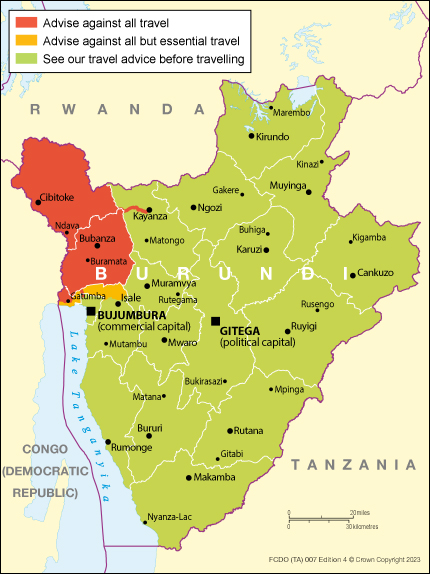
Our travel advice for Burundi varies according to the region. There are no warnings against visiting the capital Bujumbura. We advise against all travel to Bujumbura Rural, Bubanza, Citiboke and Ruyigi Provinces as well as the border areas with the Democratic Republic of Congo. For the remaining Provinces we advise against all but essential travel. The security situation across Burundi has stabilised and the last remaining rebel group was officially disarmed on 21 April 2009. The threat of ambush by bandits remains high. We advise against all travel between 1700 and 0900 partly due to the security situation and partly due to the condition of the roads.
If travelling in rural areas for essential reasons we advise that you contact the UN office in Burundi and make contact with your destination ahead of time to check on the situation. See the local travel section of this advice for more details.
In Bujumbura, the UN has designated the area which follows the lakeside road south of the port to the Club Cercle Nautique and then the dirt road which runs parallel to the lake from the Cercle Nautique to the southerly end of the city as a “non-recommended” area due to banditry.
For more general information see victims of crime abroad.
After 13 years of civil war, the Government of Burundi signed a ceasefire agreement with the leaders of the last rebel group, the National Forces for Liberation (FNL) in September 2006. Progress was slow. But on 21 April 2009, FNL were disarmed and registered as a political party bringing hopes of real peace in Burundi. Burundi is due to have Presidential, legislative and local elections in mid 2010. The elections are likely to be hotly contested, with a risk of insecurity. The FCO will continue to monitor the situation.
The UN has a presence in Burundi (BINUB) with the role of consolidating peace.
If travelling in rural areas for essential reasons we advise that you contact the UN office in Burundi and make contact with your destination ahead of time to check on the situation. See the local travel section of this advice for more details
If you decide to travel outside Bujumbura, we advise you to contact the UN office in Burundi (tel: + 257 22 21 93 42). The UN and US advise their staff to travel in a convoy of at least two vehicles. We advise that you not to travel outside of Bujumbura before 0900 and after 1700.
For more general information see driving abroad.
The EU has published a list of air carriers that are subject to an operating ban or restrictions within the community. You should check the following link to see whether this will affect your travel - European Commission Transport - Air.
For more general information see airline security.
Homosexual acts were criminalised on 22 April 2009. The punishment includes a prison sentence of between three months and two years, and a $41-80 fine.
For more general information for different types of travellers see your trip.
We advise that you carry a photocopy of your passport and visa at all times. There are police security checkpoints across Bujumbura.
Burundi reported its first case of AH1N1 ‘swine flu’ virus on 6 November. The public are being advised to take health precautions such as covering mouth and nose when sneezing, increase hand-washing and report suspected cases to the authorities. Burundi has for some months being asking travellers entering through the Airport to complete health forms, but has not at present put in place similar checks at the land borders. You should monitor media reports for any developments.
Check the “Swine Flu” page of the FCO website for further information. You can obtain further guidance on Pandemic Flu on the UK Department of Health website http://www.dh.gov.uk.
HIV/AIDS and Malaria are prevalent in Burundi.
In the 2008 Report on the Global AIDS Epidemic the UNAIDS/WHO Working Group estimated that around 90,000 adults aged 15 or over in Burundi were living with HIV; the prevalence rate was estimated at around 2.0% of the adult population. This compares to the prevalence rate in adults in the UK of around 0.2%. You should exercise normal precautions to avoid exposure to HIV/AIDS. For more general information on how to do this see HIV and AIDS.
You should seek medical advice before travelling to Burundi and ensure that all appropriate vaccinations are up-to-date. For further information on vaccination requirements, health outbreaks and general disease protection and prevention you should visit the websites of the National Travel Health Network and Centre (NaTHNaC) and NHS Scotland’s Fit for Travel or call NHS Direct on 0845 46 47.
For more general health information see travel health.
On 3 February 2008 an earthquake of 6.0 magnitude was recorded in Bukavu (eastern Democratic Republic of the Congo (DRC)) and a second earthquake of magnitude 5.0 struck near Cyangugu in (south west Rwanda). Both were felt in Burundi but there were no fatalities.
If things do go wrong when you are overseas then this is how we can help.
Their contact details are:
Boulevard de la Liberté, 9; Bujumbura
Tel: + 257 22 22 32 66 or + 257 22 22 61 76 Email: Bujumbura@diplobel.org.
See Belgian travel advice