Colombia |
|
| Still current at: 09 February 2012
Updated: 28 November 2011 |
| No restrictions in this travel advice | Avoid all but essential travel to part(s) of country | Avoid all but essential travel to whole country | Avoid all travel to part(s) of country | Avoid all travel to whole country |
Safety and Security - Terrorism
There is a high threat from terrorism in Colombia. In Bogotá, this includes indiscriminate attacks targeting government buildings, embassies, public transport, public spaces, and other areas frequented by foreigners. On 16 June 2011 a satchel bomb exploded in Bogota damaging nearby buildings. In many areas of Colombia, the security situation can change very quickly. In general, the more remote the area, the greater the potential threat to your safety. You should be particularly cautious and vigilant during any major events taking place in the country.
British nationals in and around Bogotá are advised to be vigilant at all times and to monitor local news and this Travel Advice.
Attacks are not limited to Bogotá and although the terrorist threat in most urban areas is not as high as it once was, it is still very real and could occur at any time.
Other major attacks have included:
See our Terrorism Abroad page.
Safety and Security - Security
-
Crime
Despite improvements in security, we advise visitors to exercise a high degree of caution in Colombia because of the high threat of terrorism and criminal activity.
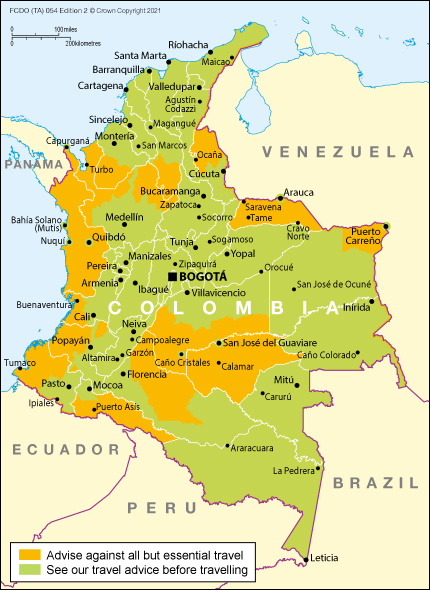
We advise against all but essential travel to rural areas bordering Panama, Venezuela and Ecuador; the town of San José del Guaviare and the surrounding areas; the rural areas of Cauca, Valle del Cauca and Huila and to the Parque Nacional Natural de La Macarena in the department of Meta. We also advise against all but essential travel to Sierra Nevada de Santa Marta and the town of Buenaventura. These areas are particularly dangerous due to the significant presence of illegal armed groups and significant levels of coca cultivation.
There are a number of illegal armed groups operating throughout Colombia, especially in rural areas. Many of them are involved in illegal drugs trade (e.g. the “Aguilas Negras” (Black Eagles) and the ELN). If it is essential that you travel to areas that are remote or reported to be dangerous, you are advised to seek professional security advice and make arrangements for your security throughout your visit. You should seek up-to-date advice from the local authorities before each stage of your journey.
The Pacific coast of Chocó is a popular eco-tourist destination, particularly for whale-watching. However, much of Chocó is remote and unsafe and there has been recent trouble there near the border with Panama, particularly in Arquĺa. This area has also been identified by the United Nationals Office on Drugs and Crime (UNODC) as the major transhipment route for Andean cocaine, resulting in an active illegal drugs trade involving armed groups. On the coast, the town of Bahia Solano is considered less dangerous though there have been reports of kidnappings. If you intend to travel to this town, we recommend that you do so only by air and that you do not venture inland or along the coast out of town.
The Parque Nactional Tayrona is a popular tourist destination for Colombian and foreign visitors alike. You are advised to only visit beach areas and resorts you are reliably advised are safe and not to venture inland as illegal armed groups are active in the area.
We advise against all but essential travel to Sierra Nevada de Santa Marta, including the “Lost City”. If you are travelling to the “Lost City” as part of an organised tour you should confirm with the organisers that they are aware of our Travel Advice. Armed groups are still active in parts of the Sierra Nevada, there are some areas of coca cultivation and the risk of kidnap remains high.
We advise against all but essential travel to the archaeological park at San Agustin in the department of Huila, if you do travel there for essential reasons, enter and leave on the main road through Nevia and not by any other routes.
We advise against ll but essential travel to the port of Buenaventura in the department of Valle de Cauca. Illegal armed groups and criminal gangs are active in this notoriously violent Pacific city.
Criminal violence is a serious problem in Colombia. Both Colombia’s illegal armed groups and other criminal groups are heavily involved in the drugs trade and in other serious crimes including kidnapping (for ransom and political purposes), money laundering and the running of extortion and prostitution rackets.
There has been an increase in criminal activity in urban areas since 2010, including in Bogotá. In particular there have been a number of armed and violent robberies in the Candelaria area of Bogotá where British nationals have been robbed at gun point. You should remain vigilant and be aware that crimes such as mugging and pick pocketing are often accompanied by violence. Foreign visitors present a tempting target to thieves, pickpockets and drug traffickers. When walking in urban areas avoid any unnecessary display of wealth; only use pre-booked taxis. Where possible, it is sensible to plan how you will to and from your destination and to be wary of unsolicited approaches from strangers. There have been several cases of assailants using drugs to subdue their intended victims. Drugs can be administered through food, drinks, needles, cigarettes, aerosols, powder, and have been impregnated in “flyers” handed out at traffic lights. These drugs can take effect extremely quickly, allowing an assailant to rob the victim and escape before the attack can be reported. Never accept offers of food, drink or cigarettes from strangers no matter how friendly or well-dressed a person appears. British nationals should remain vigilant, particularly when visiting or staying in public places used by expatriates and foreign travellers, and in the vicinity of government buildings and military establishments.
Drugs, organised crime and terrorism are inextricably linked in Colombia. Control of the drugs trade is a major driver of much of the armed conflict. We advise against all but essential travel in areas of large-scale coca cultivation. In the June 2011 World Drug Report, the UNODC reported an 16% decline in the amount of coca cultivation in the country, but nevertheless identified areas of Colombia with potentially high levels of coca cultivation.
These areas included the Pacific Regiona (Chocó, Valle Del Cauca, Cauca and Nariño), Central Region (Cesar, Antioquia, Santander and Norte De Santander), Putumayo, Caquetá Area and Meta- Guaviare Area.
There is a high risk to your personal safety in any area where coca, marijuana or opium poppies are intensively cultivated and a particularly high risk in the vicinity of cocaine processing labs.
Colombia has one of the highest kidnapping rates in the world. While Colombians are the primary targets, foreigners can also be targeted in all parts of the country, especially those working for (or perceived to be working for) oil and mining companies. You should be aware that the long-standing policy of the British Government is not to make substantive concessions to hostage takers. The British Government considers that paying ransoms and releasing prisoners increases the risk of further hostage taking.
“Express kidnappings” - short-term opportunistic abductions, aimed at extracting cash from the victim - also occur in Colombia. Victims can be targeted or selected at random and held while criminals empty their bank accounts with stolen c ash cards. Tourist and business visitors alike have been targeted. Once the ransom is paid the victim is usually released, however, there have been incidents where those who have resisted the kidnappers demands have been killed.
Avoid unnecessary visits to deprived areas of all Colombian cities. In Bogotá, be vigilant in areas to the south of Candelaria and to the west of the airport road as these parts of the city are particularly dangerous. Homicide rates in the cities of Cali and Medellin are especially high. Be cautious on city streets, especially if walking alone after dark when the risk of crime is higher. People carrying large amounts of money, wearing valuable watches or jewellery or using mobile phones in the street are especially vulnerable.
See our Victims of Crime Abroad page.
Safety and Security Unexploded Ordnance
Colombia is affected by land mines and unexploded ordnance. Mined areas are frequently unmarked. Be aware of potential dangers when visiting remote locations or venturing off the main roads.
Safety and Security - Local Travel
In much of rural Colombia the effective authority of the Colombian State is limited. The British Embassy’s ability to assist British nationals in trouble in these areas will be similarly limited.
Safety and Security - Local Travel - Road Travel
Colombia has been suffering exceptionally heavy rains which have affected large areas of the country. Travel by road has been severely affected in many areas.
The government of Colombia has announced States of Emergency in many Departments of Colombia. There have been landslides in many areas of the country, which have particularly affected shanty towns built on hillsides. Road conditions are treacherous and the rains have resulted in many reported deaths. Travellers should monitor thelocal media, and refer to this travel advice regularly for updates.
To drive in Colombia, you will need to have a valid UK or other recognised driving licence and car insurance is compulsory. Road surfaces, including in large cities, are variable. Driving standards are low and traffic accidents are common. Avoid driving at night, which can be particularly hazardous.
The risk of violence and kidnapping is higher in some rural areas, as is the threat of being caught in roadblocks set up by illegal armed groups. Main arterial roads are generally safe to travel on during daylight hours. Try to avoid intercity travel at night. We advise against hitchhiking in Colombia.
While we advise against travel to the rural areas of some departments through which the Pan-American Highway passes, the Highway itself is generally well guarded. See our Driving Abroad page.
Safety and Security - Local Travel - Rail Travel
There is no significant rail transport system in Colombia.
Safety and Security - Local Travel - Entering and Leaving Colombia
Most visitors enter or leave Colombia by air. The national carrier, Avianca, and other national airlines (the main ones are Satena and AeroRepublica) generally have good safety records. Air travel is a key mode of transport in the country, not least because of the risks involved in some overland travel.
If entering or leaving Colombia by land from or to Venezuela, you should cross at Cucuta, and not at Arauca, or via Riohacha. If entering or leaving from or to Ecuador via the Pan-American Highway, you are advised not to stop en route between the border and Pasto, the route between Cali and the border with Ecuador is considered to be volatile. Some visitors arrive by sea through Caribbean ports. We advise against trying to cross between Panama and Colombia by land.
If crossing into Colombia from either Ecuador or Venezuela, ensure that you have your passport stamped by the immigration authorities on arrival in the country. Failure to do so may result in a fine on departure. If the immigration office on the border is closed, seek assistance at the next nearest office of the Departamento Administrativo de Seguridad.
Airport tax for international departures for visitors who stay in Colombia for less than three months is US$34. For stays in excess of three months the tax is US$68. However, the charge depends on the type of visa with which you are issued. The Colombian Embassy (tel: 020 7 637 9893) or Colombian Consulate in London (tel:0207 927 7123, e-mail info@colombianconsulate.co.uk) can advise further.
Safety and Security - Political Situation
Colombia Country Profile
Avoid all dealings with illegal drugs. Colombian drug trafficking detection methods are sophisticated and anyone attempting to traffic drugs should expect to be arrested. Conviction leads to severe penalties. In recent months four British nationals have been arrested for trying to smuggle cocaine out of the country. You should pack your own luggage, and not carry items for other people.
Homosexuality is legal but not widely socially accepted, especially in rural areas.
Photography of military or strategic sites is not permitted.
It is a serious criminal offence to have sex with under-age minors in Colombia and can result in long prison sentences.
See our Your Trip page.
Entry Requirements - Visas
British nationals may enter Colombia for up to 90 days as a visitor without a visa (at the discretion of Colombian Immigration Officers); however there is no unconditional right to do so. The decision on whether to permit entry and length of stay rests with the Immigration Officer on arrival.
You may be able to extend your stay up to a maximum of a further 120 days on application and payment of a fee at the immigration office of the Department of Administration and Security once in Colombia. As a visitor, you cannot remain in Colombia for more than 180 days in any twelve-month period. You should not outstay your visa.
British-Colombian dual nationals must always enter and leave Colombia with their Colombian passports and Colombian identification card (Cedula).
Before any travel to Colombia, particularly for purposes other than tourism, contact the Colombian Embassy in London (see contact details above).
Entry Requirements - Passport validity
You must hold a valid passport to enter Colombia. Your passport must be valid for a minimum period of six months from the date of entry into Colombia. You should also have a valid return ticket with you.
Entry Requirements - Yellow Fever vaccination certificate
Airport authorities have informed us that Yellow Fever vaccination certificates are only needed if you are planning to visit jungle areas of Colombia.
If you intend to travel on to neighbouring countries in Central and Latin America from Colombia, you may not be allowed to do so without production of a Yellow Fever Certificate. Confirm with the authorities of your next destination whether they require a certificate following your visit to Colombia. It is a requirement for all travellers from Colombia to Ecuador to be in possession of a valid Yellow Fever certificate.
Entry Requirements - Customs regulations on departure
Individuals leaving Colombia are only entitled to carry up to US$10,000 in cash. Anything in excess of this may be confiscated.
Entry Requirements - Travelling with children
Children under the age of 18 years who have resident status in Colombia and who are travelling on a British passport require written permission whenever they leave the country without both parents. The non-accompanying parent(s) must write a letter giving permission for the child to leave Colombia. The letter must be authenticated by a notary or by a Colombian Consulate. The letter must mention the proposed destination, the purpose of the trip, the date of departure and the return date. More information about Colombian emigration requirements can be obtained from the Departamento Administrativo de Seguridad (DAS) or by contacting the Colombian Consulate-General in London (info@colombianconsulate.co.uk).
Private medical facilities in Colombia are generally of good quality, but may be expensive. Medical facilities in many areas of rural Colombia are limited. Most medicines are generally available, but can be costly.
Yellow Fever, Malaria and Dengue Fever are common to Colombia.
Yellow Fever affects the Magdalena, Cesar, La Guajira, Atlántico, Santander, Norte de Santander and Amazona areas. There is a high incidence of malaria in lowland tropical areas, particularly in Chocó and north western Antioquia.
Dengue Fever is common to Latin America and the Caribbean and can occur throughout the year. In Colombia it is more common on the north Caribbean coast, particularly in Chocó, Antioquia, Córdoba, Sucre, Bolivar and Atlántico departments.
In the 2010 Report on the Global AIDS Epidemic the UNAIDS/WHO Working Group estimated that around 150,000 adults aged 15 or over in Colombia were living with HIV; the prevalence percentage was estimated at around 0.5% of the adult population compared to the prevalence percentage in adults in the UK of around 0.2%. You should exercise normal precautions to avoid exposure to HIV/AIDS. For more general information on how to do this see HIV and AIDS.
You should seek medical advice before travelling to Colombia and ensure that all appropriate vaccinations are up-to-date. For further information on vaccination requirements, health outbreaks and general disease protection and prevention you should visit the websites of the National Travel Health Network and Centre (NaTHNaC) and NHS Scotland’s Fit for Travel or call NHS Direct on 0845 46 47.
Earthquakes occur regularly in Colombia. In the event of an earthquake you should monitor local media reports and follow the advice of the authorities.
There is a risk of floods and landslides after heavy rains throughout the Colombian Andes. Seek local advice before travelling on mountain roads after heavy rain.
On 25 August 2010 the Galeras Volcano in Nariño Department erupted. We advise against all travel to the department of Nariño, and the city of Pasto and La Florida. If, against our advice, you are in the vicinity of the volcano, you should pay careful attention to all warnings issued and follow the advice of the local authorities. The current alert level has been set at Level 2.
Since November 2008, Cerro Machin in Tolima Department (approx 17km west of Ibague) has been showing signs of increased instability resulting in the evacuation of residents in the immediate vicinity. The alert level has been set at Level 3. Travellers to the area should pay careful attention to all warnings issued and follow the advice of the local authorities.
The Nevado Del Huila volcano in the Parque de los Nevados (on the Huila/Cauca/Tolima boundary) erupted in November 2008, causing a mudslide in June 2010. The current state of alert is Level 3 (changes in volcanic activity). We advise that all travel in the vicinity of the volcano should be avoided at the present time. You should pay careful attention to all warnings issued and follow the advice of the local authorities.
There are British Honorary Consulates in Cali, Cartagena and Medellín, which can provide consular assistance. Contact details can be found on the British Embassy's website.
Around 23,000 visits were made by British passport holders to Colombia in 2010 (Source: Colombian State Security Department - DAS). 22 British nationals required consular assistance in Colombia in the period 1 April 2010 - 31 March 2011 for the following types of incidents: two deaths; five hospitalisations; one arrest.