Advanced search
image
Travel & living abroad

North and Central America and Caribbean

Mexico

Flag of Mexico
Still current at: 08 November 2009
Updated: 06 November 2009

This advice has been reviewed and reissued with amendments to the Summary and the Natural Disasters section (Tropical Storm Ida). The overall level of the advice has not changed.

(see travel advice legal disclaimer)                    

Travel advice for this country

Travel Summary

  • Tropical Depression Ida is forecast to increase in force to a tropical storm which will reach the Cancun area of the Yucatan peninsula late on 8th November. Windspeeds in excess of 30 mph are currently recorded, and extensive rainfall with possible flooding are likely. Tourist areas in Cancun, Cozumel and Playa del Carmen are likely to be affected. Travellers in country should listen to local weather forecasts and media reports and follow the advice of the local authorities and tour representatives.

  • The hurricane season in Mexico normally runs from June to November and can affect both the Pacific and Atlantic coasts.  You should monitor local and international weather reports and follow the advice of the local authorities as appropriate.  See the Natural Disasters (Hurricanes) section of this advice and Tropical Cyclones for more details.

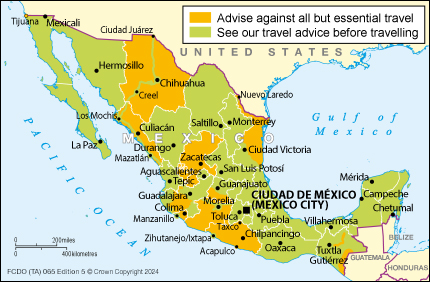
  • Most visits are trouble-free, but crime and kidnappings continue. You should be particularly alert in tourist areas (especially on public transport and when dealing with real or purported policemen) and exercise caution when exchanging or withdrawing money. There has been a significant increase in drug related violence and killings in 2008 and 2009, particularly in the northern border and Pacific states. See the Crime Section of this advice for more details. Travellers should avoid large crowds and demonstrations, and ensure they follow the advice of local authorities.
  • 315,568 British nationals visited Mexico in 2008 (Source: Instituto Nacional de Migracion).  89 British nationals required consular assistance in Mexico in the period 01 April 2008 – 31 March 2009 for the following types of incident; deaths (19 cases); hospitalisations (25 cases); and arrests, for a variety of offences (21 cases). During this period assistance was also requested with regard to lost or stolen passports (146 cases).

  • There is a low threat from terrorism. But you should be aware of the global risk of indiscriminate terrorist attacks, which could be in public areas, including those frequented by expatriates and foreign travellers. See the Terrorism section of this advice for more details.

  • We recommend that you obtain comprehensive travel and medical insurance before travelling. You should check any exclusions, and that your policy covers you for the activities you want to undertake. See the General (Insurance) section of this advice and Travel Insurance for more details.

Safety and security

Terrorism

There is a low threat from terrorism. But you should be aware of the global risk of indiscriminate terrorist attacks, which could be in public areas, including those frequented by expatriates and foreign travellers.
 
For more general information see Terrorism Abroad.

Crime

Street crime is on the increase. Around 140 cases of stolen passports are reported to the Embassy every year.  You should dress down and avoid wearing expensive jewellery or watches.  You should be particularly alert on public transport, at airports, bus stations and tourist sites. Passengers have been robbed and/or assaulted by unlicenced taxi drivers, particularly in Mexico City. At airports, use only authorised prepaid airport taxi services. In Mexico City, use better regulated “sitio” taxis from authorised cab ranks. 

Theft on buses is also common. All bus travel should be during daylight hours and on first-class buses if possible.  Although there have been several reports of bus hijackings and robberies on toll roads (de cuota), buses on toll roads have a markedly lower rate of incidents than buses (second and third class) that travel the less secure "free" (libre) roads. Although most first-class bus companies perform security checks when passengers' board buses, armed robberies of entire bus loads of passengers still occur. Be vigilant; watch your hand luggage. Long distance bus travellers should stay alert.

Women travelling on their own should be particularly alert. There have been incidents of rapes on urban buses (micros) on routes in the south of Mexico City.  Most attacks have occurred early in the morning or late at night. A number of serious sexual offences have also occurred in tourist areas in Cancun. Care should be taken even in areas close to hotels, especially after dark.  Business travellers should keep a close watch on their briefcases and luggage at apparently secure locations such as the lobby of their hotel. Pick pocketing is common on the Mexico City Metro.
For more general information see Rape and Sexual Assault Abroad.

Exercise caution when withdrawing money from cashpoints or exchanging money at a Bureau de Change. It is safer to limit withdrawals or currency exchanges to small sums, and to only use cashpoints during daylight hours and inside shops or malls. Be especially vigilant when leaving a Bureau de Change as there have been incidents of people being followed and attacked, particularly following withdrawals at Mexico City airport. Extra police have been drafted in to improve security at the airport as part of a recent government initiative to combat crime.  

Short-term opportunistic kidnapping – called “express kidnapping” – continues in urban areas, particularly in Mexico City.  Victims are required to withdraw funds from credit or debit cards at a cashpoint to obtain their release.  Where victims have friends or relatives living locally, a ransom may be demanded from them.

Longer-term kidnapping for financial gain also occurs, and there have been allegations of complicity by police officers. You should be cautious and discrete about openly discussing your financial or business affairs.

Be wary of strangers approaching you in person or contacting you by telephone, requesting personal information or financial help. They may be part of a scam operation.  In particular, be wary of persons presenting themselves as police officers attempting to fine or arrest you for no apparent reason.  There have been instances of visitors becoming victims of theft, extortion or sexual assault by persons who may or may not be police officers.  When in doubt, ask for identification and if possible note the officer's name, badge number, and patrol car number.

Exercise caution when accepting food, drinks or rides from strangers.  You are advised not to leave your food and drinks unattended in bars and restaurants. Cases of travellers being robbed or assaulted after being drugged have been reported.

Drug-related violence affects many states and is a particular problem in Sinaloa, Chihuahua, US border states and Pacific states. On 15 September 2008 two grenades were thrown into crowds during the Independence Day celebrations in Michoacán, killing at least seven people and injuring many more.  In July 2009, the Government sent additional police and troops to Michoacán, in response to a series of co-ordinated attacks by cartels against state and federal forces.  Travellers to the area should exercise caution and avoid large crowds and demonstrations. 

Early in 2009, more than 1,500 Mexican troops moved into Ciudad Juarez on the US border which is being fought over by rival drug gangs. Foreign visitors and residents have been among the victims of insecurity particularly in the border region but there is no evidence to suggest that they have been targeted because of their nationality.  Visitors to the region should follow the advice of local authorities and are advised to be extra vigilant if travelling to these areas.  There have been a high number of drug related murders in 2008 which continue in 2009, including the shooting of a number of high ranking security officials in Mexico City.  Attacks are aimed primarily at members of drug trafficking organisations, Mexican police forces, criminal justice officials, and journalists.  Again foreign visitors and residents have been among the victims of murders and kidnappings in the border region but there is no evidence to suggest that they have been targeted because of their nationality.

There have been a number of attacks aimed at banking institutions in Mexico City recently, involving small explovises. The attacks have occurred in the early hours of the morning and are unlikely to affect customers, but we do advise British Citizens to be vigilant.
 
For more general information see Victims of Crime Abroad.

Political Situation

Mexico Country Profile

Political demonstrations can occur across the country. These can be tense, confrontational and turn violent, and onlookers can be quickly drawn in.  You should avoid all demonstrations and monitor local media.

The Mexican Constitution prohibits political activities by foreigners, and participation in activities such as demonstrations may result in detention and/or deportation. 

Local travel

You should exercise particular caution if you have to travel after dark, and keep away from isolated beaches, ruins or trails at all times.

There have been a recent number of unexpected and unpredictable demonstrations across the country particularly in Monterrey and northern border areas. Visitors to these areas should be aware of the potential for disruption to their travel plans and should ensure they follow the advice of local authorities.

There is still tension in parts of the state of Chiapas, where armed groups are present.  If you visit the highlands around San Cristobal de las Casas and the municipality of Ocosingo and the jungle area towards the Guatemalan border, you should exercise caution, particularly where crowds are gathered, and should not venture off main roads without seeking local advice.

Road travel

UK and International Driving licences are valid in Mexico. 

The Mexican style of driving and standards are very different from the UK.  Be prepared to stop unexpectedly, and beware of potholes, slow moving vehicles, vehicles changing lane without indicating and going through red lights. Many local drivers do not have any form of car insurance. Keep your car doors locked at all times and the windows shut, especially at traffic lights.

In order to reduce air pollution, Mexico City and some other regions of the country have introduced restrictions on driving. Cars will be forbidden from certain areas on particular days based on number plates. This applies equally to permanent, temporary and foreign plates.  These regulations are strictly enforced and offenders face heavy fines and temporary confiscation of their vehicle.

As of 1st September 2008, a supplementary driving restriction will be implemented in Mexico City. Vehicles without plates from the State of Mexico (Estado de Mexico) or the Federal District (DF) will not be permitted from Monday to Friday, 5:00 a.m. to 11:00 a.m.  For more information (only in Spanish) visit
http://www.sma.df.gob.mx/.
 
For more general information see Driving Abroad.

Sea travel

If you visit Mexican beach resorts, you should be aware that sports and aquatic equipment may not meet UK safety standards and may not be covered with any accident insurance. This applies particularly to scuba diving, parasailing and jet-ski. Check that your own travel insurance covers these activities if you decide to rent equipment or take classes.

There were shark attacks along the Pacific coast in 2008.  The three attacks, all involving surfers, took place close to Pantla and Troncones beaches near Zihuatanejo and approximately 150 miles from the Pacific resort of Acapulco.  Two of the attacks were fatal, one involving a foreign tourist.  Shark attacks are relatively rare in Mexico.  However, caution should be taken in these coastal areas, particularly when surfing.

For more general information see
River and Sea Safety.

Local laws and customs

Do not become involved with drugs of any kind in any way. Penalties for drug offences are severe.  Convictions carry very long sentences – up to 25 years.
 
The police sometimes ask foreigners to show some form of identification. You may wish to carry photocopies of the relevant pages of your passport and important documents and leave the originals in a safe place.

Although civil unions between same sex partners are now legal in Mexico City and the state of Coahuila, homosexuality in Mexico is generally tolerated, rather than accepted.  Public displays of affection between same sex couples may be frowned upon.
 
For more general information for different types of travellers see Your trip.

Entry requirements

Visas

If you are visiting Mexico as a tourist you do not need a visa. You do need a tourist card (known as the "FMT"), which can be obtained by completing an immigration form available at border crossings or onboard flights to Mexico.  Alternatively they can be obtained at a  Mexican Consulates prior to travel.
 
Certain adventure or eco-tourism activities (eg caving, potholing, entomology) may also require visas, especially if they involve any scientific or technological research.  Be aware that the Mexican authorities may define scientific or technological research activities far more broadly than other countries.  If in any doubt, you should check carefully with the Mexican Embassy well in advance of your visit and request written confirmation if necessary.

Passport validity


Your passport should be valid for at least six months from the intended date of entry.

Travelling with children

 
Families with children should note that since January 2005, it is no longer required that minors travelling alone or with only one parent needing to have a notarised letter from their parents.  Minors only need a valid passport to fulfil the general migration requirements applied to their nationality.
 

Working in Mexico

Tourists are not permitted to undertake voluntary work or any form of paid employment. If you intend to work in Mexico you should obtain the proper visa before travelling.
 

Imports

You should not bring meat or dairy products to Mexico.  The importation of these products from the EU is prohibited.

Health

The World Health Organisation (WHO) has raised its Pandemic Threat Alert phase to level 6. See the WHO website for further details.

Following a decline in the number of reported new H1N1 influenza cases in Mexico since its peak on 26 April 2009, we no longer advise against all but essential travel.  Most cases have been reported in Mexico City, together with a number of other locations across the country. These have resulted in some deaths.

The British Government will not be in the position to offer evacuation to British Nationals in the event of an influenza pandemic.

You should take personal responsibility for your safety in the event of a future pandemic, including access to adequate healthcare and ensuring that your travel documents are up to date.

Travellers should consult a doctor immediately if they show signs of flu-like symptoms.

The Mexican Secretariat of Health has advised people to avoid large crowds, shaking hands, kissing people as a greeting.  Maintaining a distance of at least six feet from other persons and frequent hand washing may decrease the risk of exposure.

Further guidance on precautions you can take to protect yourself can be found on the  Health Protection Agency website and our swine flu page.

Travellers arriving at and departing from Mexican airports may be required to complete a health questionnaire detailing whether they are suffering any ‘flu-like symptoms.  These questionnaires are available in Spanish and English.  Travellers are also required to pass in front of a thermal imaging camera to check their body temperature.

If travellers are found to have a high temperature (above 38.5C), medical personnel will check for other ‘flu-like symptoms (e.g. cough, headache etc).  If they think any symptoms displayed could be H1N1 influenza related, a quick test will be carried out.  Travellers with negative test results will be allowed to continue their journey.  Travellers with a positive test result will be directed to an on-site doctor for further examination.  Travellers may be given anti-viral treatment and recommended to take the usual preventive measures, i.e. wear a facemask, wash hands constantly, etc at this stage.  The doctor may also recommend that travellers go to hospital.  Travellers will be advised to remain in Mexico until the anti-viral treatment is finished, but travellers are not prevented from continuing their journey if they choose to do so.  Travellers should, however, bear in mind that airlines may have their own polices on carrying passengers displaying ‘flu-like symptoms.  

The Mexican authorities are currently not quarantining anyone with H1N1.

British Nationals should continue to follow local advice on precautions to take to avoid exposure to the influenza.

Malaria is common in low-lying rural areas of Mexico and outbreaks can occur throughout the year.  Dengue fever is common to Latin America and the Caribbean and can occur throughout the year. Almost 100 cases were reported in Guadalajara in 2008. You should take all precautions against mosquito bites whenever possible.

Hygiene standards vary in Mexico.  You should drink or use only boiled or bottled water and avoid ice in drinks.  If you suffer from diarrhoea during a visit to Mexico you should seek immediate medical attention.  You should therefore exercise caution before purchasing food and unbottled drinks from street vendors.

On arrival in Mexico City and other high altitude areas, you may feel a lack of energy, shortness of breath or headaches.  Allow for a short period of adjustment when making your travel plans.

In the 2008 Report on the Global AIDS Epidemic the UNAIDS/WHO Working Group estimated that around 200,000 adults aged 15 or over in Mexico were living with HIV; the prevalence rate was estimated at around 0.3% of the adult population. This compares to the prevalence rate in adults in the UK of around 0.2%. You should exercise normal precautions to avoid exposure to HIV/AIDS. For more general information on how to do this see HIV and AIDS.

There were shark attacks along the Pacific coast in 2008. The three attacks, all involving surfers, took place close to Pantla and Troncones beaches near Zihuatanejo and approximately 150 miles from the Pacific resort of Acapulco. Two of the attacks were fatal, one involving a foreign tourist. Shark attacks are relatively rare in Mexico. However, caution should be taken in these coastal areas, particularly when surfing.

You should seek medical advice before travelling to Mexico and ensure that all appropriate vaccinations are up-to-date.  For further information on vaccination requirements, health outbreaks and general disease protection and prevention you should visit the websites of the National Travel Heath Network and Centre (NaTHNaC) and NHS Scotland's Fit For Travel or call NHS Direct on 0845 46 47.

For more general health information see Travel Health.

Natural disasters

Hurricanes

Tropical Depression Ida is forecast to increase in force to a tropical storm which will reach the Cancun area of the Yucatan peninsula late on 8th November. Windspeeds in excess of 30 mph are currently recorded, and extensive rainfall with possible flooding is likely. Tourist areas in Cancun, Cozumel and Playa del Carmen are likely to be affected. Travellers in country should listen to local weather forecasts and media reports and follow the advice of the local authorities and tour representatives.

The hurricane season in Mexico normally runs from June to November and can affect both the Pacific and Atlantic coasts.  You should monitor local and international weather updates from the
World Meteorological Organisation and the US National Hurricane Center, and check with local authorities or your tour operator for any changes to your onward travel plans.  For more detailed information see Tropical cyclones.

Earthquakes

Most of Mexico is subject to earthquakes and tremors occur regularly particularly in the state of Oaxaca.  On 27 April 2009, an earthquake measuring 5.6 on the Richter Scale occurred in the Pacific coast state of Guerrero, no British casualties have been reported. The last major earthquake in Mexico occurred in January 2003, affecting the city and state of Colima.

Volcanoes

The Popocatepetl and Colima volcanoes are both active and they are closed to the public. There are danger zones around both, the size of which can change depending on the current level of activity. Updated information on their current status can be found
for Colima (reports available in Spanish) and for Popocatepetl (reports in English).

General

Insurance

You should have comprehensive travel and medical insurance when you visit Mexico.  You should check any exclusions, and that your policy covers you for all the activities you want to undertake.  Be aware that not all hospitals will agree to deal directly with medical insurance companies and you should be prepared to pay for treatment yourself up front and then seek a refund.  For more general information see Travel Insurance.

If things do go wrong when you are oversees then this is How We Can Help.

Registration

Register with our LOCATE service to tell us when and where you are travelling abroad or where you live abroad so our consular and crisis staff can provide better assistance to you in an emergency.
  • More information about registering with LOCATE.

Language

English is not widely spoken outside the main cities.  Basic Spanish phrases are essential.

Safety in hotels

Building specifications are different in Mexico.  In some hotels, balcony balustrades may not be at the same height as you would find in the UK or elsewhere in Europe and there is a risk of falling.

Purchasing property

Before buying property in Mexico, you should seek advice from a reputable and professionally qualified lawyer.

Money

American Dollar travellers' cheques and notes are more easily exchanged throughout Mexico than sterling equivalents.  But UK debit and credit cards are widely accepted, including by ATMs.
 
See the Crime section of this travel advice for more details about using ATMs and Bureaux de Change.

Share this with:

Contacts

Mexico, Mexico City, British Embassy

Address:

British Embassy
Río Lerma 71
Col Cuauhtémoc
06500 México DF

Telephone:

(52) (55) 5242 8500

Fax:

+ 52 (55) 5242 8524

Office hours:

GMT:
Mon-Thurs: 1400-2200
Fri: 1400-1930

Local Time:
Mon-Thurs: 0800-1600
Fri: 0800-1330

Website: http://ukinmexico.fco.gov.uk/en/

Sign-up for travel alerts

Subscribe to receive email alerts for the country of your choice


LOCATE: Register with us