Haiti |
|
| Still current at: 24 May 2012
Updated: 03 May 2012 |
| No restrictions in this travel advice | Avoid all but essential travel to part(s) of country | Avoid all but essential travel to whole country | Avoid all travel to part(s) of country | Avoid all travel to whole country |
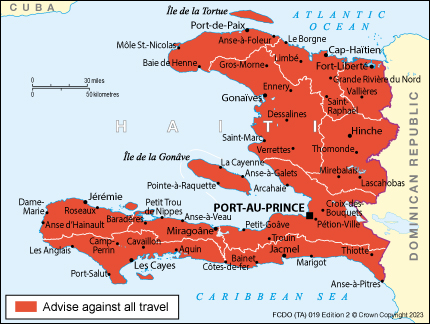
This advice has been reviewed and reissued without amendment. The overall level of the advice has not changed. We advise against all travel to the slum districts of Port-au-Prince including Carrefour, Cite Soleil, and Martissant.
To see a PDF version of this map, click here (209 KB).
(see travel advice legal disclaimer)
Safety and Security - Terrorism
There is a low threat from terrorism. But you should be aware of the global risk of indiscriminate terrorist attacks which could be in public areas, including those frequented by expatriates and foreign travellers. See our Terrorism abroad page.
Haiti suffered widespread disorder, including looting and gun violence following the 12 January 2010 earthquake. Crime figures have largely returned to pre-earthquake levels. The risk of crime is high and the general security situation unpredictable. 5,000 prisoners, many violent, escaped the National Penitentiary and are still at large. Many Haitians carry guns. The Haitian National Police (PNH) is both visible and active and supported by MINUSTAH, the UN peacekeeping force. The police are heavily armed, often with pump-action shotguns and automatic weapons.
There have been random shootings of civilians in incidents of street robbery. Foreign nationals have also occasionally been caught in the crossfire of gang violence.
You should seek professional security advice and make arrangements for your security throughout your visit. You should exercise caution during the day, and avoid travel at night. We advise against all travel to the slum districts of Port-au-Prince including Carrefour, Cite Soleil and Martissantas there is minimal policing in these areas and personal security cannot be guaranteed. You should avoid displaying expensive items of jewellery or carrying large sums of money. You should not leave property in vehicles and always travel with doors locked and windows up. You are advised to park close to any venues that you visit and not to leave a venue alone, and to always check your surroundings.
Across Haiti, pickpockets and theft of valuables are common.
Security guards are recommended at the homes of long-term foreign residents.
Safety and Security - Crime - Kidnapping
There is a serious threat of kidnapping across Haiti. Individuals have been kidnapped at their residence, work and in transit. Kidnappers do not discriminate on the basis of nationality, religion, gender, age or profession. A British national was abducted along with his Haitian national driver from Port-au-Prince on 10 May 2010. Although the British national was later released the driver was killed. You should be aware that the risk of kidnapping remains high.
Safety and Security - Local Travel
Safety and Security - Local Travel - Road Travel
Road conditions have been badly affected by the recent earthquake. Many roads, particularly near the epicentre of the earthquake, are difficult to use if not impassable. There are reports of attacks on those using the road between Port-au-Prince and the border with the Dominican Republic. Although fuel is now available supplies can suddenly run short; you should therefore carry sufficient spare fuel. You should research your journey carefully before you set out and have back up options if needed.
The standard of roads and driving is very poor in Haiti. Many of the tarmac roads are in a state of disrepair whilst others, particularly in the countryside are little more than dirt tracks. Drainage is poor and flooding is common after rainfall. Roads are often unlit and it is not uncommon after dark to encounter cars, trucks or motorcycles driving without lights. Drivers often pay little regard to the laws of the road and you should therefore drive with extreme caution at all times. Standards of car maintenance are also low.
A UK driving licence is only valid for three months in Haiti. Visitors who intend to remain in Haiti longer than this period should obtain an International Driving Permit.
It is possible to drive between the Dominican Republic and Haiti but be prepared for long queues at the four crossing points to deal with the bureaucracy of customs and immigration.
A luxury bus service operated by Caribe Tours normally runs daily between Santo Domingo and Petionville (not Port au Prince) and vice versa. It is comfortable and the journey takes about six hours.
See our Driving Abroad page.
Safety and Security - Local Travel - Air Travel
The earthquake on 12 January 2010 caused enormous disruption to the airport at Port-au-Prince and to all commercial air services operating from it. Commercial flights have now resumed, but check-in procedures are slow. Gaining access to the terminal building involves queuing in insecure conditions.
According to the US Federal Aviation Administration (FAA), the Government of Haiti's civil aviation authority has been assessed a Category 2 which does not meet ICAO (International Civil Aviation Organisation) safety standards for the oversight of Haiti's air carrier operations.
Internal flights between the capital and some provincial towns are available. For security reasons, Foreign & Commonwealth Office staff are not allowed to use the Haitian domestic airline Caribintair for any official journeys. You should take this into consideration when making travel plans.
Safety and Security - Political Situation
Haiti Country ProfileThe political structures of Haiti have been badly disrupted by the earthquake. The Haitian government is re-establishing itself despite the loss of personnel and major buildings. The UN is playing a critical role in supporting the Haitian government through this humanitarian crisis, and will continue to do so throughout the recovery period. The Haitian National Police, who also suffered a loss of personnel and damage to its buildings, is recovering. Whilst the UN and others are working to maintain security and restore access, their priority will continue to be the delivery of humanitarian aid to those most in need.
Demonstrations and protest marches are a regular occurrence and may take place at any time in Port-au-Prince and throughout the country. They may occur with little warning and can turn violent and should be avoided wherever possible. If you become aware of nearby police or MINUSTAH activity you should leave the area immediately.You are advised not to become involved with illegal drugs of any kind. Pack all luggage yourself and do not be tempted to carry any items through customs for anyone else. If you are caught in possession of drugs or suspected of drug trafficking at any point whilst in Haiti, you may be arrested and jailed for weeks or months before appearing before a magistrate. Prison conditions in Haiti are very poor.
You should always carry proof of your identity. Keep a copy of the photo page of your passport and relevant visa stamp in case your documents are stolen.
Homosexuality is legal but not widely accepted.
Entry Requirements - Visas
British passport holders do not require a visa to visit Haiti for periods of up to 90 days. For up-to-date advice, visitors are advised to contact the Haitian Embassy in Paris at Rue Théodule Ribot 10, 75827 Paris, France (telephone: +33 01 47634778) before travelling. You will be issued with a card on arrival at the airport, which you must keep and surrender to Immigration on departure.
Entry Requirements - Passport Validity
You must hold a valid passport to enter Haiti. Your passport must be valid for a minimum period of six months from the date of entry into Haiti.
Entry Requirements - Departure tax
Departing tourists are currently required to pay 25 American dollars in departure taxes. However, the Haitian authorities may change departure tax requirements without warning, so it is advisable to have some spare American Dollars and a little local currency available on departure.
Contact your GP around eight weeks before your trip to check whether you need any vaccinations or other preventive measures. Country specific information and advice is published by the National Travel Health Network and Centre, and useful information about healthcare abroad, including a country-by-country guide of reciprocal health care agreements with the UK, is available from NHS Choices.
Make sure you have adequate travel health insurance and accessible funds to cover the cost of any medical treatment abroad and repatriation.
British nationals are advised to practise food and water hygiene precautions. If you suffer from diarrhoea you should seek immediate medical attention. For further information visit the National Travel Health Network and Centre website.
The earthquake on 12 January 2010 caused considerable damage to local hospitals and impacted on healthcare provision. Limited help is available at present though field hospitals have been sent as part of the international assistance effort. Medical facilities are stretched to more than full capacity and resources have dwindled. Humanitarian assistance being brought in to the country includes medical supplies and equipment.
Normal medical facilities are very limited in Haiti, offering a poor standard of care. You should bring adequate supplies of essential medicines, especially for specific medical conditions such as diabetes, etc.
If you are ill or bitten by an animal whilst in Haiti you should seek prompt medical advice.
In the 2010 Report on the Global AIDS Epidemic the UNAIDS/WHO Working Group estimated that around 110,000 adults aged 15 or over in Haiti were living with HIV; the prevalence percentage was estimated at around 1.9% of the adult population compared to the prevalence percentage in adults in the UK of around 0.2%. You should exercise normal precautions to avoid exposure to HIV/AIDS. See our HIV and AIDS page.
If you need emergency medical assistance during your trip, dial 113 and ask for an ambulance. You should contact your insurance/medical assistance company promptly if you are referred to a medical facility for treatment.
Our Travel health pages offer further advice on how to stay healthy when overseas.
Natural Disasters - Hurricanes
The hurricane season in Haiti runs from June to November. You should pay close attention to local and international weather reports and follow the advice of local authorities.
Flash floods and landslides occur regularly.
If you are staying in Haiti when a hurricane occurs you should listen to information given on the television/radio stations and follow the advice of hosts or hotel management. You should monitor local and international weather updates from the World Meteorological Organisation and the National Hurricane Centre. See our Tropical Cyclones page.
Emergency services are ill equipped to cope with a major disaster. Should a hurricane strike Haiti, basic services - transport and communications -could be severely disrupted.
Natural Disasters - Earthquakes
An earthquake measuring 7.1 on the Richter scale hit Haiti on 12 January 2010. There were mass casualties and extensive damage to infrastructure, including to government buildings and many homes in the Port au Prince area. Humanitarian assistance is being delivered to provide requirements from clean water and sanitation to food and shelter for the millions of people affected. You should monitor local and international media reports and follow advice of international agencies and governments.
The Caribbean plate runs off the north coast of Haiti and slight earth tremors occur occasionally.
General - Insurance
You should take out comprehensive travel and medical insurance before travelling. This should cover medical evacuation by air ambulance. You should check any exclusions, and that your policy covers you for all the activities you want to undertake. See our Travel insurance page.General - Consular registration
Register with our LOCATE service to tell us when and where you are travelling abroad or where you live abroad so our consular and crisis staff can provide better assistance to you in an emergency. More information about registering with LOCATE can be found here.General - Representation in Haiti
There is no British Embassy in Haiti. An Honorary Consulate is located at 337 Route de Delmas 72/73 opposite the ERF building and close to the Canadian Embassy – its hours of service are restricted. If contact cannot be made then consular enquiries should be directed to the British Embassy in the Dominican Republic.General - Communications
Communications have been widely disrupted by the recent earthquake. Mobile phone networks will not always work. Landlines and internet networks are similarly affected.General - Money
You can exchange American Dollars cash or travellers' cheques for local currency in commercial banks. Other foreign currencies may be exchanged at the discretion of the bank. Some hotels and shops accept payment in American Dollars. Most credit cards may be used in major hotels, and in some shops and businesses in the capital. You are advised not to change money on the street.