Advanced search
image
Travel & living abroad
   

Middle East and North Africa

Tunisia

Flag of Tunisia
Still current at: 24 May 2012
Updated: 22 May 2012
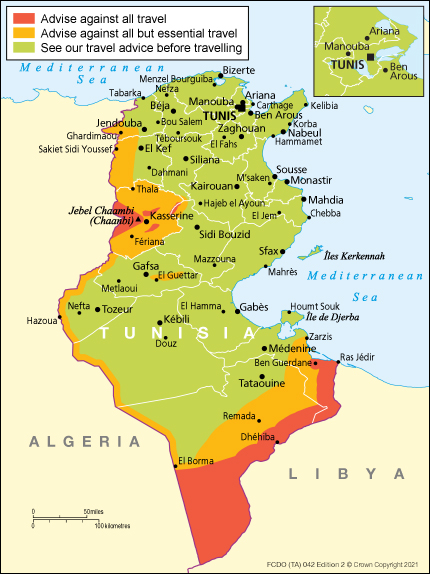
No restrictions in this travel advice Avoid all but essential travel to part(s) of country Avoid all but essential travel to whole country Avoid all travel to part(s) of country Avoid all travel to whole country


This advice has been reviewed and reissued with amendments to the Travel Summary and the Safety and Security - Local Travel section (unofficial roadblocks). The overall level of the advice has not changed; there are no travel restrictions in this Travel Advice for Tunisia.

(see travel advice legal disclaimer)

Travel advice for this country

  • Most visits to Tunisia are trouble-free, but all travellers should be aware of the current political and security situation, restrictions imposed, and the impact of the situation in neighbouring Libya.

  • Tunisia is no longer experiencing the widespread unrest that occurred during the events of January 2011 and most visits are trouble-free. Public order is maintained in most places, including the main tourist coastal areas, but all travellers should be aware that spontaneous and unpredictable events such as political and industrial protests, including unofficial roadblocks still occur throughout the country.

  • While most forms of protest pass without incident there is the possibility of injury if you are caught up in an event that does not pass peacefully.  A protest in Gafsa (south west of Tunisia) on 28 March resulted in two deaths and several injuries and on 9 April in Tunis a small number of protesters and police were injured following violent clashes between protesters and the police.

  • Future demonstrations are likely and we recommend that British nationals avoid all forms of demonstration.

  • A State of Emergency still exists and curfews or other temporary movement restrictions may be imposed or changed with little or no notice. You should observe instructions given by local security authorities and/or your tour operator and are advised to carry a copy of your passport, or other form of photo ID, at all times as proof of nationality and identity.

  • There is a general threat from terrorism in Tunisia. Attacks cannot be ruled out and could be indiscriminate, including in places frequented by British expatriates and foreign travellers. See Safety and Security - Terrorism Section.

  • The border with Libya is open but the security situation remains tense and there are regular clashes between groups of informal economy traders and black market traders and the authorities in towns close to the border. Border crossing points are occasionally temporarily closed without notice.

  • 218,347 British nationals visited Tunisia from 1 January - 30 November 2011 (Source: Tunisian National Tourist Office). Most visits are trouble free. See General - Consular Assistance Statistics. The majority of consular cases occur in Hammamet and Sousse.

  • You should take out comprehensive travel and medical insurance before travelling. See General - Insurance.

Safety and Security - Political Situation

Tunisia has experienced unprecedented political and social change since the events of the “Jasmine Revolution” in January 2011. The first democratic elections were held on 23 October 2011 and a new coalition government led by the Ennahda Party was sworn in on 24 December 2011. However, political protests and strikes (often unannounced), roadblocks and other public disturbances still occur.

Economically motivated protests are most prevalent in the mining area in the south west of Tunisia and around large industrial sites. Some demonstrations have affected key public services, such as police and customs, which can cause serious disruption. The majority of protests are peaceful but there are still occasional incidents of violence and damage to property. Most protests take place in the centre of large towns and cities but they can occur at any time and in any location across Tunisia. There have also been a number of demonstrations on major roads, designed to cause traffic delays and disruption. Although protests are not aimed at foreigners and British nationals are unlikely to be targeted, we recommend that you remain alert to local security developments and observe instructions given by security authorities, and/or your tour operator or hotel.  A State of Emergency remains in place and the authorities may restrict travel or movements with little or no notice.


Government security forces, including the police, army and National Guard are present throughout Tunisia and you may encounter increased security near strategic sites, such as the Presidential palace, main government and military buildings and police stations. You should carry a form of photo ID at all times (such as a copy of your passport) and be prepared to show this to uniformed security officials if asked to do so.

Safety and Security - Border Areas
The borders with Libya and Algeria are open but security around the borders, especially the border with Libya, remains tense. Border crossing points are occasionally temporarily closed or restricted without notice. Reports state that gunshots were fired across the border on 8 December 2011 and there have been reports of clashes between rival groups of black market traders in towns near to the border crossing into Libya at Ras Jedir. We strongly advise those who need to cross the border into Libya to check with local authorities before travelling to the border and to consult the FCO travel advice for Libya.

Safety and Security - Terrorism
There is a general threat from terrorism in Tunisia. Attacks cannot be ruled out and could be indiscriminate, including in places frequented by British expatriates and foreign travellers. You are advised to maintain a high level of vigilance with regard to your personal security whilst you are in Tunisia. 

On 13 February 2012, the Tunisian authorities announced that 12 Tunisians linked to terrorist groups were arrested after clashes occurred in the region of Sfax (south east) on 1 and 2 February.

See our Terrorism Abroad page.

There is a risk of kidnap in Tunisia from terrorists operating in the area of the southern Tunisia/Algeria border, and we advise caution when travelling in such areas. Tourists must seek permission from the Tunisian authorities to enter certain desert areas bordering Algeria and the southern military zones and must travel with licensed guides and/or military escorts. Such trips should be undertaken with a reputable tour company. On 22 February 2008, two Austrian tourists were kidnapped in a military zone in the south of Tunisia, close to the border with Algeria. The tourists were released in October 2008.

Be aware that the long standing policy of the British Government is not to make substantive concessions to hostage takers. The British Government considers that paying ransoms and releasing prisoners increases the risk of further hostage taking.

Safety and Security - Crime
It is reported that incidents of mugging, pick pocketing, bag snatching and petty theft are on the increase and you are advised to ensure that bags are kept close to your person at all times. Where possible, avoid carrying all your important documents, money and other valuables in the same bag. Take precautions to protect yourself and your belongings - as you would do in the UK. You should remain vigilant and alert to potential confidence tricks.

There have also been some reports of fringe groups seeking to impose their interpretation of Islamic dress/ behaviour upon others through violence against individuals. While the primary target of these groups has been Tunisian women this behaviour could affect foreigners. These attacks have been very rare, but visitors should be aware of the potential for such acts in tourist areas, on beaches and in restaurants and cafes especially during religious holidays. Such attacks are illegal and the Tunisian government has stated that it will seek to prevent any such violence.

See our Victims of Crime Abroad page.

Safety and Security - Local Travel
Because of the unpredictability of social tensions and demonstrations, including unofficial roadblocks and an increase in the levels of crime, if you wish to visit sights in the interior it is recommended that you do so with an approved local guide or reputable tour operator. Please also note that tourists wanting to visit the southern border areas have to obtain permission from the Tunisian authorities to enter certain desert areas on the borders with Algeria and the southern military zones and must travel with licensed guides and/or military escorts – you should seek advice from a reputable agent. See our Travel Advice: Algeria.

Safety and Security - Local Travel - Road Travel
Driving in Tunisia is more erratic than in Europe. There is very little lane discipline; often confusion about the right of way (especially at roundabouts), few pedestrian crossings and sometimes traffic lights are ignored. Care needs to be taken when driving in urban areas as pedestrians tend to walk on the roads and have the right of way. Take particular care when crossing roads, even where there is a signal allowing you to do so.

You may encounter military or police security checks. If you do, approach slowly, do not cross boundaries without permission and be prepared to present photo ID if requested.

Roads are of a reasonable standard although large pot-holes can appear quickly following heavy rain. There are three motorways in Tunisia, running from Tunis to Bizerte in the north, to Sousse on the coast and west to Beja.

See our Driving Abroad page.

Safety and Security - Local Travel - Air Travel
The EU has published a list of air carriers that are subject to an operating ban or restrictions within the community. Check the following link to see whether this will affect your travel - European Commission Transport - Air.

See Airline Security.

Safety and Security - Local Travel - Rail Travel
Rail travel is generally considered safe, but ensure that you remain vigilant against petty criminals at all times.

Local laws reflect the fact that Tunisia is an Islamic country. Respect local traditions, customs, laws and religions at all times and be aware of your actions to ensure that they do not offend other cultures or religious beliefs, especially during the holy month of Ramadan or if you intend to visit religious areas.

See our Travelling During Ramadan page.

In the coastal holiday resorts the dress code is very much like any European city or tourist area. If visiting the main cities, religious sites or more remote areas of Tunisia, dress more modestly and avoid any articles of clothing which may cause offence. Topless sunbathing on beaches may cause offence.

Possession, use and trafficking of controlled drugs are all serious criminal offences in Tunisia. The possession of even a small amount of 'soft' drugs could result in a prison term.

If you have any concerns about taking medication with you to Tunisia, contact the Tunisian Embassy in London, for further information. Additionally in the case of prescription medication, we recommend that you carry a note from your GP confirming that the medication has been prescribed for an existing condition.

Be aware that it is not permitted to remove antiquities from Tunisia without first obtaining permission from Customs authorities. Failure to do so could result in lengthy delays on departure, fines and/or imprisonment.

Homosexuality is a criminal offence in Tunisia and sexual relations outside of marriage are also punishable by law.

Avoid taking any photographs near sensitive political or military sites.

Tunisian family law is very different from UK law and particular caution is needed when, for example, child custody becomes an issue. 

See our Your Trip page.

Entry Requirements - Visas
British passport holders do not require visas for a stay of three months or less. On arrival, security checks are sometimes run on British passport holders who are not UK-born. This can take a few hours and such visitors are advised to be patient until clearance is given. There is unlikely to be a similar checking process or delay on departure.   

Entry Requirements - Passport Validity 
You must hold a valid passport to enter Tunisia. Your passport must be valid for a minimum period of six months from the date of entry into Tunisia.

Entry Requirements - Currency Declarations
Tunisian regulations require you to declare on entry any large amounts of money being brought in. You will also be asked to declare if you expect to have more than £500 on you when you leave. The export of Tunisian dinars is expressly prohibited. You could be required to show the currency declaration on departure.

Entry Requirements - Travelling with Children
For information on exactly what will be required at immigration please contact the Embassy of Tunisia in London.

Entry Requirements - Dual Nationals
Dual nationals should enter and leave Tunisia on their Tunisian passports.

Contact your GP around eight weeks before your trip to check whether you need any vaccinations or other preventive measures. Country specific information and advice is published by the National Travel Health Network and Centre, and useful information about healthcare abroad, including a country-by-country guide of reciprocal health care agreements with the UK, is available from NHS Choices.

There is no provision for free medical attention for non-Tunisians. All doctors' fees, medication and hospitalisation in private (as opposed to state run) clinics have to be paid for on the spot. These costs can be quite high. Make sure you have adequate travel health insurance and accessible funds to cover the cost of any medical treatment abroad and repatriation.

In the 2010 Report on the Global AIDS Epidemic the UNAIDS/WHO Working Group estimated that around 2,400 adults aged 15 or over in Tunisia were living with HIV; the prevalence percentage was estimated at around less than 0.1% of the adult population compared to the prevalence percentage in adults in the UK of around 0.2%. You should exercise normal precautions to avoid exposure to HIV/AIDS. For more general information on how to do this see HIV and AIDS.

If you need emergency medical assistance during your trip, dial 190 and ask for an ambulance. You should contact your insurance/medical assistance company promptly if you are referred to a medical facility for treatment. 

Our Travel Health pages offer further advice on how to stay healthy when overseas.

General - Insurance
You should take out comprehensive travel and medical insurance before travelling. Check any exclusions, and that your policy covers you for the activities you want to undertake. See our Travel Insurance page.

If things do go wrong when you are overseas see When Things Go Wrong

General - Consular Registration
Register with our LOCATE service to tell us when and where you are travelling abroad or where you live abroad so our consular and crisis staff can provide better assistance to you in an emergency.

General - Replacing a Lost or Stolen Passport
The Consular Section at the British Embassy in Tunisia offers a full passport issuing service. If you lose your passport while on holiday, immediately report the loss first to the nearest police station, and then to the Consular Section, who will advise on the arrangements for a replacement passport to be issued.

Carry a copy of your passport for identity and leave the passport itself in a safe place such as a deposit box at your hotel.

General - Purchasing Property
There have been numerous instances where British nationals wishing to buy property in Tunisia have been advised to do so through a Tunisian "friend" on the pretence that it is illegal for foreign nationals to purchase property in Tunisia. If you are considering purchasing property in Tunisia, immediately consult a local lawyer who will be best placed to offer advice. Do not make private arrangements, which in themselves may be illegal and may result in large financial loss.  

General - Money  

ATMs are widely available in Tunisia though they do not always work. Almost all ATMs will accept Visa cards, and many (most notably Bank of Tunisia and BIAT) will also accept Maestro (Switch) cards for cash withdrawals. Visa and Mastercard are widely acceptable for payment in shops, restaurants and hotels although there are frequent problems in obtaining authorisation for Mastercard purchases.

General - Consular Assistance Statistics
349 British nationals required consular assistance in Tunisia during 2011, including 150 as a result of unrest in Libya.


Contacts

Tunisia, Tunis, British Embassy

Address:

British Embassy
Rue du Lac Windermere
Les Berges du Lac
Tunis 1053

Telephone:

(216) 71 108 700

Fax:

(216) 71 108 749 Management
(216) 71 108 779 Consular
(216) 71 108 749 Commercial

Office hours:

Monday-Thursday 08.00 am to 04.30 pm/ Friday 08.00am to 01.00pm (local time)

Consular opening Hours Summer and Winter

Monday, Tuesday, Thursday and Friday From 9.00am To 12.00pm (Local time)

Wednesday Closed 

Email: british.embassy@planet.tn
Visa Enquiries
Commercial Enquiries
Consular Enquiries
Press Enquiries

Website: http://ukintunisia.fco.gov.uk/en/

register
 
register
 
 
Facebook - British abroad
 
 
Overseas Business Risk