Advanced search
image
Travel & living abroad
   

Middle East and North Africa

Syria

Flag of Syria
Still current at: 22 May 2012
Updated: 14 May 2012
No restrictions in this travel advice Avoid all but essential travel to part(s) of country Avoid all but essential travel to whole country Avoid all travel to part(s) of country Avoid all travel to whole country


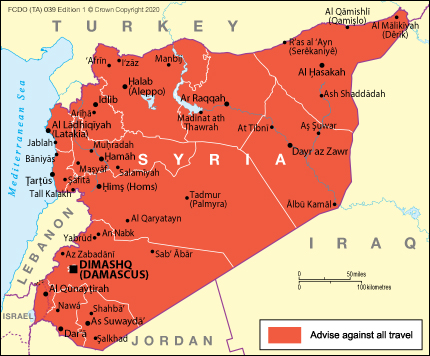
This advice has been reviewed and reissued with amendments to the Travel Summary ('Nakba Day’). The overall level of the advice has not changed. We advise against all travel to the whole of Syria; British nationals in Syria should leave now by commercial means.

(see travel advice legal disclaimer)


Travel advice for this country


  • On 1 March 2012, the Foreign Secretary announced his decision to withdraw all remaining UK diplomatic staff from Syria and suspend the services of the British Embassy in Damascus with immediate effect. This decision was based on the deteriorating security situation in country.

  • We advise against all travel to the Syrian Arab Republic. British nationals in Syria should leave now by commercial means whilst these are still available. Those who choose to remain in Syria or to visit against our very clear advice should be aware that we are not able to provide normal consular services nor are we able to organise or assist your evacuation from the country. If, despite our advice to leave now, you choose to travel to Syria, or stay there, make sure you and your family have a valid exit stamp on your travel documents if you need one.

  • The Hungarian Embassy has assumed the role of Protecting Power for British interests in Syria.  British nationals requiring urgent consular assistance should therefore contact the Hungarian Embassy in Damascus.  See Entry Requirements and General - Consular Services.

  • There is a high threat from terrorism. Attacks could be indiscriminate, including in places frequented by Westerners, including British nationals. There have been a number of explosions in Syria since December 2011, which have killed and injured people. On 10 May there were explosions in Qazzaz, a southern suburb of Damascus, reportedly killing at least fifty and injuring over 300. Public places, hotels or restaurants could be targeted.

  • There are continued violent attacks across the country, including Damascus and its suburbs. Military operations and clashes between protestors and security forces have resulted in a significant number of deaths and injuries. There have also been a number of attacks on regime-affiliated targets in different parts of the country using gunfire, rocket-propelled grenades and improvised explosive devices. If you remain in Syria against our advice, you should remain vigilant, avoid crowds, and assess the security situation before travelling anywhere in Syria.

  • It is likely that road networks may be blocked during disturbances or demonstrations. Several major highways including Tartous-Latakia, Tartous-Homs, Latakia-Aleppo, Homs-Hama, Homs-Damascus and Damascus-Jordan have been temporarily closed because of demonstrations or disturbances. There has also been an increase in the number of security force checkpoints on major road routes. There is an increased likelihood of large gatherings on public holidays and at weekends, particularly in the hours following Friday prayers.

  • Disturbances and road closures have affected access to some land border crossing points. This can happen at short notice, and it may not be possible to guarantee security along the route. You should check the status of the border crossing and access routes, including those into Turkey, before travelling. The main Nasib/Jaber border crossing with Jordan is currently open, but at times it has also been affected, with limited access due to numerous road blocks along the route. You should avoid the Ar Ramtha border crossing to Jordan and the Tal Kalakh/Hdaideh crossing in to north-east Lebanon.. You should not attempt to enter Iraq via the Syrian border, which is subject to restrictions on both sides.

  • You should be aware that there are reports of kidnappings. On 28 April, two Hungarian nationals were kidnapped in South-East Syria.  You should be aware that the long-standing policy of the British Government is not to make substantive concessions to hostage takers. The British Government considers that paying ransoms and releasing prisoners increases the risk of further hostage-taking.

  • As a result of the ongoing political and security instability, certain financial transactions have become more difficult. There have been reports that service providers outside Syria are refusing to accept payment using a Syrian-issued credit or debit card; all Dollar payments and Dollar bank accounts in Syria have effectively been frozen; it has become very difficult to withdraw Dollars and Euros, and most cash withdrawals are limited to Syrian pounds. See General – Money. 

  • If despite our advice you decide to travel to Syria, you should take out comprehensive travel and medical insurance before travelling. See General - Insurance.

  • 15 May is ‘Nakba Day’. We advise those travelling to the Israeli border area with Syria to be extra vigilant during this time. You should avoid any political gatherings and/or demonstrations.

Safety and Security - Civil Unrest/Political Tension
There are continued violent attacks across the country, including Damascus and its suburbs. Military, government and public buildings, have been  targets.  Military operations and clashes between protestors and security forces have resulted in a significant number of deaths and injuries. There have also been a number of attacks on regime-affiliated targets in different parts of the country using gunfire, rocket-propelled grenades and improvised explosive devices.

We therefore advise against all travel to the Syrian Arab Republic. British nationals in Syria should leave now by commercial means.  If you choose to remain in Syria or travel there against our very clear advice, you should be aware that the British Embassy will not be able to provide normal consular services nor would they be able to organise or assist your evacuation from the country. If, despite our clear advice to leave you choose to remain, please make sure you and your family have a valid exit stamp on your travel documents if you need one to leave Syria.

Violent protests have taken place outside a number of Embassies and Consulates in Damascus, Aleppo and Latakia; in some cases the buildings were physically attacked and damaged. You should take precautions for your personal safety and avoid all public gatherings and demonstrations of any kind, as they all have the potential to turn hostile. You should be particularly vigilant in public places. There has been live gunfire during some of the demonstrations. If you are caught up in such a situation, you should keep a low profile, leave the area as soon as it is safe to do so and make your way to a safe location. There is an increased likelihood of large gatherings on public holidays or at the weekend, particularly in the hours following Friday prayers.

You should not film or take photographs of gatherings, as this will attract attention. You should keep your passport with you for identification purposes. It is likely that mobile phone, landline and internet networks will be disrupted during a protest.

Since the start of the disturbances there have been a number of military operations, including in the cities of Deraa, Baniyas, Hama, Homs, Latakia, Der-ez-Zor, Tal Kalakh, Ar Rastan and Jisr al Shugur. During these operations it is likely that movement will be limited due to cordons of checkpoints and roadblocks. Communications may also be limited with disrupted access to mobile, landline and internet networks. Given the possibility of live gunfire and possibly other weaponry and the increased security presence during these operations, British nationals caught up in such an operation should keep a low profile and stay indoors.

It is likely that road networks may be blocked during disturbances or demonstrations. Several major highways including Tartous-Latakia, Tartous-Homs, Latakia-Aleppo, Homs-Hama, Homs-Damascus and Damascus-Jordan have been temporarily closed because of demonstrations or disturbances. There has also been an increase in the number of security force checkpoints on major road routes. Because of the unpredictable security situation, you should take extreme care when travelling.

Disturbances and road closures have affected access to some land border crossing points. This can happen at short notice, and it may not be possible to guarantee security along the route. You should check the status of the border crossing and access routes, including those into Turkey, before travelling.  The main Nasib/Jaber border crossing with Jordan is currently open, but at times it has also been affected, with limited access due to numerous road blocks along the route. You should avoid the Ar Ramtha border crossing to Jordan and the Tal Kalakh/Hdaideh crossing in to north-east Lebanon. You should not attempt to enter Iraq via the Syrian border, which is subject to restrictions on both sides.

Journalists working in Syria should be particularly aware of the sensitivities of the authorities towards the media, particularly those working for foreign media organisations. In addition, all foreign journalists entering Syria require special permission from the Syrian authorities. A number of foreign journalists have been killed. Others have been detained by the Syrian security forces during the crisis. The security forces have also confiscated phones, cameras and video cameras of foreigners in Syria. Like all other visitors to Syria, journalists should take particular care to avoid demonstrations which can and have turned violent.

British nationals resident in or visiting Syria are strongly encouraged to register with the FCO via e-mail to consularenquiries.damascus@fco.gov.uk or using LOCATE. Please also make sure you provide the same details of any dependents and highlight their relationship to you. If registering by e-mail, please ensure that you provide us with the following details:

  1. Full name as stated in your passport
  2. Your nationality - Details of any other nationalities held (we recognise dual (British) nationals)
  3. Passport number (s) – please provide both if you are a dual national
  4. Date of Birth
  5. An accurate address (house number, street, town, region, distance from nearest significant town) and/or Global Positioning System co-ordinates
  6. Details of the company you work for including contact details in Syrian and in the UK where appropriate
  7. Are you a resident or tourist in Syria
  8. Do you have a fixed departure date for Syria
  9. Your LOCATE reference if you have begun registration on LOCATE


You should be aware that there are restrictions on unlicensed political and religious activity in Syria. The Syrian authorities have recently detained and deported several British nationals for unauthorised activity. If you are deported by the local authorities, you will not be able to return to Syria.

Syria Country Profile

Safety and Security - Terrorism
There is a high threat from terrorism. Attacks could be indiscriminate, including in places frequented by Westerners, including British Nationals. Public areas, hotels or restaurants could be targeted.  There have been a number of explosions in Syria since December 2011, which have killed and injured people.

  • On 10 May there were explosions in Qazzaz, a southern suburb of Damascus, reportedly killing at least fifty and injuring over 300.
  • On 30 April 2012, there were reports that at least 8 people were killed in two suicide bombs in the north-western city of Idlib.
  • On 27 April 2012, at least 10 people were killed and 25 injured in a suicide attack in Midan, central Damascus.  An extreme Islamic group calling itself Al Nasrah Front claimed responsibility for the attack.  
  • On 17 March 2012, two car bomb attacks in Damascus killed at least 27 people and injured over 100.  Reports suggest that attacks targeted the criminal police headquarters and an air security intelligence centre.
  • On 10 February 2012, there were a number of explosions at different locations in Aleppo.

You should be aware of the global risk of indiscriminate terrorist attacks, which could be against civilian targets including places frequented by foreigners. 

See our Terrorism Abroad page.

Safety and Security - Kidnap
You should be aware that there are reports of kidnappings in Syria. On 28 April, two Hungarian nationals were kidnapped in south-east Syria by unknown figures. You should be aware that the long-standing policy of the British Government is not to make substantive concessions to hostage takers. The British Government considers that paying ransoms and releasing prisoners increases the risk of further hostage-taking.


Safety and Security - Crime
Personal crime levels are low. But all visitors, particularly female travellers alone or in small groups, should continue to take normal precautions with regard to your personal safety and your belongings. Care should be taken in the choice of accommodation - reputable hotels are safer than guesthouses. You should also take care downtown and in the Old City, where there have been reported cases of pick pocketing and harassment. There has been an increase in the number of passports being reported stolen within the Old City: you are advised to keep a photocopy of your passport in a safe place, which you can then use to register the loss of your passport and obtain a replacement.

See our Victims of Crime Abroad page.

Safety and Security - Local Travel
The situation on the Syria/Iraq border is unclear. Traffic across is restricted to certain categories of individuals (businessmen amongst others, but not tourists). You should not attempt to enter Iraq via Syria.

On 23 July 2011, a train travelling from Aleppo to Damascus was derailed in the al-Souda area in Homs. A fire broke out in the cabin resulting in the death of the driver. Several hundred passengers were injured.

Safety and Security - Local Travel - Road Travel
Driving standards and traffic systems are poor and the accident rate is high. Self-drive hire is best left to the experienced. When there is a car accident with a pedestrian, the car driver is always legally responsible in Syria. Driving at night outside main cities is unsafe and should be avoided when possible. Please see the Safety & Security section for more advice on the current demonstrations.

See our Driving Abroad page.

Safety and Security - Regional Developments.
Tensions between Israel, Lebanon and Syria, or between Israelis and Palestinians, or developments in Iraq, can have an effect on public opinion in the whole of the region, including Syria.  You should follow news reports and be alert to regional developments, which might trigger public disturbances.

Syria is a multi-faith country with a long history of religious tolerance. Alongside the majority Sunni population, there are large practising Shia, Christian, Druze and Alawite communities, as well as other smaller sects and religions. However, you should be aware of restrictions on unlicensed political and religious activity, particularly political Islam. Please see the Political Situation section for more details.

The punishment for possession of drugs is life imprisonment. For drug trafficking, the death penalty applies. 

You are advised to carry a photocopy of the information page and the page displaying your visa and entry stamp of your passport, as proof of identity at all times.

Photography near military and many other government installations is prohibited. These zones are not always marked; you should exercise common sense and limit photography to traditional tourist sites. See our Your Trip page.

Entry Requirements - Visas
Should you still decide to travel to Syria, against our clear advice, you require a visa. Whether or not you have a visa you should be aware that if your passport contains an Israeli stamp or stamps from other countries’ border crossing points with Israel, you will be refused entry to Syria. If you are planning to add in side-trips to Lebanon or Jordan, you should apply for a double or multiple entry visa for Syria, as these are otherwise difficult to obtain after arrival. If you intend staying for more than fifteen days you will need to have your visa extended at the immigration office, otherwise you may face difficulties when trying to leave the country. For further information contact the Syrian Embassy in London. 

Entry Requirements - Passport Validity  
You must hold a valid passport to enter Syria. Your passport must be valid for a minimum period of three months from the date of entry into Syria. 

Entry Requirements - Travelling with Children
Single parents or other adults travelling alone with children should be aware that Syria requires documentary evidence of parental responsibility before allowing lone parents to enter the country or, in some cases, before permitting the children to leave the country.

Medical treatment is inexpensive but standards vary from one hospital to another, although most are well equipped. Doctors are generally well qualified though nursing standards vary. Many medical staff speak French or English.

You should exercise normal precautions to avoid exposure to HIV/AIDS. See our HIV and AIDS page. You should seek medical advice before travelling to Syria and ensure that all appropriate vaccinations are up-to-date.  

For further information on vaccination requirements, health outbreaks and general disease protection and prevention you should visit the websites of NaTHNaC and NHS Scotland's Fit For Travel or call NHS Direct on 0845 46 47. For more health information see our Travel Health and Swine Flu pages.

General - Insurance  
You should take out comprehensive travel and medical insurance before travelling. In light of the advice against all travel to Syria you should carefully check the small print of your policy for any exclusions. For more general information see our Travel Insurance page.

General - Consular Services  

British nationals requiring routine consular advice should contact the Foreign and Commonwealth office  office on +44 20 7008 1500 or e-mail ConsularEnquiries.Damascus@fco.gov.uk.  In an emergency, you should contact the Hungarian Embassy in Damascus.
Address: Mezzeh, East Villas, As-Salam Str. 12. Mosque Al-Akram, Damascus,
Phone numbers:  (00-963-11) 611-07-87, 611-28-04, 611-79-66,
Emergency number: 00-963-955-336-006
Fax:  611-79-17
E-mail:  titkarsag.dam@mfa.gov.hu  or mission.dam@mfa.gov.hu

If you require a new full validity British passport  you must now  apply for these services in a neighbouring country. If you require an Emergency Travel Document, to travel immediately please contact the Foreign and Commonwealth Office at consularenquiries.damascus@fco.gov.uk or by telephone +44 20 7008 1500, for further information and to discuss options for how you might apply

General - Money  
As a result of the ongoing political and security instability, there have been a number of restrictions placed on financial transactions in Syria. Some of these restrictions are the decision of the Syrian Government, while others are the result of international businesses and banks being unwilling to invest or trade with Syria in the current environment.

At the moment it is unclear exactly what is possible and what is not. However, the information below may help you to manage your own finances more effectively.

- It is no longer possible to use internationally issued credit and debit cards to withdraw money from cash machines or to pay for goods and services in Syria. Some card issuers have stated that they will still process transactions in high end hotels and restaurants, but this is subject to change and some service providers, including a 5 star hotel, have already refused to accept payment by international credit card.

- There have been reports that service providers outside Syria are refusing to accept payment using a Syrian-issued credit or debit card.

- Since August 2011 it has become very difficult to obtain dollars or euros in Syria.  It is possible to make cash withdrawals at a bank in Syrian pounds (although please note the point above about Visa and Mastercard restrictions) and you may be able to make euro withdrawals depending on the availability of currency on the day.

- Most international banks are now refusing to transfer funds direct to banks located in Syria. However, it may be possible to route funding through Dubai or Jordan. You should speak to your bank to check their individual policy.

- Some international banks are closing down personal accounts held by individuals resident in Syria. In most cases it is not possible to change your place of residence to an address outside Syria; this is because of anti-fraud and audit requirements. However, you may be able to close your account and open a new one using an address outside Syria. You should contact your bank to check their latest advice.

Currency exchange bureaux are no longer able to exchange dollars or receive transactions on your behalf. However, exchange offices and money transfer offices, such as Western Union (+963 11 334 5555 (phone), +963 11 334 6666 (fax), or online at www.westernunion.com) may be able to provide assistance depending on the circumstances.

Travellers’ cheques are not accepted at most banks in Syria. In the rare cases where they are accepted, the handling process is complicated and time-consuming.

It is illegal to change money on the street. You should only change money in recognised exchange shops, banks and hotels.


Contacts

Syria, Damascus, British Embassy

Address:

The British Embassy Damascus has suspended all services and all Diplomatic personnel have been withdrawn from Syria.

Those who choose to remain in Syria or to visit against our advice should be aware that we cannot provide consular assistance or service in Syria.

In an emergency, you should contact the Hungarian Embassy in Damascus.
Address: Mezzeh, East Villas, As-Salam Str. 12. Mosque Al-Akram, Damascus,
Phone numbers:  (00-963-11) 611-07-87, 611-28-04, 611-79-66,
Emergency number: 00-963-955-336-006
Fax:  611-79-17, E-mail:  titkarsag.dam@mfa.gov.hu or mission.dam@mfa.gov.hu


British nationals should also register with us using our on LOCATE service, by email to Consular Enquiries Damascus or by telephone (+44) 20 7008 1500. 

Telephone:

N/A

Fax:

N/A

Office hours:

N/A

Website: http://ukinsyria.fco.gov.uk/en/

register
 
register
 
 
Facebook - British abroad
 
Overseas Business Risk