Advanced search
image
Travel & living abroad

Middle East and North Africa

Mauritania

Flag of Mauritania
Still current at: 12 March 2010
Updated: 02 March 2010

This advice has been reviewed and reissued.  The overall level of the advice has not changed; we currently advise against all travel and against all but essential travel to some areas of Mauritania.    

(see travel advice legal disclaimer)

Travel advice for this country

Travel Summary


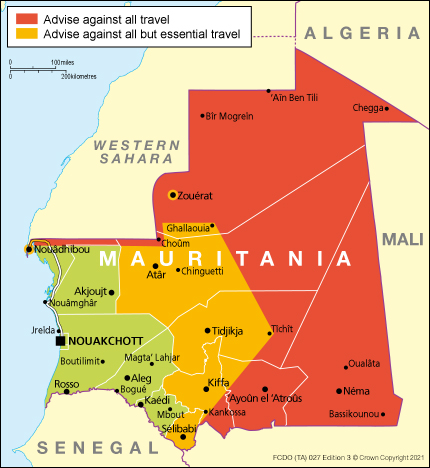
  • We advise against all travel to the eastern and northern provinces of Mauritania - Tiris Zemmour, Adrar, Tagant, and Hodh el Chargui - due to the continuing high threat from terrorism throughout the country, This includes all areas bordering Mali, Western Sahara and Southern Algeria.

  • We also advise against all travel to the western provinces of Dakhlet-Nouadhibou and Inchiri, after the kidnapping of three Spanish aid workers in November 2009.  This includes the road from the port of Nouadhibou to Nouakchott - please see our rally racing travel advice page for further information.

  • We advise against all but essential travel to the rest of the country.  We believe that terrorists continue to plan attacks.  These could be indiscriminate, including in places frequented by expatriates and foreign travellers.

  • There is a high threat of kidnapping in Mauritania and surrounding countries by Al Qaeda in the Islamic Maghreb (AQ-M). A British national who was kidnapped with a group of travellers in the Mali/Niger border region in January 2009 was later executed.

  • We advise British nationals to keep a low profile, exercise caution, and avoid all areas where there are large gatherings of people.  If a demonstration or disturbance is taking place, you should leave the area as quickly and safely as possible.  It is important to be aware of your surroundings at all times.  British nationals should make themselves aware of developments by listening to media reports for further information, as well as monitoring our Travel Advice. 

  • There is no British diplomatic presence in Mauritania and you should register your presence with the British Honorary Consul in Nouakchott.  You should inform the Honorary Consul if you intend to travel to areas outside the main cities of Nouakchott and Nouadhibou. See the General (Representation in Mauritania) section of this Travel Advice.

  • Developments in the region may trigger public unrest, especially after Friday prayers.  You should avoid large gatherings of people and demonstrations, which can turn hostile.  Be particularly alert in public places.

  • The main type of incident for which British nationals required consular assistance in Mauritania in 2008 were for replacing lost and stolen passports. You should carry a copy of your passport with you at all times for identification purposes.

  • We recommend that you obtain comprehensive travel and medical insurance before travelling. See the General (Insurance) section of this Travel Advice.

Safety and security

Terrorism

We advise against all travel to the eastern and northern provinces of Mauritania - Tiris Zemmour, Adrar, Tagant, and Hodh el Chargui - due to the continuing high threat from terrorism throughout the country. This includes all areas bordering Mali, Western Sahara and Southern Algeria.

We also advise against all travel to the western provinces of Dakhlet-Nouadhibou and Inchiri, after the kidnapping of three Spanish aid workers in November 2009.  This includes the border with Western Sahara and the road from the port of Nouadhibou to the capital, Nouakchott - please see our rally racing travel advice page for further information.

We advise against all but essential travel to the rest of the country.  We believe that terrorists continue to plan attacks.  These could be indiscriminate, including in places frequented by expatriates and foreign travellers.   There is a high risk of kidnap in Mauritania and surrounding countries by al Qaida in the Lands of the Islamic Maghreb (AQ-M).   Al Qaeda in the Islamic Maghreb (AQ-M) operates directly or through criminal gangs who carry out kidnappings on their behalf or pass on their kidnap victims for monetary gain.

  • On 28 December 2009, a group of Saudi nationals were attached near the village of Djambala in Niger, close to the Mali border.  Four died in this attack.
  • On 18 December 2009 an Italian couple were kidnapped by an armed group in south eastern Mauritania 18 km east of Kobonni on the road to Mali.
  • On 29 November 2009 three Spanish nationals, were kidnapped whilst travelling in an 11-vehicle convoy from the capital, Nouakchott, to the northern port city of Nouadhibou.   Media reports state that AQ-M has claimed responsibility.
  • On 26 November 2009 a French national was kidnapped near Gao in Eastern Mali.
  • On 14 November 2009 there was an attempted kidnap in Tahoua, Niger, by heavily-armed individuals against employees of the American Embassy.
  • On 8 August 2009 a suicide bomb attack took place outside the French Embassy in Nouakchott, injuring three people.
  • On 23 June 2009 a US national was killed in Nouakchott. Al Qaeda in the Islamic Maghreb (AQ-M) has claimed responsibility for the killing.
  • On 22 January 2009 a group of European tourists were kidnapped in the area of the Mali-Niger border.  A British national who was part of this group was later executed.  
  • On 1 February 2008 a group of armed men attacked the Israeli Embassy in Nouakchott.  
  • In December 2007 a family of French tourists was attacked by armed men in the Aleg region of southern Mauritania, in what was believed to be a kidnap attempt.  Four were killed and one was seriously injured.

When travelling in Mauritania you should take steps to protect your safety, and should make sure you have confidence in your individual security arrangements.  You should maintain a high level of vigilance, particularly in public places.  You should take precautions for your personal and vehicle safety.

You should be aware that the long-standing policy of the British Government is not to make substantive concessions to hostage-takers. The British Government considers that paying ransoms and releasing prisoners increases the risk of further hostage-taking.

For more general information see our Terrorism Abroad page.

Crime

Crime levels are moderate but steadily increasing. There have been several incidents of car jacking involving foreigners in the capital as well as reports of robbery, rape and assault. For more general information see our Rape and Sexual Assault Abroad page.  You should avoid the unlit and isolated beach at Nouakchott and ‘Le Cinquième’ district after dark as a number of thefts and violent incidents have been reported there in recent years.


For more general information see our Victims of Crime Abroad page.

Political Situation


Mauritania Country Profile

A bloodless coup took place in Mauritania in August 2008 that overthrew Mauritania's first democratically elected President.  Following months of political tension and uncertainty, elections were held on 18 July 2009 and the inauguration ceremony of the elected President was held on 5 August 2009.

Mauritania is calm but further instability cannot be ruled out.

Travellers to Mauritania should be aware of the impact that the situation in Iraq, as well as the violence between Israelis and Palestinians, has had across the Arab world and the risk of public disturbance in response. You should follow news reports and be alert to developments in the Middle East that might trigger public disturbances. You should take precautions for your personal safety and avoid public gatherings and demonstrations. Any increase in regional tension might affect the local situation.

You should be prepared to adjust travel plans at short notice in light of developments.

Local Travel

You should inform the Honorary Consul in Nouakchott if you intend to travel to areas outside the main cities of Nouakchott and Nouadhibou.

Crossing the border from Senegal can be time-consuming and officials may request payments to cross the border.
Should you experience any difficulties, you should seek advice from the British Honorary Consul.  Contact details are:

Mr Sid’ Ahmed Ould Abeidna
Tel:  +222 525 8331Mob:  +222 630 1217/+33 6800 19567Fax:  +222 525 3903

Road Travel

The coast road between Nouakchott and Nouadhibou runs through a region to which we advise against all travel. On 29 November 2009 three Spanish nationals who were travelling in a convoy on this road were kidnapped (see the Safety & Security – Terrorism section of this Travel Advice for further details).  

The conditions of paved roads in Mauritania are generally poor, and overland travel is difficult. You are advised to use four wheel drive vehicles, check the tide times, travel in convoy and ensure you take adequate supplies of water and fuel.

For more information see the Driving Abroad, see also our page on Rally Racing.

Rail Travel

The national mining company, SNIM, runs a train service for both people and vehicles between Nouadhibou and Atar (80km from Choum).  It is essential to book in advance.

Air Travel

You should reconfirm all flights.

Mauritania Airways runs flights linking Nouakchott to Nouadhibou (daily), Zouerate, Atar, Kaedi, Kiffa, Tidjikja, Aioun and Nema.

Significant deficiencies have been identified in the level of safety oversight that Mauritania gives to aircraft on its register and to the airlines that it certifies.  

Sea Travel

Sailing in the port at Nouadhibou can be dangerous because of the number of shallow shipwrecks.

For more general information see our River and Sea Safety page.

Local laws and customs

Local laws reflect the fact that Mauritania is an Islamic country.  You should respect local traditions, customs, laws and religions at all times and be aware of your actions to ensure that they do not offend other cultures or religious beliefs, especially during the holy month of Ramadan or if you intend to visit religious areas.  For more general information see our Travelling During Ramadan page.

You should respect Mauritanian laws and regulations.  It is considerate to dress modestly.  Sale and consumption of alcohol is against the law, although some restaurants do serve it.  Police sometimes object to photography without prior permission.

It is highly advisable to carry ID, especially when travelling outside Nouakchott (where you may encounter many police road checks).  You are also advised to comply promptly with directions from the police and other Mauritanian security forces, and to carry copies of your personal identity papers (passport) with you at all times.

Homosexuality remains a punishable offence in Mauritania.

Drugs laws are severe.  Those found in the possession of any illegal drug may receive a prison sentence.

For more general information for different types of travellers see our Your trip page.

Entry requirements

Visas

Visas are required for entry to Mauritania.  They should be obtained prior to travel from the Mauritanian Consulate General in Paris, 89, rue de Cherche-Midi, 75006 Paris, Tel +33 1 45 48 23 88, Fax +33 1 45 44 72 42.  Open Monday - Thursday 1000 - 1300. 

Passport validity

The minimum passport validity for entry to Mauritania is three months. 

Travelling with children

Single parents or other adults travelling alone with children should be aware that some countries require documentary evidence of parental responsibility before allowing lone parents to enter the country or, in some cases, before permitting the children to leave the country. For further information on exactly what will be required at immigration please contact the Mauritanian Embassy in Paris at:  ambassade.mauritanie@wanadoo.fr.

Health

Medical facilities are extremely limited, particularly outside Nouakchott and Nouadhibou, where lack of communications makes dealing with an emergency very difficult. Clinics in Nouakchott and Nouadhibou charge for medical care (sometimes in Euros or US dollars), and may not accept foreign insurance cards. You should ensure that your insurance covers medical repatriation by air ambulance.

The weather can be very hot and dry. Fluid intake should be kept high, making sure enough salts are included.

In the 2008 Report on the Global AIDS Epidemic the UNAIDS/WHO Working Group estimated that around 14,000 adults aged 15 or over in Mauritania were living with HIV; the prevalence rate was estimated at around 0.8% of the adult population. This compares to the prevalence rate in adults in the UK of around 0.2%. You should exercise normal precautions to avoid exposure to HIV/AIDS.  You should exercise normal precautions to avoid exposure to HIV/AIDS. For more general information on how to do this see our HIV and AIDS page.

You should seek medical advice before travelling to Mauritania and ensure that all appropriate vaccinations are up-to-date.  For further information on vaccination requirements, health outbreaks and general disease protection and prevention you should visit the websites of the National Travel Heath Network and Centre (NaTHNaC) and NHS Scotland's Fit For Travel or call NHS Direct on 0845 46 47.

For more general health information see our Travel Health and our Swine flu pages.

General

Insurance

We recommend that you obtain comprehensive travel and medical insurance before travelling. Your insurance should also cover you for medical repatriation by air ambulance. You should check any exclusions, and that your policy covers you for all the activities you want to undertake. For more general information see Travel Insurance.

If things do go wrong when you are overseas see our When Things Go Wrong page.

Registration

Register with our LOCATE service to tell us when and where you are travelling abroad or where you live abroad so our consular and crisis staff can provide better assistance to you in an emergency. 

More about registering with LOCATE

Representation in Mauritania

There is no British Embassy in Mauritania. The British Ambassador in Rabat, Morocco is accredited to Mauritania.  There is a British Honorary Consul in Nouakchott, Mr Sid'Ahmed Ould Abeidna. If you decide to travel to Mauritania, you should endeavour to register with the Honorary Consul.

Contact details of the British Honorary Consulate are as follows:

Mr Sid’ Ahmed Ould Abeidna:Tel: +222 525 8331Mob: +222 630 1217/+33 6800 19567Fax: +222 525 3903

Honorary Consul is authorised to issue emergency passports in Mauritania. 

Money

Local currency (Ouguiya) is not convertible and may not be exported.  US Dollars or (preferably) Euros can be changed for Ouguiyas at banks, some hotels and official Bureaux de Change. The rate for Sterling is very poor. Credit cards can be used at a few hotels in Nouakchott and Nouadhibou. ATMs do not accept foreign credit or debit cards.

Contacts

Morocco, Rabat, British Embassy

Address:

British Embassy                                        
28 Avenue S.A.R. Sidi Mohammed            
Soussi 10105 (BP 45)
Rabat

Telephone:

+212 (0)537 63 33 33

Fax:


Office hours:

GMT: (Local Time = GMT)
Monday - Thursday: 08:00 - 16:15
Friday: 08:00 - 13:00
Ramadan: Monday - Thursday: 08:00 - 14:00; Friday: 08:00 - 13:00
E-mail: Rabat.Consular@fco.gov.uk

Website: http://ukinmorocco.fco.gov.uk/en