Advanced search
image
Travel & living abroad

Middle East and North Africa

Lebanon

Flag of Lebanon
Still current at: 12 February 2012
Updated: 30 December 2011
No restrictions in this travel advice Avoid all but essential travel to part(s) of country Avoid all but essential travel to whole country Avoid all travel to part(s) of country Avoid all travel to whole country


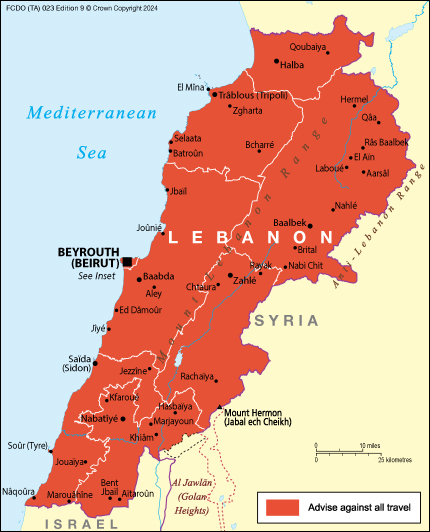
This advice has been reviewed and reissued with an amendment to the Safety and Security - Terrorism section (explosions in Tyre; be vigilant over the New Year period). The overall level of the advice has not changed; we advise against all travel to Palestinian refugee camps; we advise against all but essential travel to within 5km of the Syrian border, to the Bekaa Valley and to areas south of the Litani river.


To see a PDF version of this map, click here (197 KB).

(see travel advice legal disclaimer)

Travel advice for this country

  • We advise against all but essential travel to anywhere within 5km of the border with Syria. There have been a number of incidents where Syrian troops have crossed into Lebanon at various points on the border.

  • We advise against all but essential travel to south of the Litani river because of the risks of landmines and insecurity.

  • We advise against all but essential travel to the Bekaa Valley due to the risk of kidnap. If you have an essential requirement to travel between Beirut and Masna’a you should take appropriate security precautions, exercise particular caution during your journey and not stray off the main road.

  • We advise against all travel to Palestinian refugee camps in Lebanon due to the risks of insecurity.
  • You are advised to avoid large crowds, demonstrations and political gatherings. Such events often turn violent.

  • There is a general threat from terrorism in Lebanon. Attacks could be indiscriminate, including in places frequented by expatriates and foreign travellers such as hotels and restaurants. You are advised to be vigilant over the New Year period. See Safety and Security - Terrorism.

  • 38 British nationals required consular assistance in Lebanon in the period 01 April 2010 - 31 March 2011. See General - Consular Assistance - Statistics.

  • If you choose to travel to Lebanon we recommend that you register with the British Embassy. You can do this online at LOCATE. See General - Registration. You should also get comprehensive travel and medical insurance. See General -  Insurance.

Safety and Security - Terrorism

There is a general threat from terrorism in Lebanon. Attacks could be indiscriminate, including in places frequented by expatriates and foreign travellers such as hotels and restaurants. Previous terrorist attacks have taken various forms, including vehicle bombs, hand grenades and small, improvised bombs. There is a risk that Western and British interests may be targeted as well as areas where large numbers of people congregate. You are advised to maintain a high level of vigilance in public places, including tourist sites.

On 9 December 2011, five French soldiers and two civilians were injured in a bomb attack targeting a UNIFIL patrol in the Eastern side of Tyre. Anyone travelling to Lebanon should keep themselves well informed and closely monitor political and security developments.

In November and December 2011, bombs exploded in front of two establishments licensed to sell alcohol in Tyre. There are some local media reports suggesting other attacks over the New Year period are also possible. We therefore suggest that extra vigilance is observed during this time.


On 29 November 2011, several rockets were fired into northern Israel from the area between Rumaysh and Ain Ebel in southern Lebanon.  Israel responded by firing into the area of the launch in southern Lebanon. There were no reported casualties.


On 11 August, a small explosion took place in Antelias, a northern suburb of Beirut in which at least one person was killed and another injured. You are advised to remain vigilant at all times.


We advise against all but essential travel to the Bekaa Valley due to the risk of kidnap. On 23 March, seven Estonian nationals were abducted by armed men near Zahle in the Bekaa Valley. They were released on 14 July, but the kidnappers are still at large. Several other kidnaps of Lebanese and Syrian nationals have taken place since then, most recently on 7 December.  If you have an essential requirement to travel between Beirut and Masna’a you should take appropriate security precautions, exercise particular caution during your journey and not stray off the main road.

See our terrorism abroad page.

Safety and Security - Crime

The risk to tourists from petty or violent crime is low by international standards, though vehicle crime and bag snatching continues to be relatively high. In addition there are increasing reports of armed robberies taking place in shared taxis (known locally as Service taxis) with passengers being robbed by either the driver or other passengers. It is advisable to only use taxis from recognised companies and to not use shared taxis or taxis hailed on the street. Normal precautions should be taken. See our victims of crime abroad page.

Safety and Security - Local Travel


We advise against all but essential travel to anywhere within 5km of the border with Syria. There have been a number of incidents where Syrian troops have crossed into Lebanon at various points on the border. On 15 September and 3 October there were incursions by Syrian troops at Al Mwanseh and Wadi Khaled in North Lebanon. There have also been two further incursions into Lebanon, at A’arsal in the northern Bekaa. These incursions have been unpredictable and violent.

We advise against all travel to Palestinian refugee camps in Lebanon, which present volatile environments where the Lebanese state has limited capacity to impose law and order. There has long been a pattern of violent clashes in particular in Ein El Helwe camp near Sidon in southern Lebanon.

We advise against all but essential travel south of the Litani River. Although a large scale de-mining operation has made a big impact on the large amount of unexploded ordnance, including cluster bombs remaining from the 2006 conflict between Israel and Hizballah, this still poses a danger to civilians in the more remote areas. Since 2006 the UN have deployed extra peacekeepers in the area south of the Litani which has led to a period of relative calm between Israel and Lebanon. However, the situation remains unpredictable. On 15 May there were clashes on the Blue Line following a demonstration, during which 11 fatalities were reported with many more injured.

On 29 November 2011, several rockets were fired into northern Israel from the area between Rumaysh and Ain Ebel in southern Lebanon.  Israel responded by firing into the area of the launch in southern Lebanon.  There were no reported casualties.

Safety and Security - Road Travel

An international driving licence is compulsory in Lebanon. This must be certified by the authorities on arrival.

Driving standards are poor and the accident rate is high. Traffic lights are not always observed. Self-drive hire is best left to the experienced. Seat belts must be worn (if fitted). Taxis are not always in good condition or safe; hotels can advise on firms with cars that are recognised as being safe and well maintained. Night driving should be avoided if possible, especially outside well-lit urban areas. Should you choose to drive your own car to Lebanon you should be aware that vehicles with diesel engines are banned. Anyone attempting to enter the country in a diesel car will be required to leave the vehicle at the Syrian border.

You should carry identity papers with you at all times and be prepared to stop at check points and to show your papers. The army have set up temporary check points on major and minor roads.

See our driving abroad page.

Safety and Security - Political Situation

Lebanon country profile

A new government has now been appointed. Anyone travelling to Lebanon should keep themselves well informed and monitor political and security developments.

On several occasions in recent years, the security situation in Lebanon has deteriorated quickly. Demonstrations and other forms of civil unrest can occur at short notice. On 17 June, seven people were killed in Tripoli in violence which followed a demonstration. British nationals are advised to remain vigilant. Demonstrations in Beirut often turn violent, with injuries and sometimes fatalities being reported.

Lebanon is part Muslim, part Christian. In many areas you will find dress codes more relaxed than in other countries of the region, but you should still dress modestly when visiting sites of religious significance such as mosques or churches, and also where it is clear that local people expect it.

You should respect the local traditions, customs, laws and religions at all times and be aware of your actions to ensure they do not offend other cultures or religious beliefs, especially during the holy month of Ramadan or if you intend to visit religious areas. During Ramadan eating, drinking or smoking in public places between the hours of sunrise and sunset may cause offence in some areas. See our travelling during Ramadan page.

Possession, use and trafficking of illegal substances including minute quantities are all serious offences in Lebanon, and carry custodial sentences. Photography should be limited to tourist sites. Photographing military sites may result in your arrest.

The Lebanese Criminal Code contains a general provision concerning 'every sexual act against nature'. Lebanese courts consider that this provision includes homosexuality. A criminal offence under this provision is punishable with a custodial sentence of up to one year. See our your trip page.

Local Laws and Customs - Child Abduction

One of the most common reasons for consular assistance for British nationals in Lebanon is from mothers seeking help in overturning travel bans placed on their children, or themselves, by their fathers or husbands. Lebanese family law is very different from UK law and particular caution is needed if child custody is (or becomes) an issue.

If you have concerns about child custody you should seek advice before travelling to Lebanon about 'travel bans' that can be imposed by male heads of family to prevent wives, children or female family members from leaving Lebanon. Even if a child or female family member holds a British passport they may be Lebanese automatically by descent and so be subject to Lebanese laws and regulations.

Families should note that if children are travelling without their father (even if the mother is accompanying them) the Lebanese immigration authorities may ask for proof that permission to travel has been given by the children's father.

See our Child Abduction page.

Entry Requirements - Visas

British citizens can apply for a single entry tourist or family visit visa on arrival at the port of entry. British Overseas Citizens and British Protected Persons are required to obtain a visa prior to travel to Lebanon (unless they are travelling to Lebanon on their Lebanese documents).  

Overstaying without the proper authority is a serious matter. You may be refused permission to leave until a fine has been paid.

It is considered a very serious offence for anyone of Lebanese descent to have visited Israel, whether or not they have travelled on a British passport. British travellers should not have Israeli stamps in their passports. If your passport contains Israeli stamps you may be refused entry to Lebanon even if you hold a valid Lebanese visa.  

Entry visas for Lebanon are issued free of charge at the airport on arrival however, there is a charge at the border posts if entering Lebanon by road. On a single entry visa issued on arrival at the airport a traveller is permitted to travel to Syria as long as the return to Lebanon is made within five days.

As visa requirements are subject to change, you may wish to contact the nearest Lebanese Embassy.

Entry Requirements - Passport Validity
You must hold a valid passport to enter Lebanon. Your passport must be valid for a minimum period of three months from the date of entry into Lebanon.

Medical treatment in Lebanon can be expensive. Most hospitals are well equipped. Doctors are generally well qualified though nursing standards vary. The majority of medical staff speak French and English.

In the 2010 Report on the Global AIDS Epidemic the UNAIDS/WHO Working Group estimated that around 3,400 adults aged 15 or over in Lebanon were living with HIV; the prevalence percentage was estimated at around 0.1% of the adult population compared to the prevalence percentage in adults in the UK of around 0.2%. You should exercise normal precautions to avoid exposure to HIV/AIDS. For more general information on how to do this see HIV and AIDS

You should seek medical advice before travelling to Lebanon and ensure that all appropriate vaccinations are up-to-date. For further information on vaccination requirements, health outbreaks and general disease protection and prevention you should visit the websites of NaTHNaC and NHS Scotland's Fit For Travel or call NHS Direct 0845 46 47.

See our travel health page and the UK Department of Health website.

Lebanon is in an earthquake zone. However there have been no damaging tremors in recent years.

General -  Insurance

You should get comprehensive travel and medical insurance before travelling. You should check any exclusions, and that your policy covers you for all the activities you want to undertake. See our travel insurance page.

If things do go wrong when you are oversees then see our when things go wrong page.

General -  Registration

British residents in Lebanon as well as British visitors (tourists and business visitors) should register with the British Embassy in Beirut.

You can register via our LOCATE service to tell us when and where you are in Lebanon so our consular and crisis staff can provide better assistance to you in an emergency. You only need to register for the service once and then update your account when you make a new trip abroad. You can even add planned trips abroad up to a year ahead. Help in registering is available by contacting the Embassy.

Ensure that your travel documents are readily available and that your permission to remain or reside in Lebanon is up to date as failure to do so may impede your departure from Lebanon.

General - Consular Assistance - Statistics

38 British nationals required consular assistance in Lebanon in the period 01 April 2010 - 31 March 2011 for the following types of incident; five deaths; and 12 arrests, for a variety of offences.

General - Where To Get Information During A Crisis

In the event of a situation arising where we need to get information to you urgently your Warden network will contact you if you are registered. If, however, there is a loss of communication between you and the Warden network you should monitor the following media outlets for updated information and advice to the community:

TV Stations:
LBCI  
New TV
NBN
Future News
OTV

Radio Stations:
Radio One 105.5 FM
Voice of Lebanon 93.3 FM
Radio Oreint 88.3- 88.6 FM
Sawt El Ghad 97.1- 96.7 FM
BBC Arabic 93.1 FM

Websites:
www.naharnet.com (English Website)
www.nowlebanon.com (English website)
www.dailystar.com.lb (English)
www.bbc.co.uk (English)
www.bbc.co.uk/arabic (Arabic)
www.elnashra.com (Arabic Website)
www.tayyar.org (Arabic Website)

Contacts

Lebanon, Beirut, British Embassy

Address:

Embassies Complex,
Armies Street,
Zkak Al-Blat,
Serail Hill,
PO Box 11-471,
Beirut

Telephone:

+961 (1) 9608 00 (24 hours)

Fax:

+961 (1) 9904 20

+961 (1) 9608 55

Office hours:

GMT: Mon-Thurs: 0600-1400; Fri: 0600-1200

Local Time: Mon-Thurs: 0800-1600; Fri: 0800-1400

Email Visa section: Visa.Beirut@fco.gov.uk

Website: http://ukinlebanon.fco.gov.uk/en

register
 
register


Facebook - British abroad
 
Overseas Business Risk