Advanced search
image
Travel & living abroad

Middle East and North Africa

Jordan

Flag of Jordan
Still current at: 12 March 2010
Updated: 18 January 2010

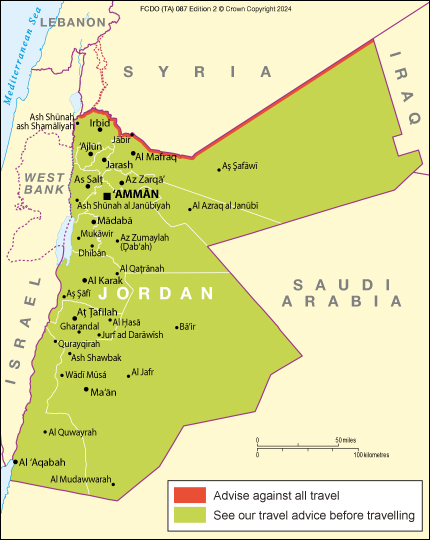
This advice has been reviewed and reissued with editorial amendments throughout.  The overall level of the advice has not changed; there are currently no travel restrictions in place in Jordan.

(see travel advice legal disclaimer)

Travel advice for this country

Travel Summary


  • The majority of visits to Jordan are trouble-free and there are no specific threats to the safety of British visitors or residents. 

  • Regional developments can trigger popular unrest and you should, for example, take care to avoid public demonstrations.

  • There is a general threat from terrorism in Jordan. Attacks could be indiscriminate, including in places frequented by expatriates and foreign travellers. There have been a small number of successful and attempted terrorist attacks in Jordan since 2001 (see the Terrorism section of this Travel Advice).

  • The Jordanian authorities have taken precautionary measures including establishing a hotline for information about A (H1N1)   (+962 79 903 6023)and installing thermal scanning cameras at Queen Alia International Airport and other border crossings.. British nationals with confirmed A (H1N1) infection in Jordan should alert the British Embassy on 00962 6 5909200. The World Health Organisation (WHO) pandemic threat alert phase has been raised to Level 6. The WHO website has further details. You should monitor local media reports for any further developments and advice. There is a dedicated swine flu page on the FCO web-site. Guidance on pandemic flu is available on the UK Department of Health website.
  • If you are planning to travel to Jordan, you should have confidence in your personal security arrangements throughout your visit.  See the Crime section of this Travel Advice.

  • 13 British nationals required consular assistance in Jordan in the period 01 April 2008 – 31 March 2009 for the following types of incident: deaths (4 cases), hospitalisations (2 cases), and arrests, for a variety of offences (3 cases). During this p eriod assistanc e was also requested with regard to lost or stolen passports (15 cases).

  • We recommend that you obtain comprehensive travel and medical insurance before travelling. See the general (insurance) section of this Travel Advice and travel insurance for more details.

Safety and security

Terrorism


There remains a general threat from terrorism in Jordan. Attacks could be indiscriminate, including in places frequented by expatriates and foreign travellers. 

For more general information see terrorism abroad
  • On 14 January 2010, there was a roadside explosion on the Amman to Dead Sea road near the town of Na’ur. There were no injuries from the explosion which was reportedly targeted at an Israeli diplomatic convoy.
  • On 4 September 2006, a shooting incident in downtown Amman left one British national dead and a number of tourists injured.
  • On 1 March 2006, the Jordanian authorities seized explosives and arrested three individuals suspected of planning to carry out a terrorist attack in Amman.
  • On 9 November 2005, three suicide bombers killed 60 people and injured almost 100 in the Radisson SAS, Days Inn and Grand Hyatt hotels in Amman. There were no British casualties.
  • On 19 August 2005, there was a rocket attack in the port of Aqaba in which one Jordanian soldier was killed and another injured. There were no foreign casualties.

Border


Jordan’s land borders are prone to periodic closure.

You should take care at the borders with Israel and Iraq.

You should take care when using taxis for journeys into neighbouring countries.

Iraq - For specific advice on travel to Iraq refer to the FCO travel advice: Iraq. There have been incidences when passengers have been handed over to kidnappers once in Iraq.

Syria - For specific advice on travel to Syria refer to the FCO travel advice: Syria. There have been reports of taxi drivers using the opportunity to indulge in minor smuggling, particularly if travelling late at night.

Crime


Although levels of crime are generally low, women, in particular, should be careful to avoid situations where they might become victims of sexual assault. Advice from the Jordanian police is that, anyone who finds themselves stranded - even in daytime - should call the police (191 or 192). The police will then take the person to a place of safety. Do not accept lifts from strangers. If you have to use a taxi and are resident in Jordan, try to use a regular driver whom you trust and keep his telephone number with you at all times. In the case of short-term visitors to Amman, your hotel should be able to introduce you to a reliable driver. For more general information see rape and sexual assault abroad.

Most other crime is limited to pick pocketing and occasional bag snatching. To avoid becoming a victim, stay alert and keep your money and valuables secure.

For more general information see victims of crime abroad.

Kidnappings

You should be aware that the long-standing policy of the British government is not to make substantive concessions to hostage takers. The British government considers that paying ransoms and releasing prisoners increases the risk of further hostage taking. 

Political situation


Jordan country profile

Developments in Iraq and on the Middle East Peace Process continue to have an impact on local public opinion in the region. There are occasional demonstrations in response to events in Gaza and the West Bank at refugee camps, university campuses and town centres. You should be aware of local sensitivities on these issues. You should follow news reports and be alert to regional developments, which might trigger public disturbances. You should take sensible precautions for your personal safety and avoid political gatherings and demonstrations – although the local authorities monitor demonstrations carefully and effectively, they are unlikely to get out of control. You should avoid downtown Amman after Friday prayers.

Road travel


You should obtain an International driving permit before travelling to Jordan.

There are a high number of road accidents. You should drive with care, especially at night, and avoid driving on unlit roads due to poor road conditions.  Make sure you obtain third party insurance. Special care should be taken when driving outside urban areas at night and should be avoided if possible.  Most roads are unlit and stray animals, broken-down vehicles and unmarked roadworks are commonplace.

The police carry out random security checks at checkpoints on the roads. You should keep identification documents with you to present at these checkpoints. The police also strictly enforce the speed limit and issue on the spot fines between 15 to 150 Jordanian Dinars.

Front seatbelts are required by law. Failure to wear one can result in a fine. All cars must carry a fire extinguisher and warning triangle. Child car seats are generally not available.

In Jordanian law a driver is always guilty if they hit a pedestrian. If you are involved in such an incident, you could face imprisonment and be liable for the payment of hospital bills and other compensation.

Landmines may be located near military installations and borders. Minefields are usually fenced off and marked with a skull and crossbones sign, but fences and signs may be in a state of poor repair.

Roads in mountain areas, including Petra and the surrounding area, can become blocked and cars/coaches can become trapped by occasional heavy snow falls in winter. For more general information see driving abroad.

Local laws and customs

Local laws reflect the fact that Jordan is an Islamic country. You should respect local traditions, customs, laws and religions at all times and be aware of your actions to ensure that they do not offend other cultures or religious beliefs, especially during the holy month of Ramadan or if you intend to visit religious areas. For more general information see travelling during Ramadan.
 The government does not interfere with the practice of Christianity but encouraging conversion to the Christian faith is illegal. It is also considered for a Muslim to convert to Christianity.

Jordan is a conservative society. You are reminded to dress modestly and behave courteously.

Possession, use or trafficking in illegal drugs is a serious offence and can result in lengthy prison sentences and heavy fines.

Whilst Jordanian law may not explicitly outlaw homosexual acts, Jordan is a conservative society and public displays of affection between homosexual couples are not generally tolerated; they could result in arrest and prison sentences imposed under Jordanian law.

Women are advised to take extra caution when travelling alone as there have been isolated incidents of harassment. For more general information for different types of travellers see your trip

Entry requirements

Visas

 You need an entry visa to Jordan. You can obtain single entry visas, valid for one month, on arrival at any port of entry, except for the King Hussein Bridge at the Jordan/Israel border. A single entry visa costs 10 Jordanian Dinars.

If you wish to visit Israel and the Palestinian Authority during your visit, it is better to obtain a multiple entry visa before departure from the Embassy of the Hashemite Kingdom of Jordan in London.

If you would like a multiple entry visa you can only apply for this at Jordanian diplomatic missions abroad.

You can extend your visa up to three months at any police station after your arrival. You are allowed to extend your stay in Jordan for a maximum period of six months. If you do not extend the validity of your visa, and stay in Jordan after your visa expires you will be fined 1.5 Jordanian Dinars for each day you overstay.  

Passport Validity

 You need a valid passport to enter Jordan and it should have at least 6 months' validity remaining. 

Travelling with Children

 Single parents or other adults travelling alone with children should be aware that some countries require documentary evidence of parental responsibility before allowing lone parents to enter the country or, in some cases, before permitting the children to leave the country. For further information on exactly what will be required at immigration please contact the Embassy of the Hashemite Kingdom of Jordan in London

HIV Test


You must undergo an HIV test if you intend to stay in Jordan for more than three months, either as a resident or as a long-term visitor. 

Dual nationals


If you are a British/Jordanian national, you are allowed to use your British passport on arrival, but will need to show your Jordanian passport on departure.

Health

Medical facilities outside Amman are basic and primitive and in an emergency you are advised to seek treatment in Amman. However, if needed, emergency treatment is also available in Aqaba. But please be aware for more complicated matters you will be transferred to Amman.

The temperature in summer months can reach over 40 degrees Celsius. Take care and use high factor sun-block. Drink plenty of water to avoid dehydration.

You should exercise normal precautions to avoid exposure to HIV/AIDS. For more general information on how to do this see HIV and AIDS.

You should seek medical advice before travelling to Jordan and ensure that all appropriate vaccinations are up-to-date. For further information on vaccination requirements, health outbreaks and general disease protection and prevention you should visit the websites of NaTHNaC and NHS Scotland's Fit For Travel or call NHS Direct on 0845 46 47.

For more general health information see travel health.

A (H1N1) - swine flu

There have been confirmed human cases of A (H1N1) Swine Flu in Jordan, including a small number of deaths.  The Jordanian authorities have taken precautionary measures including establishing a hotline for information about A (H1N1):  + 962 79 903 6023and have installing thermal scanning cameras at Queen Alia International Airport and other border crossings. British nationals with confirmed A (H1N1) infection in Jordan should alert the British Embassy on 00962 6 5909200. The World Health Organisation (WHO) pandemic threat alert phase has been raised to Level 6. The WHO website has further details. You should monitor local media reports for any further developments and advice. There is a dedicated Swine Flu page on the FCO website. Guidance on Pandemic Influenza is available on the UK Department of Health website.

Natural disasters


There are occasional earth tremors in Jordan. The last one occurred in February 2008, and measured 5.2 on the Richter scale.

General

Insurance

 You are recommended to obtain comprehensive travel and medical insurance before travelling. Ensure your insurance covers unexpected losses or expenses eg lost luggage, stolen cash and credit cards or cancelled/missed flights. You should check any exclusions, and that your policy covers you for all the activities you want to undertake. Please see travel insurance for more information.

If things go wrong when overseas, then this is how we can help.

Visas for Syria and Saudi Arabia


If you are travelling from Jordan to Syria and Saudi Arabia, you must obtain these visas before arriving in Jordan. If your passport contains Israeli stamps or Jordanian or Egyptian stamps from border crossings with Israel, you will be refused entry to Syria and Saudi Arabia, even if you have a valid visa.

Registration


Register with our LOCATE service to tell us when and where you are travelling abroad or where you live abroad so our consular and crisis staff can provide better assistance to you in an emergency.

Money


Cash machines are available throughout Amman and at the Queen Alia airport. There is limited availability in the rest of the country.

Contacts

Jordan, Amman, British Embassy

Address:

British Embassy
(PO Box 87) Abdoun
Amman 11118

Fax:

(962) (6) 590 9279
(962) (6) 590 9219 Political

Office hours:

Sun-Wed: 0600-1330 GMT (0800-1530 local time)
Thurs: 0600-1300 GMT (0800-1500 local time)

Website: http://ukinjordan.fco.gov.uk/en/