Travel Summary
-
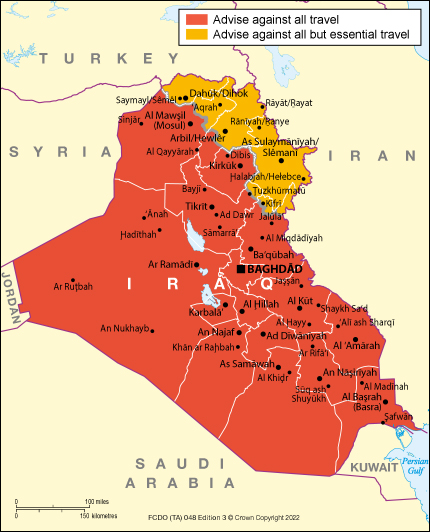
We advise against all travel to Baghdad and its surrounding area, the provinces of Basra, Maysan, Al Anbar, Salah Ad Din, Diyala, Wasit, Babil, Ninawa and At-Tamim (At-Tamim is often referred to as "Kirkuk Province"). We also advise against all but essential travel to the provinces of Al Qadisiyah, Muthanna, Najaf, Karbala, and Dhi Qar. See the Terrorism/Security section of this Travel Advice.
-
Although there has been a decrease in the level of violence throughout Iraq the situation remains highly dangerous with a continuing high threat of terrorism throughout the country (except in the Kurdish Region see next para). This includes violence and kidnapping targeting foreign nationals (including individuals of non-western appearance). You are advised to seek professional security advice and make arrangements for your security throughout your visit. Even those working with dedicated protection teams should exercise extreme caution.
-
The risk of terrorism in the Kurdistan Regional Government controlled provinces of Dohuk, Erbil and Sulaimaniyah (Note: this does not include Kirkuk) is markedly and statistically lower than in other parts of Iraq. You should seek advice before travelling to the remote border areas with Turkey and Iran where there have been incidents of shelling. See the Terrorism/Security (Kurdistan Region) section of this Travel Advice for more specific details regarding the unique security situation.
-
There is currently no countrywide curfew in Iraq. They can be and are imposed at short notice often around religious holidays. During early March, travel restrictions may be put in place to ensure the security of the national elections on 7 March which may lead to disruption to travel into, out of and around the country. When in place curfew times must be strictly adhered to and avoid large gatherings. See the Terrorism/Security (Curfews) section of this Travel Advice.
-
15 British nationals required consular assistance in Iraq in the period 1 April 2008 – 31 March 2009 for the following types of incident: deaths (5 cases); hospitalisations (3 cases); and arrests, for a variety of offences (2 cases). During this period assistance was also requested with regard to lost or stolen passports (36 cases). The British Embassy in Baghdad is able to offer only limited consular assistance. The British Embassy Offices in Basra and Erbil are able to offer limited consular assistance, in the event of an emergency. You should register your presence with LOCATE.
-
We recommend that you obtain comprehensive travel and medical insurance before travelling.
See the General (Insurance) section of this Travel Advice
.
Safety and security
Terrorism/Security
There is a high threat of terrorism throughout Iraq. We advise against all travel to Baghdad and the surrounding area, the provinces of Basra, Maysan, Al Anbar, Salah Ad Din, Diyala, Wasit, Babil, Ninawa, and At-Tamim (At-Tamim is often referred to as "Kirkuk Province"). We advise against all but essential travel to the provinces of Al Qadisiyah, Muthanna, Najaf, Karbala, and Dhi Qar.
Terrorists and insurgents conduct frequent and widespread lethal attacks on a wide range of targets in Iraq, including against British and other international military, political and civilian targets. There have been in August, October and December 2009, major bomb attacks against state institutions in Baghdad. In January 2010 there were major bomb attacks against a number of hotels in Baghdad that are popular with British and western-flagged organisations. There may be further attacks of this nature in the future.
For more general information see our
Terrorism abroad page.
Targets
Terrorists, insurgents and criminals target British and western flagged organisations, non-governmental organisations and contractors working – or perceived to be working - in support of them (particularly those who live and work outside of military protected bases or the International Zone in Baghdad) are at high risk of attack. There have been attacks on the International Committee of the Red Cross, the UN, journalists, foreign contractors and visitors to Iraq. As are commercial, aviation, maritime and infrastructure targets as well as Iraqi Government and other related political and security facilities. Indiscriminate attacks against civilian targets also occur.
Targets have included places such as hotels, restaurants where westerners congregate and civilian vehicles and civil aviation. Civilian and military aircraft arriving in and departing from Baghdad International Airport and flying to other major cities in Iraq have been subjected to attack by small arms and missiles. However, the standard of security at Baghdad International Airport’s civilian terminal has improved. There are still concerns and we urge you exercise caution if using the civilian terminal.
There have also been attacks within Baghdad's International (or Green) Zone. Terrorists and insurgents continue to attack mosques, churches, army recruiting centres, public transport, police stations, government buildings and party political offices. You should avoid large gatherings and exercise extreme vigilance, especially on Fridays after weekly prayers. Ceremonies to mark Islamic and Christian festivals have been targeted, including near churches or holy areas. Rocket and mortar attacks occur sporadically in Baghdad (including the International Zone) and Basra.
Methods of attack include shootings, bombings, suicide bombs, vehicle bombs, rockets and mortars.
Kidnap
There remains a high threat of kidnapping across Iraq. Five British nationals were abducted from eastern Baghdad on 29 May 2007 and one from Basra on 10 February 2008. Particular caution should be exercised throughout all of the country. Individuals have been kidnapped at their residence, work and in transit. Kidnappers do not discriminate on the basis of nationality, religion, gender, age or profession. Since April 2006, large numbers of people have been kidnapped, of which a number resulted in the death of hostages. You should be aware that further kidnaps might be planned.
The motives of hostage takers vary from political to profit. The long-standing policy of the British Government is not to make substantive concessions to hostage takers. The British Government considers that paying ransoms and releasing prisoners increases the risk of further hostage taking.
The provision of close security protection is extremely important for those working in and moving around Iraq. But this in itself does not remove the threat – a number of those who have been kidnapped include individuals who had security arrangements in place. British Citizens, including those working for private security companies, are advised to reassess security arrangements and consider carefully when planning movements throughout Iraq, especially when moving outside the International Zone in Baghdad.
The Kurdistan Region
The three provinces of Dohuk, Erbil and Sulaimaniyah form the Kurdistan Region and are administered by the Kurdistan Regional Government which, under the 2005 constitution, has considerable powers of autonomy within a federal Iraq. The Kurdistan Regional Government administered area has significantly greater stability, compared with the rest of Iraq. However, despite largely effective policies countering terrorism in the region, extremist Islamist terrorist groups including Al-Qaida in Iraq and Ansar al Islam have planned and carried out infrequent attacks in the past. A network of Iran-based Kurdish extremists, affiliated with Al-Qaida in Iraq mount occasional cross-border attacks. The threat of terrorism and kidnap remains. Terrorist operations, including in the cities of Erbil and Sulaymaniyah, have generally been conducted against Kurdistan Regional Government targets. On 10 March 2008, a suicide vehicle bomb exploded outside Sulaimaniyah Palace Hotel. On 9 May 2007, a suicide vehicle bomb exploded outside the Ministry of Interior in Erbil. This was the first attack of its kind in Erbil in two years. Shelling in the border areas with Turkey and Iran in the Kurdistan Region still occurs. You should seek advice on the situation in these remote border areas before travelling there.
Northern Iraq (Outside Kurdistan Region)
Outside the Kurdistan Region, the security situation in northern Iraq remains highly dangerous and volatile. In Kirkuk and Mosul there are still a number of terrorist attacks, including suicide bomb attacks, vehicle bombs, and shootings, which have led to many innocent bystanders being killed. On 28 July 2008 a suicide bombing among a crowd of demonstrators in Kirkuk caused a number of deaths and casualties, and a suicide bomber caused large numbers of deaths at a restaurant during holiday festivities in December the same year. On 16 July 2007, two vehicle bombs caused a number of deaths and casualties. In a separate incident on the same day in Khataniya and Jazeera, the Kurdish Yazidi area of Ninawa province, around 400 people were killed and around 500 injured in four co-ordinated suicide vehicle bombs.
Curfews
Although there is currently no countrywide curfew we advise that curfews and vehicle bans can and are enforced at short notice, particularly around religious holidays, pilgrimages and key political dates such as elections.
During early March, travel restrictions may be put in place to ensure the security of the national elections on 7 March 2010, which may lead to disruption to travel into, out of and around the country. Please ensure you check with the relevant local authorities for curfews before travelling.
Travelling to Iraq
If you consider your presence in Iraq is essential you should have adequate and continuous professional close security arrangements and ensure they are regularly reviewed.
Any companies with involvement or planned involvement in commercial projects should contact the Iraq Unit at UK Trade and Investment (tel: 020 7215 8893; e-mail: iraqunit@uktradeinvest.gov.uk). Pre-deployment security training for employees is highly recommended.
Visitors to Basra are advised that meeting facilities in Basra International Airport can be used for essential business meetings. This can be done via one of the many professional security companies based at Basra Air Station. Any travel to Basra city itself should be organised through a professional security company.
Local Travel
We understand that the Government of Iraq has closed four border crossings with Iran at Kella, Saranban-Golle, Taiwella and Parweez Khan. The border posts of Al Abdali and Safwan with Kuwait have previously been closed at short notice for indefinite periods.
Road Travel
Road travel remains highly dangerous and there continue to be fatal roadside bombings, and random and premeditated attacks on military and civilian vehicles. There have been cases of false vehicle checkpoints from which violent attacks have been mounted. In addition to the threat from terrorism/kidnapping, there is also a continuing criminal threat from car jacking and robbery.
For more general information see our
Driving abroad page.
Sea Travel
Maritime and sailing craft should exercise extreme caution if entering the northern Persian Gulf.
For more general information see our
River and sea safety page.
Local laws and customs
Local laws reflect the fact that Iraq is a predominantly Islamic country. You should respect local traditions, customs, laws and religions at all times and be aware of your actions to ensure that they do not offend other cultures or religious beliefs, especially during the holy month of Ramadan or if you intend to visit religious areas. For more general information for different types of travellers see our Your trip page.
Entry requirements
British nationals must have a visa before travelling to Iraq. You can apply for a visa at Iraqi missions overseas, including the Iraqi Embassy in London. Please see the Iraqi Ministry of Foreign Affairs website. For British nationals travelling only to Kurdistan Region, a visa may be obtained on arrival.
You should ensure that you have the appropriate documentation for entering Iraq. This includes, but is not limited to, a valid visa, in-date Weapon Authority Cards (WAC) (if carrying weapons), registration documentation from the Ministry of the Interior and/or military ID if using military routes. The Department of Border Enforcement (DBE) have recently made a number of arrests, including British nationals, who have failed to provide the appropriate documentation when requested. For more details on what documentation you need you should see the Iraqi Ministry of Foreign Affairs website or contact the Iraqi Embassy in London.
Health
Limited medical facilities are available. In the event of serious accident or illness, an evacuation by air ambulance may be required. Malaria is common in some rural areas in the north and in Basra province in the south. In 2008 twelve out of the eighteen provinces across Iraq had outbreaks of cholera. As a precaution you should drink or use only boiled or bottled water and avoid ice in drinks. If you suffer from diarrhoea during a visit to Iraq you should seek immediate medical attention. If you are travelling to Jordan you may be asked to either prove you have been vaccinated against cholera or you may be required to take antibiotics. The temperature in summer months can exceed 40 ºC (104ºF) and drop as low as 10ºC (50ºF), which can result in dehydration and serious health problems. Drink plenty of water. Weather conditions are arduous. You should exercise precautions to avoid exposure to HIV/AIDS. For more general information on how to do this see our HIV and AIDS page.
You should seek medical advice before travelling and ensure that all appropriate vaccinations are up-to-date. NHS Direct (0845 46 47) can provide you with advice on the vaccination requirements for Iraq.
For further information on endemic diseases, like malaria, health outbreaks and vaccination requirements for Iraq you should check the websites of NaTHNaC or NHS Scotland's Fit For Travel. For more general information see our Travel health page.
You should read this advice in conjunction with our Avian and Pandemic Influenza page.
General
Insurance
We recommend that you obtain comprehensive travel and medical insurance for your proposed trip prior to travel. You should check any exclusions, that your policy covers you for medical assistance and repatriation, and that your policy covers you for all the activities you want to undertake. For more general information see our
Travel insurance page.
If things do go wrong when you are oversees see our
When Things Go Wrong page.
Registering your presence in Iraq
We encourage you to register your presence in Iraq. You can do this in the UK before you leave using our
LOCATE service. Information can be found on the FCO website or
www.ukiniraq.fco.gov.uk Alternatively with the British Consular Officer in Baghdad at:
BritishConsulBaghdad@yahoo.co.uk (for a registration form or to register on line go to:
www.britishembassy.gov.uk.
The British Embassy in Baghdad will only be able to offer limited consular assistance for the foreseeable future. The British Embassy Offices in Basra and Erbil are able to offer limited consular assistance, in the event of an emergency. You may also register with our LOCATE service to tell us when and where you are travelling abroad or if you live abroad so our consular and crisis staff can provide better assistance to you in an emergency.
For general enquiries please contact Iraq Group, Foreign & Commonwealth Office, London, SW1A 2AH, telephone 020 7008 1500 or email:
iraqtraveladvice@fco.gov.uk.
British Embassy Office Basra
E-mail:
Basra.Contact@fco.gov.uk