Advanced search
image
Travel & living abroad

Middle East and North Africa

Iran

Flag of Iran
Still current at: 12 February 2012
Updated: 09 January 2012
No restrictions in this travel advice Avoid all but essential travel to part(s) of country Avoid all but essential travel to whole country Avoid all travel to part(s) of country Avoid all travel to whole country

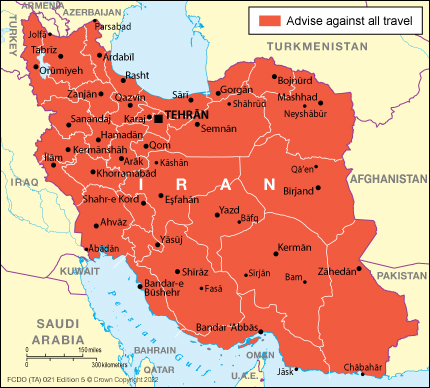
This advice has been reviewed and reissued with editorial amendments. The overall level of the advice has not changed; we advise against all travel to within 100km of the Iran/Afghanistan border, to within 10km of the Iran/Iraq border and east of the line running from Bam to Jask including all travel to Bam; we advise against all but essential travel to the rest of Iran.

(see travel advice legal disclaimer)

Travel advice for this country

  • We advise against all but essential travel to Iran. We advise all British nationals in Iran to keep a low profile. British nationals have been arbitrarily detained in Iran in 2010 and 2011.

  • We advise against all travel to within 100km of the entire Iran/Afghanistan border, and to within 10km of the entire Iran/Iraq border. The Pakistan border area is also insecure, and we advise against all travel east of the line running from Bam to Jask. This includes all travel to Bam.  See Safety and Security - Terrorism and the Safety and Security - Local Travel.

  • There has been a dramatic increase in anti-British rhetoric from parliamentarians and demonstrators. The Iranian parliament and Guardian Council voted on 27 and 28 November 2011 respectively to expel the British Ambassador to Iran. During a demonstration on 29 November 2011 the British Embassy in Tehran was attacked and set on fire.

  • The British Embassy in Tehran has closed and all UK-based staff have been evacuated. We cannot ourselves, at this time, provide consular assistance to British nationals in country. British nationals requiring urgent consular assistance can visit the Embassy of any EU Member State in Tehran, or in an emergency call the FCO in London on (+44) 20 7008 1500. British Nationals should be aware that the ability of EU member states to act on their behalf may be limited.

  • Dual nationality is not recognised in Iran: the authorities will deny that the British Government has any legitimate responsibility for British Iranians and is highly unlikely to inform the us that a dual national has been detained or to grant any consular access. The authorities may technically confiscate the British passport if entry is on the Iranian passport.

  • Photography near military and other government installations is strictly prohibited in Iran. It is not always easy to identify such installations or buildings (which may appear to be ordinary buildings) so we advise extreme caution when taking photographs in public places, and advise you only to use your camera near recognised tourist attractions. Avoid using laptops or other electronic equipment in public places.  See Local Laws and Customs .

  • You should stay away from demonstrations, pro-government gatherings, large crowds or areas where police and security forces are being deployed. You should not watch, photograph or be seen taking an interest in demonstrations or the security forces as you may find yourself subject to arrest and detention without warning.

  • There is a general threat from terrorism. There have been a number of terrorist incidents in Iran. Most recently on 15 December 2010 four terrorist attacks, at a mosque in Chabahar in the south-eastern province of Sistan-Baluchistan, killed 41 people and injured more than 51, during a Shia religious service. Jundullah, the Baluchi separatist terrorist group, claimed responsibility for the attack. See Safety and Security - Terrorism.

  • We believe there remains a threat to foreigners from kidnapping by Baluchi separatists throughout Iran. See Safety and Security - Terrorism.

  • Respect the local laws and traditions at all times and be aware of your actions to ensure they do not offend others' cultures and religious beliefs, especially during the holy month of Ramadan. See  Local Laws and Customs.

  • You should take out comprehensive travel and medical insurance before travelling. See General - Insurance.

  • 17 British nationals required consular assistance in Iran in the period 01 April 2010 - 31 March 2011. See General - Consular Assistance Statistics. You should carry some form of identification with you at all times. Some dual UK/Iranian nationals have also faced problems leaving Iran due to insufficient/incorrect documentation.  See the Entry Requirements - Dual Nationality section.

Safety and Security - Safety

We advise against all but essential travel to Iran. All British nationals in Iran should keep a low profile. There has been a dramatic increase in anti-British rhetoric from parliamentarians and demonstrators. The Iranian parliament and Guardian Council voted on 27 and 28 November respectively to expel the British Ambassador to Iran. During a demonstration on 29 November the British Embassy in Tehran was attacked and set on fire. The Embassy is now closed. British nationals requiring urgent consular assistance can, however, visit the Embassy of any EU Member State in Tehran, or in an emergency call the FCO in London on (+44) 20 7008 1500. British nationals have been arbitrarily detained in Iran in 2010 and 2011.

The US State Department issued a worldwide travel alert on 11 October 2011, urging US citizens to be aware of the potential for anti-US actions following their disruption of a plot linked to Iran. The plot has also been publicly condemned by the UK, so UK nationals should be aware of the potential for anti-US sentiment to be directed at British nationals.

British travellers to Iran – including dual British/Iranian nationals – face greater risks than nationals of most other countries. Iranian paranoia about Britain’s supposed role in its politics means that the security forces are suspicious of people with British connections.

The risks increase for independent travellers, particularly, but certainly not exclusively, if they go off the beaten track. But any behaviour - no matter how innocent - that does not have an obvious explanation can put travellers at greater risk.

Some British nationals submit travel plans to the Iranian authorities. If the traveller later decides to deviate from that route by time or geography, they will help mitigate any potential risk by informing the authorities of a change in their plans.

The Iranian authorities have in many cases failed to meet their international obligations to notify the relevant Embassies immediately that their nationals have been detained. There have been occasional cases of independent travellers detained for more than a month without access to anyone outside the Iranian system. Even if asked for by both the individual and the Embassy, adequate consular access is not always granted. Independent travellers in particular are therefore recommended to ensure they remain in close touch with a third party, such as family or friends.

Dual nationality is not recognised in Iran. On 29 January 2011, Iran executed a Dutch/Iranian national. Despite repeated requests, the Netherlands Embassy was not granted consular access they were neither given information about the case, nor told in the advance of the execution.

The threat to travellers is likely to be higher if there is any national unrest, terrorist incidents or an increase in Iranian-international community tensions. Travellers are advised to monitor the news. In particular, travellers should avoid any demonstrations, where the risk of arrest may be high.

Safety and Security - Security


The Iranian authorities regard border areas as particularly sensitive. The greatest care should be taken not inadvertently to enter into Iranian territories – whether by land, sea or air.

From within Iran, we advise against all travel within 100km of the entire Iran/Afghanistan border or within 10 km of the entire Iran/Iraq border. The Pakistan border area is also insecure, and we advise against any travel east of the line running from Bam to Jask. This includes all travel to Bam.

This area, which mainly covers the south eastern Iranian province of Sistan-Baluchistan, is notorious for its banditry and is the main route for drug-traffickers from Afghanistan and Pakistan. The towns of Zahedan, Zabol and Mirjaveh are particularly insecure. See the Terrorism & Security section of this advice.

Some Iranian officials and media reports have falsely alleged a UK connection to separatist groups in Khuzestan and Sistan-Baluchistan. You should therefore be particularly cautious in Khuzestan and Sistan-Baluchistan.

If you travel to these areas against our advice, you should also stick to the main thoroughfares to avoid accidentally wandering into the numerous restricted or military zones.

Safety and Security - Terrorism


There is a general threat from terrorism. Attacks could be indiscriminate, including in and against places frequented by expatriates and foreign travellers. You should maintain a high level of vigilance and exercise good security practice. British institutions and businesses should also keep their security arrangements under review. See our Terrorism abroad page.

There have been terrorist incidents in cities in Iran.

On 15 December 2010 four terrorist attacks, on a mosque in Chabahar in the south-eastern province of Sistan-Baluchistan, killed 41 people and injured more than 51, during a Shia religious service. Jundullah, the Baluchi separatist terrorist group, claimed responsibility for the attack.

On 29 November 2010 there were two separate car bomb attacks in Tehran. Reports indicate that one attack resulted in a fatality and two were injured in the other. It is not yet clear who perpetrated the attacks.

Iranian Media have reported that on 7 October 2010 gunmen opened fire on a police patrol vehicle and pedestrians in Sanandaj, the capital city of Kordestan Province. Four police officers and one civilian were killed.

On 22 September 2010 ten people were reported killed and over 50 injured in a bomb blast in the north-western town of Mahabad, close to the borders of Turkey and Iraq. The blast happened at a military parade to mark the 30th Anniversary of the start of the Iran-Iraq war.

On 12 January 2010, an Iranian physicist was killed in Tehran when a bomb hidden in a motorbike exploded outside his home.

Several bombings have taken place in the south-eastern province of Sistan-Baluchistan, and we advise against all travel there (see Safety and Security - Local Travel below). On 15 July 2010 a terrorist attack on a mosque in Zahedan in the southern province of Sistan-Baluchistan killed an estimated 27 people and injured 160. On 18 October 2009, a suicide bomber carried out an attack in Pishin, killing at least 42 and injuring more than 30. Jundullah, the Baluchi separatist terrorist group, is believed to be responsible for the attack. Some Iranian sources, including from within the Regime, have claimed that foreign powers – particularly the UK, US and Pakistan – were in some way involved in the attack. The UK has firmly denied this. The risk to foreigners may be greater in the aftermath of such events.

We believe there is a potential threat of kidnap to foreign tourists. You should be aware that the long-standing policy of the British Government is not to make substantive concessions to hostage takers. The British Government considers that paying ransoms and releasing prisoners increases the risk of further hostage taking.

See our Terrorism abroad page.

Safety and Security - Crime


Official crime statistics have not been released but anecdotal evidence has indicated that street crime is rising in Iran. This includes an increase in attacks and robbery against foreigners, including some violent incidents. There have been reports of a number of muggings by young men on motorcycles or in unmarked cars, snatching bags from individuals and open car windows/doors. Where possible, you should avoid carrying large amounts of hard currency on your person and keep your passport secure. Pre-booked taxis are safer than those hailed from the street. There have been incidents of motorcycle taxis taking tourists to quiet locations where they meet an associate and then rob the tourist.

There have been a number of attempted robberies by bogus policemen, usually in civilian clothing. If you are approached by anyone who claims to be a policeman, you should ask to see the officer’s identity card and request the presence of a uniformed officer/marked patrol car. You should not surrender any documents or cash. If the policeman has a vehicle with him and you are not sure he or she is genuine, do not get in.

See our Victims of crime abroad page.


Safety and Security - Local Travel - Road Travel


Iran has one of the highest rates of road accidents in the world. Most of the accidents are due to poor driving standards, dilapidated vehicles, poor road maintenance, and reckless driving. Great care should be taken when travelling by road, including by public transport. Many pedestrians are killed on the roads, and you should exercise great care when crossing streets. If you are involved in an accident, no matter how minor, do not leave the scene. You should wait until the police arrive to make their report.

The Iranian authorities sometimes mount informal roadblocks both in cities and on main highways. They are often suspicious of foreigners, and are often manned by young and inexperienced officers. You should always carry your identification with you in case of such encounters, and avoid getting into disputes.

If you wish to drive your own vehicle into Iran, you may be subject to Iranian customs and other regulations. There are particular requirements for travellers wishing to bring motorcycles into the country. We recommend that you contact the Iranian authorities for details well before you travel.

See our Driving abroad page.

Safety and Security - Local Travel - Air Travel

The European Union has highlighted a number of concerns about air safety oversight in Iran. Since April 2010, a number of aircraft operated by the State carrier Iran Air have been refused permission from operating to/from the European Union. Fourteen aircraft of type Airbus A300, eight aircraft of type Airbus A310 and one aircraft Boeing B737 are exempted from the ban. The restriction was put in place because Iran Air had been unable to demonstrate that a number of aircraft in its fleet (including those of type Airbus A320, Boeing 727, B747-100, B747-200 and B747-SP) meet international safety standards.

The list of airlines banned within the EU is based on random inspections on aircraft of airlines that operate flights to and from EU airports. The fact that an airline is not included in the list does not automatically mean that it meets the applicable safety standards.

There is limited reliable independent expert information available about domestic airline safety in Iran and the International Civil Aviation Organisation has not audited those bodies responsible for air safety oversight in Iran. International travellers should be aware that aircraft operating domestic routes in Iran may not necessarily comply with international safety standards. There have been a number of fatal accidents including:

  • On 9 January 2011, a Boeing 727 domestic Iran Air flight crashed near Orumiyeh in northwest Iran. Of the 105 passengers, at least 77 were reported killed and 28 injured.
  • On 24 January 2010, a Russian registered Tupolev 154 aircraft leased by Taban Airlines of Iran flying from Esfahan to Mashhad damaged its tail while landing and caught fire. 46 of the 157 passengers and 13 crew on board were injured.
  • On 24 July 2009, a Kazakhstan registered Illyushin 62 aircraft leased by Aria Airlines of Iran flying from Tehran to Mashhad skidded off the runway whilst landing. 16 of the 153 passengers and crew on board were killed.
  • On 15 July 2009, a Caspian Airlines Tuploev TU154 plane crashed 75 miles northwest of Tehran shortly after takeoff from Imam Khomeini Airport. All 168 passengers and crew onboard were killed.


Safety and Security - Local Travel - Sea Travel


Many areas of the Caspian Sea and Persian Gulf are highly sensitive politically. The waters around the islands of Abu Musa and the Tunbs in the southern Persian Gulf are particularly sensitive and are militarised. Unaware of this, in 2005 a British couple who anchored at Abu Musa were detained. Similarly, in 2005, French and German nationals were imprisoned for 14 and 15 months respectively for entering the waters near the island. In November 2009 a group of British sailors were detained for a week, along with their vessel, after accidentally sailing into Iranian waters in this area.

On 28 July 2010 a maritime incident involving the Japanese oil tanker M/V M Star occurred in the Strait of Hormuz.

Mariners should not attempt to dock at all or sail into waters around these islands without express permission from the Iranian authorities.

See our River and sea safety page.

Safety and Security - Political Situation

Following the 2009 Iranian Presidential elections, there were significant demonstrations in Iran’s larger cities until 27 December 2009.

After a period without significant demonstrations, there were demonstrations in 2011 in February and March and most recently in June in Tehran, Esfahan and Shiraz and possibly other cities. Police and security forces were deployed in large numbers. During these events a large number of protesters were taken into custody and two opposition leaders remain under house arrest. In 2009 and again in 2011, senior regime figures and the Iranian state media claimed that foreign governments including the UK were behind the demonstrations. These claims are entirely false. Demonstrations were also held in the Azeri regions including provincial capital cities of Urumiyah and Tabriz in August and September 2011. Again, security forces were deployed in large number and protestors taken into custody.

It is very important that British nationals should stay away from demonstrations, pro-government rallies, large crowds or areas where police and security forces are being deployed. If you are unable to leave the immediate vicinity quickly, you should find a place of safety off the street, preferably indoors.

You should not watch, photograph or be seen taking an interest in demonstrations or the security forces as you may find yourself subject to arrest and detention without warning. Given Iranian paranoia about the UK, any such behaviour – no matter how innocent – can put British nationals at greater risk. Travellers should be aware that arbitrary detentions have occurred, including in 2010 and 2011.  

Islamic law is strictly enforced in Iran. You should respect local traditions, customs, laws and religions at all times and be aware of your actions to ensure that they do not offend other cultures or religious beliefs, especially during the holy month of Ramadan or if you intend to visit religious areas.

Local Islamic codes of behaviour and dress are enforced by law. In any public place women must cover their heads with a headscarf, wear trousers (or a floor length skirt), and a long-sleeved tunic or coat that reaches to mid-thigh or knee. Men should wear long trousers and long-sleeve shirts and. If you disregard these rules, you may encounter difficulties or even face arrest.

There are additional dress requirements at certain religious sites, where, for example, women may be asked to put on a chador (a garment that covers the whole body except the face) before entering.

The import, sale, manufacture and consumption of alcohol in Iran is strictly forbidden on religious grounds, with exceptions only for certain recognised Iranian religious minorities (not foreigners). Penalties can be severe.

Photography near military and other government installations is strictly prohibited. Sensitive Government buildings and facilities are often difficult to identify and extreme caution should be taken when taking photographs in any areas that are anything other than very obvious tourist attractions. Use of a laptop or other electronic equipment in public places can be misinterpreted, especially if it contains photographs. You may be arrested and detained on serious criminal charges, including espionage. It is also better to ask before taking photographs of people.

Behaviour regarded as inoffensive elsewhere can lead to serious trouble in Iran, particularly with regard to sexual relations, alcohol and drugs. . Relationships between non-Muslim men and Muslim women are illegal, although few Westerners have been prosecuted. Unmarried partners and friends of the opposite sex travelling together should be discreet at all times in public. Iranian hotel managers could insist on seeing a marriage certificate before allowing any couple to share a double hotel room.  

When you are in public places during the holy month of Ramadan, you should be respectful of the Muslim tradition of not eating, drinking or smoking from sunrise to sunset each day. There are exemptions for travellers who will be able to eat discreetly in hotel and airport restaurants.  

  • Homosexual behaviour, adultery and sex outside of marriage are illegal under Iranian law and can carry the death penalty. 
  • If a Muslim woman is found in a relationship with a non-Muslim man, she may be sentenced to be whipped.
  • Penalties for importing and possessing drugs are severe and enforced. A large number of individuals convicted of drug offences, including foreign nationals, have been executed in recent years.
  • The importation of all alcohol and pork products is banned. 
  • Women's magazines and DVDs/ videos depicting sexual relations are forbidden. There are periodic clampdowns and satellite dishes and many Western CDs and films remain illegal.
See out Travelling During Ramadan page.

For more general information for different types of travellers see Your trip.

Entry Requirements - Visas

British nationals require a visa to travel to Iran. These are only available from Iran’s diplomatic and/or consular missions. British nationals cannot obtain visas on arrival at airports in Iran.

Iranian visas are not required for entry to Kish Island where a stay of 14 days is permitted without a visa.  Travellers must not attempt to travel to the Iranian mainland or stay longer than 14 days in Kish without an Iranian visa.

You should be aware that if your passport contains an Israeli stamp or stamps from other countries’ border crossing points with Israel, you may be refused entry to Iran.

The Iranian Consulate in London has closed.

Since 9 February 2010, the Iranian authorities require fingerprints from British nationals applying for Iranian entry visas.

You should lodge your visa application well in advance of your date of travel. The application process for an Iranian visa can be protracted and unpredictable, and you are advised not to purchase flight tickets or pay for hotels or other travel arrangements before you have secured a visa. You should make sure that your travel documents are in order, and check the expiry date of your visa before travelling. If you overstay your visa, you may be required to remain in Iran until the situation is resolved. You should be aware that some British nationals have experienced considerable difficulties in trying to obtain visas from private online visa agencies.

Women, and girls over the age of nine, should wear a headscarf in their visa application photos.

Entry Requirements - Passports

Standard passport services in Iran have been suspended.

New customers are advised to use other passports, (if they hold dual nationality), to exit Iran and make a full validity UK passport application elsewhere. Full details on how to apply for a new UK passport can be found on FCO website of the country to which they travel (e.g. if to UAE it will be www.ukinuae.fco.gov.uk).  If they travel to the UK and wish to apply there, details of UK application process can be found at www.direct.gov.uk.

Customers needing to travel urgently and have no other passport available are advised to apply to the Embassy of any EU Member State in Tehran for an emergency EU travel document (ETD). The standard application procedures for that country will then apply.  

Customers who applied for a passport before the British Embassy closed, who have not already been contacted by staff at the Regional Passport Processing Centre in Dusseldorf and informed about the whereabouts of their passport, should ring  (+44) 20 7008 1500 for assistance.

See also the UK Border Agency website for UK immigration queries at: http://www.bia.homeoffice.gov.uk

Entry Requirements - Passport Validity

You must hold a valid passport to enter Iran. Your passport must be valid for a minimum period of six months from the date a visa application for Iran is submitted.


Entry Requirements - Dual nationality


Iran does not recognise dual nationality and the authorities will deny that the British Government has any legitimate responsibility for British Iranians. If you are regarded as an Iranian national under Iranian law, you will be required to enter and depart Iran using Iranian travel documents. This may apply if your father is Iranian, or if you are married to an Iranian man, even if you do not consider yourself Iranian.

If you travel on your Iranian travel documents you should ensure that you have the appropriate UK Immigration re-entry/residence endorsement or alternatively your British passport with you when you enter and leave Iran. There is a very small risk that the Iranian authorities may confiscate the British passports of dual nationals.

Entry Requirements - Travelling with children


Iranian law means that a female parent travelling with her children must have the (usually verbal) permission of the father to take them out of the country. This is assumed to be the case by Iranian immigration authorities unless the father has petitioned  the court, and / or the court has ruled to prevent the children travelling in such circumstances. For further information on exactly what will be required at immigration please contact the  Iranian Embassy or Consulate nearest you.

Medical facilities are reasonable in the major cities in Iran but poor in remote areas. Many health professionals will speak some English.

You should seek medical advice before travelling to Iran and ensure that all appropriate vaccinations are up to date. For further information on vaccination requirements, health outbreaks and general diseases for Iran you should check the websites of NaTHNaC (National Travel Health Network and Centre) and NHS Scotland's Fit For Travel or call NHS Direct on 0845 46 47. For more general health information see our Travel health and Swine Flu pages.

In the 2010 Report on the Global AIDS Epidemic the UNAIDS/WHO Working Group estimated that around 91,000 adults aged 15 or over in Iran were living with HIV; the prevalence percentage was estimated at around 0.2% of the adult population, which equals the prevalence percentage in the UK. You should exercise normal precautions to avoid exposure to HIV/AIDS. For more general information on how to do this see HIV and AIDS

Most of Iran is prone to earthquakes. Small tremors occur frequently. On 27 August 2010, an earthquake occurred in the Province of Semnan in North Iran. About three people were killed and at least a dozen injured. The earthquake measured 5.7 on the Richter scale. In 2003, a large earthquake hit Bam, in south eastern Iran, and around 30,000 people died.

UN-sponsored reports suggest that Iran is the world’s number one country for earthquakes, and that it may be ill-equipped to cope in the event of significant tectonic activity in built-up areas.

For advice on how to protect yourself in the event of being caught in an earthquake or tremor, please see: http://www.geologyuk.com/index.htm

General - Insurance

You should ensure that you have comprehensive medical and travel insurance. Some Iranian insurance firms are no longer re-insured by British companies. You should check for any exclusions and that your policy covers you for the activities you want to undertake. See our Travel insurance page.

If things do go wrong when you are overseas see our When Things Go Wrong page.

General - Money

Debit/credit cards will not work in Iran. There are no cash machines or ATMs in Iran that accept UK bank cards. It is also usually not possible to change travellers’ cheques. You should therefore bring sufficient hard currency with you (US$ or Euros are the most useful). It is illegal to change money on the street.

General - LOCATE Registration

We recommend all British nationals register with our LOCATE service to tell us when and where you are travelling abroad or where you live abroad.

General Consular Assistance Statistics

17 British nationals required consular assistance in Iran in the period 01 April 2010 - 31 March 2011 for the following types of incident: two deaths; and four arrests, for a variety of offences.  

Contacts

Iran, Tehran, British Embassy

Address:

The British Embassy in Tehran has closed.

British nationals requiring urgent consular assistance can visit the Embassy of any EU Member State in Tehran, or in an emergency call the FCO in London on (+44) 20 7008 1500.

Website: http://ukiniran.fco.gov.uk/en/

register
 
register


Facebook - British abroad
 
Overseas Business Risk