Travel Summary
-
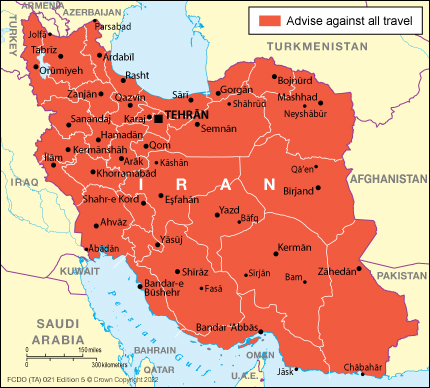
We advise against all travel to within 100km of the entire Iran/Afghanistan border, and to within 10km of the entire Iran/Iraq border. The Pakistan border area is also insecure, and we advise against all travel east of the line running from Bam to Jask. This includes all travel to Bam. See the Terrorism & Security, and Local Travel, sections of this advice for further details.
-
There are confirmed human cases of the H1N1 swine flu virus in Iran, and there have been a small number of deaths. See the Health section of this advice for information on Swine Flu in Iran, and check the FCO Swine Flu page for further information.
-
Large scale demonstrations followed the Iranian Presidential elections on 12 June 2009. The number of people killed in clashes is officially put at 20, but it is probably higher. You should avoid demonstrations, large public gatherings and areas where security forces are deployed. A 23-year-old French national is currently on trial after having attended a post-election political demonstration.
-
The regime has claimed that foreign powers are behind the demonstrations and unrest. The UK has been singled out for particularly strong criticism. In recent years, there have been several violent attacks on, and violent demonstrations outside, the British Embassy compounds in Tehran.
-
You should maintain a high level of security awareness, particularly in public places. If you intend to travel to Iran you should monitor political developments closely and check this advice regularly.
-
There is a general threat from terrorism. Explosions have killed a number of people in recent years. Terrorist attacks could be indiscriminate, including against expatriate and foreign travellers, and you should remain vigilant. On 18 October, a suicide bomber carried out an attack in Pishin in the southern Iranian province of Sistan-Baluchestan. Some Iranian sources have claimed that foreign powers, including the UK (incorrectly), are in some way involved in the attack. Please see the Terrorism & Security section of this advice for further details.
-
We believe there remains a threat to foreigners from kidnapping by Baluchi separatists throughout Iran. See the Safety and Security section of this advice for further details.
-
A series of incidents in recent years have demonstrated that there is a risk to travellers of arbitrary arrest and detention by the Iranian authorities. The Iranian authorities do not always inform the relevant Embassy of the arrest of a foreign national promptly, or even at all.
-
Credit cards and bankcards cannot generally be used in Iran and travellers’ cheques can be very difficult to exchange. See the General (Money) section of this advice for more details.
-
The application process for an Iranian visa can be protracted and unpredictable. Travellers are therefore advised not to purchase flight tickets or pay for hotels and other travel arrangements before they have secured a visa.
-
The main type of incident for which British nationals required consular assistance in Iran in 2008 was for replacing lost or stolen passports. You should carry some form of identification with you at all time. Some dual UK/Iranian nationals have also faced problems leaving Iran due to insufficient/incorrect documentation. See the Entry/Exit Requirements (Dual Nationality) section of this advice for more details.
-
We recommend that you obtain comprehensive travel and medical insurance before travelling. You should check any exclusions, and that your policy covers you for all the activities you want to undertake. See the General (Insurance) section of this advice and Travel insurance for more details.
Safety and security
There is a general threat from terrorism. Attacks could be indiscriminate, including in and against places frequented by expatriates and foreign travellers. You should maintain a high level of vigilance and exercise good security practice. British institutions and businesses should also keep their security arrangements under review. For more general information see:
Terrorism abroad.
In recent years there have been a number of bombs and explosive attacks in cities in Iran.
Several bombings have taken place in the south-eastern province of Sistan-Baluchistan, and we advise against all travel there (see the Local Travel section for more details). On 18 October 2009, a suicide bomber carried out an attack in Pishin, killing at least 42 and injuring more than 30. Jundullah, the Baluchi separatist terrorist group, is believed to be responsible for the attack. Some Iranian sources, including from within the Regime, have claimed that foreign powers – particularly the UK, US and Pakistan – are in some way involved in the attack. The UK has firmly denied this. In May 2009 a bomb exploded inside a mosque in Zahedan, killing 25 people and injuring 178 according to local media. In January 2009 ten police officers were killed following a battle with armed gunmen near the city of Zahedan. In December 2008 a suicide bomber killed two police officers and two civilians in an attack on a police station in Sistan-Baluchistan province.
There have also been attacks elsewhere in Iran in recent years.
In April 2008 there was an explosion at a religious centre in the city of Shiraz that killed 14 and injured about 300. The police and Interior Ministry initially said that it was an accident rather than a terrorist attack, but in May confirmed that it was a terrorist attack.
In October 2007, a Japanese national was kidnapped by suspected bandits from his hotel in Bam and held for eight months. Earlier that same year a Belgian tourist was kidnapped in Sistan-Baluchistan and held for 24 days; his companion was held but released after two days. We believe there remains a threat to foreigners from kidnappings by Baluchi separatists. You should be aware that the long-standing policy of the British Government is not to make substantive concessions to hostage takers. The British Government considers that paying ransoms and releasing prisoners increases the risk of further hostage taking.
For more general information see
Terrorism abroad.
Following the Iranian Presidential elections on 12 June 2009, large-scale demonstrations took place in Tehran and other major cities. These were mainly peaceful but there were violent clashes with police and Basij militia.
Water cannons, teargas, smoke grenades and violent force were sometimes used. Official sources put the official death toll at 20, but there are credible claims that the actual total was much higher.
Sporadic, smaller demonstrations are still possible and could turn violent quickly. You should stay away from demonstrations, large crowds or areas where police and security forces are being deployed. If you are unable to leave the immediate vicinity quickly, you should find a place of safety off the street, preferably indoors.
You should not watch, photograph or be seen taking an interest in demonstrations or the security forces as you may find yourself subject to arrest and detention without warning. One British National was detained for two days recently when he was picked up near a demonstration.
Clothilde Reiss, a 23-year-old French national, was arrested on 1 July and charged with espionage after having gone to see post-election demonstrations in Esfahan. She is now on trial.
Senior regime figures and the Iranian state media have claimed that foreign governments are behind the demonstrations and unrest following the elections. Britain has been singled out for particular criticism. A small demonstration took place outside the Embassy in Tehran on 23 June 2009 complaining of UK interference. Two British diplomats were expelled from Iran on 29 June. Nine Iranian members of staff at the British Embassy were detained on 27 July. They have all since been released. One Iranian member of staff is currently on trial, charged with espionage.
Even before the election there were sporadic violent attacks on, and violent demonstrations outside, the British Embassy compounds in Tehran, coinciding with moments of tension in political relations between the UK and Iran, and with events elsewhere in the region. On 30 December 2008, the Embassy compound was attacked and property damaged. Nobody was hurt in these incidents.
Some Iranian officials and media reports have alleged a UK connection to separatist groups in Khuzestan; British travellers in this province should therefore be particularly cautious.
We advise you to register with the British Embassy in Tehran. You can do this online prior to arrival at:
http://ukiniran.fco.gov.uk/en/. Click on Services then Consular then Online Consular Registration. Alternatively you can register in person at the British Embassy in Tehran, or by telephone +98 (0) 21 6405 2291/94. You may also register with our
LOCATE service to tell us when and where you are travelling abroad or where you live abroad so our consular and crisis staff can provide better assistance to you in an emergency.
More information about registering with LOCATE
Although street crime in Tehran, as in other Iranian cities, is low, incidents of robbery against foreigners are not unknown. There have been a number of robberies by young men in unmarked cars, and young men on motorcycles have also snatched bags, including from open car windows/doors. You are advised not to carry large amounts of hard currency with you. Pre-booked taxis are safer than those hailed from the street.
There have been a number of attempted robberies by bogus policemen, usually in civilian clothing. If you are approached by anyone who claims to be a policeman, you should insist on seeing the officer’s identity card and request the presence of a uniformed officer/marked patrol car. You should not surrender any documents or cash. If the policeman has a vehicle with him and you are not sure he or she is genuine, do not get in.
We advise against all travel within 100km of the entire Iran/Afghanistan border or within 10 km of the entire Iran/Iraq border. The Pakistan border area is also insecure, and we advise against any travel east of the line running from Bam to Jask. This includes all travel to Bam.
This area, which mainly covers the south eastern Iranian province of Sistan-Baluchistan province, is notorious for its banditry and is the main route for drug-traffickers from Afghanistan and Pakistan. The towns of Zahedan, Zabol and Mirjaveh are particularly insecure. See the Terrorism & Security section of this advice.
If you travel to the Iraq border against our advice, you should be aware that the Government of Iraq has closed six border crossings with Iran at Kella, Saranban-Golle, Taiwella, Parweez Khan, Muntheria and al Sheeb.
Iran has one of the highest rates of road accidents in the world. Most of the accidents are due to dilapidated vehicles, poor road maintenance, and/or reckless driving. Great care should be taken when travelling by road, including by public transport. Many pedestrians are killed on the roads, and you should exercise great care when crossing streets. If you are involved in an accident, no matter how minor, do not leave the scene. You should wait until the police arrive to make their report.
The Iranian authorities sometimes mount informal roadblocks both in cities and on main highways. They are often suspicious of foreigners, and are often manned by young and inexperienced officers. You should always carry your ID with you in case of such encounters, and avoid getting into disputes.
If you wish to drive your own vehicle into Iran, you may be subject to Iranian customs and other regulations. There are particular requirements for travellers wishing to bring motorcycles into the country. We recommend that you contact the Iranian Embassy: for details well before you travel.
You should be aware that many of the planes flown on domestic routes in Iran are ageing. There have been a number of accidents in recent years.
On 24 July 2009, an Aria Airlines Ilyushin plane flying from Tehran to Mashhad skidded off the runway whilst landing and hit a wall. 16 of the 153 passengers and crew on board were killed.
On 15 July 2009, a Caspian Airlines plane crashed 75 miles northwest of Tehran shortly after takeoff from Imam Khomeini Airport. All 168 passengers and crew onboard were killed. The cause of the crash has not yet been revealed.
In December 2007, there was a collision between a KLM and Lufthansa passenger plane at ground level at the Imam Khomeini International Airport. There were no casualties. The wing of one of the planes collided with the other one resulting in minor damages.
Iran’s worst air crash was in February 2003 when a Russian made Ilyushin aircraft crashed into the mountains of south-eastern Iran, killing 302 people.
Many areas of the Caspian Sea and Persian Gulf are highly sensitive politically. The waters around the islands of Abu Musa and the Tunbs in the southern Persian Gulf are particularly sensitive and are militarised. Unaware of this, in 2005 a British couple who anchored at Abu Musa were apprehended and they and their vessel were detained. Similarly, in 2005, a French and German national were arrested, put on trial and imprisoned for 14 and 15 months respectively for entering the waters near the island. Three Finns were also detained in the area in June 2007.
Mariners should not attempt to dock at all or sail into waters around these islands without express permission from the Iranian authorities.
Local laws and customs
Islamic law is strictly enforced in Iran. You should respect local traditions, customs, laws and religions at all times and be aware of your actions to ensure that they do not offend other cultures or religious beliefs, especially during the holy month of Ramadan or if you intend to visit religious areas.
Local Islamic codes of behaviour and dress are enforced by law in any public place e.g. hotels and restaurants men should wear long trousers and long-sleeve shirts and women must cover their heads with a headscarf, wear trousers (or a long skirt), and a long-sleeved tunic or coat that reaches to mid-thigh or knee. There are occasional crackdowns on dress particularly in the summer months and during times of religious commemoration. If you blatantly disregard these rules, you may encounter difficulties or even face arrest. There are additional dress requirements at certain religious sites, where e.g. women may be asked to put on a chador (a garment that covers the whole body except the face) before entering.
The import, sale, manufacture and consumption of alcohol in Iran is strictly forbidden on religious grounds, with exceptions only for certain recognised Iranian religious minorities (not foreigners). Penalties can be severe.
Photography near military and other government installations is strictly prohibited. Many such places are often difficult to identify and great care should be taken with photography in areas away from tourist locations, including urban areas. You may be arrested and detained on serious criminal charges, including espionage. Two Swedish men were arrested in April 2006 and imprisoned for over a year on espionage charges for photographing military installations considered sensitive by the Iranians in the Southern Port of Qeshm. It is better to ask before taking photographs of people.
Behaviour regarded as inoffensive elsewhere can lead to serious trouble in Iran, particularly with regard to sexual relations, alcohol and drugs. In general, it is best to err on the side of caution. Relationships between non-Muslim men and Muslim women are illegal, and while few Westerners have been prosecuted since the late 1980s, in the late 1990s a Western businessman was detained for two years on such charges. Unmarried partners and friends of the opposite sex travelling together should be discreet at all times in public. Iranian hotel managers could insist on seeing a marriage certificate before allowing any couple to share a double hotel room. During the holy month of Ramadan, you should in general observe the Muslim tradition of not eating, drinking or smoking in public from sunrise to sunset each day, though there are exemptions for travellers who will be able to eat in hotel and airport restaurants.
You should also be aware that:
- Homosexual behaviour, adultery and sex outside of marriage are illegal under Iranian law and can carry the death penalty.
- Penalties for importing and possessing drugs are severe and enforced. Large numbers of convicted drug traffickers have been executed in recent years.
- The importation of all alcohol and pork products is banned.
- Women's magazines and DVDs/ videos depicting sexual relations are also forbidden. Although cultural restrictions have loosened, there are periodic clampdowns and satellite dishes and many Western CDs and films remain illegal.
For more general information for different types of travellers see
Your trip.
Entry requirements
British nationals require a visa to travel to Iran. Please note that British nationals are not eligible to obtain visas on arrival at airports in Iran. The Iranian Consulate in London is at 50 Kensington Court, London, W8 5DB; tel: 020 7937 5225; fax: 020 7938 1615; (website
http://www.iran-embassy.org.uk). Visa applications should be lodged well in advance of your date of travel. The application process for an Iranian visa can be protracted and unpredictable. Travellers are therefore advised not to purchase flight tickets or pay for hotels and other travel arrangements before they have secured a visa. Women, and girls over the age of nine, should wear a headscarf in their visa application photos.
You should make sure that your travel documentation is in order and check the expiry date of your visa before travelling. If you overstay your visa you may be required to remain in Iran until the situation has been resolved.
Some British travellers have experienced considerable difficulties in trying to obtain visas from private online visa agencies.
All passports must be valid for a minimum period of six months after arrival.
Iran does not recognise dual nationality. If you are regarded as an Iranian national under Iranian law, you will be required to enter and depart Iran using Iranian travel documents. This may apply if your father is Iranian, or if you are married to an Iranian man, even if you do not consider yourself Iranian. If you travel on your Iranian travel documents you should ensure that you have the appropriate UK Immigration re-entry/residence endorsement or alternatively your British passport with you when you enter and leave Iran. For more information on Iranian dual nationality issues contact the Consular Section at the British Embassy, Tehran – email –
tehran.consular@fco.gov.uk.
Single parents or other adults travelling alone with children should be aware that some countries require documentary evidence of parental responsibility before allowing lone parents to enter the country or, in some cases, before permitting the children to leave the country. For further information on exactly what will be required at immigration please contact the Iranian Embassy or Consulate nearest you.
Health
Medical facilities are reasonable in the major cities in Iran but poor in remote areas.
In the 2008 Report on the Global AIDS Epidemic the UNAIDS/WHO Working Group estimated that around 85,000 adults aged 15 or over in Iran were living with HIV; the prevalence rate was estimated at around 0.2% of the adult population. This compares to the prevalence rate in adults in the UK of around 0.2%. You should exercise normal precautions to avoid exposure to HIV/AIDS. For more general information on how to do this see
HIV and AIDS.
You should seek medical advice before travelling to Iran and ensure that all appropriate vaccinations are up to date. For further information on vaccination requirements, health outbreaks and general diseases for Iran you should check the websites of
NaTHNaC and
NHS Scotland's Fit For Travel or call NHS Direct on 0845 46 47.
For more general health information see
Travel health.
H1N1 - Swine Flu
There have been a number of confirmed human cases of the A(H1N1) Swine Influenza virus in Iran, including a number of deaths, and increased surveillance and control measures are in place at Imam Khomeini International Airport (IKIA).
Travellers who exhibit influenza symptoms such as coughing, sneezing, and/or signs of fever are asked to report them on arrival and will be referred to a separate area of the airport for further diagnosis.
Any traveller with suspected H1N1 will be quarantined. Those persons confirmed with the H1N1 virus will be started on a course of anti-viral treatment (Tamiflu).
There are currently no exit checks for travellers leaving the country. Nor are there restrictions on travellers arriving from overseas.
Further general information on Swine Flu can be found on the following websites: www.hpa.org.uk, www.dh.gov.uk and www.direct.gov.uk/swineflu.
In November 2005 the Iranian authorities have confirmed outbreaks of Avian Influenza (Bird Flu) in wild swans in Anzali Wetlands and in domestic poultry in the northern Iranian provinces of Azarbaiyan and Gilan. The World Health Organisation (WHO) have also confirmed cases elsewhere in the region, although there have been no human infections or deaths reported. There have been a number of confirmed human fatalities in Eastern Turkey, 45 kilometres from the border with Iran, and in Iraq. No human infections or deaths have been reported.
The risk to humans from Avian Influenza is believed to be very low. As a precaution, you should avoid visiting live animal markets, poultry farms and other places where you may come into close contact with domestic, caged or wild birds; and ensure poultry and egg dishes are thoroughly cooked.
You should read this advice in conjunction with
Avian and Pandemic Influenza, which gives more detailed advice and information.
Natural disasters
Most of Iran is prone to earthquakes. Small tremors occur frequently. On 10 September 2008, an earthquake occurred in the Province of Hormozgan near the South Iranian city of Bandar Abbas. About seven people were killed and at least 40 injured. The earthquake measured 6.1 on the Richter scale. In 2003, a large earthquake hit Bam, in south eastern Iran, and around 30,000 people died.
UN-sponsored reports suggest that Iran is the world’s number one country for earthquakes, and that it may be ill-equipped to cope in the event of significant tectonic activity in built-up areas.
General
You should ensure that you have comprehensive medical and travel insurance. You should check any exclusions, and that your policy covers you for the activities you want to undertake. See
Travel insurance for more details.
If things do go wrong when you are overseas then this is
how we can help.
The Iranian authorities have in many cases failed to meet their international obligations to notify the relevant Embassies immediately that their nationals have been detained and to provide adequate consular access when asked to do so by the individual.
Credit cards are very rarely accepted and should not be relied upon as a means of payment. There are no cash machines or ATMs in Iran that accept British bank cards. It is also usually not possible to change travellers’ cheques. You should bring sufficient hard currency with you (US$ or Euros are the most useful). It is illegal to change money on the street.