Egypt |
|
| Still current at: 10 February 2012
Updated: 09 February 2012 |
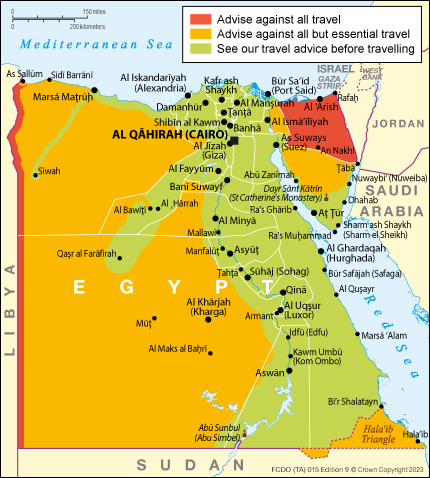
| No restrictions in this travel advice | Avoid all but essential travel to part(s) of country | Avoid all but essential travel to whole country | Avoid all travel to part(s) of country | Avoid all travel to whole country |
This advice has been reviewed and reissued with minor amendments throughout (possible demonstrations on Saturday). The overall level of this advice has not changed; there are
no travel restrictions
in place in this travel advice for Egypt.
(see travel advice legal disclaimer)
Saturday 11 February marks the first anniversary of former President Mubarak's departure. There have been calls to mark the occasion with a Day of Civil Disobedience and large demonstrations are likely, especially in and around the area of Tahrir Square, Cairo. There remains a possibility of demonstrations taking place elsewhere in Cairo, as well as other cities in Egypt, including Alexandria.
British nationals should avoid all crowds and demonstrations. The situaiton can change rapidly and we recommend that you follow events on local and international news and seek advice from tour operators and local authorities.
On 9 February, an accident involving a semi-submersible submarine resulted in three deaths and five injuries to a tour party of German nationals.
Two foreign tourists and their Egyptian guide were kidnapped while travelling by bus on the road between St Catherine's Monastery and Nuweibh in Sinai on 3 February. They were released 10 hours later. You should exercise caution when travelling outside resorts in the Sinai and take advice from local security authorities and your tour operator.
1.034 million British nationals visited Egypt in 2011 (Source: Egyptian Ministry of Tourism). See
General - Consular Assistance Statistics.
The majority of consular cases occur in Cairo and Sharm el-Sheikh.
You should carry some form of photographic ID at all times. A copy of your passport is sufficient.
Safety and Security - Political Situation
Egypt Country Profile
Between 25 January and 11 February 2011 there were major disturbances in Cairo and other locations across Egypt, including Suez, North Sinai, Al-Arish, Rafah, the Delta region and some areas of Upper Egypt, including Luxor. Since this time there have been frequent demonstrations in a number of major cities, usually on Fridays. Some of the demonstrations have been violent and have resulted in deaths.
Demonstrations in Cairo have often centred on Tahrir Square, the Maspero area of downtown Cairo and the Israeli embassy in the district of Giza. There have been reports of sexual assaults on women during some demonstrations in Tahrir Square. There have also been a number of arrests during demonstrations, including British and other foreign nationals. We advise that you follow the news on the television and radio closely, and stay away from demonstrations and large gatherings of people.
There has also been an increase in incidents of protestors blocking roads. Roads have been blocked and tourist buses delayed in Sinai, Aswan, Qena, Suez and between Luxor and Hurghada. You should exercise caution and comply with instructions from local security authorities and tour operators.
Elections for the Shura Council Upper House of Parliament are scheduled to run in two phases, on 29/30 January 2012, and 14/15 February 2012, with run-offs on 7 and 21 February 2012. Recent elections in Egypt have passed peacefully, but polling stations may become the focus of protests.
The trial of former President Mubarak is ongoing in the Police Academy in Katameya, Cairo, which is heavily policed, making traffic very slow. There have been clashes in the immediate vicinity and a number of arrests have been made. We recommend that you avoid the immediate vicinity of the Police Academy and exercise caution on the Ring Road passing in front of the building when the trial is ongoing.
Israeli retaliation, following attacks in southern Israel on 18 August 2011, caused the deaths of six Egyptian security personnel near to the Eilat border with Israel. As a result there were large-scale violent disturbances outside the Israeli Embassy in the Giza district of Cairo on 9 and 10 September 2011, which resulted in the sacking of the Embassy and its subsequent closure.
Saturday 11 February marks the first anniversary of former President Mubarak's departure. There have been calls to mark the occasion with a Day of Civil Disobedience, and large demonstrations are likely, especially in and around the area of Tahrir Square, Cairo. There remains a possibility of demonstrations taking place elsewhere in Cairo, as well as other citiies in Egypt, including Alexandria.
Recent violent incidents include:
Safety and Security - Terrorism
There is a high threat from terrorism throughout Egypt, including in Sinai. Although security is tight throughout the country, especially in resort areas, there remains a high risk of indiscriminate attacks including on public places frequented by expatriates and foreign travellers, including but not limited to resorts, hotels and restaurants.
On 01 January 2011, there was an explosion, believed to be from a suicide bomb, outside a Coptic Church in Alexandria. At least 21 people were killed and over 80 were injured. There have been several explosions at gas terminals and pipelines in and around the north Sinai town of Al Arish in the past year. The most recent was in early February 2012.
In May 2009, an explosion occurred outside St Mary’s Church (Coptic) in Zeitoun, Cairo. No one was injured. In February 2009 there was an explosion in Cairo’s Khan al Khalili market which killed one foreign tourist.
You should exercise caution in public areas and heed instructions from the local security authorities who may insist on escorting you in some areas. You should carry photo identification and co-operate fully with officials.
Since 2004, there have been three separate bomb attacks in the Sinai Peninsula. British nationals were killed or injured in each of these attacks. The most recent incident involving British nationals occurred on 24 April 2006 in the resort town of Dahab.
As some of these attacks have taken place over local holiday weekends, you are advised to take extra caution at these times and respect any advice or instruction from the local security authorities. A list of Egyptian holidays can be found on the website of the British Embassy in Cairo. See our Terrorism Abroad page.
Safety and Security - Crime
Two foreign tourists and their Egyptian guide were kidnapped while travelling by bus on the road between St Catherine's Monastery and Nuweibh in Sinai on 3 February 2012. They were released the same day. Exercise caution while travelling outside resorts in Sinai and take advice from local security authorities and your tour operator.
Although the crime rate generally remains relatively low, since November 2011, there has been a marked increase in crime such as armed robberies, muggings, sexual assaults, rapes, break-ins to accommodation and cars and car-jackings at gun and knife-point, including in areas popular with expatriates and during the daytime. Muggings have occurred in taxis.
Two people were killed in an armed robbery in Sharm el Sheikh old town market area in January 2012. There have also been some cases of abductions for financial gain. The presence and effectiveness of police and security forces is not at the level it was prior to February 2011. You should be vigilant of your surroundings at all times.
Reports of cases of sexual assault cases against British nationals-have increased during and since the unrest of January/February 2011. In 2011, we handled 20 cases of sexual assault and six cases of rape. Some assaults were against minors. Many occurred in what were considered to be safe environments e.g. hotel premises. Assaults have also occurred in taxis and on microbuses. If travelling on microbuses, be aware of your surroundings and avoid being the last passenger left on the bus.
See our Rape and Sexual Assault page.
Alcohol and drugs can lead to you being less alert, less in control and less aware of your environment. If you are going to drink, know your limit. Remember that drinks served in bars overseas are often stronger than those in the UK.
You should take care of your passport and valuables, use hotel safes and be aware of pickpockets and bag snatchers. If you are the victim of any crime you must report it to the Tourist Police immediately. Failure to report crimes before you leave Egypt will make it impossible to seek a prosecution at a later date.
See our Victims of Crime page.
Safety and Security - Local Travel - Border Areas
All border areas should be treated with extreme caution. If you intend to travel to the south west corner of the country near the Sudan/Libya border, you must apply for a permit from the Travel Permits Department of the Egyptian Ministry of the Interior. We advise extreme caution in travelling to this area, and carefully consider whether your security arrangements are adequate. In 2008, 19 people were kidnapped whilst on safari in the Karkur Talh area, near the border. The borders in this area are porous and bandits and armed groups operate.
The area of the border between Egypt and Gaza and surrounding North Sinai area is often tense with occasional outbreaks of violence. We advise British Nationals to exercise caution if travelling in this area and to seek and respect the advice of the local authorities before doing so.
Since 11 February 2011, security has been looser in North Sinai and there have been attacks on government buildings and energy infrastructure - mainly in the Al Arish area. There was an armed attack on a police station in Al Arish on 29 July 2011, which spread to the surrounding area. Five people died and over 100 were injured in the incident. It is unclear who was responsible for the attack. Gun battles between local tribes in and around Al-Arish are relatively common.
There have been reports of cross-border shootings into Egypt, including on 6 January 2010, when an Egyptian border guard was shot and killed. Demonstrators on the Gaza side of the border near the Rafah crossing were injured during clashes on 6 January 2011 and the security situation in the area remains tense.
The border with Israel can also be tense. Following attacks in Southern Israel on 18 August 2011, in which eight Israelis died, Israeli forces killed five Egyptian security personnel on the Egyptian border with Eilat.
The Rafah crossing between Egypt and Gaza is now open daily from 09:00 – 17:00 except Fridays and public holidays. As the border is subject to closure at short notice we advise you check in advance of travel if the crossing is open.
Male holders of Palestinian passport aged between 18 and 40 will need to seek prior clearance before entering Egypt. Non-Palestinian nationals crossing into Gaza from Egypt will still need clearance. For the latest requirements on crossing from Egypt to Gaza, delivering aid or entering for humanitarian purposes, you should contact the Egyptian Embassy in London. However, the Egyptian authorities have stated that all aid going into Gaza from Egypt must be channelled through the Egyptian Red Crescent (Tel + 20 226 703 979, + 20 226 703 983, Fax + 20 226 703 967). Short notice requests for humanitarian access and those made in Egypt are unlikely to be considered. The Egyptian authorities can request a letter from the British Embassy in Cairo as part of their entry requirements. The British Embassy considers each request carefully and is only able to provide letters in certain circumstances and against strict criteria when entry is for humanitarian aid purposes. Please contact the British Embassy (http://ukinegypt.fco.gov.uk/en/about-us/our-embassy/contact-us/) directly for details. You should also read the FCO Travel Advice for Israel and the Occupied Territories.
Safety and Security - Road Travel
Car-related crimes began to increase after January/February 2011 but since November 2011, there has been a marked increase in such criminal activity, including car-jackings at gun and knife-point and delays caused by protesters blocking roads. You should be vigilant when driving.
Road accidents are very common in Egypt, mainly due to poor road conditions, including main roads, dangerous driving and non-enforcement of traffic laws. Police estimate that road accidents kill over 6,000 people in Egypt each year. This is double the UK figure. Avoid driving outside main cities and resorts at night and observe the local speed limit. Make sure you obtain adequate insurance. In the event of an accident emergency medical facilities are limited.
You can drive in Egypt on an International driving licence for up to six months. If you intend to remain in Egypt for a longer period you must apply for an Egyptian driving licence.
By law, seatbelts must be worn when travelling in the front of a vehicle. Where available, seatbelts should be worn at all times. Child car seats are available locally.
Only certain categories of foreign residents may import vehicles. Vehicles of visitors should be temporarily imported with a valid “carnet de passage” available from the Automobile Association.
There have been a number of serious bus crashes in recent years with large numbers of fatalities, including tourists. On 19 November 2010, eight tourists were killed and around 22 were injured when their bus crashed on a highway near the Red Sea resort of Hurghada. On 26 December 2010, eight tourists were killed and 21 were injured when their bus collided with a truck which was parked on a road near Aswan. On 6 November 2011, eleven tourists were killed when their bus crashed avoiding another vehicle near Hurghada. If you are a passenger in a vehicle that is travelling at an unsafe speed you should firmly instruct the driver to slow down.
If travelling off road, a qualified guide should be employed and appropriate permits obtained from the Ministry of Interior.
See our Driving Abroad page.
Safety and Security - Rail Travel
Egypt's rail network has experienced a number of fatal accidents in recent years. The most recent crash with a large number of fatalities occurred on 25 October 2009 when two passenger trains collided in Al-Ayyat, 31 miles south of Cairo.
Safety and Security - River/Sea Travel
On 9 February, an accident involving a semi-submersible submarine resulted in three deaths and five injuries to a tour party of German nationals.
In recent years, overcrowding and poor safety standards have led to several accidents on Red Sea ferries and Nile cruisers. There have been four significant fires on Nile cruisers since September 2006. An Egyptian ferry sank in the Red Sea between Duba, Saudi Arabia and Safaga, Egypt in February 2006. Seventeen people died when a minibus fell off a ferry in late April in Beni Suef.
Egypt does not experience the scale of piracy seen in the Horn of Africa. Travellers in small or slow boats are however advised to move in convoy and obtain detailed advice from the coastguard before carefully considering the risks in travelling through the Red Sea. Some cruise ships departing from Egyptian ports travel through the Gulf of Aden. Consult the Department for Transport's latest advice on piracy in the Gulf of Aden if you are considering travelling through this region.
See our River and Sea Safety page.
Safety and Security - Adventure Travel
Before undertaking any adventure activity ensure that your travel insurance covers you for the activity.
If you are considering diving or snorkelling in any of the Red Sea resorts be aware that safety standards of diving operators can vary considerably. A basic rule is never to dive or snorkel unaccompanied. Where possible make any bookings through your tour representative. Unusually cheap operators may not provide adequate safety and insurance standards. Ensure that your travel insurance covers you fully before you dive. Diving beyond the depth limit of your insurance policy will invalidate your cover.
The Egyptian Chamber of Diving and Water Sports (CDWS) website provides further details and regular updates on diving conditions in Sharm el Sheikh, including advice following a number of shark attacks on 30 November, 1 December and 5 December in which a tourist died and three others were injured. Shark attacks of any kind are very unusual in the Red Sea but we advise that you monitor updates issued by the local authorities and your tour operator.
Ensure that your travel insurance covers you fully before you dive. Diving beyond the depth limit of your insurance policy will invalidate your cover. You should also ensure that your travel insurance, or that of the tour or dive company, provides adequate cover for the costs involved in any air/sea rescue if you are lost at sea. The current fee can exceed US$4000 per hour. The Egyptian authorities will only undertake air/sea rescue operations on receipt of a guarantee of payment. The British Embassy is unable to provide this initial guarantee, but does facilitate communication between insurance companies and the Egyptian authorities.
Quad bikes can be dangerous. There have been several serious quad bike accidents involving British nationals in resort areas. Take the same precautions as you would in the UK and note that safety standards can vary considerably. Always wear a crash helmet and ensure that your travel insurance policy covers you fully before you hire a quad bike.
There were three serious hot air balloon accidents in Luxor in 2009. You should consider the operator's safety arrangements carefully.
Other activities which could invalidate your insurance cover are camel and horse riding.
Safety and Security - Landmines
There remains a small risk from unexploded landmines in certain desert areas in the north west of Egypt near to Alamein, and on some limited stretches of the Mediterranean coast near Marsa Matrouh and on the Red Sea coast south of Suez. Danger areas are usually well marked with signs and barbed wire fencing. Exercise caution and follow local advice, especially if planning trips off marked roads.
Egyptian society is conservative and women should dress modestly. Local laws reflect the fact that Egypt is predominantly an Islamic country. Respect local traditions, customs, laws and religions at all times and be aware of your actions to ensure that they do not offend other cultures or religious beliefs. This is especially important during the holy month of Ramadan or if you intend to visit religious areas. See our Travelling During Ramadan page.
The government does not interfere with the practice of Christianity but encouraging conversion to the Christian faith is illegal.
Egypt is also a conservative society; dress modestly, especially in rural areas, mosques and souqs (markets). Women's clothes should cover their legs and upper arms. Men should cover their chests. Public displays of affection are frowned upon. What may be acceptable in the tourist resort areas may not be in other areas.
Drinking in the street and anywhere other than a licensed restaurant or bar is not allowed and can lead to arrest.
Possession, use or trafficking in illegal drugs is a serious offence and can, even for possession of small amounts, lead to lengthy prison sentences (25 years), life imprisonment or the death penalty. Those convicted to life imprisonment on drugs charges will normally spend the rest of their life in prison with no possibility of parole or pardon. Khat is illegal in Egypt.
Photography of or near military official installations is strictly prohibited. This includes the Suez Canal. Don’t photograph officials without their consent. Plane spotting is not advised in any circumstances. You may be detained or arrested if you use binoculars near an airport.
Although homosexuality is not in itself illegal under Egyptian law, homosexual acts in public are illegal and homosexuals have been convicted for breaching laws on public decency.
Women are advised to take extra caution when travelling alone as there have been cases of harassment and sexual assault, including rape. Egyptian family law is very different from UK law and particular caution is needed when, for example, child custody becomes an issue. See our parental child abduction page.
See our Your trip page.
Entry Requirements - Visas
British passport holders travelling to Egypt normally require a visa. However, the Egyptian authorities state that "British nationals travelling to Sharm El Sheikh, Dahab, Nuweiba and Taba resorts only, for up to 14 days, do not require a visa. They shall receive a free entry permission stamp upon arrival. If you intend to travel out of the mentioned areas or overstay, you must obtain a visa." Visas can be obtained from an Egyptian Consulate outside Egypt or on arrival by payment in Sterling or USD, for stays of up to a month. If you have travelled to the Sinai peninsula, entering without a visa and your plans change you can normally purchase a visa at Sharm El Sheikh airport to allow you to travel. Applications for visa extensions should be made at Egyptian Passport and Immigration Offices. Further information is available from the Egyptian Consulate and any enquiries should be directed to the Egyptian authorities or see the Ministry of Immigration.
A visa does not guarantee entry into Egypt. The decision to allow or decline entry rests solely with the Egyptian immigration authorities and we cannot interfere in another country's immigration policy or procedures. We will, however, do all we properly can to make contact within 24 hours of hearing of the detention of a British national to offer advice and contact relatives in the UK if requested. You may have difficulties leaving Egypt with an out of date visa. You will not normally be allowed to leave if the visa is out of date by more than 14 days. For visas and further information on entry requirements, check with the Egyptian Embassy in your country of residence: the Egyptian Embassy in London.
Entry Requirements - Passport Validity
You must hold a valid passport to enter Egypt. Your passport must be valid for a minimum period of six months from the date of entry into Egypt.
Entry Requirements – Previous Travel to Israel
Evidence of a previous visit to Israel such as an Israeli entry/exit stamp in your passport does not normally cause any difficulties when entering Egypt. It is, however, for the Egyptian authorities to determine the right of entry into the country. If you have any concerns, you should contact the Egyptian consulate.
Entry Requirements - Work Permits
Evidence of testing for HIV is required if you are applying for a work permit.
Entry Requirements - Customs Regulations
5,000 Egyptian pounds is the maximum amount of local currency you are allowed to bring in or take out of Egypt. There is no limit to the amount of hard currency that you may bring in, but sums that exceed USD 10,000 should be declared on arrival. Egyptian currency should not be sent through the post. Certain valuables such as electrical equipment, video camera etc must be declared on arrival. Satellite phones and radio communications equipment brought into Egypt without prior clearance from the Ministry of Telecommunications are likely to be confiscated: http://www.ntra.gov.eg/english/main.asp. Electrical items noted in passports must be produced on exit from the country. Failure to do so will result in payment of high rates of customs duty. It is advisable to contact the Egyptian embassy in your country of residence for specific information regarding customs requirements.
Medical facilities outside Cairo and other major cities and resorts can be basic and in case of emergency you are advised to seek treatment in Cairo or the nearest urban centre, including Sharm el Sheikh. You should ensure that your medical insurance covers the cost of local hospitalisation and medical repatriation to your country of residence.
Come prepared for the heat. Use a high factor sun block and drink plenty of water to guard against exposure and dehydration, which can result in serious health problems.
In general tap water is not safe to drink. However bottled water is cheap and readily available.
In the 2010 Report on the Global AIDS Epidemic the UNAIDS/WHO Working Group estimated that around 10,000 adults aged 15 or over in Egypt were living with HIV; the prevalence percentage was estimated at less than 0.1% of the adult population compared to the prevalence percentage in adults in the UK of around 0.2%. Exercise normal precautions to avoid exposure to HIV/AIDS. See our HIV and AIDS page.
Seek medical advice before travelling to Egypt and ensure that all appropriate vaccinations are up-to-date. For further information on vaccination requirements, health outbreaks and general disease protection for Egypt you should check the websites of the National Travel Health Network and Centre NaTHNaC and NHS Scotland's Fit For Travel or call NHS Direct on 0845 46 47.
See our Travel Health page.
Health - Avian Influenza (Bird Flu) H5N1)
There are cases of bird flu in Egypt, mostly in rural areas. The Egyptian Ministry of Health confirmed a total of 22 cases of avian influenza and nine deaths during 2010. All of the cases are known to have had contact with sick or dead poultry before the onset of symptoms.
The risk to humans from Avian Influenza is believed to be very low. However, as a precaution you should avoid visiting live animal markets, poultry farms and other places where you may come into close contact with domestic, caged or wild birds; and ensure poultry and egg dishes are thoroughly cooked.
You should read this advice in conjunction with the Avian and Pandemic Influenza page, which gives more detailed advice and information.
Egypt is susceptible to occasional earthquakes; the last major one was in 1992.
You should take out comprehensive travel and medical insurance before travelling. Make sure it covers the cost of local hospitalisation and medical repatriation to your country of residence. Check for any exclusions and that your policy covers you for all the activities you want to undertake. You should contact your insurer if you have had a previous health condition, including mental illness, as this may not be covered if it recurs. See our Travel Insurance page.
If things go wrong when overseas, see our When Things Go Wrong page.
General -
Registering with the British Embassy
Register with our LOCATE service to tell us when and where you are travelling abroad or where you live abroad so our consular and crisis staff can provide better assistance to you in an emergency.
General - Money
Cash machines are quite common in Egypt, especially in the main tourist areas.
Scottish and Northern Irish bank notes are not exchangeable in Egypt.
Major hotels and medical facilities will usually accept payment by credit card, however smaller hotels and medical establishments may expect payment in hard currency.
General - Purchase of Property
British nationals have purchased land in many parts of Egypt. Some have encountered problems. If you intend to purchase a property in Egypt engage a local lawyer in whom you have confidence. A list of English speaking lawyers is available on the British Embassy Cairo website. Deal only with established and reputable lawyers and estate agents or with other contacts that they know to be reliable and genuine, and make all payments within bank premises and/or through banking channels and not in cash. In parts of Egypt (including, increasingly, in the area of the West Bank in Luxor) your land tenure rights can be severely curtailed by local legislation. It is important that your lawyer obtains an extract from the local land registry to satisfy you that the property or land in question is formally registered. Seek legal advice before entering into any contract. Don't sign anything that you do not understand. A list of translators is available on the British Embassy, Cairo website (see above). Ensure that your personal details and the full purchase price of the property are reflected on the deeds.
The British Embassy is unable to interfere with court or legal proceedings. Neither can it lobby or provide updates to British national involved in land or property disputes.
General - Consular Assistance Statistics
1.034 million British nationals visited Egypt in 2011 (Source: Egyptian Ministry of Tourism). Most visits are trouble-free. 322 British nationals required consular assistance in Egypt in the period 01 April 2010 - 31 March 2011 for the following types of incident: 78 deaths; 100 hospitalisations; 34 arrests for a variety of offences. The majority of consular cases occur in Cairo and Sharm el-Sheikh.