Egypt |
|
| Still current at: 14 March 2010
Updated: 19 February 2010 |
We continue to receive a significant number of reports of cases of sexual assault cases against British Nationals. In 2008, we handled 24 cases of serious sexual assault and six cases of rape. Some assaults were against minors. Many occurred in what were considered to be safe environments e.g. hotel premises. For more guidance about this see our Rape and Sexual Assault page.
Be aware that alcohol and drugs can lead to you being less alert, less in control and less aware of your environment. If you are going to drink, know your limit. Remember that drinks served in bars overseas are often stronger than those in the UK.
For more general information see our Victims of Crime page.
Opposition in Egypt to western and British policy in the Middle East is widespread. You should follow news reports and be alert to events which might trigger public disturbance. You should avoid political gatherings and demonstrations, and respect any advice or instruction from the local security authorities.
Border Areas
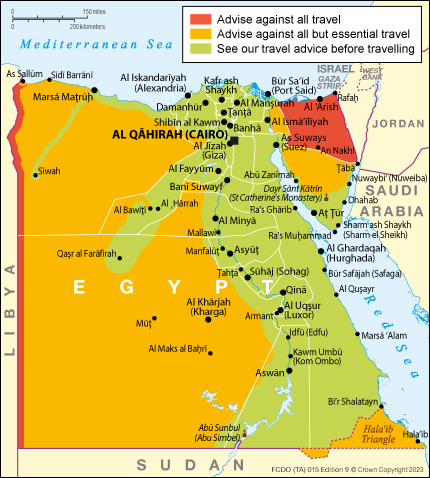
All border areas should be treated with extreme caution. If you intend to travel to the south west corner of the country near the Egypt/Sudan/Libya border, you must apply for a permit from the Travel Permits Department of the Egyptian Ministry of the Interior. We advise extreme caution in travelling to this area, and you should carefully consider whether your security arrangements are adequate. In 2008 19 people were kidnapped whilst on safari in the Karkur Talh area, near the border. The borders in this area are porous and bandits and armed groups operate.
The area of the border between Egypt and Gaza and surrounding North Sinai area is often tense with occasional outbreaks of violence. There have been recent reports of cross-border shootings into Egypt, including on 6 January 2010 when an Egyptian border guard was shot and killed. Demonstrators on the Gaza side of the border near the Rafah crossing were injured during clashes on 6 January and the security situation in the area remains tense. For the latest requirements on crossing from Egypt to Gaza, delivering aid or entering for humanitarian purposes, you should contact the Egyptian Embassy in London.
However, the Egyptian authorities have stated that all aid going into Gaza from Egypt must be channelled through the Egyptian Red Crescent (Tel + 20 226 703 979, + 20 226 703 983, Fax + 20 226 703 967) and that they will not accept any aid convoys. Short notice requests for humanitarian access and those made in Egypt are unlikely to be considered. You should also read the FCO Travel Advice for Israel and the Occupied Territories.
Road accidents are very common in Egypt, mainly due to poor roads, dangerous driving and non-enforcement of traffic laws. Police estimate that road accidents kill over 6,000 people in Egypt each year. This is double the UK figure. Avoid driving outside main cities and resorts at night and observe the local speed limit. Make sure you obtain adequate third party insurance. In the event of an accident emergency medical facilities are limited.
You can drive in Egypt on an International driving licence for up to six months. If you intend to remain in Egypt for a longer period you must apply for an Egyptian driving licence.
By law, seatbelts must be worn when travelling in the front of a vehicle. Where available, seatbelts should be worn at all times. Child car seats are available locally.
Only certain categories of foreign residents may import vehicles. Vehicles of visitors should be temporarily imported with a valid “carnet de passage” available from the Automobile Association.
There have been eight serious bus crashes since January 2006, in which over 100 people have been killed. If you are a passenger in a vehicle that is travelling at an unsafe speed you should firmly instruct the driver to slow down.
If travelling off road, a qualified guide should be employed and appropriate permits obtained from the Ministry of Interior
Adventure activities
Before undertaking any adventure activity ensure that your travel insurance covers you for the activity.
The hiring of quad bikes can be dangerous. There have been several serious quad bike accidents involving British nationals in resort areas. You should take the same precautions as you would in the UK and note that safety standards can vary considerably. You should always wear a crash helmet and you should ensure that your travel insurance policy covers you fully before you hire a quad bike.
If you are considering diving or snorkelling in any of the Red Sea resorts you should be aware that safety standards of diving operators can vary considerably. A basic rule is never to dive or snorkel unaccompanied. Where possible you should make any bookings through your tour representative. Unusually cheap operators may not provide adequate safety and insurance standards. Ensure that your travel insurance covers you fully before you dive. Diving beyond the depth limit of your insurance policy will invalidate your cover.
You should ensure that your travel insurance, or that of the tour or dive company, provides adequate cover for the costs involved in any air/sea rescue if you are lost at sea. The current fee can exceed US$4000 per hour. The Egyptian authorities will only undertake air/sea rescue operations on receipt of a guarantee of payment. The British Embassy is unable to provide this initial guarantee, but does facilitate communication between insurance companies and the Egyptian authorities.
There have been three serious hot air balloon accidents in Luxor so far in 2009. You should consider the operator's safety arrangements carefully.
Other activities which could invalidate your insurance cover are camel and horse riding.
Local laws reflect the fact that Egypt is predominantly an Islamic country. You should respect local traditions, customs, laws and religions at all times and be aware of your actions to ensure that they do not offend other cultures or religious beliefs. This is especially important during the holy month of Ramadan or if you intend to visit religious areas. For more general information see our Travelling During Ramadan page.
The government does not interfere with the practice of Christianity but encouraging conversion to the Christian faith is illegal. Egypt is also a conservative society. You should dress modestly, especially in rural areas, mosques and souqs (markets). Women's clothes should cover their legs and upper arms. Men should cover their chests. Public displays of affection are frowned upon. What may be acceptable in the tourist resort areas may be frowned upon in other areas.
Visitors and residents should carry photographic ID at all times. Your passport must contain a valid visa.
Drinking in the street and anywhere other than a licenced restaurant or bar is not allowed and can lead to arrest.
Possession, use or trafficking in illegal drugs is a serious offence and can, even for possession of small amounts, lead to lengthy prison sentences (25 years), life imprisonment or the death penalty. Those convicted to life imprisonment on drugs charges will normally spend the rest of their life in prison with no possibility of parole or pardon.
Photography of or near military official installations is strictly prohibited. Don’t photograph officials without their consent. Plane spotting is not advised in any circumstances. You may be detained or arrested if you use binoculars near an airport.
Although homosexuality is not in itself illegal under Egyptian law, homosexual acts in public are illegal and homosexuals have been convicted for breaching laws on public decency.
Women are advised to take extra caution when travelling alone as there have been cases of harassment and sexual assault, including rape. Egyptian family law is very different from UK law and particular caution is needed when, for example, child custody becomes an issue. Please see o0ur parental child abduction page.
For more general information for different types of travellers see our Your trip page.
Medical facilities outside Cairo can be basic and in case of emergency you are advised to seek treatment in Cairo. You should ensure that your medical insurance covers the cost of local hospitalisation and medical repatriation to your country of residence.
Come prepared for the heat. Use a high factor sun block and drink plenty of water to guard against exposure and dehydration, which can result in serious health problems.
In general tap water is not safe to drink. Bottled water is cheap and readily available.
In the 2008 Report on the Global AIDS Epidemic the UNAIDS/WHO Working Group estimated that around 9,000 adults aged 15 or over in Egypt were living with HIV; the prevalence rate was estimated at less than 0.1% of the adult population. This compares to the prevalence rate in adults in the UK of around 0.2%. You should exercise normal precautions to avoid exposure to HIV/AIDS. For more general information on how to do this see our HIV and AIDS page.
You should seek medical advice before travelling to Egypt and ensure that all appropriate vaccinations are up-to-date. For further information on vaccination requirements, health outbreaks and general disease protection for Egypt you should check the websites of the National Travel Health Network and Centre NaTHNaC and NHS Scotland's Fit For Travel or call NHS Direct on 0845 46 47.
For more general health information see our Travel Health page.
Swine Flu - A (H1N1)
There are confirmed human cases of the H1N1 virus (Swine Flu) in Egypt, including several deaths. The World Health Organisation (WHO) Pandemic Threat Alert has been raised to Level 6. The World Health Organisation website has further details. You should monitor local media reports for any developments and advice. There is a dedicated Swine Flu page. Guidance on Pandemic Flu can be found on the UK Department of Health website.
The Egyptian authorities no longer screen for the Swine Flu virus at their airports nor place in quarantine those who show flu-like symptoms. However, several British nationals have been taken to hospital after showing high temperatures and/or flu-like symptoms. If you have a high temperature and/or flu like symptoms, you should seek medical advice prior to travel to prevent hospitalisation on arrival in Egypt.Medical facilities can be basic and vary throughout the country. Consular staff are unable to secure better hospital facilities or food and because of isolation requirements are unable to visit those affected. British nationals who are hospitalised with swine flu should contact their insurance company and travel representative as soon as possible.
If you are quarantined in a private hospital you may be charged for accommodation, food and medical treatment even if you are found to be H1N1 negative. The British Embassy is unable to advance payment or settle bills on your behalf.
Avian Influenza (Bird Flu) (H5N1)
The first cases of bird flu in Egypt were confirmed on 17 February 2006. Since then, bird flu has been confirmed in 20 Governorates. This has led to a number of cases of human infection, including a number of fatalities, believed to have arisen from close contact with infected poultry.
The risk to humans from Avian Influenza is believed to be very low. However, as a precaution you should avoid visiting live animal markets, poultry farms and other places where you may come into close contact with domestic, caged or wild birds; and ensure poultry and egg dishes are thoroughly cooked.
You should read this advice in conjunction with the Avian and Pandemic Influenza page, which gives more detailed advice and information.
Egypt is susceptible to occasional earthquakes; the last major one was in 1992.