Advanced search
image
Travel & living abroad

Middle East and North Africa

Algeria

Flag of Algeria
Still current at: 15 March 2010
Updated: 02 March 2010

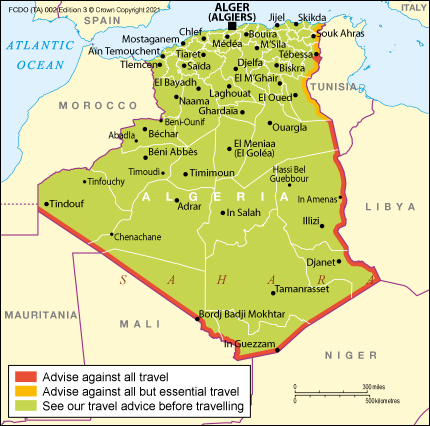
This advice has been reviewed and reissued with amendments to the Summary, Terrorism and Local Travel sections. The overall level of the advice has changed; we no longer advise against all travel to the area south of Arak; we advise against all but essential travel to some areas of Algeria.

(see travel advice legal disclaimer)


Travel advice for this country

Travel Summary

  • We advise against all but essential travel to the administrative districts (wilayas) of Boumerdès, Bouira, Tizi Ouzou, east of Algiers, which have been the focus of sustained terrorist activity over the last three years. Travellers should also exercise caution in the wilayas of Bejaia, the the east of Algiers, and Blida, Medéa, Chlef and Ain Defla, south and west of Algiers. Journeys within Algeria should be made by air where possible.

  • There is a high threat from terrorism in Algeria.  You should exercise extreme caution at all times as terrorist attacks could be indescriminate, targeting places frequented by expatriates and foreign travellers such as restaurants, hotels and shopping centres.  Terrorists have been involved in kidnaps in the region and we believe that further kidnap attacks are likely.  See the Terrorism section of this travel advice.

  • If visting Algiers you should continue to exercise caution at all times. It is generally safe to move around the centre of the city during the day. You should avoid areas that you do not know, particularly in the suburbs of the city, and especially after dark.  See the 'Travelling in Algiers' section of this Travel Advice.

  • We advise against travel by road at night outside the major cities. See the Crime and Local Travel sections of this this Travel Advice.

  • 14 British nationals required consular assistance in Algeria in the period 1 April 2008 – 31 March 2009. During this period assistance was also requested with regard to lost or stolen passports (10 cases).  The main type of incidents for which British nationals required consular assistance in Algeria in 2008 related to family disputes, often involving child abduction/custody issues (1 case) and/or theft of family documents and passports.  See the Entry Requirements (Travelling with children) section of this Travel Advice.

  • We recommend that you obtain comprehensive travel and medical insurance before travelling. See the General (Insurance) section of this Travel Advice .

Safety and security

Terrorism


Terrorists have been involved in kidnaps in the region and we believe that further kidnap attacks are likely.  Al Qaeda in the Islamic Maghreb (AQ-M) operates directly or through criminal gangs who carry out kidnappings on their behalf or pass on their kidnap victims for monetary gain.  Recent attacks close to Algeria include:

  • On 28 December 2009, a group of Saudi nationals were attacked near the village of Djambala in Niger, close to the Mali border.  Four died in this attack.
  • On 18 December 2009, an Italian couple were kidnapped by an armed group in south eastern Mauritania 18km east of Kobonni on the road to Mali.
  • On 29 November 2009, three Spanish nationals were kidnapped whilst travelling on the road from Nouakchott, the capital of Mauritania, to the northern city of Nouadhibou.
  • On 25 November 2009, a French national was kidnapped near the city of Gao in eastern Mali.
  • On 14 November 2009, there was an attempted kidnap in Tahoua, Niger, by heavily armed individuals against employees of the American Embassy.
  • A group of European tourists were kidnapped in the area of the Mali-Niger border on 22 January 2009.  A British national who was part of this group was later executed.
  • Two Canadian diplomats were kidnapped 25 miles outside of Niamey on 14 December 2008 and held in Mali.
You should be aware that the long-standing policy of the British Government is not to make substantive concessions to hostage takers.  The British Government considers that paying ransoms and releasing prisoners increases the risk of further hostage taking.

There is a high threat from terrorism in Algeria. You should exercise extreme caution at all times as terrorist attacks could be indiscriminate, including in places frequented by expatriates and foreign travellers such as restaurants, hotels and shopping centres.

Since the beginning of 2007 there have been a number of bomb attacks in Algeria.  There were two bombs in central Algiers on the morning of 11 December 2007.  These occurred near the Supreme Court building in El Biar and at the offices of the UN agencies in Hydra.  Over 30 people were killed, and many more injured.  The attacks were claimed by Al Qaeda in the Islamic Maghreb (AQIM), a name adopted by Algerian terrorist group the Salafist Group for Preaching and Combat (GSPC) in January 2007.

  • On 22 October 2009, seven Algerian security guards were killed and two were injured in a gun attack 20kms south-east of Tizi Ouzou, between Maatkas and Souk El Tenine.  The security guards were en route to work, where they were responsible for protecting the building site of a Canadian company.
  • On 29 July 2009, 14 Algerian soldiers were kileed and several others wounded in an ambush in Damous, in the wilaya of Tipaza.  A roadside bomb was detonated and then the soldiers were fired upon.  Damous is situated 150km west of Algiers and 75km off the city of Tipaza.
Foreign workers and their means of transport have also been targets for attacks.  In the last two years there have been at least three roadside bomb attacks on vehicles carrying foreign workers, which have resulted in six deaths and several injuries.  For unavoidable travel and regular journeys we recommend changing the timings and routes where possible.

The Sahara Desert and mountainous regions in the south of Algeria have seen occasional outbreaks of terrorist violence.  You should exercise caution when travelling in the area close to the borders with Tunisia and Libya.

We advise against all but essential travel to the wilayas (administrative districts) of Boumerdès, Bouira, Tizi Ouzou, east of Algiers and caution when visiting the wilayas of Bejaia, to the east of Algiers, and Blida, Medéa, Chlef and Ain Defla (south and west of Algiers).  There are clashes between suspected militants and the security forces across Algeria on virtually a daily basis.  Journeys within Algeria should be made by air where possible.

If you intend to visit Algeria you should check this advice regularly for the latest security advice. You should review thoroughly information on the local situation, take all necessary precautions in terms of your personal security arrangements throughout your visit, and follow local advice. You should exercise caution at all times.

For more general information see terrorism abroad.

Travelling in Algiers


In Algiers itself it is generally safe to move around the centre of the city during the day, but best if accompanied by someone who knows the city well. You should avoid areas that you do not know, particularly in the suburbs of the city, and especially after dark. Do not carry large amounts of money or valuables around with you. If you plan to tour the casbah area of Algiers, you should  employ the services of a recommended local guide and ensure local police have been informed of your plans.

Crime


While most visits to Algeria are trouble-free, in certain areas of larger cities there are incidents of robbery and thefts of and from motor vehicles. There have been reports of car-jackings and robberies and thefts by criminals posing as police officers outside the main cities. You should avoid areas that you do not know, especially after dark. Do not carry large amounts of money or valuables around with you.

For more general advice see victims of crime abroad.

Political Situation


Algeria Country Profile

You should take sensible precautions for your personal safety and avoid political gatherings and demonstrations and take local dvice about places best to avoid.

Local Travel


We advise against all but essential travel to the administrative districts (wilayas) of Boumerdès, Bouira, Tizi Ouzou, east of Algiers, which have been the focus of sustained terrorist activity over the last three years. Travellers should also exercise caution in the wilayas of Bejaia, the the east of Algiers, and Blida, Medéa, Chlef and Ain Defla, south and west of Algiers. Journeys within Algeria should be made by air where possible.


If you are travelling to Algeria you should seek the advice of your hosts about appropriate security measures. You should arrange, if possible, to be met on arrival in Algiers and, if travelling alone, should stay at one of the main hotels where proper security precautions are taken.

You should, where possible, make journeys by air and stay in pre arranged accommodation at your destination. Business visitors without established contacts should seek advice in the first instance from the British Embassy, Algiers or the Algeria desk in UK Trade and Investment.


Road Travel


If you want to drive a car you will need to obtain a local permit. You should not use public transport other than taxis recommended by your hotel. Overland travel outside major cities should be avoided at night, as buses and other vehicles have been attacked, sometimes at illegal vehicle checkpoints. It is advisable to travel in a convoy of at least two to three vehicles. Sustained small-scale attacks, including bombings, illegal roadblocks and kidnapping occur in many rural parts of the country.

For more general information see driving abroad.

Air travel


It is good practice to re-confirm flights to, from or within Algeria.

For more general information see airline security.

Local laws and customs


Local laws reflect the fact that Algeria is a Muslim country. You should respect local traditions, customs, laws and religions at all times and be aware of your actions to ensure that they do not offend other cultures or religious beliefs, especially during the holy month of Ramadan or if you intend to visit religious areas. For more general information see travelling during ramadan.

The weekend is Friday and Saturday. There are some restrictions on serving alcohol in restaurants in urban areas. To avoid unwelcome attention women should dress conservatively. Possession, use and trafficking of controlled drugs are all serious criminal offences in Algeria and carry custodial sentences.

 You are not required to carry your passport at all times. But you should take it with you if you are making a longer journey or travelling by air.  You should keep a photocopy of it somewhere safe. Homosexuality is illegal in Algeria. Sexual acts between persons of the same sex are punishable by imprisonment. Where one of the participants is a minor, penalties for the other party are increased. You should not attempt to take photos of police or military personnel or establishments.

For more general information for different types of travellers see your trip

Entry requirements

Visa


British nationals intending to visit Algeria must ensure they obtain a visa before travelling from the Algerian Consulate in London.
 

Passport validity


The Algerian Consulate will not accept a passport with less than six months validity remaining.

Currency declaration


Algeria has strict foreign exchange laws and the Dinar cannot be exported. (see The Money section of this Travel Advice.


Travel with children

British women who are the wives or partners of Algerian citizens should be aware that any children they have together will be regarded as Algerian citizens if the father's name is on the birth certificate. If such children are brought to Algeria and are under 18, they will only be able to leave again if the father signs an "Autorisation Paternelle". For further information on exactly what will be required at immigration please contact the Algerian Consulate in London.

Health

The Algerian authorities have informed us that anyone suspected of having swine flu will be quarantined and transported to one of the 109 designated hospitals in the country. Once at the hospital further tests will be carried out, samples will be tested in Algiers, and treatment will be carried out as appropriate. A number of schools have also been closed following suspected outbreaks.

You should seek medical advice before travelling to Algeria and ensure that all appropriate vaccinations are up-to-date. For further information on vaccination requirements, health outbreaks and general disease protection and prevention you should visit the websites of the National Travel Heath Network and Centre NaTHNaC and NHS Scotland's Fit For Travel or call NHS Direct on 0845 46 47.


In 2008 there were confirmed reports of an outbreak of Typhoid fever in the Djelfa region. Travellers should practice strict food and water hygiene. Young children, those visiting friends and relatives and long-term visitors, travelling to this area may wish to consider vaccination before travelling to this region of Algeria.

Facilities at private clinics are usually more comprehensive than at government hospitals. In the 2008 Report on the Global AIDS Epidemic the UNAIDS/WHO Working Group estimated that around 21,000 adults aged 15 or over in Algeria were living with HIV; the prevalence rate was estimated at around 0.1% of the adult population. This compares to the prevalence rate in adults in the UK of around 0.2%. You should exercise normal precautions to avoid exposure to HIV/AIDS. For more general information on how to do this see HIV and AIDS.

For more general health information see travel health and the UK Department of Health website. You should monitor local media reports for any developments and advice.

Natural disasters


Parts of Algieria are susceptible to severe flood damage. Northern Algeria is also within an earthquake zone. In May 2003, a severe earthquake struck the Algiers area. There were over 2,200 dead and more than 10,000 injured.

General

Insurance

We recommend that comprehensive travel and medical insurance (including medical evacuation) is obtained before travelling. You should check any exclusions, and that your policy covers you for the activities you want to undertake. For more general information see our travel insurance page.

If things do go wrong when you are overseas then this is our When Things Go Wrong page.
 

Replacing a passport in Algeria


The British Embassy in Algiers does not issue passports. Before setting off, you should ensure that your passport has sufficient validity and plenty of unused pages. Applications for new passports are accepted in Algiers for forwarding to the UK for processing, but this may take up to six weeks. If a courier is used, the cost will have to be borne by the applicant.

Registration


If you are resident in Algeria you should make your whereabouts known to the British Embassy in Algeria, or by registering online with our LOCATE service. This tells us where you live abroad so our consular and crisis staff can provide better assistance to you in an emergency.
 

Money


The use ATM machines and credit cards in is still confined to hotels and a limited number of other businesses in the larger cities. Algerian Dinars should be obtained from bureaux de change at the international airports and larger hotels or from banks in the main cities. You should not attempt to change money on the streets. Algeria has strict foreign exchange laws and the Dinar cannot be exported.

Share this with:

Contacts

Algeria, Algiers, British Embassy

Address:

Ambassade Britannique,
3 Chemin Capitaine Hocine Slimane (ex Chemin des Glycines),
Hydra,
Algiers

Telephone:

+213 (0) 770 085 000

Fax:

+213 (0) 770 085 099

Office hours:

Sun-Thur: 0700-1430 GMT
Sun-Thur: 0800-1530 Local Time

Website: http://ukinalgeria.fco.gov.uk/en/