Ukraine
Warnings and insurance
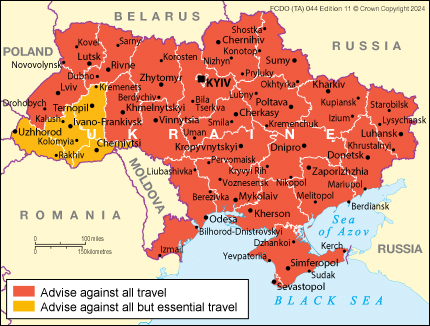
The Foreign, Commonwealth & Development Office (FCDO) provides advice about risks of travel to help British nationals make informed decisions. Find out more about FCDO travel advice.
Your travel insurance could be invalidated if you travel against FCDO advice. Consular support is also severely limited where FCDO advises against travel.
FCDO advises against all but essential travel to the western regions of:
- Zakarpattia
- Ivano-Frankivsk
- Ternopil
- Chernivtsi
FCDO advises against all travel to the rest of Ukraine.
Russian invasion of Ukraine
The Russian invasion of Ukraine is ongoing, with missile and drone attacks across the country. Russian missile and drone strikes have caused significant damage to civilian infrastructure and injured and killed civilians. Ukraine’s airspace remains closed.
There is an ongoing risk of harm to British nationals from Russian attacks across all of Ukraine, including from missiles and drones that hit unintended targets or from falling debris. Whilst these are more frequent where FCDO advises against all travel, they could also happen in the western regions, where FCDO advice is against all but essential travel.
In the event of attacks, follow the advice of the local authorities, including responding to air raid sirens.
The situation in Ukraine can change quickly. Local rules and measures may change at short notice or with no notification. FCDO cannot confirm that all information here reflects the latest situation in Ukraine.
Zaporizhzhia Nuclear Power Plant
Explosions continue to be reported near the area of the Zaporizhzhia Nuclear Power Plant indicating ongoing military activity. There have been no reports of any radiation release.
If you are in Ukraine
Leave Ukraine if safe to do so
We continue to advise British nationals in regions where FCDO advises against all travel, to leave these areas, if they judge it safe to do so.
Martial law is in place. Follow the instructions of the Ukrainian authorities and check any measures in place in your location, as they will vary by region.
If you are in Ukraine, you should:
- stay alert to air raid warnings and follow advice of the Ukrainian authorities
- pay close attention to your personal security
- monitor the media for information about security risks in your area
- avoid demonstrations and public gatherings
- take extra care while moving around
- know what curfews are in place
There are a number of air raid alert apps available, including “Air Alert” and “Карта Тривог”.
Monitor travel advice regularly. Sign up to get email notifications when this advice is updated. See FCDO advice on how to deal with a crisis overseas.
Leaving Ukraine
Expect increased documentation checks, transport restrictions and increased security measures. Other measures could include additional border controls, restrictions on public events, curfews, restrictions on telephones, internet and broadcasting, and evacuations of certain areas.
If you are a dual British-Ukrainian national or you have the right to reside in the UK, and want to leave Ukraine, contact the State Border Guard Service of Ukraine on adpsu@dpsu.gov.ua for advice.
Ukrainian national and dual-national males aged 18 to 60 are prohibited from leaving the country.
The authorities in the countries bordering Ukraine set and enforce their entry rules. Before you travel, check the foreign travel advice for any countries you plan to travel through. If you need consular assistance, contact the British Embassy in that country (contact details can be found in the relevant foreign travel advice page).
Assisted departure or evacuation
The British Embassy in Kyiv is unable to provide in-person consular assistance.
FCDO cannot facilitate your departure from Ukraine or evacuation. If you are in Ukraine against FCDO advice, or require support to leave Ukraine, take advice from a private security company and take appropriate security measures.
FCDO cannot endorse or recommend any private security companies. Research whether a service provider will be suitable for your requirements and meets code of conduct and safety standards. The Security in Complex Environments Group (SCEG) has several companies listed on their website. These companies have accredited certification for international standards.
FCDO has not completed due diligence checks on these companies. FCDO does not accept any liability arising to any person for any loss or damage suffered through using these service providers or this information. FCDO is not able to provide financial assistance for employing private security or medical evacuation companies.
Visas for the UK
If you are a family member of a British national normally living in Ukraine and intend to apply for a visa under the Ukrainian Family Scheme, read the guidance on visas for family members of British nationals normally living in Ukraine. Call +44 (0)808 164 8810 (select option 1) for assistance before applying.
Under this scheme, which is free, those joining family in the UK can stay in the UK for up to 3 years. They will be able to study, work and access public funds.
Foreign fighters
If you travel to Ukraine to fight, or to assist others engaged in the war, your activities may amount to offences under UK legislation. You could be prosecuted on your return to the UK.
British nationals fighting in Ukraine have been killed or captured. British nationals undertaking humanitarian work have also been detained by Russian authorities. The risk to life, or of mistreatment, is high.
Our ability to provide consular support in these circumstances is very limited.
Supporting Ukraine
There are many ways to support Ukraine from the UK. For further information, see Ukraine: what you can do to help.