Advanced search
image
Travel & living abroad

Europe

Turkey

Flag of Turkey
Still current at: 08 February 2012
Updated: 31 January 2012
No restrictions in this travel advice Avoid all but essential travel to part(s) of country Avoid all but essential travel to whole country Avoid all travel to part(s) of country Avoid all travel to whole country


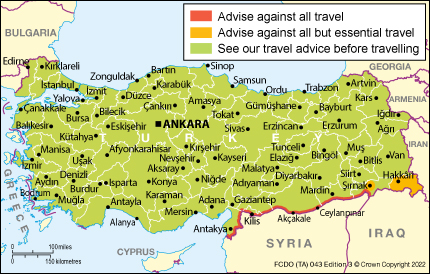
This advice has been reviewed and reissued with amendments to the Entry Requirements section (enforcement of rules relating to visit visas issued on arrival). The overall level of the advice has not changed; we advise against all but essential travel to the provinces of Hakkari, Sirnak, Siirt and Tunceli.


To see a PDF version of this map, click here (1MB)


(see travel advice legal disclaimer)

Travel advice for this country

  • Due to the high threat of terrorism we advise against all but essential travel to the provinces of Hakkari, Sirnak, Siirt and Tunceli. Visitors should remain vigilant when travelling in other provinces in south eastern Turkey.

  • There is a high threat from terrorism in Turkey and a number of terrorist groups remain active in the country. Statements have been made in the press indicating that attacks could take place against tourists or places used by foreigners. Terrorist attacks have taken place in major cities and resorts against government, military and civilian targets. Improvised explosive devices (IEDs) have been placed in crowded areas, restaurants, refuge bins, outside banks and hotels and on dolmus mini-buses and trains. Terrorist attacks are regularly carried out against the security forces in the south east of the country by the separatist Kurdistan Workers Party (PKK). In the past, military personnel and German mountain climbers in the East of Turkey have been kidnapped. You should remain vigilant at all times.

  • Al Qaeda and other networks inspired by religious extremism have specifically targeted western interests in Turkey and there remains a global risk of attack from such groups. See Safety and Security - Terrorism.

  • Demonstrations occur regularly in major cities and have the potential to turn violent. Taksim Square and Istiklal Street in Istanbul are gathering points for those seeking to demonstrate. Police will take measures to control crowds using various means, which may include tear gas. While the focus of these may be in predominately Kurdish areas, it is possible that they may spread elsewhere.

  • 2,673,565 British nationals visited Turkey in 2010 (Source: Ministry of Tourism). Most visits are trouble-free. See General - Consular Assistance Statistics.

  • You should take out comprehensive travel and medical insurance before travelling to Turkey. See General - Insurance.

Safety and Security - Terrorism


There is a high threat from terrorism in Turkey and a number of terrorist groups remain active in the country. Statements have been made in the press indicating that attacks could take place against tourists or places used by foreigners.

Terrorist attacks are regularly carried out against the security forces in the south east of the country by the separatist Kurdistan Workers Party (PKK). Attacks consist of IEDs and armed assaults and are carried out in both urban and rural areas. There are also occasional occurrences of violent public disorder in the region. The main provinces affected by PKK attacks are Hakkari, Sirnak, Siirt and Tunceli. There is a high level of security activity in these provinces and you risk arrest if you fail to comply with restrictions. We advise against all but essential travel to these areas. There is also a significant level of PKK activity elsewhere in the south east of the country (Van, Bitlis, Bingol, Elazig, Mus, Batman, Erzincan, Diyarbakir, Mardin and Agri). A number of Turkish school teachers were kidnapped in September 2011 by the PKK in southeast Turkey (most notably the Lice, Hazro and Elazig regions of Diyarbakir). Please be especially vigilant when travelling in these areas.

Terrorist bomb attacks have also been carried out on government and civilian targets, including military targets, in major cities such as Istanbul, Ankara and Adana, Izmir, Mersin and tourist resorts on the Mediterranean and Aegean coasts (these have included Kusadasi, Cesme, Marmaris and Antalya, Manavgat). Devices have been placed in crowded areas, restaurants, refuge bins, outside banks and hotels and on dolmus mini-buses and trains. See attached map (below).

Map showing areas with a history of terrorist insurgency and attacks
[PDF, 1MB].

(This map is presented for information only. The Foreign & Commonwealth Office (FCO) accepts no responsibility for errors or omission of any geographical features. Please read the FCO travel advice text for more detailed information).


International terrorist groups, including Al Qaeda, and indigenous networks inspired by religious extremism have also specifically targeted western interests in Turkey. Extremists have also on occasion attacked Christian targets.

You should be aware of the global risk of indiscriminate terrorist attacks. We advise you to remain vigilant in all public areas across the country and report anything suspicious to the authorities.


Safety and Security - Terrorism - Significant Terrorist Incidents

  • On 11 November, there was an attempted hijack of a ferry off the east Coast of Istanbul. Turkish Security forces ended the hijack and killed the lone hijacker. All 18 passengers and six crew were led to safety.
  • On 18-19 October 2011, twenty-six Turkish soldiers were killed and eighteen were injured in attacks in Yuksekova / Cukurca district of Hakkari in south-eastern Turkey.
  • On 18 October 2011, a bomb exploded in the Güroymak district of Bitlis, south-eastern Turkey, killing seven people and injuring more.
  • On 30 September 2011, there was a suicide bombing at a Jandarma station at Goynuk, on the coast west of Antalya, south-west Turkey. The bomber was killed and one other person injured.
  • On 20 September 2011, an explosion occurred in central Ankara causing three deaths and an unconfirmed number of injuries. We advise you to remain vigilant at all times.
  • On 26 and 28 August 2011, there were two separate explosions on beaches in Konyaalti and Kemer (on the Mediterranean coast). The cause of the explosions is not yet known. We advise you to remain vigilant at all times in public areas.
  • On 17 August 2011 nine Turkish soldiers were killed and fifteen injured  in a bomb attack on their convoy in Çukurca, Hakkari province (far South East Turkey).
  • On 14 July 2011 a rescue operation of two kidnapped soldiers and a healthcare technician in Diyarbakir, southeast Turkey, resulted in a close-range armed conflict in which 13 soldiers and seven terrorists were killed.

  • On 13 July the Turkish authorities arrested 14 suspected members of Al Qaeda who have been accused of planning to bomb American interests in Turkey, including its Embassy in Ankara.
  • On 26 May 2011, there was an explosion at a bus stop in the Etiler district of Istanbul.  Seven people were reported to be injured.

  • On 31 October 2010 a bomb was detonated in Taksim Square, Istanbul. Local media state a number of Turkish nationals have been injured. No British nationals were involved.
  • On 16 September 2010 a passenger minibus carrying civilians in Hakkari province (far South East Turkey) exploded after driving over a roadside bomb. Nine people were killed and four injured.
  • On 10 August 2010 there was an explosion on an oil pipeline in south east Turkey passing through Midyat (in Mardin province) and İdil (in Şırnak province) which killed two people and injured one other. The cause of the explosion is not clear but the possibility that it is a terrorist attack has not been ruled out.
  • 20 November 2003 - Al Qaeda carried out vehicle-borne IED attacks on the British Consulate and the headquarters of HSBC in Istanbul, killing 33 people. This followed similar attacks on two synagogues in the city on 15 November, which killed 23 people.

See our Terrorism Abroad page.

Safety and Security - Crime


Generally crime is low, but street robbery and pickpocketing are common in the major tourist areas of Istanbul. You should be wary of approaches from strangers offering to change money or offering food and drink, which may be drugged, or offering to take you to a restaurant or nightclub.

In 2010 40 cases of sexual assaults, including rape, were reported to our Consular staff in Turkey. The majority of these cases occurred during the summer holiday period in coastal tourist areas visited by British nationals in South Western Turkey. Most occurred late at night and most assaults were committed by someone that the victim had met during the evening. See our Rape and Sexual Assault Abroad page.

You should maintain at least the same level of personal security awareness as in the UK. Be aware that alcohol and drugs can lead to you being less alert, less in control and less aware of your environment. If you are going to drink, know your limit. Remember that drinks served in bars overseas are often stronger than those in the UK. In all circumstances, you should buy your own drinks and keep sight of them at all times to make sure they are not spiked.

Never accept lifts from strangers or passing acquaintances at any time. Always try to find a registered yellow taxi and make a note of the registration number before getting in. See our Victims of Crime Abroad page.

Safety and Security - Local Travel - Road Travel


You should take particular care when travelling by road throughout Turkey, as road conditions can be poor. Road traffic accidents are common and are mainly due to either poor or reckless driving, particularly at night. According to the Turkish National Police Traffic Department website, in 2010 there were 1,104,388  road traffic accidents which resulted in  4,045 deaths and over 211,496injuries.

If you wish to drive in Turkey, you are required to carry either an International Driving Permit issued in the UK or a notarised copy, in Turkish, of your Driving Licence. Please note provisional driving licences are not recognised. An 'A' category standard motorcycle licence is required to hire motorcycles over 50cc in Turkey. An 'A1' category 'light motorcycle' driving licence is only suitable for motorcycles below 50cc. It is against the law not to wear a helmet and failure to do so could result in a heavy fine.

Do not drink and drive. The Police will breathalyse drunk drivers, fine them on the spot and immediately confiscate their licence for six months.

See our Driving Abroad page.

Safety and Security – Extreme Sports


If you intend to participate in extreme sports (including paragliding, parasailing, white-water rafting and off-road driving), consider the dangers involved and satisfy yourself that adequate safety precautions are in place. Rent only from reputable operators and insist on sufficient training before use. Ensure that your travel insurance covers you for all the activities you want to undertake. British nationals have been injured and in some cases killed participating in extreme sports.

Safety and Security - Political Situation


Turkey Country Profile

Turkey is a stable democracy. Demonstrations occur regularly in major cities. Taksim Square and Istiklal Street in Istanbul are gathering points for those seeking to demonstrate. Demonstrations in Turkey can get out of hand and have the potential to turn violent. Police will take measures to control crowds using various means, which may include tear gas. You should avoid all demonstrations and to leave the area if one develops. While the focus of these may be in predominately Kurdish areas, it is possible that they may spread elsewhere.

There is a smoking ban on all forms of public transport (trains, ferries and taxis) and in outdoor venues (including stadiums, playgrounds, cafes, bars, and restaurants). You risk being fined if you are caught smoking in a designated smoke-free area.

Turkey has strict laws against the use, possession or trafficking of illegal drugs. If you are convicted of any of these offences, you can expect to receive a heavy fine or a prison sentence of four to 24 years.

The possession, sale and exportation of antiquities is against the law, as is the use of metal detectors.  

Dress modestly if visiting a mosque or a religious shrine. It is illegal not to carry some form of photographic ID in Turkey. It is therefore advisable to carry a photocopy of your passport with you at all times.  

Do not take photographs near military or official installations. You should seek permission before photographing individuals.  

Homosexuality is not illegal but is not widely tolerated: public displays of affection could result in prosecution for public order offences.  

It is an offence to insult the Turkish nation or the national flag, or to deface or tear up currency.

See our Your Trip page.

Entry Requirements - Visas

British nationals require a visa to enter Turkey, except cruise ship passengers entering the country for a day trip and returning to the ship the same day. British citizens may obtain a multiple entry visitor's visa, valid for 90 days, at the port of entry on payment of £10 in cash (Scottish currency is not accepted). Visas can also be obtained in advance from the Turkish Consulate in London.

Turkish visit visas issued at arrival ports state that they are valid for multiple stays up to a maximum of 90 days in a 180 day period.

Up to 31 January 2012, the Turkish immigration authorities operated a flexible interpretation of this requirement whereby visitors could leave after 90 days, and immediately re-enter for a further 90 day period.  However, from 1 February 2012 the rules will be fully enforced, and you will only be able to stay in Turkey for a total of 90 days in any period of 180 days.

If you plan to remain in Turkey for a period of more than 90 days, you should either apply for a longer stay visa from the Turkish Embassy in your country of residence before departure, or regularise your stay by obtaining a residence permit from the local authorities in Turkey before 90 days has elapsed.  Those who exceed the 90 day limit may be fined, deported and banned from re-entry.

If you are entering Turkey via the Bulgarian border crossing, make sure that your passport has a dated entry stamp before you leave the border crossing area. Some British nationals have obtained a visa but not had their passport stamped. In some cases, this has resulted in detention and later deportation for illegal entry.

If you hold a BN(O), British Overseas Citizen, British Protected Person or British Subject passport  you should check visa requirements with your nearest Turkish Consulate before travelling.  If you arrive without the correct visa, you - may be refused entry to Turkey.

Working illegally, without the correct visa and work permit, could result in deportation from Turkey, a fine and a ban on re-entering.  You may be held in a detention centre awaiting deportation and are unlikely to be able to collect your belongings before departure.

Entry Requirements - Passport validity


You must hold a valid passport to enter Turkey. Your passport must be valid for a minimum period of six months from the date of entry into Turkey and have at least three months validity from the date you are exiting Turkey. British Emergency Travel Documents are accepted for travel (and if specified, re-entry) within the dates printed on the document.

Entry Requirements - Travelling with children


If you are leaving Turkey with a child who is a dual British/Turkish national, you may be asked to show the Turkish Immigration Authorities evidence that the Turkish parent has given permission for travel.  Permission can be in the form of a note.  Failure to produce this could mean that the child will be unable to leave Turkey.

Please refer to the British Embassy, Turkey website for details of English speaking hospitals and doctors.

The European Health Insurance Card (EHIC), relating to free medical treatment in EU countries, is not valid in Turkey.

Turkey can be very hot, especially in summer when temperatures can reach 30-40C. To avoid heat-related illness drink plenty of water to avoid dehydration, use a high-factor sunscreen and avoid direct sunshine. Older, very young and some other travellers may be particularly vulnerable to heat-related illnesses and should take extra care.

Outbreaks of diarrhoeal illness occur in Turkey. Travellers to Turkey should practice strict food and water hygiene precautions.

In the 2010 Report on the Global AIDS Epidemic the UNAIDS/WHO Working Group estimated that around 4,500 adults aged 15 or over in Turkey were living with HIV; the prevalence percentage was estimated at less than 0.1% of the adult population compared to the prevalence percentage in adults in the UK of around 0.2%. You should exercise normal precautions to avoid exposure to HIV/AIDS: for more general information on how to do this see our HIV and AIDS page.

You should seek medical advice before travelling to Turkey and ensure that all appropriate vaccinations are up-to-date. For further information on vaccination requirements, health outbreaks and general disease protection and prevention you should visit the websites of NaTHNaC and NHS Scotland’s Fit for Travel or call NHS Direct on 0845 46 47.

There are reports that counterfeit alcohol is circulating in Turkey.  In recent years  this was responsible for the death of two German tourists and in 2011 Russian tourists died after drinking counterfeit whisky. If you have any concerns, please discuss them with your tour operator or with the Turkish local authorities.

See our Travel Health page.

Many parts of Turkey lie on a major seismic fault line and are subject to earthquakes and tremors. In August 1999 an earthquake measuring 7.0 on the Richter scale resulted in over 17,000 deaths when it struck Izmit, a town 55 miles south of Istanbul. On Sunday 23 October a 7.2 magnitude earthquake hit Van province in eastern Turkey killing over 250 people and injuring over 1,100.

You should familiarise yourself and your family with safety procedures in the event of an earthquake.

General - Insurance


You should take out comprehensive medical insurance which covers medical care (including cover for medical repatriation).  Medical  treatment for British nationals is not state-funded and is very expensive. If you or your family have existing medical conditions, you should inform your insurance company immediately.  If you do not do so, your insurance company may refuse to cover medical costs. 

If you plan to hire vehicles or take part in adventure/extreme sports, you should ensure that your insurance policy covers you for the activities you want to undertake. Check the exclusions section to be sure. See Safety and Security – Extreme Sports.  

If things do go wrong when you are overseas see our When Things Go Wrong page.

General - Registration


Register with our LOCATE service to tell us when and where you are travelling abroad or where you live abroad so our consular and crisis staff can provide better assistance to you in an emergency.

General - British diplomatic missions in Turkey


In addition to the Embassy in Ankara and the  Consulate-General in Istanbul, we have consular offices in Antalya, Bodrum, Fethiye, Izmir and Marmaris and an Honorary Consul in Adana. Full contact details are on the Embassy website.

General - Passports


Full validity British passports are no longer issued in Turkey. For details on how to apply for a full validity (10 year) British passport, please refer to the British Embassy website.

Please take care of your passport in Turkey. In 2010 more than 500 passports were lost or stolen.  Many were stolen from rented villas, even though they had been kept in the villa safe. This is a particular problem in Didim, Kas, Kalkan and the Fethiye/Hisaronu/Ovacik area. Losing your passport could mean that your departure from Turkey will be delayed and you will incur extra costs in obtaining replacements.

British nationals in Turkey, without a valid passport, who need to travel urgently or have lost their British passport should contact our offices in Ankara, Antalya, Bodrum, Fethiye, Istanbul, Izmir or Marmaris for advice about Emergency Passports/Travel Documents.

General - Money


ATMs are widely available in major cities and tourist areas. Local currency can also be obtained from banks and exchange bureaux, known as DOVIZ in Turkish.

General - Consular Assistance Statistics


2,673,565 British nationals visited Turkey in 2010 (Source: Ministry of Tourism). Most visits are trouble-free. 554 British nationals required consular assistance involving serious cases in Turkey in period 01 April 2010 - 31 March 2011 for the following types of incident: 115 deaths; 143 hospitalisations; and 79 arrests, for a variety of offences.

Contacts

Turkey, Ankara, British Embassy

Address:

British Embassy
Şehit Ersan Caddesi 46/A
Çankaya

Telephone:

0312 455 3344

Fax:

0312 455 33 52

Office hours:

GMT
Mon-Fri: 0645-1530

Local
Mon-Fri: 0845-1700

Open to public
Mon - Fri: 0900 - 1230 / 1415 - 1545

Website: http://ukinturkey.fco.gov.uk/en

register
 
 
register
 
Facebook - British abroad
 
 
Overseas Business Risk