Advanced search
image
Travel & living abroad

Europe

Moldova

Flag of Moldova
Still current at: 11 February 2012
Updated: 25 November 2011
No restrictions in this travel advice Avoid all but essential travel to part(s) of country Avoid all but essential travel to whole country Avoid all travel to part(s) of country Avoid all travel to whole country


This advice has been reviewed and reissued with an amendment to the Safety and Security - Local Travel - Road Travel section (updated information on road safety and documents required to drive a vehicle into the country). The overall level of the advice has not changed; there are no travel restrictions in place in this travel advice for Moldova.

(see travel advice legal disclaimer)

Travel advice for this country


  • Our Embassy in Chisinau has been advised by the Moldovan authorities that student groups wishing to attend summer camps and/or carry out charity/voluntary work should complete the attached form and bring this with them when they visit Moldova.

  • There is a low threat from terrorism. But you should be aware of the global risk of indiscriminate terrorist attacks which could be in public areas, including those frequented by expatriates and foreign travellers.

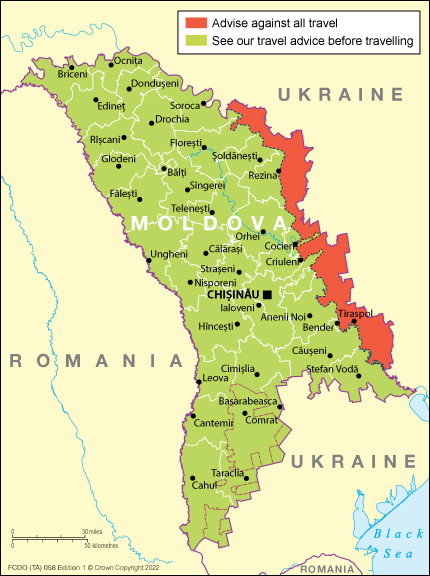
  • We advise caution if considering travelling to the Transnistria region. This region is outside of the control of the Moldovan authorities, and British consular services may be limited in their ability to help.

  • Most visits to Moldova are trouble-free. See General - Consular Assistance Statistics. The Moldovan authorities are strictly enforcing penalties (including deportation) against those who overstay. See Entry Requirements.

  • You should be vigilant to petty crime, particularly in Chisinau. Leave your passport, travel documents and other valuable items in a safe place. But you should always carry a photocopy of your passport for identification purposes, as police checks are frequent.

  • There are strong penalties for possession or use of drugs and avoid taking photographs of military or government installations. See Local Laws and Customs section.

  • You should take out comprehensive travel and medical insurance before travelling.  See General - Insurance.

Safety and Security - Terrorism
There is a low threat from terrorism. But you should be aware of the global risk of indiscriminate terrorist attacks which could be in public areas, including those frequented by expatriates and foreign travellers. See our Terrorism Abroad page.

Safety and Security - Crime

You should be alert to the risk of street crime and petty theft, particularly in Chisinau, and for pickpockets and bag snatchers in crowded areas. Try not to draw attention to yourself on the streets. Credit card and ATM fraud is on the increase and you should avoid using credit/debit cards whenever possible and take precautions when using ATM’s. You should keep your valuables and passport secure in hotel safes and make sure that you carry a copy of your passport with you.  It is useful to carry a small torch after dark, as street lighting is poor. See our Victims of Crime Abroad page.

Safety and Security - Local Travel
 
The Transnistria region is not under Moldovan government control and seeks independence. Since July 2006, there have been two explosions on or near public transport in the regional capital Tiraspol.  While the exact motives remain unclear, there is no evidence to suggest that these attacks were linked to any terrorist group or organisation.  We advise caution if considering travelling to Transnistria. It is very important to avoid getting into difficulty with the Transnistrian authorities.

The Embassy will do its best to provide Consular help where needed.  But in practice this will be very limited.  Anyone in trouble with the Transnistrian authorities should try to telephone the Embassy in Chisinau at an early stage.

Safety and Security - Local Travel - Road Travel

In order to drive a vehicle into Moldova you will need to provide the following documents:

  • Car registration
  • Valid insurance (Green Card / Cartea Verde)
  • Your UK driving licence
  • Passport
  • If you are not the owner, written permission from the owner to drive the vehicle. This should be translated into Romanian and legalised.


The vehicle will need to be declared to the customs authority at the point of entry into Moldova. From 4 April 2011 vehicles can be brought into Moldova without payment of import taxes for a maximum of 90 cumulative days in a 365-day period, from the date of first entry.

Please contact the Moldovan Embassy in London if you have more detailed questions about bringing a vehicle in to the country. The British Embassy is unable to offer any assistance to individuals attempting to bring vehicles into Moldova who do not have the correct documentation on arrival at the border.

Avoid driving outside urban areas, particularly at night. Driving standards are poor and roads are of variable quality. There are a high number of traffic accidents, including fatalities. You should comply with all local speed limits. There is a zero tolerance policy on drink driving.  From 1 November until 31 March, drivers are obliged to travel with headlights on at all times. Failure to do so could result in a fine.  

Official looking taxis can be unlicensed. Do not share a taxi with strangers or flag down unofficial taxis. You should negotiate a price before getting into a taxi. Where possible ask your hotel to get a taxi for you, or to give you the telephone number of a reputable company.

The Department of Traffic Police has published the following helpline that you may contact for advice:


42, Vasile Alecsandri street, Chisinau, Moldova
Tel: 00 373 (22) 255-920 (hot line)
Fax: 00 373 (22) 255-200
E-mail: pol.rutiera@mai.gov.md
E-mail: info@pr.gov.md
(Moldovan officials speak only Romanian and Russian)


For more general information see Driving Abroad.

Safety and Security - Political Situation
The political situation is calm; however, you should avoid any political rallies, demonstrations or large gatherings.

Moldova Country Profile

There is a zero tolerance policy in Moldova for possessing or supplying any drugs. Whilst legislation stipulates that fines are possible penalties for drug use/supply, in practice possession of even small quantities of drugs (Class B/C drugs as well as Class A) could result in long prison terms (2-5 years, 5-8 years for repeat offenders) in addition to heavy fines.

Homosexuality is not forbidden in Moldova, though the Moldovan government does not formally recognise unmarried or same-sex partners. There is an active social and lobbying group on gay/lesbian issues in Chisinau. But public attitudes are less tolerant. 

The authorities in the Transnistrian region of Moldova can be uncomfortable with visitors taking photos in Transnistria. We advise caution if taking photos of even the most normal buildings/monuments, and we advise against taking photographs of any peacekeeping or military staff/installations, which could lead to difficulty.  

You should also avoid taking photos of military and government (including airports, power stations etc) facilities in Moldova more widely. There are frequent police checks. 

You should carry with you at least a copy of identification documents (passport) at all times.  Drivers should hold a valid international driving licence and original car/insurance documents, and should keep to speed limits. You must obtain permission from the Moldovan Department of Monuments to bring out of the country any artwork or antiques. Failure to obtain this permission could result in the artwork or antiques being impounded and criminal charges brought.

See our Your Trip page.

Entry Requirements - Visas
Visas are no longer required to enter Moldova if your stay is under 90 days. The Moldovan Embassy in London now issues visas. 

You should check your visa after it has been issued and before travelling to ensure that it is valid for the time of the proposed visit, as there have been occasional errors resulting in fines and delays to travel plans. The Moldovan authorities are now strictly enforcing penalties (including deportation) against foreign visitors who overstay the terms of their visas. As a visitor you are allowed to spend no more than 90 days in a six months period in Moldova. Residence and/or work permits are still required for stays over 90 days. Immigration, residence, and work permits usually need to be extended annually, but can be issued for up to five years. Alternatively, you must regularise your stay by applying for a Residence or work visa.

Entry Requirements - Entry into Moldova via Transnistria
Visitors entering into Transnistria overland from Ukraine (e.g. by bus or rail) should be aware that the Transnistrian border guard will not place entry stamps into passports. There are no ‘immigration controls’ in place on the internal boundary between Transnistria and Moldova proper and entry stamps will also not be placed into passports at this juncture. Visitors who enter Moldova in this way (via Transnistria) are likely to encounter problems when leaving Moldova (by air from Chisinau or overland into Romania) as their passport will show no valid entry stamp into Moldova and may potentially be deemed to have illegally entered the country. Visitors entering Moldova via Transnistria are advised to register with the Ministry of Information, Technologies and Communication, located in Chisinau at 49 M. Kogalniceanu str, within 3 days (72 hours) on arriving.

Entry Requirements - Entry into Moldova via Ukraine
Visitors intending to enter Moldova overland from Ukraine are advised to do so at one of the internationally recognised border crossing points between Moldova (excluding the Transnistria segment) and Ukraine in the north and south of the country.

Entry Requirements - Passport validity
Before setting off you should ensure that your passport has at least six months’ remaining validity and at least one unused page. 

Entry Requirements - Registration
Registration is carried out automatically when visitors enter Moldova, regardless of whether they enter by air, land or sea. When you arrive in Moldova by either of these routes you will automatically be registered with the local authorities. If you enter Moldova via Transnistria, as stated above, you must register with the Ministry of Information, Technologies and Communication, located in Chisinau at 49 M. Kogalniceanu str or the local passport office (the British Embassy can provide you with the address of the relevant passport office for your area) within 3 days (72 hours). To register your stay in Moldova you must present the following documents:  

  • a written request for registration giving details of where your are staying, for how long and the reason for the visit; 
  • your passport.


Failure to register may result in fines and/or difficulties when leaving Moldova.  


Entry Requirements - STUDENT GROUPS TRAVELLING TO MOLDOVA FOR SUMMER CAMPS/CHARITY/VOLUNTARY WORK

Our Embassy in Chisinau has been advised by the Moldovan authorities that groups wishing to attend summer camps and/or carry out charity/voluntary work should complete the attached form and bring this with them when they visit Moldova.

Entry Requirements - Travelling with children

Single parents or other adults travelling alone with children should be aware that some countries require documentary evidence of parental responsibility before allowing lone parents to enter the country or, in some cases, before permitting the children to leave the country.  For further information on exactly what will be required at immigration, please contact the Moldovan Embassy in London.

The standard of medical care in Moldova is below that available in the UK. Non Russian/Romanian speakers may encounter difficulties in a medical emergency. The Embassy has details of English-speaking doctors.

We advise you to drink bottled water, as Moldovan tap water may cause visitors to become ill.

In the 2010 Report on the Global AIDS Epidemic the UNAIDS/WHO Working Group estimated that around 12,000 adults aged 15 or over in Moldova were living with HIV; the prevalence percentage was estimated at around 0.4% of the adult population compared to the prevalence rate in adults in the UK of around 0.2%. You should exercise normal precautions to avoid exposure to HIV/AIDS. For more general information on how to do this see HIV and AIDS.

Seek medical advice before travelling to Moldova and ensure that all appropriate vaccinations are up-to-date.  For further information on vaccination requirements, health outbreaks and general disease protection and prevention visit the websites of the NaTHNaC and NHS Scotland's Fit For Travel or call NHS Direct on 0845 46 47.

See our Travel Health page.

Earthquakes are not uncommon in Moldova, it is located in a seismically active area and is prone to small earth tremors that are recorded throughout the year without consequence. The last significant earthquake occurred in 1986, causing fatalities and significant damage to buildings.

Independent advice on how to prepare for an earthquake and how to protect yourself during an earthquake or tremor is available from many sources online. For further information please see the Embassy website http://ukinmoldova.fco.gov.uk/en/


General - Insurance
You should take out full, comprehensive insurance and make sure that this covers medical evacuation in an emergency. Check for any exclusions, and that your policy covers you for all the activities you want to undertake. See our Travel Insurance page.

If things do go wrong when you are overseas then see our When Things Go Wrong page.

General - Registration
Register with our LOCATE service to tell us when and where you are travelling abroad or where you live abroad so our consular and crisis staff can provide better assistance to you in an emergency.

General - UK passport applications
UK passport applications are now processed by the British Passport Processing Centre in Dusseldorf. You can obtain further information on this procedure on the Embassy website.

The British Embassy can issue you with an emergency travel document within normal working hours if you need to travel back to the UK urgently and cannot wait for a full passport. If your passport is lost or stolen, you should obtain a police report and apply for an emergency travel document. You should keep a photocopy of your passport with you at all times as proof of identity.

General - Money
The most widely accepted foreign currencies are the US Dollar and the Euro. We recommend that you carry some Euro cash. The Euro notes should be in perfect condition or they may not be accepted. It is not always easy to exchange Sterling for the local currency. Credit cards are not widely accepted in Moldova. Moldovan Lei can be obtained from a number of ATM machines in Chisinau. However only a very limited of these ATM machines will accept ‘chip and pin’ cards. ATMs outside Chisinau will not accept ‘chip and pin’ cards.

General - Consular Assistance Statistics
Four British nationals required consular assistance in Moldova in the period 01 April 2010 – 31 March 2011.

Contacts

Moldova, Chisinau, British Embassy

Address:

British Embassy Chisinau
18 Nicolae Iorga str.
Chisinau, MD-2012
Republic of Moldova

Telephone:

(373 22) 22 59 02

Fax:

(373 22) 25 18 59

Email: mailto:visa.enquiries@fco.gov.uk

Email: mailto:visa.enquiries@fco.gov.uk

Office hours:

Local time:

Summer (mid June – end August)
Mon – Thur:  0900 – 1730
Fri: 0900 – 1300

Winter (September – mid June)
Mon – Thur:  0900 – 1730
Fri: 0900 – 1400


GMT:

Summer (mid June – end August)
Mon – Thur:  0600 – 1430
Fri: 0600 – 1000

Winter (September – mid June)
Mon – Thur:  0700 – 1530
Fri: 0700 – 1200

General enquiries:  Enquiries.Chisinau@fco.gov.uk

Public Holidays

Website: http://ukinmoldova.fco.gov.uk/en/

register
 
register
 
 
Facebook - British abroad