Belarus |
|
| Still current at: 24 May 2012
Updated: 14 May 2012 |
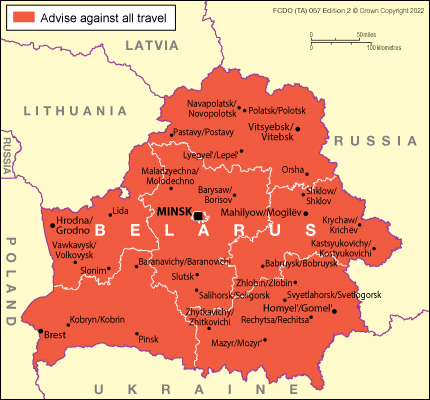
| No restrictions in this travel advice | Avoid all but essential travel to part(s) of country | Avoid all but essential travel to whole country | Avoid all travel to part(s) of country | Avoid all travel to whole country |
Safety and Security - Terrorism
There is a general threat from terrorism. There was an explosion at October Square (Oktyabrskaya) metro station in central Minsk on the evening of 11 April 2011 with 13 fatalities. No British nationals were affected. We advise all visitors to Minsk to exercise caution at this time and be aware of the global risk of indiscriminate terrorist attacks, which could be against civilian targets, including places frequented by foreigners. See our terrorism abroad page.
Safety and Security - Crime
There is little crime in Belarus. However, you should be alert at all times to the possibility of mugging, pickpocketing and theft from vehicles or hotel rooms. You should take extra care when travelling by train, as there have been instances of theft from travellers, especially on sleeper trains to Warsaw and Moscow.
See our victims of crime abroad page.
Safety and Security - Local Travel - Road travel
British driving licence holders must possess a valid International Driver's Licence to drive legally in Belarus. When travelling by private vehicle, you must be able to produce ownership documents or a letter of 'power of attorney' at Custom's offices at border crossings. Only originals of these documents are accepted. You must have third party car insurance or you may get an 'on-the-spot' fine. But you can only buy this when entering Belarus. Motorists should enquire at Customs' border offices for information. Drivers of foreign vehicles must pay a fee to use Belarus' highways. Payments are collected at border checkpoints and will vary according to the length of stay. The quality of driving in Belarus is erratic. Belarus' 'A-class' highways are in average to good condition. The condition of 'B-class' roads varies considerably and some are impassable for periods in winter. Drivers should note that road works and potholes are usually poorly marked. Pony and trap combinations are a specific hazard for drivers in rural unlit areas. You should observe the speed limit at all times. The standard speed limit is 60 kph (37 mph) in built up areas; 90 kph (55 mph) outside built up areas; and 100 kph (62 mph) on motorways (Brest-Moscow). Visiting motorists who have held a driving licence for less than two years must not exceed 70 kph (43 mph). The authorities operate a zero-tolerance policy in respect of drink-driving. Motorists should be aware that there may be long queues at the border and that customs and immigration can be lengthy and bureaucratic. You should ignore 'private facilitators' who offer to help travellers pass through checkpoints and border crossings. There are police checkpoints on routes throughout the country. Drivers should stop at these when instructed, and have the vehicle documentation to hand, otherwise you risk a fine and delay. Motorists entering Belarus should ensure that they do not overstay the temporary import terms for their vehicles. Violation of the exit deadline may result in confiscation of your vehicle at the Belarusian border or if stopped at an in-country police checkpoint.
See our driving abroad page.
Safety and Security - Local Travel - Air travel
Some local airlines do not observe proper maintenance procedures. For your safety, where possible, you should fly directly to your destination on an international flight originating outside the former Soviet Union and Central Asia.
For more general information see airline security.
Political situation
Belarus Country Profile
Belarus is governed by a strong Presidential system with security forces loyal to it. The authorities show little tolerance for their opposition counterparts. This has often been reflected in the sometimes heavy-handed use of the security forces to disperse or intimidate opposition events. You should be alert and avoid any demonstrations or rallies in Belarus.
Belarus has severe penalties for drugs-related crimes. The penalties for possession of drugs range from fines to up to five years imprisonment. Large-scale drug-related offences can result in imprisonment of between seven and 15 years.
Homosexual relationships are permitted under Belarusian law. However, Belarus remains a conservative society and the gay/lesbian scene is very low profile. Few homosexuals openly declare themselves.
You should avoid taking photographs of all government buildings, military installations and uniformed officials. You should also be aware that you could be fined for jaywalking.
If you wish to import goods or services for charitable purposes, you should consult the Belarus Embassy in London for advice about local procedures and tariffs. If you think that your goods are subject to exemption from Belarusian taxation, you should obtain a written note from the Belarus Embassy in London, confirming this.
See our your trip page.
Entry Requirements - Visas
Visas are required to enter or transit Belarus. This includes anyone travelling by train on popular routes such as Warsaw-Moscow and St Petersburg-Kiev. If you attempt to transit Belarus without a visa, the border authorities will send you to Minsk to obtain the appropriate visa. You may also be required to pay a fine of up to $300 and you may face deportation. Belarusian diplomatic offices and consulates issue visas.
If there is no Belarusian Embassy or Consulate in the country you are leaving, and you are travelling by plane, it is possible to obtain a visa on arrival at Minsk National Airport. However, you should be aware that the fees are more expensive for visas on-arrival: US$234 for a transit visa and US$342 for a short-term visa. Further details can be found on the Belarus Ministry of Foreign Affairs website.
Entry Requirements - Passport validity
You must hold a valid passport to enter Belarus. Your passport must be valid for a minimum period of three months from the date of entry into Belarus.
Entry Requirements - Registration
Anyone staying more than five working days in Belarus must register with the local police office (OVIR) in the district in which they are staying. If you are staying in an hotel this will be arranged by the hotel. If you are not staying in a hotel this must be organised by your host. There are fines for not registering in time. If arriving at the weekend the earliest you will be able to register is Monday (but they are only open until 1300). Monday will count as the first of the five days.
Entry Requirements - Declaration of currency and goods
If carrying more than $10, 000 in cash or travellers cheques you must complete a currency and goods declaration form on entering Belarus. This must be completed accurately and must be stamped on entry by a Customs Officer. You will not be allowed to take out from Belarus more currency than you originally declared on the currency declaration form on entry to Belarus. You should keep these forms for the duration of your visit. When leaving Belarus you will have to complete a new form but you should also have the original form to hand. If you do not do so, your journey may be delayed and you may be fined.
Entry Requirements - Travelling with children
Single parents or other adults travelling alone with children should be aware that some countries require documentary evidence of parental responsibility before allowing lone parents to enter the country or, in some cases, before permitting the children to leave the country. Children of Belarusian parentage, regardless of where they were born or any other nationality they may have, are required to have a Belarusian travel document to travel to Belarus.
Entry Requirements - Entering by Car
There is a fee for entering and transiting Belarus for all vehicles (except for non-transit passenger cars). The fee ranges from $20 to $155. There is also a requirement to include the details of your vehicle in the customs declaration and purchase insurance for the vehicle (only insurance by a few foreign companies is accepted). Insurance agents are present at every border crossing point and the charges range from €5 for 15 days to €53 for a year.
Foreign drivers must also possess a valid international driver’s licence and be able to produce one of the following documents: an original ownership certificate for their vehicle; rental contract; or power of attorney from the owner of the vehicle. There can be long queues at Belarus’ land borders with Poland and Lithuania.
For further information some useful links are:
http://belarustourist.minsk.by/tips/
http://www.bairc.org/engver/terms_e
http://www.dfa.ie/home/index.aspx?id=397
Contact your GP around eight weeks before your trip to check whether you need any vaccinations or other preventive measures. Country specific information and advice is published by the National Travel Health Network and Centre, and useful information about healthcare abroad, including a country-by-country guide of reciprocal health care agreements with the UK, is available from NHS Choices.
Standards of health care are below that of the UK. You should bring essential personal medications, as the availability of local supplies cannot be guaranteed. Make sure you have adequate travel health insurance and accessible funds to cover the cost of any medical treatment abroad and repatriation.
You should take care to avoid certain foodstuffs (primarily local dairy produce, forest mushrooms and fruits of the forest), which can carry high levels of radiation as a result of contamination from the 1986 accident at Chernobyl in Ukraine.
Otherwise the risk of radioactive contamination from the Chernobyl site is insignificant. There is an exclusion zone immediately around the Chernobyl site, which includes the area close to the border with Ukraine in the south east of Belarus. You may find that access to this part of the country is limited.
You should not drink village well water as it is usually heavily contaminated with impurities. In cities, you should first boil, then filter tap water before drinking. We recommend that you buy bottled water. This is widely available in shops.
In the 2010 Report on the Global AIDS Epidemic the UNAIDS/WHO Working Group estimated that around 16,000 adults aged 15 or over in Belarus were living with HIV; the prevalence percentage was estimated at around 0.3% of the adult population compared to the prevalence percentage in adults in the UK of around 0.2%. You should exercise normal precautions to avoid exposure to HIV/AIDS. For more general information on how to do this see HIV and AIDS.
If you need emergency medical assistance during your trip, dial 103 and ask for an ambulance. You should contact your insurance/medical assistance company promptly if you are referred to a medical facility for treatment. The majority of people in Belarus only speak the Russian or Belarusian languages. You may need to find someone who speaks English to interpret for you.
Our travel health pages offer further advice on how to stay healthy when overseas.
General - Insurance
You should obtain comprehensive travel and medical insurance before travelling. Check for any exclusions, and that your policy covers you for the activities you want to undertake. See our travel insurance page.
If things do go wrong when you are overseas then see our When Things Go Wrong page.
Under a bilateral agreement which came into effect on 1 March 2006 British citizens are not required to purchase on arrival in Belarus the medical insurance which is mandatory for other foreign nationals (including other EU countries).
General - Money
Sterling is not widely accepted for exchange into Belarusian Roubels (BYR). We advise that you carry US Dollars. Euros are also widely accepted. Ensure you have enough money for the duration of your stay. It is only possible to exchange BYR back into other foreign currency, most commonly US Dollars, in Belarus and only at some exchange outlets on the on the presentation of a valid passport. It is not possible to exchange BYR into other currencies outside of Belarus.
There are plenty of ATMs in major cities. Credit cards are not widely used but can be used to withdraw cash at major hotels and banks. Usually only BYR can be withdrawn from ATMs. A small number of ATM’s issue US Dollars but the supply is not reliable. Some large stores and restaurants will accept credit cards. It is advisable to inform your UK bank of your intended travel to Belarus before you depart to ensure that they do not block your card because of suspicion of fraudulent use in a foreign country.
You should only exchange foreign currency at Government licensed booths. These can be found in or near major stores, hotels, banks and shopping centres. Non-compliance can result in fines and/or arrest and the currency involved in the deal will be confiscated. There are proposals by the Belarusian Ministry of Interior to further toughen penalties for illegal foreign currency transactions.
General - Passports
The British Embassy in Minsk does not issue passports. Applications for new passports are accepted in Minsk for forwarding to the British Embassy in Dusseldorf for processing, but this takes at least four weeks. If you use a courier you will have to pay the cost.
General - Consular Assistance Statistics
Around 4,000 British nationals (Source: Ministry of Foreign Affairs for Belarus) visit Belarus every year. Most visits are trouble-free. Two British nationals required consular assistance in Belarus in the period 01 April 2010 - 31 March 2011 for the following types of incident; one death and one arrest.