Armenia |
|
| Still current at: 11 February 2012
Updated: 06 February 2012 |
| No restrictions in this travel advice | Avoid all but essential travel to part(s) of country | Avoid all but essential travel to whole country | Avoid all travel to part(s) of country | Avoid all travel to whole country |
Safety and Security - Terrorism
There is a low threat from terrorism. But you should be aware of the global risk of indiscriminate terrorist attacks, which could be in public areas including those frequented by expatriates and foreign travellers. See our terrorism abroad page.
Safety and Security - Crime
Crime, especially violent crime, remains relatively low in Armenia. But there are incidents of pick pocketing, bag snatching, theft from cars and burglary involving British or other foreign nationals. You should not carry your passport, credit card, travel tickets and money together. We advise you to leave spare cash, passports and valuables in a safe place, but you should carry a photocopy of your passport as identification at all times.
There have been occasional shooting incidents, chiefly related to organised crime. Although tourists and foreigners were not targeted, there is a risk of being caught up in such events and you should remain vigilant at all times.
We also advise that you take the same personal safety precautions on the street and when using ATMs as you would in the UK. Take particular care if using them after dark, especially if you are alone. Check no one has followed you after conducting your business.
See our victims of crime abroad page.
Safety and Security - Local Travel
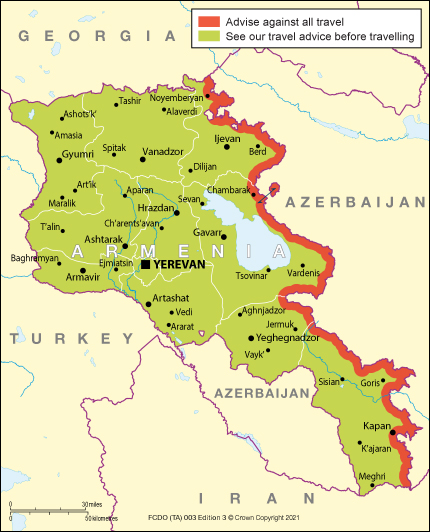
The border between Armenia and Azerbaijan is closed and we advise against all but essential travel close to the border with Azerbaijan, particularly the border areas of Tavush and Gegharkunik regions, where there have been reports of sporadic gunfire. We specifically advise against all travel on the road from Ijevan to Noyemberyan, which passes close to the border and military emplacements, where there have also been some reports of sporadic gunfire. If travelling between Armenia and Georgia we advise you to use one of the routes further west, or through the Lori region.
The land border with Turkey is also closed, but there are now direct flights from Yerevan to Istanbul. Travelling within the South Caucasus can be difficult and needs careful planning.
Safety and Security - Local Travel - Road travel
You can drive in Armenia on an International driving licence. The local standard of driving is poor. If you plan to drive in Armenia, you should be prepared for drivers who drive recklessly and flout traffic laws. The roads are also in a poor state, particularly in the coldest months (November to February). If you are walking, you should be careful when crossing roads and use subways where available. See our driving abroad page.
Safety and Security - Local Travel - Rail Travel
Public transport is often overcrowded and poorly maintained. If you have to travel by train, secure your valuables, do not leave the compartment unattended, and lock the door from the inside.
Safety and Security - Local Travel - Air travel
Evidence suggests that some airlines serving Armenia do not always comply with international safety standards in respect of maintenance procedures. Foreign and Commonwealth Office (FCO) staff have therefore been advised to avoid flying with non-scheduled or non-international airlines from Armenia if an acceptable alternative means of travel exists.
Western airlines currently serving Armenia are BMI, Czech Airlines, Lot Polish Airlines, Air France and Austrian Airlines.
On 15 July 2009, a Caspian Airlines flight from Tehran to Yerevan crashed 75 miles northwest of Tehran shortly after takeoff. All 168 passengers and crew onboard were killed. The cause of the crash has not yet been revealed.
A Canadian-built CRJ-100, operated by the Belarussian state airline Belavia, crashed shortly after taking off from Yerevan airport on 14 February 2008. There were no fatalities. An investigation concluded poor aircraft maintenance was to blame.
See our airline security page.
Safety and Security - Political Situation
Armenia country profile
There is an ongoing risk of political demonstrations in central Yerevan and in other cities and towns around the country. We advise you to avoid the area of known demonstrations and large gatherings of people and if not possible, we urge you to exercise vigilance and caution at all times. Demonstrations or gatherings can attract large numbers, and even if intended to be peaceful could turn confrontational.
The dispute over Nagorno Karabakh remains unresolved. The British Embassy cannot provide consular assistance to you if you are in the Nagorno-Karabakh region. Although a ceasefire has been in place since May 1994, the borders between Azerbaijan and both Armenia and Armenian occupied territory remain closed. There are no peacekeeping forces separating the two sides. There are regular exchanges of sniper fire and some skirmishes. The border areas also contain mines and unexploded ordnance. Any foreigners venturing within five kilometres of these borders are liable to be stopped by the police or the military.
Armenia is a Christian country and women can usually dress in normal western-style clothing. Outside the capital people are more conservative and inappropriate dress will attract attention.
You should carry a photocopy of your passport as identification at all times. The use of illegal drugs carries stiff penalties, including fines and long prison terms. The penalty for smuggling drugs carries a prison term of between four to ten years.
Homosexuality was decriminalised in 2003 but is still regarded with disapproval by many Armenians. Local LGBT groups have told us that their members occasionally suffer from verbal and physical harassment. We therefore advise gay or lesbian travellers to exercise discretion on visits to Armenia. Although you will see men (and women) holding hands and kissing in public, this is common in Armenian culture, and is not necessarily an indicator of sexual orientation. You should refrain from photographing sites such as military bases, equipment and installations in whatever condition. These are considered sensitive areas and visitors have been detained and questioned while attempting to photograph them.
See our Your Trip page.
Entry Requirements - Visas
All visitors to Armenia require a visa. It is possible to get one on arrival at the airport and the main road and rail border crossings of Bagratashen (coming from Georgia) and Iran (Meghri). You can also apply for an e-visa via the Internet. For further details on entry requirements and e-visas visit: Ministry of Foreign Affairs of Republic of Armenia website.
Holders of Diplomatic or Official passports need to apply for their visas before they travel.
Entry Requirements - Passport validity
You must hold a valid passport to enter Armenia. Your passport must be valid for a minimum period of six months from the date of entry into Armenia.
Entry Requirements - Travelling with children
For information on exactly what will be required at immigration please contact the Armenian Embassy in London.
Entry Requirements – Dual nationals
Dual national passport holders entering Armenia using their Armenian passport and travelling with children on a United Kingdom passport should make themselves aware of Armenian nationality law before entering the country.
Under Armenian Law a child of an Armenian passport holder is automatically regarded as Armenian and has to present an Armenian passport to leave the country. They may be detained on departure if they cannot produce one.
For further information, please see the Armenian Foreign Ministry's website: www.armeniaforeignministry.com/perspectives/dualcitizenship-final-eng.pdf
Medical facilities are generally poor, particularly outside Yerevan, and treatment is not recommended for anything other than minor or straightforward ailments.
You should seek medical advice before travelling to Armenia and ensure that all appropriate vaccinations are up to date. For further information on vaccination requirements, health outbreaks and general disease protection and prevention you should visit the websites of the National Travel Health Network and Centre (NaTHNaC) and NHS Scotland’s Fit for Travel or call NHS Direct (0845 46 47).
In the 2010 Report on the Global AIDS Epidemic the UNAIDS/WHO Working Group estimated that around 1,900 adults aged 15 or over in Armenia were living with HIV; the prevalence percentage was estimated at around 0.1% of the adult population compared to the prevalence percentage in adults in the UK of around 0.2%. You should exercise normal precautions to avoid exposure to HIV/AIDS. For more general information on how to do this see HIV and AIDS.
See our Travel Health page.
Armenia is in an active seismic zone. The last serious earthquake, in 1988, was centred in the Lori region in the north, killing between 25,000 and 50,000 people, injuring thousands and leaving several cities in ruins.
General - Insurance
You should take out comprehensive medical as well as travel insurance before travelling. This should include cover for medical air evacuation in the event of serious injury or illness.
See our travel insurance page.
If things do go wrong when you are overseas please see When Things Go Wrong.
General - Issuing replacement passports
The British Embassy in Yerevan does not issue passports. You should therefore ensure that your passport has sufficient validity and a plentiful supply of unused pages. Applications for new passports are accepted in Yerevan for forwarding to the Passport Processing Centre, but this may take up to six weeks.
General - Registration
Register with our LOCATE service to tell us when and where you are travelling abroad or where you live abroad so our consular and crisis staff can provide better assistance to you in an emergency.
General - Telephone/Internet communications
Communication by telephone and e-mail can sometimes be difficult especially in the regions. Not all British mobile phones work in Armenia: please check for coverage before leaving the UK if you intend to rely on it. There are a growing number of internet cafes but access can still be slow and unreliable. You should ensure that family/friends who expect regular contact are aware of this to avoid unnecessary worry.
General - Money
Cash can be changed at banks and in exchange bureaux. British pounds may be less readily accepted outside Yerevan than dollars or euros.
Credit cards and UK debit cards displaying the Maestro and/or Cirrus sign are accepted at major stores and restaurants in Yerevan but are far less acceptable outside the capital. Prices for goods and services are sometimes quoted in US Dollars. But by law, payment must be made in Armenian Dram.
There are many ATMs in Yerevan. They accept major credit cards and debit cards with the Maestro/Cirrus or Visa sign displayed on the card.
General - Consular Assistance Statistics
One British national required consular assistance in Armenia in the period 01 April 2010 - 31 March 2011.