Uzbekistan |
|
| Still current at: 10 February 2012
Updated: 11 January 2012 |
| No restrictions in this travel advice | Avoid all but essential travel to part(s) of country | Avoid all but essential travel to whole country | Avoid all travel to part(s) of country | Avoid all travel to whole country |
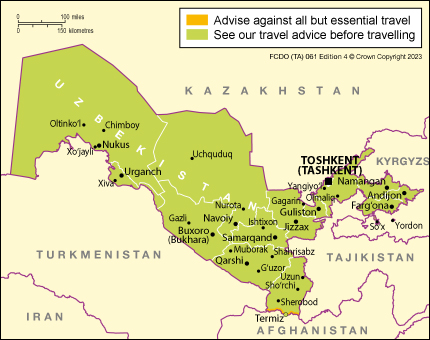
We advise against all but essential travel to areas of Uzbekistan bordering Afghanistan. You should also exercise caution in areas bordering Tajikistan and Kyrgyzstan. Uzbekistan's borders are potential flashpoints and uncontrolled border areas may be land-mined. Borders are subject to closure without notice.
We advise against all but essential travel to the Oblasts (Provinces) of Osh and Jalal-Abad in neighbouring Kyrgyzstan following inter-ethnic violence in June 2010. See FCO Travel Advice for Kyrgyzstan.
On 20 July 2011 an earthquake measuring 6.2 on the Richter scale hit the Batken region of south-western Kyrgyzstan and tremors were felt in Tashkent. A number of deaths and injuries
were reported.
Visitors to the Fergana Valley should be aware of the heightened tensions and exercise caution
.
Relatively few British nationals visit Uzbekistan, and most visits are trouble free. See
General - Consular Assistance.
There is an underlying threat from terrorism. Attacks could be indiscriminate, including in places frequented by expatriates and foreign travellers. Visitors should be aware that terrorist incidents have occurred in Uzbekistan. In May 2009, armed attacks took place in the Andizhan region of the Fergana Valley. See Safety and Security -
Terrorism.
You should get comprehensive travel and medical insurance before travelling to Uzbekistan. See General - Insurance.
There have been several instances in 2010 and 2011 of foreign nationals being detained at the Khusaily border crossing near Nukus for possession of medication that would not normally be problematic in other countries. Visitors should be particularly careful about carrying medication into Uzbekistan. See Health.
Safety and Security - Terrorism
There is an underlying threat from terrorism in Uzbekistan. Attacks could be indiscriminate, including in places frequented by expatriates and foreign travellers. You should be particularly vigilant in public places, and pay attention to any security announcements by the Uzbek authorities. Terrorist incidents have occurred in Uzbekistan in recent years. In May 2009, armed attacks, including a suicide bomb, took place in the towns of Andizhan and Khanabad in Ferghana Valley.
Security has been stepped up at airports, railway and metro stations as a result of the bombing at Moscow airport in January, with an increased police presence and the introduction of checks using metal detecting devices.
See our Terrorism Abroad page.
Safety and Security - Crime
There have been occasional muggings and petty crime against foreigners. Policemen, or sometimes those pretending to be policemen, may seek to impose an on-the-spot fine. If you are any doubt you should ask for an ID or pay any fines at the nearest police station. Keep valuables out of sight and avoid unlit or remote areas. Avoid obvious displays of wealth, especially in rural areas. You should avoid walking alone at night.
We have received reports of raids upon local establishments, including restaurants, by groups of unknown persons. The perpetrators do not identify themselves and bear no visible means of identification (men dressed in black and wearing balaclavas). We have had no reports of violence against foreigners, but the use of violence against local restaurant guests and staff has been reported. If you are inadvertently caught up in a situation like this, remain calm, follow any instructions given and leave the area as soon as permitted and safe to do so.
See our Victims of Crime Abroad page.
Safety and Security - Local Travel
Security incidents have been reported along the Uzbek/Tajik border. In April 2011 an alleged trespasser was reportedly shot dead by border guards.
Land borders between Uzbekistan and neighbouring states, particularly Kyrgyzstan and Tajikistan, are often closed at short or no notice. If travelling overland, you should check in advance which border posts are currently open.
You should exercise caution in areas bordering Tajikistan and Kyrgyzstan. Uzbekistan's borders are potential flashpoints and there is a risk that uncontrolled border areas may be land-mined.
Tensions exist over recognition of the Uzbek/Kyrgyz borders. There have been a number of security incidents in this region and there have been several gunfire exchanges across the Uzbek/Kyrgyz border. We understand that the Uzbek/Kyrgyz border may close without notice, and that security has been increased in the border areas. Security incidents have also been reported along the Uzbek/Tajik border. In April 2011 an alleged trespasser was reportedly shot dead by border guards.
If you wish to travel to Termez and other areas of the Surkhandarya region you will need a permit. You can apply for the permit, which usually takes five days to process, from the Ministry of Foreign Affairs in Tashkent.
Safety and Security - Local Travel - Road Travel
If you drive in Uzbekistan you must ensure that you have all registration papers, including motor insurance. You must carry your UK Driving Licence or an International Driving Permit at all times, and present it in the event of an accident.
There are security checkpoints at the city limits of Tashkent and other towns. You may experience delays if driving. In Tashkent it is safer to use official taxis rather than unlicensed ones. Take care if driving, as many roads are poorly-surfaced and badly-lit.
You drive on the right in Uzbekistan. Be aware that vehicles approaching a roundabout have the right of way over vehicles already on the roundabout.
Though widely ignored, seatbelts for drivers and passengers are compulsory and the use of mobile phones while driving is prohibited.
A bus exploded in Tashkent on 11 May 2010, causing six fatalities. The accident was reportedly due to a fault with its Compressed Natural Gas (CNG) fuel tank. Many buses and taxis in Uzbekistan run on CNG and safety regulations are often not followed. Where possible you should opt for modern vehicles when travelling by bus or taxi.
See Driving Abroad.
Safety and Security - Local Travel - Rail Travel
Take care when travelling long distances by train. If you have to travel overnight, store valuables in a safe place; do not leave the compartment unattended, and secure the door from the inside. You must present your passport when booking train tickets.
Safety and Security - Local Travel - Air Travel
Evidence suggests that some airlines serving Uzbekistan do not always comply with international safety standards in respect of maintenance procedures.
Uzbekistan Airways operate regular services to a number of European destinations. Uzbekistan is also served by Turkish Airlines, Czech Air, and Lufthansa, which all meet current European Union safety standards.
Safety and Security - Political Situation
Uzbekistan Country Profile
The political situation in Uzbekistan is stable.
You should monitor local media and avoid any planned demonstrations or public gatherings. In the past, these have sometimes turned violent.
Uzbekistan has a secular constitution. Most Uzbek people are Muslims. See Travelling During Ramadan.
We recommend that you carry a photocopy of your passport at all times. Requests to produce an ID, for example by the police, are frequent.
Possession of drugs is illegal. There is a ban on the sale of alcohol and tobacco to those under 20. You should carry a doctor's prescription if you intend to travel with prescription medicine (see section below on Health). Prison sentences can be lengthy. While prison conditions have reportedly improved, reports of widespread hepatitis and tuberculosis and allegations of mistreatment of some prisoners by officials remain a source of concern.
Homosexuality is illegal under Uzbek law and is still very much frowned upon socially. You should take care over public displays of affection.
You should be aware that any form of photography can upset the authorities. You should check before using a camera, especially near airports, border checkpoints, military barracks, bridges, police stations and metro stations.
See our Your Trip page.
Entry Requirements - Visas
British nationals need a visa to enter Uzbekistan, which you should get before you arrive and which should cover your entire stay. You will need to provide a letter of invitation with your application. Business visitors must get a letter from an Uzbek business partner whilst tourists must get one from their tour company.
Check your Uzbek visa once issued and carefully note the date of expiry and the number of entries permitted.
Do not overstay your visa. Ensure you have onward visas for other countries if travelling elsewhere. Any traveller found to have overstayed will face a considerable fine and possibly deportation. It is not always easy or possible to extend your visa if you wish to remain in the country for longer than you had originally intended. If travelling overland you should ensure you arrive at your intended border crossing in good time before expiry of your Uzbek visa.
For further advice contact the Embassy of the Republic of Uzbekistan in London.
Entry Requirements - Visas - Registering your presence
You must register within three days of arrival. If you are staying in a hotel, you will be asked for your passport at check-in and it will be retained for a short period. Hotel staff will complete the registration paperwork and return your passport to you.
If staying in a private house, your host should register you with their local district OVIR (Department of Foreign Travel & Exit (they also deal with the registration of Foreign Citizens)). If you travel to another city and plan to stay for longer than three days, you will need to register again. You must follow this procedure, as a full record of your whereabouts whilst in Uzbekistan is required upon departure. Visitors who are unable to account for their whereabouts could be fined and possibly deported.
Entry Requirements - Visas - Travelling to other countries from Uzbekistan
You should ensure that you have a valid visa for the next country you intend to visit or transit. A number of people have been sent back to Uzbekistan for failing to do this. Please note that if you intend to travel by road to Kazakhstan from eastern Uzbekistan via Kyrgyzstan you also need to have a valid visa to visit or transit Kyrgyzstan. You will need the appropriate double- or multiple-entry visa for Uzbekistan if you plan to return to Uzbekistan following your trip to a neighbouring country.
If you plan to travel to neighbouring countries from Uzbekistan, you should also get your visa in advance, rather than trying to do so at the border. Do not cross the border illegally as the absence of entry/exit stamps may lead to detention or a fine when you try to leave or re-enter.
Entry Requirements - Passport Validity
You must hold a valid passport to enter Uzbekistan. Your passport must be valid for the proposed duration of your stay. No additional period of validity beyond this is required. However, it is always sensible to have a short period of extra validity on your passport in case of any unforeseen delays to your departure. You do not have to wait until your old passport expires to apply to renew it. Any time left on your old passport when you apply will be added to your new passport, up to a maximum of nine months. For passport applications in the UK, you should apply to the Identity and Passport Service.
Entry Requirements - Visas - Travelling with children
For information on exactly what will be required at immigration please contact the Embassy of the Republic of Uzbekistan in London.
Entry Requirements - Visas - Customs Declarations
Ensure that you fill out two copies of a Customs Declaration form on arrival. You will need to present one to Customs as you enter the country and produce the other on departure, so keep it in a safe place. Any currency or valuables found in your possession and not declared on your Customs Declaration form may be confiscated by Customs officials.
The quality of medical care in Uzbekistan is generally poor. Most hospitals are badly-equipped and unhygienic, with a limited supply of drugs. There is no guarantee that equipment will have been properly sterilised, especially in rural hospitals. You should avoid all but basic treatment or essential treatment in the event of an emergency. Medical insurance companies usually refer complaints of a more serious nature to hospitals in Europe or New Delhi.
You should carry a doctor’s prescription if you intend to travel with prescription medicine and declare the items on your Customs Declaration Form. Possession of such items, even with a doctor's prescription could, if not declared, or if the quantity held exceeds legal limits, lead to administrative or even criminal proceedings.
A British national was detained for four weeks in the summer of 2010 for carrying prescription drugs slightly over the legal limit. There have been similar cases in the last few weeks at the Khusailly border crossing near Nukus. We therefore advise people intending to use this border to pay close attention to this advice. You should check legal quantities with your nearest Uzbek Embassy or with Customs officials on arrival if you intend to bring prescription drugs into Uzbekistan.
There have been outbreaks of Hepatitis A, Meningitis, Diphtheria and Anthrax in Uzbekistan.
There have been internet reports of an unknown disease with symptoms of cholera in the Yangiyol area near Tashkent Region. It is not clear whether the disease is in fact cholera. There has been a seasonal rise of acute intestinal infections in Tashkent and in Tashkent Province and the Uzbek authorities say tests have given no positive results for cholera. Cholera is mainly transmitted through contaminated water. See this health information sheet for further information and advice on how to avoid cholera.
Malaria is uncommon in Uzbekistan, but cases have been confirmed along the Kyrgyz/Afghan and Kyrgyz/Tajik borders.
An outbreak of polio was reported in neighbouring Tajikistan in July 2010. Uzbekistan has also reported several cases of polio near the Tajikistan border.
You should drink or use only boiled or bottled water and avoid ice in drinks. If you suffer from diarrhoea during a visit to Uzbekistan and your condition does not respond quickly to medicines you may have brought with you, seek immediate medical attention.
In the 2010 Report on the Global AIDS Epidemic the UNAIDS/WHO Working Group estimated that around 28,000 adults aged 15 or over in Uzbekistan were living with HIV; the prevalence percentage was estimated at around 0.1% of the adult population compared to the prevalence percentage in adults in the UK of around 0.2%. You should exercise normal precautions to avoid exposure to HIV/AIDS. For more general information on how to do this see our HIV and AIDS page.
You should seek medical advice before travelling to Uzbekistan and ensure that all appropriate vaccinations are up-to-date. For further information on vaccination requirements, health outbreaks and general disease protection and prevention you should visit the websites of the National Travel Health Network and Centre (NaTHNaC) and NHS Scotland’s Fit for Travel or call NHS Direct on 0845 46 47.
See our Travel Health page.
Uzbekistan is located in an active seismic zone. The last significant earthquake to cause major damage in Uzbekistan was in 1966. There are regular earth tremors. Registering with the Embassy on arrival (online via LOCATE) would ensure your presence in the country was known in the event of a significant seismic incident.
General -
Insurance
You should get comprehensive travel and medical insurance before travelling to Uzbekistan. Check any exclusions, and that your policy covers you for all the activities you want to undertake. See Travel Insurance.
If things do go wrong when you are overseas see When Things Go Wrong.
General - Money
You should bring enough cash for the duration of your stay. Travellers’ cheques are not normally accepted. Cash dispensers are uncommon. Some of the larger hotels have them but they are not always in service. US dollars are the most widely accepted foreign currency. Only change money through official exchange booths. Damaged or marked bank notes will not be accepted at official exchange locations. You will need to complete a foreign currency declaration form when you arrive, and keep a copy yourself. You cannot leave with more foreign currency than you arrive with.
General - Registration
Register with the FCO's LOCATE service to tell us when and where you are travelling abroad or where you live abroad so our consular and crisis staff can provide better assistance to you in an emergency.
General - Consular Assistance - Replacing a lost or stolen passport
If you lose your passport you must report this immediately to the police and get a police report.
The British Embassy in Tashkent does not issue full passports and, before travel, you should ensure that your passport has sufficient validity and a good number of unused pages. The Embassy is able to accept applications for new passports, which will be forwarded to the Regional Passport Processing Centre in Dusseldorf for processing. Please be aware that this may take up to six weeks. Emergency Travel Documents, valid for a return journey, are available in Tashkent.
You should ensure that you have entered your next of kin details into the back of your passport.
Make a copy of your passport and driving licence and store these separately from the originals.
General - Consular Assistance - Contact Details
British Embassy Tashkent - 67 Gulyamov St, Tashkent, Uzbekistan (Tel: 00998 71 120 1500 Fax: 00998 71 120 1520).
Office hours: GMT: Mon-Fri 04:00-07:30 / 08:30-12:00
Local Time: Mon-Fri 09:00-12:30 / 13:30-17:00
General - Consular Assistance - Statistics
Two British nationals required consular assistance in Uzbekistan in the period 1 April 2010 - 31 March 2011 for the following types of incident: one hospitalisation and one arrest.