Advanced search
image
Travel & living abroad

Asia and Oceania

Uzbekistan

Flag of Uzbekistan
Still current at: 24 November 2009
Updated: 29 September 2009
This advice has been reviewed and reissued with amendments to the Summary (consular assistance figures).  The overall level of the advice has not changed 

(see travel advice legal disclaimer)

Travel advice for this country

Travel Summary

  • The World Health Organisation (WHO) has raised its Pandemic Threat Alert Phase to Level 6. The WHO website at http://www.who.int/csr/disease/swineflu/en/index.html has further details. Check Swine Flu for further information.  See the Health section of this advice for screening procedures.

  • Very few British nationals visit Uzbekistan each year.  Most visits are trouble-free.  All visitors, even short-term ones, should register with the British Embassy on arrival. Three British nationals required consular assistance in Uzbekistan in the period 01 April 2008 – 31 March 2009 for the following types of incident; deaths (2 cases); hospitalisations (1 cases); and arrests, for a variety of offences (0 cases). During this period assistance was also requested with regard to lost or stolen passports (0 cases).

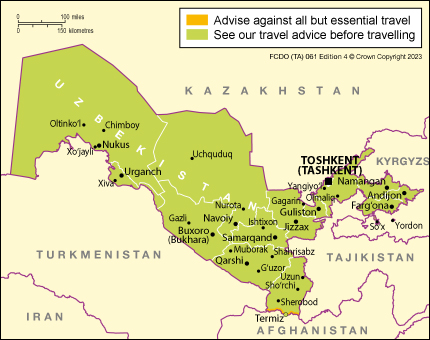
  • We advise against all but essential travel to areas bordering Afghanistan, Tajikistan and Kyrgyzstan other than via authorised crossing points. We also advise against all but essential travel to the Andizhan region of the Fergana Valley in eastern Uzbekistan. Uzbekistan's borders are potential flashpoints and there is a risk that there may be land mines in uncontrolled border areas.

  • There is a general threat from terrorism in Uzbekistan.  Attacks could be indiscriminate, including in places frequented by expatriates and foreign travellers. Visitors should be aware that terrorist incidents have occurred in Uzbekistan. Most recently, in May 2009, armed attacks took place in the Andizhan region of the Fergana Valley in eastern Uzbekistan.  See the Terrorism Section of this travel advice for more details.

  • We recommend that you obtain comprehensive travel and medical insurance before travelling to Uzbekistan. You should check any exclusions, and that your policy covers you for all the activities you want to undertake.  See the General (Insurance) section of this advice and Travel Insurance for more details.

Safety and security

Terrorism

There is a general threat from terrorism in Uzbekistan. Attacks could be indiscriminate, including in places frequented by expatriates and foreign travellers.  You should be particularly vigilant in public places, and pay attention to any security announcements by the Uzbek authorities.  Reports that armed attacks, including a suicide bomb, took place in May 2009 in the towns of Andizhan and Khanabad in the Andizhan region of the Ferghana Valley have been confirmed by the Uzbek authorities.

For more general information see Terrorism Abroad.

Crime

There have been occasional muggings and petty crime against foreigners.  Sometimes policemen, or those pretending to be policemen will seek to impose an on-the-spot fine. If you are any doubt you should ask for ID or pay any fines at the nearest police station.  You should keep valuables out of sight and avoid unlit or remote areas. You should avoid obvious displays of wealth, especially in rural areas. You should avoid walking alone at night.

For more general information see Victims of Crime Abroad.

Political Situation

Uzbekistan Country Profile

The political situation in Uzbekistan is stable.

You should monitor local media and avoid any planned demonstrations or public gatherings.  In the past, these have turned violent.

Sporadic unrest occasionally occurs in areas outside Tashkent.  Visitors should not get involved in any demonstrations and should avoid any locations where a demonstration might be occurring.

Local Travel

We advise against all but essential travel to the Andizhan region of the Fergana Valley and to areas bordering Afghanistan, Tajikistan and Kyrgyzstan, other than via authorised crossing points.  Uzbekistan's borders are potential flashpoints and some are mined.
 
If you wish to travel to Termez and other areas of the Surkhandarya region you will need a permit. You can apply for the permit from the Ministry of Foreign Affairs in Tashkent: they usually take five days to process.

Road Travel

If you drive in Uzbekistan you must ensure that you have all registration papers, including motor insurance.  You should carry your UK/International driving licence at all times, as this must be presented in the event of an accident.

There are security checkpoints at the city limits of Tashkent and other towns throughout the country. You may experience delays in reaching your destination if travelling by car. In Tashkent it is safer to use official taxis rather than unlicensed ones.  Take care if driving, as many roads are poor and badly lit.
 
Uzbeks drive on the right.  You should be aware that vehicles approaching a roundabout have the right of way over vehicles already on the roundabout.
 
The use of seatbelts by drivers and passengers is compulsory. The use of mobile phones while driving is prohibited.

For more general information see Driving Abroad.
 
Rail Travel

Take care when travelling long distances by train. If you have to travel overnight, store valuables in a safe place. Do not leave the compartment unattended, and secure the door from the inside. You need to present your passport when booking train tickets.

Air Travel

Evidence suggests that some airlines serving Uzbekistan do not always comply with international safety standards in respect of maintenance procedures. FCO staff have therefore been advised to avoid flying with non-scheduled or non-international airlines from Uzbekistan if an acceptable means of travel exists.

Uzbekistan Airways operate regular services to a number of European destinations.  In addition, Uzbekistan is served by Turkish Airlines, which is regulated in accordance with current European Union safety standards.  Czech Air began direct flights from Prague in July 2009.

Local laws and customs

Uzbekistan has a secular constitution. Most Uzbek people are Muslims.  For more general information see Travelling During Ramadan.

We recommend that you carry a photocopy of your passport at all times.  Requests to produce proof of identity, for example by the police, are frequent.

You should be aware that any form of photography can upset the authorities.  You should check before using a camera, especially near airports, border checkpoints, military barracks and police stations.

Possession of drugs is illegal.  Prison sentences can be lengthy and conditions are very basic.  There are regular reports of severe abuse, overcrowding, and shortages of food and medicine.  Although access to prisons in Uzbekistan is very restricted, tuberculosis (TB) and hepatitis are reported to be endemic.

Homosexuality is illegal under Uzbek law and is still very much frowned upon socially. You should take care over public displays of affection.

For more general information for different types of travellers see Your Trip.

Entry requirements

Visas

British Nationals need a visa to enter Uzbekistan, which should be obtained before you arrive and which should cover your entire stay. You will need to provide a letter of invitation with your application. Business visitors must get one from an Uzbek business partner whilst tourists must get it from the tour company arranging the visit.  If you plan to travel to neighbouring countries from Uzbekistan, you should also get your visa in advance, rather than trying to obtain it at the border.  Do not try to cross the border illegally as the absence of entry/exit stamps will cause problems (e.g. possible detention or fines) when you try to leave or re-enter. Visitors should ensure they check their Uzbek visas once issued and carefully note the date of expiry and the number of entries permitted. Do not overstay your visa and ensure you have onward visas for other countries if travelling elsewhere.  Any traveller found to have overstayed will face a considerable fine and possibly deportation.   It is not always easy or possible to extend your visa if you wish to remain in the country for longer than you had originally intended.

For further advice you should contact the Embassy of the Republic of Uzbekistan in London.

Registering your presence

You should register within three days of arrival.  If you are staying in a hotel, you will be asked for your passport at check-in and it will be retained for a short period.  The hotel staff will complete the registration paperwork and return your passport to you.  If you are staying in a private house, your host should register you with their local district OVIR (Department of Foreign Travel & Exit (they also deal with the registration of Foreign Citizens)).  If you travel to another city and plan to stay for longer than three days, you will need to register again. It is very important that you follow this procedure, since a full record of your whereabouts whilst in Uzbekistan is required upon departure. Visitors who are unable to account for their whereabouts could be fined and possibly deported.

Please also ensure that you fill out a Customs Declaration form on arrival and keep it in a safe place. You will need to produce it on departure. You may not take out more currency than you bring in and you should also be careful to declare all valuables when entering the country.

Travelling to other countries from Uzbekistan

You should ensure that you have a valid visa for the next country you intend to visit or transit.  We are aware of a number of people who have been sent back to Uzbekistan for failing to do this. Please note that if you intend to travel by road to Kazakhstan from eastern Uzbekistan via Kyrgyzstan you also need to have a valid visa to visit or transit Kyrgyzstan.  You will need the appropriate double or multiple entry visa for Uzbekistan, if you intend to return to Uzbekistan following your trip to a neighbouring country.

Travelling with children

Single parents or other adults travelling alone with children should be aware that some countries require documentary evidence of parental responsibility before allowing lone parents to enter the country or, in some cases, before permitting the children to leave the country.  For further information on exactly what will be required at immigration please contact the Embassy of the Republic of Uzbekistan in London.

Health

The quality of medical care in Uzbekistan is poor.  Hospitals are badly equipped and unhygienic, with a limited supply of drugs.  There is no guarantee that equipment will have been properly sterilised especially in rural hospitals.  You should avoid all but basic treatment or essential treatment in the event of an emergency.  Medical insurance companies usually refer complaints of a more serious nature to hospitals in Europe or New Delhi.

The World Health Organisation (WHO) has raised its Pandemic Threat Alert Phase to Level 6.  The WHO website at: www.who.int/ has further details.  You should also monitor local media reports for any developments and advice.  There is a dedicated Swine Flu page.  Guidance on Pandemic Flu can be obtained on the UK Department of Health website at www.dh.gov.uk

There are no reported cases of (A) H1N1 in Uzbekistan (source: Uzbek Ministry of Public Health).  All border crossings (airports, railway stations and road borders) operate automatic screening procedures on arrival.  Procedures vary depending upon place of entry but include either non-contact scanning with high-tech temperature scanners, or more basic use of electronic thermometers.  Any passengers displaying symptoms of (A) H1N1 may be taken aside at port of entry for further basic visual diagnostic tests, which could include a blood test.  If further tests proved positive any non-Uzbek citizen would be offered treatment in Uzbekistan at a quarantine unit in Tashkent under the supervision of the Uzbek Ministry of Public Health.  Anyone declining temperature checks upon entry or treatment in Uzbekistan, if these were deemed necessary, would be denied entry into Uzbekistan.  Arriving non-Uzbek passengers in this situation would be offered generic medicines and returned to their point of departure straight away to limit the danger of contagion.  Any British nationals who are detained are advised to contact the British Embassy.

Outbreaks of Hepatitis A, Meningitis and Diphtheria have occurred in Uzbekistan.  There have also been confirmed cases of malaria contracted in the southern Sukhandarya province.

You should drink or use only boiled or bottled water and avoid ice in drinks.  If you suffer from diarrhoea during a visit to Uzbekistan and your condition does not respond quickly to proprietary medicines you may have brought with you, you should seek immediate medical attention.

In the 2008 Report on the Global AIDS Epidemic the UNAIDS/WHO Working Group estimated that around 16,000 adults aged 15 or over in Uzbekistan were living with HIV; the prevalence rate was estimated at around 0.1% of the adult population. This compares to the prevalence rate in adults in the UK of around 0.2%.  You should exercise normal precautions to avoid exposure to HIV/AIDS. For more general information on how to do this see HIV and AIDS.

You should seek medical advice before travelling to Uzbekistan and ensure that all appropriate vaccinations are up-to-date.  For further information on vaccination requirements, health outbreaks and general disease protection and prevention you should visit the websites of the National Travel Health Network and Centre (NaTHNaC) and NHS Scotland’s Fit for Travel or call NHS Direct on 0845 46 47.

For more general health information see Travel Health.

Natural disasters


Uzbekistan is located in an active seismic zone. The last significant earthquake to cause major damage in Uzbekistan was in 1966.

General

Insurance

We recommend that you obtain comprehensive travel and medical insurance before travelling to Uzbekistan.  You should check any exclusions, and that your policy covers you for all the activities you want to undertake.  For more information see Travel Insurance

If things do go wrong when you are overseas then this is How We Can Help.

Next of kin details

You should ensure that your next of kin details are entered into the back of your passport.  Make a copy of your passport and driving licence and store these separately from the originals.

Registration

Register with our LOCATE service to tell us when and where you are travelling abroad or where you live abroad so our consular and crisis staff can provide better assistance to you in an emergency.  More information about registering with LOCATE can be found here.

Marrying in Uzbekistan

British Nationals hoping to be married in Uzbekistan must first obtain a Certificates of No Impediment (CNI) produced by the British Embassy in Tashkent.  There is no guarantee that the Certificate will be accepted by the Legalisation Section of the Uzbek Ministry of Foreign Affairs.  As long as this continues to be the situation, British nationals hoping to be married in Uzbekistan may experience difficulties.  Prospective couples should check with the British Embassy before travelling to Uzbekistan for the purpose of marriage.
 
Money

You should bring enough money for the duration of your stay. Only change money through official exchange booths. Damaged or marked bank notes will not be accepted at official exchange locations. You will need to complete a foreign currency declaration form when you arrive. Please retain this.  You cannot leave with more foreign currency than you arrive with.

Share this with:

Contacts

Uzbekistan, Tashkent, British Embassy

Address:

British Embassy
67, Gulymov Street
Tashkent 100 000

Telephone:

(99871) 1201500 (Switchboard)

Fax:

(99871) 1201520 (Switchboard)
(99871) 1201506 (Consular/Visa)

Office hours:

GMT:
Mon-Fri: 0400-0730 / 0830-1200

Local Time:
Mon-Fri: 0900-1230 / 1330-1700

Website: http://ukinuzbekistan.fco.gov.uk/en/

Sign-up for travel alerts

Subscribe to receive email alerts for the country of your choice


LOCATE: Register with us