Advanced search
image
Travel & living abroad

Asia and Oceania

Thailand

Flag of Thailand
Still current at: 07 November 2009
Updated: 03 November 2009

This advice has been reviewed and reissued with an amendment to the Local Travel section (removal of reference to the suspension of train services) and the Health section (cases of Chikungunya virus in provinces, including the tourist destination Phuket).  The overall level of the advice has not changed.


(see travel advice legal disclaimer)


Travel advice for this country

Travel Summary


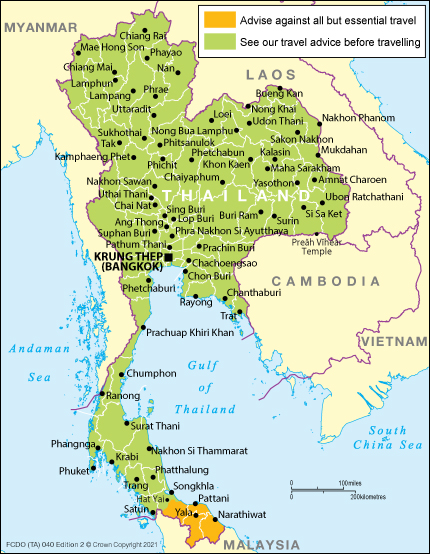
  • We advise against all but essential travel to, or through, the far southern provinces of Pattani, Yala, Narathiwat and Songkhla.  There continue to be frequent attacks, including bombings and shootings, due to the insurgency in these areas.  See the Terrorism section of this advice for more details.

  • We advise against all travel to the Preah Vihear (Khaoi Pra Viharn in Thai) temple area.  Fighting broke out on 15 October 2008 between Thai and Cambodian troops along the disputed border area near the temple.  On 2 April 2009, further hostilities were reported at Veal Antri, near to Preah Vihear. On 19 September clashes occurred between political demonstrators and local villagers during which several people were injured.  Although talks continue between the two countries, tensions remain high. You should remain alert to the local situation when travelling in other border regions, and at land crossings between the two countries.

  • There have been a significant number of confirmed human cases of the A (H1N1) - Swine Influenza virus in Thailand, including a number of deaths, and increased surveillance and control measures are in place.  All travellers arriving at airports on international flights will be thermally scanned and will be required to complete a questionnaire about their recent medical history.  Passengers with a temperature of over 38°C or who exhibit influenza symptoms will be referred for further diagnosis, and any passenger with suspected H1N1 will be quarantined.

  • The political situation in Thailand remains uncertain. Throughout Thailand, British citizens should exercise great caution and avoid demonstrations or large gatherings of people that might turn violent.

  • There is a high threat from terrorism in Thailand.  Attacks could be indiscriminate, including in places frequented by expatriates and foreign travellers.  There were a number of bomb explosions in Bangkok in 2007.  See the Terrorism section of this advice for more details.

  • Penalties for possession, distribution or manufacture of drugs are severe and can include the death penalty.

  • Outbreaks of Avian Influenza (Bird Flu) in Thailand have resulted in a small number of human fatalities.  The last fatality was in August 2006. See the Health (Avian Influenza) section of this advice and Avian and Pandemic Influenza for more details.

  • Around 812,000 British nationals visited Thailand in 2008 (Source: Tourism Authority of Thailand).  843 British nationals required consular assistance in Thailand in the period 01 April 2008 – 31 March 2009 for the following types of incident; deaths (288 cases); hospitalisations (198 cases); and arrests, for a variety of offences (202 cases). During this period assistance was also requested with regard to lost or stolen passports (774 cases). The majority of consular cases occur in Bangkok, Pattaya and Koh Samui.

  • We recommend that you obtain comprehensive travel and medical insurance before travelling.  You should check any exclusions, and that your policy covers you for all the activities you want to undertake.  See the General (Insurance) section of this advice and Travel insurance for more details.

Safety and security

Terrorism/Security

There is a high threat from terrorism throughout Thailand. Attacks could be indiscriminate, including in places frequented by expatriates and foreign travellers. You should exercise caution at all times.

We advise against all but essential travel to, or through, the far southern provinces of Pattani, Yala, Narathiwat and Songkhla, where there is continuing violence due to insurgency and civil unrest.  On 15 March 2008, there were two bomb attacks at the CS Pattani Hotel in Pattani. Two people were killed and 15 others injured. On 21 June 2008, insurgents killed four people on the Sungai Kolok - Yala train.

Since January 2004, there have been almost daily attacks in the far south. These include arson, bombings and shootings. Targets have included civilians and members of the security forces, government offices, tourist hotels, discotheques and bars, shops, marketplaces, supermarkets, schools, transport infrastructure and trains. Over 3,000 people have been killed and several thousand more injured. No British nationals have been killed in these attacks, but some other foreign nationals have been killed and injured. There is a state of emergency in the provinces of Pattani, Yala and Narathiwat. Martial law remains in place in these provinces. Security authorities can detain suspects without charge, censor the media, conduct searches and seize documents. Martial law is also in place in the Chana and Thepha districts of Songkhla province.

If you are considering travel to, or through, the far southern provinces of Thailand, you should seriously reflect on whether or not your journey is absolutely necessary. If you do decide to go ahead with your trip you are advised to regularly review your own and your family's security arrangements.

On 31 December 2006, a series of bomb explosions in Bangkok killed three people and injured at least 36 others, including six foreigners. Since then there have been a number of attacks in Bangkok, with motives which remain unclear. Most have been small and caused no casualties.

On 13 and 29 November 2008, bombs were thrown at protestors demonstrating as part of a long-running commercial dispute on the Rama IV Road close to the Queen Sirikit Convention Centre. The explosion resulted in 30 people injured, five seriously. On 18 March two security guards were shot dead at the same location by unidentified gunmen. The police suspect the violence is related to a business conflict.

For more general information see Terrorism abroad.


Political Situation


Thailand country profile

The political situation in Thailand remains uncertain. Civil unrest occurred in Bangkok and the seaside resort of Pattaya in the period of 11-14 April.   Outbreaks of violence between red-shirted protestors and military and police units in central Bangkok and the seaside resort of Pattaya left over 100 injured.  In a clash between locals and the red shirts on 13 April at Nang Loeng near Government House in Bangkok, in which troops were not involved, there were two civilian deaths from gunshot wounds and nine injured.  On 17 April 2009, the leader of the Peoples Alliance for Democracy (yellow shirt protestors), Sondhi Limthongkul, was shot and injured in central Bangkok (near Bang Khun Prom intersection, Phra Nakorn district). British citizens are advised to avoid any large political gatherings in Bangkok as they could turn violent. Throughout Thailand you should exercise caution, avoiding any demonstrations or large gatherings of people.  See the Terrorism/Security and Local Travel sections for more details.

On 19 September 2006, there was a coup against the Thai civilian government, and martial law was imposed throughout the country. Martial law has since been lifted in 41 provinces including Bangkok but it remains in 31 other provinces.

Political unrest and demonstrations in Bangkok in 2008 sparked a series of violent incidents, including grenade attacks, which have caused several fatalities. Bangkok's two airports (Suvarnabhumi International Airport and Don Muang Airport) were closed for two weeks after being occupied by anti-government protestors at the end of November 2008.

Crime

Six British nationals have been murdered in Thailand since January 2009.

Watch out for crimes of opportunity. You should take sensible precautions and be on your guard against pickpockets and bag snatchers. When walking along busy streets or travelling in open transport, such as tuk tuks, you should be aware that foreigners have had items snatched by riders on motorbikes.

There have been a number of incidents in Koh Phangan where western tourists have been victims of vicious unprovoked assaults by gangs. These attacks are increasingly common around the time of the Full Moon Parties and generally occur late at night in the vicinity of bars in Haad Rin. You should be extremely careful when walking in this area at any time, especially after dark and, if possible you should avoid it altogether.

We receive regular reports of credit card fraud after shop employees have copied card details. You are advised not to lose sight of your credit card during transactions. You should also be careful to observe demarcation lines between shops and stalls, particularly in market areas and at Suvarnabhumi Airport. Taking items from one shop’s area to another is likely to be treated by shop staff as suspected theft. You may be arrested by the police and asked to pay a substantial fine and/or face imprisonment.

There have been a number of incidents where tourists have had their drinks drugged (in both tourist areas and red light districts). You should be careful about taking drinks from strangers and be wary at clubs and parties, particularly in the Koh Samui area and at the Full Moon party on Phangan Island where incidences of date rape have been reported. A number of British nationals have suffered severe psychiatric problems because of drug use, in a small number of cases resulting in suicide.

We receive occasional reports of tourists who have been robbed after bringing visitors to their hotel rooms. In some cases their drinks were drugged. Ensure that your passport and wallet are secure at all times.

We continue to receive reports of sexual offences committed against foreign women and men. In 2007 our Consular staff were aware of a number of British nationals who were the victim of a serious sexual offence in Thailand. In January 2006, three British women were raped in separate incidents in Thailand, including one who was murdered.

Female travellers in particular should maintain a high state of personal awareness during their time in Thailand. Be aware that alcohol and drugs can lead to you being less alert, less in control and less aware of your environment. If you are going to drink, know your limit.  Remember that drinks served in bars overseas are often stronger than those in the UK. Reports of sexual assaults against women have become particularly prevalent in the Koh Samui archipelago. Women travellers are, therefore, advised to take particular care over their personal security whilst staying in this area. For more guidance about this see Rape and sexual assault overseas.

You should report any incidents of crime to the Thai police before leaving the country.

Fire in Bangkok Nightclub

There was a fire in a Bangkok nightclub in the early hours of 1 January 2009. Thai police report that at least 59 people died and over 100 were injured. Four British nationals were amongst the injured.

Sailing off the coast of Satun, Southern Thailand

Two British nationals were attacked and one of them was murdered on 24 March 2009 whilst sailing off the coast of Satun in Southern Thailand. If you are sailing or intend to sail in the Satun area, you are advised to take all necessary steps to protect your safety. For more general information, see River and sea safety.

For more general information please see Victims of crime abroad.

Local Travel

The line of the international border in the vicinity of the Preah Vihear temple (Khao Pra Viharn in Thai) is the subject of dispute between Cambodia and Thailand. Fighting broke out on 15 October between Thai and Cambodian troops along the disputed border area near the Preah Vihear temple (Khao Pra Viharn in Thai).  On 2 April 2009, further hostilities were reported at Veal Antri near Preah Vihear.  We advise against all travel to the temple area. Although talks continue between the two countries, tensions remain high. You should remain alert to the local situation when travelling in other border regions, and at land crossings between the two countries.

Disputes also exist over control of the Ta Moan and Ta Krabey temples, which lie close to the Thai-Cambodia border. There has been no fighting in these areas, but we recommend that you should avoid them.  

As noted in the Terrorism/Security section of this travel advice, there has been a resurgence of violence in the far southern provinces of Pattani, Yala, Narathiwat and Songkhla.  This has included attempts to sabotage the railways and lethal attacks on public buses.  On 21 June 2008, insurgents killed four people on the Sungai Kolok - Yala train. This has resulted in increased numbers of security personnel on the trains.  We recommend against all but essential travel to, or through, these four provinces.

Thai to Burma Border

The main towns along the border with Burma are generally safe.  However, if you plan to travel to remoter areas you should exercise particular care.  There is sporadic conflict on the Burmese side between Government soldiers and armed opposition troops, some of whom cross the border into Thailand to seek refuge.  There are also occasional clashes between the Thai security forces and armed criminal groups, such as drug traffickers who operate in these areas.  There have also been a number of security incidents in the Mae Sot area. You should, therefore, remain vigilant at all times if you intend to travel in this region.

Outside the main towns, police and military checkpoints are actively manned and travellers may be asked to produce identification.  If you wish to visit border areas outside the main towns you should consult the local authorities for advice on the current situation. Visit www.tourismthailand.org for more advice.

Do not attempt to cross the border into Burma other than at an official border checkpoint and after obtaining any relevant permissions/ visas from the Burmese and Thai authorities. You are recommended to consult the FCO travel advice for Burma.

Travelling to Cambodia

We advise against all travel to the Perth Vihear (Khaoi Pra Viharn in Thai) temple area. The line of the international border in the vicinity of the Preah Vihear temple (Khao Pra Viharn in Thai) is the subject of dispute between Cambodia and Thailand. Military forces for both countries have been deployed and fighting broken out on 15 October near the temple. Although talks continue between the two countries, tensions remain high. You should remain alert to the local situation when travelling in other border regions, and at land crossings between the two countries.

There are two legal land border crossing points into and out of Cambodia for foreigners:  Srakaew Province to Poipet, open daily 07:30 hours to 20:00 hours; and Klong Yai at Had Lek, Trad Province to Koh Kong, open daily 07:00 hours to 20:00 hours.  British nationals need a visa for Cambodia. You are recommended to consult the FCO travel advice for Cambodia.

Crossing to Laos

Visas are available at the principal entry points, the Thai to Lao Friendship Bridge, Luang Prabang and Vientiane Airports, on payment of 35 US dollars, or 1,500 Thai baht in cash and provision of a passport photograph.  If you intend to enter at any other entry point then you will need to get a visa in advance.  You should also be aware that not all entry points are open to foreigners. You are recommended to consult the FCO travel advice for Laos.

Road Travel

An international or Thai driving licence is required to drive in Thailand.

Riding a motorcycle or scooter in Thailand can be dangerous.  On average 38 people a day die in motorcycle accidents in Thailand.  You should take the same safety precautions as in the UK.  The Thai law that safety helmets must be worn is widely ignored: a contributing factor in many tourist deaths each year.

The motorcycles or scooters available for hire in beach resorts are often unregistered and cannot, consequently, be used legally on a public road. Before you hire a vehicle you should check your travel insurance policy carefully to ensure that you are covered and check the small print of the lease agreement carefully.  You should never hand over your passport as a guarantee against returning a motor scooter or cycle.  Unscrupulous owners have been known to hold on to passports against claimed damage to the motor scooter or cycle.

Riding ‘Quad-bikes’ can also be dangerous. You should also note that it is illegal to drive these on the roads in Thailand despite the fact that they are available to hire on the roadside.

For more general information see Driving abroad .

Air Travel

On 4 August 2009, one person was killed and 12 injured when a Bangkok Airways flight from Krabi to Koh Samui skidded along the runway in wet weather and crashed into a disused control tower.

Don Muang Airport (the old international airport) re-opened for some domestic flights on 25 April 2007. You should check with your airline which airport your flight will arrive at and depart from.

Orient Thai 1-2 Go Flight number OG269 from Bangkok to Phuket crashed on landing at Phuket airport on Sunday 16 September 2007.  Over 80 people were killed, including 10 British Nationals.  You should be aware that the Thai Civil Aviation Department suspended 1-2 Go operations indefinitely.  As 1-2 Go does not operate to the UK or the EU it has not been possible to assess their safety standards.

The European Commission has published a list of air carriers that are subject to an operating ban or restrictions within the European Union.

Rail Travel

An accidental train derailment on the main line between Bangkok andthe south of Thailand occurred just south of Hua Hin in the early hoursof 5 October. 89 people were injured and seven Thai nationals were killed.

Sea/River Travel

There have been a number of instances of passenger boats sinking, usually due to overloading and/or poor maintenance.  During the full moon party speedboats to and from Koh Pha Ngan are often severely overloaded.  You should exercise care at all times when travelling by passenger ferry or speedboat and avoid travel on vessels that are clearly overloaded or in poor condition.  You should also ensure that life jackets are available.

You should take care when swimming/diving/kayaking or white water rafting in rivers or close to waterfalls, particularly in the rainy season from May to October. Currents are extremely strong.

For more general information see River and Sea Safety.

Swimming

You should take particular care when swimming off coastal areas, especially during monsoon season (November-March in Koh Samui and the south-east of the Thai peninsula and May - October in the remainder of Thailand).  Strong riptides have resulted in a number of drownings in several areas including Phuket, Koh Chang, Hua Hin/Cha-am, Rayong and Pattaya and the Samui archipelago.  Always comply with warning signs, especially red flags, and only swim from approved beaches.  Jellyfish can swim close to the shore, particularly during the rainy season from May to October.  Their sting can be fatal.  If in doubt take local advice e.g. from hotel management, dive centres.

Water sports and scuba diving

If you choose to rent jet skis or any other type of water sports equipment, you should first consider the dangers involved and satisfy yourself that adequate safety precautions are in place.  Once satisfied about this, rent only from reputable operators and insist on sufficient training before use.  Also ensure that the operator is licensed and has adequate insurance cover.

The standards maintained by diving schools and rescue services are not always as high and comprehensive as they might be in the UK.  Check a dive operator's credentials carefully before using them and ensure that your insurance covers you for all of the activities that you undertake. If you are an experienced diver you should purchase dive specific insurance and check that your qualifications and experience fall within the cover provided.  You should contact your issuing authority (i.e. PADI or BSAC) if you are in any doubt.  If you have had no previous diving experience you should ask your dive operator to explain what cover they offer before signing up for a course; you should also be satisfied that sufficient safety equipment is available on the boat, particularly oxygen.  You should also ask about contingency plans, which should include the ability to call for help whilst at sea and to evacuate divers to the nearest hyperbaric chamber if necessary.

Bungee Jumping

Bungee jumping is an exceptionally dangerous activity and accidents sometimes occur. If you do decide to undertake this activity in Thailand you should first satisfy yourself that the company concerned is using the best and most up to date equipment, including all of the requisite safety features and that they are fully licensed and insured.

Local laws and customs

Never become involved with drugs of any kind in Thailand.  Possession of even very small quantities can lead to imprisonment.  If you are found guilty of being in possession of marijuana you are likely to receive a long prison sentence plus a hefty fine.  Amphetamines and Ecstasy are regarded as class A drugs and possession or trafficking of them carries the same penalties as, for example, heroin.  If you are found guilty of being in possession of 20 grams, or more, of a class A drug at a point of exit from Thailand you will most likely be sentenced to death.

It is illegal to import more than 200 cigarettes per person into Thailand.  The importation of more than 200 cigarettes will be met with a heavy fine and the confiscation of the cigarettes.

By law, tourists are expected to carry their passports with them at all times in Thailand.  There have been incidents where tourists have been arrested because they were unable to produce their passport.

It is a criminal offence to make critical or defamatory comments about the King or other members of the Royal family in Thailand.  This offence is punishable by a sentence of three to fifteen years or longer.

Thai family law is very different from UK law and particular caution is needed when, for example, child custody becomes an issue.

Fore more general information for different types of travellers see Your trip.


Entry requirements

Visa Requirements

 
British passport holders arriving by air may enter Thailand for up to 30 days without obtaining a visa in advance of arrival.  However, those arriving at overland crossings will only be given visa free entry valid for 15 days.  If you intend to stay in Thailand for longer than the time endorsed on arrival, or you intend to work in the country, you must obtain an extension of stay or a valid visa.
 
Overstaying without the proper authority is a serious matter and you can be held in detention until a fine is paid.  The only legal way of obtaining a new visa, entry permit or extension of stay is from a Royal Thai Embassy or Consulate, an Immigration Officer at a point of entry into Thailand or one of the Immigration Offices around the country.
 
Visas issued by visa shops, travel agents or by any other means are likely to be illegal and lead to criminal proceedings, which may result in a large fine or imprisonment.  You would also be prohibited from entering Thailand again.

If you have any queries about visas or entry requirements, you should check with the Royal Thai Embassy.

Passport validity

 
Entry to Thailand is normally refused if you have a passport with less than six months’ validity. Entry is also normally refused if your passport is damaged, or if pages are missing from your passport.
 

Employment in Thailand

 
You need a work permit, which is difficult to obtain and time consuming, in order to work legally in Thailand.  If you enter Thailand on a tourist visa you are not allowed to take up employment.  Failure to observe this rule can lead to arrest and deportation.

Travelling with children

 
Single parents or other adults travelling alone with children should be aware that some countries require documentary evidence of parental responsibility before allowing lone parents to enter the country, or, in some cases, before permitting the children to leave the country.  Thai authorities do not require such evidence, but if you have any concerns please check with the Royal Thai Embassy.

Health

There are excellent international hospitals in Bangkok but they can be expensive.  Ordinary hospitals and clinics in Thailand are not always up to UK standards.  This applies particularly to the coastal islands and many mainland districts outside of Bangkok, where hospitals and clinics are not equipped to deal with major trauma.  Many hospitals require guarantee of payment for the hospital bills before they will begin treatment.  You should complete next of kin details in the back of your passports.

Dengue and malaria occur in Thailand; these diseases are transmitted by mosquitoes.   An increase in the number of dengue cases has been reported in 2008.  These There are no vaccinations against these diseases but there are preventative measures that you can take, as advised on the National Travel Heath Network and Centre (NaTHNaC) website.  You should visit your GP to discuss malaria prevention tablets.

There are cases of Chikungunya virus in 50 odd (it varies) of Thailand’s  provinces, including the tourist destination of Phuket.  The disease is carried by mosquitoes and the symptoms are similar to dengue fever.

In the 2008 Report on the Global AIDS Epidemic the UNAIDS/WHO Working Group estimated that around 600,000 adults aged 15 or over in Thailand were living with HIV; the prevalence rate was estimated at around 1.4% of the adult population. This compares to the prevalence rate in adults in the UK of around 0.2%.  You should exercise normal precautions to avoid exposure to HIV/AIDS. For more general information on how to do this see HIV and AIDS

You should seek medical advice before travelling to Thailand and ensure that all appropriate vaccinations are up to date. For further information on vaccination requirements, health outbreaks and general disease protection and prevention you should visit the websites of the National Travel Heath Network and Centre (NaTHNaC) or NHS Scotland’s Fit for Travel or call NHS Direct on 0845 46 47.

For more general health information see Travel Health and for food/drink hygiene see Eat and Drink Safely.

Avian Influenza

 
There have been outbreaks of Avian Influenza (Bird Flu) in domestic poultry and wild birds in Thailand (most recently in November 2008). The outbreaks in Thailand have led to a small number of human fatalities (most recently in August 2006) believed to have arisen through close contact with infected poultry.

The risk to humans from Avian Influenza is believed to be very low.  However, as a precaution, you should avoid visiting live animal markets, poultry farms and other places where you may come into close contact with domestic, caged or wild birds; and ensure poultry and egg dishes are thoroughly cooked.
 
The World Health Organisation (WHO) has warned of the possibility that the Avian Influenza outbreaks could lead at some point to a human flu pandemic, if a virus mutates to a form which is easily transmissible between people.
 
British nationals living longer term in an Avian-Influenza affected region should take personal responsibility for their own safety in the event of a future pandemic, including considering their access to adequate healthcare and ensuring travel documents are up to date.
 
You should read this advice in conjunction with Avian and Pandemic Influenza.
 

A (H1N1) - Swine Flu


There have been a significant number of confirmed human cases of the A (H1N1) - Swine Influenza virus in Thailand, including a number of deaths, and increased surveillance and control measures are in place.  All travellers arriving at airports on international flights will be thermally scanned and will be required to complete a questionnaire about their recent medical history.  Passengers with a temperature of over 38°C or who exhibit influenza symptoms will be referred for further diagnosis, and any passenger with suspected H1N1 will be quarantined.

The World Health Organisation (WHO) Pandemic Threat Alert Phase for swine influenza has been raised to Level 6.  The WHO website has further details.  You should monitor local media reports for any developments and advice.  There is a dedicated Swine Flu page on the FCO website. Guidance on Pandemic Flu is also available on the UK Department of Health website.

Natural disasters

 
Monsoon Season
 
The rainy season in much of Thailand runs from May to October, with September and October being the height of the monsoon season.  The rainy season in Koh Samui and the south east of the Thai peninsula runs from November to March.

Torrential rain and widespread flooding often result in flash floods and mudslides in Thailand. You should exercise caution and follow the advice of local authorities. Flooding also affects the southern tourist areas of Phuket, Krabi and Koh Samui. You should check with the Thai Meteorological Department (Thai Meteorological Department) for up-to-date information or with your tour operator before travelling to affected areas.

The Mekong River Commission, an international organisation, posts official updates on the Mekong River on their website.

When visiting Lake Caves, particularly during the rainy season, you should be aware that they are prone to dangerous flash flooding.  On 13 October 2007 eight people died, including one British national at Khao Sok National Park following a flash flood.

If you are considering jungle trekking you should also ensure that you use reliable licensed tour guides.

General

Insurance

 
We recommend that you obtain comprehensive travel and medical insurance before travelling. You should check any exclusions, and that your policy covers you for all the activities you want to undertake.  See Travel Insurance for more information.

If things do go wrong when you are overseas, then this is How We Can Help.
 

Registration

 
Register with our LOCATE service to tell us when and where you are travelling abroad or where you live abroad so our consular and crisis staff can provide better assistance to you in an emergency.  More information about registering with LOCATE can be found here.
 
If you are a British national and plan to stay for an extended period in Thailand you are advised to register with the British Embassy in Bangkok upon arrival.
 

Purchasing Property

 
Before purchasing property anywhere in Thailand you are advised to seek qualified legal advice from a source that is independent from the seller.  British nationals purchasing property in Thailand are recommended to deal only with established and reputable estate agents or with other contacts that they know to be reliable and genuine, and to make all payments within bank premises and/or through banking channels.
 

Money

 
It is not possible to change Scottish or Northern Irish bank notes anywhere in Thailand.

Share this with:

Contacts

Thailand, Bangkok, British Embassy

Address:

14 Wireless Road
Lumpini, Pathumwan
Bangkok 10330

Telephone:

+66 (0) 2 305 8333 - Main Embassy line
+66(0) 2 305 8229 - Consular information (Please note, the Consular Section cannot answer visa enquiries)

Fax:

+66 (0) 2 255 9278

Office hours:

Office hours (Local time):
Mon-Thurs: 08:00-12:00 / 12:45-16:30
Fri: 08:00-13:00

Website: http://ukinthailand.fco.gov.uk/

Sign-up for travel alerts

Subscribe to receive email alerts for the country of your choice


Taking a gap year?

Then visit.....


LOCATE: Register with us