Advanced search
image
Travel & living abroad
   

Asia and Oceania

Philippines

Flag of Philippines
Still current at: 24 May 2012
Updated: 18 May 2012
No restrictions in this travel advice Avoid all but essential travel to part(s) of country Avoid all but essential travel to whole country Avoid all travel to part(s) of country Avoid all travel to whole country

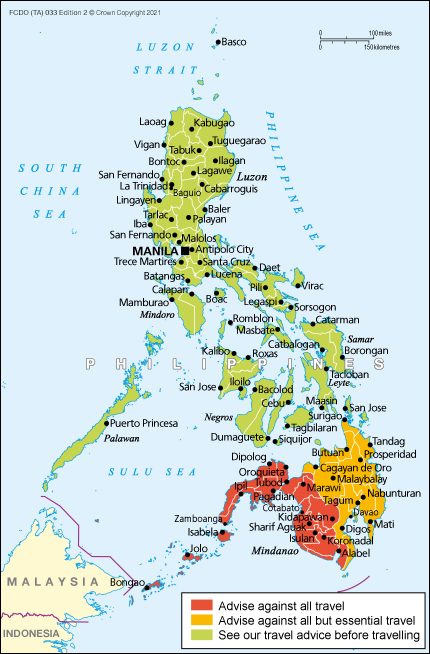
This advice has been reviewed and reissued with the addition of an Entry Requirements - Emergency Travel Document section and a revised Health section. The overall level of the advice has not changed; we advise against all travel to specific areas of the Philippines and against all but essential travel to other specific areas of the Philippines.

(see travel advice legal disclaimer)


To see an enlarged version of this map, click here (1.09MB).

Travel advice for this country


  • We advise against all travel to south-west Mindanao and the Sulu archipelago because of on-going terrorist activity and clashes between the military and insurgent groups. We advise against all but essential travel to the remainder of Mindanao for the same reason. See Safety and Security - Terrorism and Safety and Security -  Local Travel.

  • There is a high threat from terrorism. Attacks could be indiscriminate, including in places frequented by expatriates and foreign travellers. Such places could include, but are not limited to, airports, shopping malls, places of worship etc.

  • There is a threat from kidnapping in the Philippines, particularly in the south. Kidnapping could occur anywhere, including on coastal and island resorts and dive boats and sites in the Sulu Sea. On 1 February two foreign nationals were kidnapped from Parangan in the township of Panglima Sugala in the Tawi Tawi island province. On 5 December 2011, an Australian citizen was kidnapped in Zamboanga Sibugay.

  • The European Commission announced an operating ban on all air carriers certified in the Philippines from 1 April 2010. This follows an audit of the Philippines carried out by ICAO in October 2009. The EU ban has been imposed because the Philippine regulatory authority is unable to verify that these airlines comply with international safety standards.  We recommend that you avoid flying with Philippine-certified airlines subject to the EU operating ban. See Safety and Security - Local Travel - Air Travel.

  • Over 130,000 British tourists visited the Philippines in 2011 (Source: Philippines Ministry of Tourism). Most visits are trouble-free. See General - Consular Assistance Statistics.

  • You should obtain comprehensive travel and medical insurance before travelling. See the General -  Insurance.

Safety and Security -  Terrorism


There is a high threat from terrorism throughout the Philippines. Terrorist groups continue to plan attacks and have the capacity and the intent to carry out these attacks at anytime and anywhere in the country. Attacks could be indiscriminate, including in places frequented by expatriates and foreign travellers.. On 25 January 2011 an explosion on a passenger bus in the Makati district of Manila killed five people and injured 13.

We advise against all travel to south west Mindanao covering the following areas, the Autonomous Region in Muslim Mindanao (ARMM, which includes Lanao del Sur, Maguindanao, and the islands of Basilan, Sulu and Tawi-Tawi) plus theprovinces of Sarangani, North and South Cotabato, Sultan Kudarat, Lanao del Norte, Zamboanga del Sur and Zamboanga Sibugay. We advise against all but essential travel to the remainder of Mindanao because of ongoing terrorist activity. There have been a number of attacks against civilian targets.  Since November 2011 there have been at least ten bombing incidents in North Cotabato, Cotabato City, Sulu, Sultan Kudarat, and Zamboanga killing a total of eight people and leaving 66 others wounded. See the Safety and Security - Local Travel section of this Travel Advice.

Be aware of the risk of terrorist attacks to all forms of public transport: road, rail, sea and air. Terrorist groups have threatened to attack passenger ferries and other vessels, particularly those operating from Mindanao.

There is also a threat from kidnapping in the Philippines particularly in the southern Philippines. Kidnapping could occur anywhere, including on coastal and island resorts and on dive boats and sites in the Sulu Sea. Foreigners have been targeted in rural, urban and coastal areas in the past. On 1 February two foreign nationals were kidnapped from Parangan in the township of Panglima Sugala in the Tawi Tawi island province.  On 5 December 2011, an Australian citizen was kidnapped in Zamboanga Sibugay. On 12 July 2011 two US citizens and a Philippine national were kidnapped from a resort on the island of Tictabon near the southern port city of Zamboanga. You should be aware that it is the long-standing policy of the British Government not to make substantive concessions to hostage takers. The British Government considers that paying ransoms and releasing prisoners increases the risk of further hostage taking.

The Philippine government is taking action against the terrorist and kidnapping threat. It has tightened security in Metro Manila and other areas considered at high risk, including airports and seaports.

See our Terrorism Abroad page. You should also check the Embassy website: Philippines: British Embassy Manila.

Safety and Security - Crime


There is a high incidence of violent crime, including gun crime British nationals have been recent victims, but there is no evidence that they are specifically targeted.

Criminal gangs sometimes use terrorist tactics, such as kidnapping and explosions. Explosions attributed to criminal organisations have caused fatalities.

There is a high incidence of street crime and robberies . Sensible precautions include: arranging to be met at the airport or using hotel transfer services; using a driver or taxis from a reputable source and avoiding displays of cash or jewellery. You should beware of strangers offering drinks or confectionery; criminals intent on robbery may lace these to render the victim unconscious.

You should be particularly vigilant when travelling on public transport. Armed hold-ups have occurred on jeepneys and buses in the Philippines, and have in some cases resulted in fatalities. The roadworthiness of some of these vehicles is also a concern.

On 23 August 2010, an armed man hijacked a tourist bus in Manila. During the incident eight hostages were killed.

See our Victims of Crime Abroad page.

Safety and Security -  Local Travel


You should take precautions to ensure your personal safety. Be vigilant; avoid large demonstrations or gatherings; seek advice from local contacts, avoid travel off the beaten track and always leave travel plans with friends, colleagues or relatives. Safety standards on taxis, buses and boats can be low.

You should take particular care during the rainy season when flash floods and landslides can occur.

Safety and Security - Local Travel - Mindanao


We advise against all travel to south west Mindanao and the Sulu archipelago covering the following areas: the Autonomous Region in Muslim Mindanao (ARMM, which includes Lanao del Sur, Maguindanao, and the islands of Basilan, Sulu and Tawi-Tawi), plus the provinces of Sarangani, North and South Cotabato, Sultan Kudarat, Lanao del Norte, Zamboanga del Sur and Zamboanga Sibugay, because of ongoing terrorist and insurgent activity. We advise against all but essential travel to the remainder of Mindanao.

If you intend to travel to the provinces of Zamboanga del Norte and Misamis Occidental you should use air or sea routes as we advise against all travel to neighbouring provinces.

There have been terrorist attacks against civilian targets in Mindanao. There is also criminal activity in Mindanao, including the use of kidnapping and explosions. Recent significant explosions that have killed civilians in Mindanao include:

  • On 27 Nov 2011 an explosion in a pension house in Zamboanga City killed three people and injured 27 others.
  • On 14 Nov 2011 an explosion in a recreational park in Carmen, North Cotabato killed one person and injured 22 others.
  • On 21 October 2010 an explosion on a bus in North Cotabato Province killed ten people and injured thirty others.
  • On 5 August 2010 at Zamboanga airport an explosion killed two people and injured 24 people including a British national.

There are on-going clashes between the military and insurgent groups in the Sulu archipelago including Basilan, Tawi-Tawi and Jolo. There is currently a ceasefire between the government and the MILF armed group. The situation has deteriorated with little warning in the past.  There were clashes in Basilan and Zamboanga Sibugay in October 2011, and in August 2008 clashes in Maguindanao, North Cotabato, Lanao del Sur and Lanao del Norte lead to civilian casualties and thousands of people being displaced.

Extortion and kidnap for ransom gangs, that have targeted public transport with armed hold-ups and explosions, operate in Mindanao. We advise against using public transport throughout Mindanao.

There is also a threat of kidnapping in south west Mindanao and the Sulu archipelago. Kidnapping could occur in any place and at any time, including on coastal and island resorts and on dive boats and sites in the Sulu Sea.  An Australian citizen was kidnapped in Zamboanga Sibugay on 5 December 2011. A Japanese citizen was kidnapped in July 2011 on Pangutaran Island in the Sulu Archipelago. He remains in captivity. Previous incidents include the kidnapping of US citizens and a Filipino companion in July 2011; a Swiss national in Zamboanga City in April 2010; an Irish priest from Pagadian City in Zamboana del Sur in October 2009 and three members of the International Red Cross, including two foreign nationals, were kidnapped in Sulu in February 2009. In these cases the victims were subsequently released unharmed.

You should be aware that it is the long-standing policy of the British Government not to make substantive concessions to hostage takers. The British Government considers that paying ransoms and releasing prisoners increases the risk of further hostage taking.

Safety and Security - Local Travel -  Air Travel


The European Commission announced an operating ban on all air carriers certified in the Philippines from 1 April 2010. This follows an audit of the Philippines carried out by ICAO in October 2009. The EU ban has been imposed because the Philippine regulatory authority is unable to verify that these airlines comply with international safety standards. 

It is recommended that you avoid flying with Philippine certified carriers subject to the EU operating ban.

British Government employees are advised to use carriers that are not subject to an operating ban or restrictions with the EU unless this is unavoidable. You should bear this in mind when making your own travel plans.

If leaving the country by air you must pay the departure tax (550 Pesos) in cash and in local currency or the equivalent in US Dollars.

You should re-confirm domestic flights not less than 72 hours before departure.  Check your international airline's policy on re-confirmation when you make your booking.

Safety and Security - Local Travel - Sea Travel


Inter-island travel by small boats can be dangerous as storms appear quickly.

There is a high incidence of piracy and armed robbery against ships in and around Philippine waters.

You should be aware that maritime rescue services in the Philippines might not be as comprehensive as they might be in the UK.

See our River/Sea Safety page.

Safety and Security - Political Situation


Philippines Country Profile

You should avoid demonstrations and large gatherings of people.

You should not get involved with drugs of any kind. Penalties for illegal drug importation and use are severe.

You are required to show some identity if requested by the police. o photocopies of the relevant pages of passports will suffice. . You should leave details of travel plans, passports and credit cards with friends and family in the UK and enter next of kin details into your passport.

Philippine law on paedophile activity is severe, and strictly enforced. Severe penalties can be passed in child abuse or rape cases. A child is defined in Philippine law as a person under the age of 18. Entrapment may also occur where strangers with children have befriended single male tourists; allegations of abuse are then made in an attempt to extort money.

Any foreign national planning to get involved in recruiting Filipinos for employment overseas must make sure that they have done their due diligence and consulted local lawyers to ensure that they are fully compliant with local legislation and suitably licensed. The laws relating to illegal recruitment are stringent and carry non-bailable charges – foreign nationals have been known to spend more than 2 years in city jails on remand whilst their cases are processed.  

The Consular Section at the British Embassy in Manila is able to provide a list of locally registered law companies.

See our Your Trip page.

Entry Requirements - Visas


British nationals may enter the Philippines without a visa for an initial period of 21 days, while a tourist visa from the nearest Philippine Embassy will allow an initial 59 day stay. These periods may be extended, before they expire and for a fee, at the offices of the Bureau of Immigration. The Philippine Embassy in London is located at 6-8 Suffolk Street, London SW1Y 4HG; (Tel: 020 7451 1800). Overstaying without the proper authority is a serious matter and can lead to detention pending payment of outstanding fees and fines and voluntary deportation at your own expense.

Entry Requirements - Passport validity


You must hold a valid passport to enter Philippines. Your passport must be valid for a minimum period of six months from the date of entry into Philippines. Entry to the Philippines may be refused if your passport has less than six months validity or if you do not have an onward or return air ticket.

Entry Requirements - Emergency Travel Documents

UK Emergency Travel Documents (ETDs) are valid for entry into the Philippines.  However, holders of an ETD must have a Philippine visa in the ETD. The ETD must also be valid for at least six months from date of arrival into the country

For exit: ETD holder must contact the Philippine Bureau of Immigration head office before leaving the country to get the necessary stamps.

Entry Requirements - children travelling to the Philippines without their parents


The Philippine Authorities have tightened up procedures for the exclusion of foreign minors (children under 15 years of age) who are unaccompanied by, or not coming to, a parent in the Philippines. However, the Commissioner of Immigration can waive the exclusion of children if the minor's guardian or representative pays a P3120.00 waiver fee. The passport will be taken from the minor and returned when he/she arrives at the airport for departure from the Philippines. If a minor is travelling to visit a parent they should carry a copy of their parents’ resident visa. Parents of children travelling unaccompanied to the Philippines must file an "affidavit of support" with the nearest Philippines Embassy or Bureau of Immigration, or contact the Philippine Embassy in London.

Contact your GP around eight weeks before your trip to check whether you need any vaccinations or other preventive measures. Country specific information and advice is published by the National Travel Health Network and Centre, and useful information about healthcare abroad, including a country-by-country guide of reciprocal health care agreements with the UK, is available from NHS Choices.

The extent of medical care varies across the Philippines, and may not meet the standards of care in the UK. Although sufficient in major cities, medical care is limited in more remote areas. You should be aware that medical treatment can be very expensive. Make sure you have adequate travel health insurance and accessible funds to cover the cost of any medical treatment abroad and repatriation.

In the 2010 Report on the Global AIDS Epidemic the UNAIDS/WHO Working Group estimated that around 8,600 adults aged 15 or over in the Philippines were living with HIV; the prevalence percentage was estimated at less than 0.1% of the adult population compared to the prevalence percentage in adults in the UK of around 0.2%. You should exercise normal precautions to avoid exposure to HIV/AIDS. See our HIV and AIDS page.

If you need emergency medical assistance during your trip, dial 117 and ask for an ambulance. You should contact your insurance/medical assistance company promptly if you are referred to a medical facility for treatment.

Our Travel Health pages offer further advice on how to stay healthy when overseas. 

Natural Disasters -  Typhoons


Approximately twenty typhoons hit the Philippines each year. The monsoon season in the Philippines normally runs from July to November. Most typhoons occur during this period but they can affect the country at any time. See our Tropical cyclones page for more detailed information about what to do if you are caught up in a typhoon.

During the monsoon season you should exercise caution and follow the advice of the local authorities. Tropical depressions and cyclones typically bring strong winds and rain to the Visayas and Luzon regions, and particular care should be taken when travelling to Northern Luzon and the Bicol, Samar and Leyte regions. During the monsoon season, heavy rains can cause flooding and landslides may occu.

For the most up to date information you should access www.weather.gov.ph, www.ndcc.gov.ph and www.typhoon2000.ph or follow Typhoon2k on Twitter.

Natural Disasters - Volcanoes


There are numerous volcanoes in Philippines, any of which can erupt without warning. Sudden steam and ash explosions may occur at any time.

The capacity of the Philippine emergency and rescue services to deal with large natural disasters is limited. You are advised to exercise caution, check news reports and follow local advice before travelling to volcanic areas. You are also advised to avoid volcanic areas during and immediately after heavy rainfall when there is increased risk of lahar flows. More information can be found on the PHIVOLCS website.

Natural Disasters - Earthquakes


The Philippines is in an earthquake zone. The last significant earthquake to affect the Philippines was on July 16 1990 in Central Luzon when over 1100 people were killed.

On 6 February at 11:49 local-time a 6.9 magnitude earthquake affected areas in the Visayas and Mindanao regions in the southern Philippines, in particular Dumaguete City, in the Negros province and Cebu.

General -  Insurance 


You should get comprehensive travel and medical insurance before travelling. You should check any exclusions, and that your policy covers you for all the activities you want to undertake. In particular you should be aware that your insurance company might not extend cover to areas to which the FCO advises against travel. You should have insurance cover for unexpected losses such as cancelled flights, stolen cash, cards, passport or luggage. See our Travel Insurance page.

If things do go wrong when you are overseas see our When Things Go Wrong page.

General - Registering with the British Embassy


Register with the FCO's LOCATE service to tell us when and where you are travelling abroad or where you live abroad so our consular and crisis staff can provide better assistance to you in an emergency. Residents and longer-term visitors should register with the British Embassy and renew this annually to help keep information up-to-date. 

General - Money


ATMs are available in Manila and other major cities. Some machines accept major international credit or debit cards. Retail outlets in urban areas usually accept payment by international credit card though often add a service charge. Banks do not always accept travellers' cheques, but it will help if you can show your receipt of purchase for the cheques. Cash, in Pounds sterling or US dollars, can be exchanged for Philippine pesos at the airport, in banks, hotels and some retail outlets. Scottish and Northern Ireland bank notes are not generally accepted. Buying foreign currency in the Philippines can be difficult.

General - Consular Assistance Statistics


Over 130,000 British tourists visited the Philippines in 2011 (Source: Philippines Ministry of Tourism).  Most visits are trouble-free. 171 British nationals required consular assistance in the Philippines in the period 1 April 2010 - 31 March 2011 for the following types of incident: 74 deaths; 25 hospitalisations; and 16 arrests, for a variety of offences.


Contacts

Philippines, Manila, British Embassy

Address:

British Embassy Manila
120 Upper McKinley Road
McKinley Hill, Taguig City 1634

Fax:

(+63) (2) 858 2237 - Management
(+63) (2) 858 2305 - Visa
(+63) (2) 858 2371 - Commercial
(+63) (2) 858 2313 - Information
(+63) (2) 858 2342 - Consular
(+63) (2) 858 2216 - Chancery

Office hours:

Office hours (Local time):
Monday-Friday: 08:00-16:45 

Office hours (GMT):
Monday-Friday:  00:00-08:45 

Public holidays ›

Website: http://ukinthephilippines.fco.gov.uk

register
 
register
 
Facebook - British abroad


Overseas Business Risk