Advanced search
image
Travel & living abroad

Asia and Oceania

Papua New Guinea

Flag of Papua New Guinea
Still current at: 11 February 2012
Updated: 10 February 2012
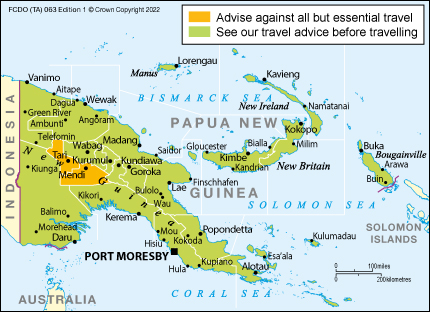
No restrictions in this travel advice Avoid all but essential travel to part(s) of country Avoid all but essential travel to whole country Avoid all travel to part(s) of country Avoid all travel to whole country

This advice has been reviewed and reissued with editorial amendments. The overall level of the advice has not changed; there are no travel restrictions in place in this travel advice for Papua New Guinea. 

(see travel advice legal disclaimer)


Travel advice for this country


  • As the complex political process surrounding PNG’s leadership unfolds and in the run up to elections in 2012 British nationals in Papua New Guinea, particularly Port Moresby are reminded to exercise caution, monitor the media for information about possible new safety or security risks and avoid large gatherings which can quickly turn violent. British nationals should take particular care in the areas around Parliament House, the Supreme Court, Waigani and Konedobu including Government House.
  • Law and order remains poor or very poor in many parts of the country. Armed carjacking, assault, robbery, shootings and serious sexual offences, including rape, are common. We advise you to be vigilant whilst travelling in all cities, particularly during the hours of darkness. See Safety and Security -  Crime.

  • Carjacking is an ever present threat, particularly in Port Moresby and Lae. Car doors should be locked with windows up at all times and caution should be taken when travelling after dark. We recommend you travel in a convoy in the evening or at night.

  • Sporadic outbreaks of tribal fighting can occur and may escalate quickly. You should avoid large crowds and public gatherings as they may turn violent.

  • There is a low threat from terrorism.  Be aware of the global risk of indiscriminate terrorist attacks, which could be in public areas, including those frequented by expatriates and foreign travellers.

  • Around - 2,329 British nationals visited Papua New Guinea in 2009 (Source: Papua New Guinea Tourism Office).  Most visits are trouble free.  See General - Consular Assistance - Statistics.

  • Take out comprehensive travel and medical insurance before travelling. See General - Insurance.

Safety and Security - Terrorism
There is a low threat from terrorism. Be aware of the global risk of indiscriminate terrorist attacks, which could be in public areas, including those frequented by expatriates and foreign travellers. See our Terrorism Abroad page.

Safety and Security - Bougainville
Bougainville Island has recently emerged from a period of separatist conflict. You must provide notice of your intention to visit the island to the Bougainville Provincial Administration (Tel: +675 973 9798), and must contact the Administration again upon arrival. The mountainous area in central Bougainville around the old Panguna mine is a ‘No Go Zone’. You should not enter the ‘No Go Zone’. Foreigners who have entered the Zone without authorisation from the PNG Government have been questioned, some for many days, by PNG authorities and had their passports withheld on departure from the Zone.


Safety and Security - Crime
Pay close attention to your personal security at all times.

Serious crime is particularly high in the capital, Port Moresby, and in the cities of Lae and Mt Hagen. Settlement areas of towns and cities are particularly dangerous. ’Bush knives’ (machetes) and firearms are often used in assaults and thefts. Carjacking, assault (including sexual assaults), bag snatching and robberies are common. Banks and cash machines are attractive targets for criminals. Walking after dark is particularly dangerous in Port Moresby and other urban centres.

Armed carjacking and robberies, including those that take place inside shops and restaurants, can occur throughout Papua New Guinea at any time. Known high-risk areas include the area around Parliament House in the Port Moresby suburb of Waigani, particularly outside of working hours, and along the highway between Lae and Nadzab Airport, particularly between Goroka and Kainantu. Criminals use roadblocks on roads outside of towns to stop and loot vehicles and then attack the occupants. If you intend to travel in these areas, exercise a high degree of caution and consider using a security escort.

Travel at night, if essential, should be made by car, with doors locked and windows up. You should also consider travelling in a convoy or with a security escort.

Most crime is random, but number of people have been abducted by organised gangs and forced to open office safes while others are held captive until the ransom has been paid.

Rape and sexual assault are problems across the country. Due to the high prevalence of HIV/AIDS, victims of violent crime, especially rape, are strongly encouraged to seek immediate medical assistance. For more general information see our Rape and Sexual Assault Abroad page. It is particularly dangerous to walk after dark in most major towns. The situation is generally safer away from large towns.

  • Avoid squatter (“settlement”) areas of towns
  • Avoid public protests, large crowds and public gatherings as these can turn violent very quickly
  • Avoid carrying large amounts of cash or openly displaying expensive jewellery and electronic equipment
  • Be vigilant at all times


Sporadic outbreaks of tribal fighting are a normal occurrence, especially in Port Moresby, the Highlands Provinces (particularly Southern and Western Highlands) and Enga Province. Ethnic disputes can quickly escalate and result in the widespread destruction of property, disruption of normal services and serious injury. Stay alert, monitor local media for alerts and consult local contacts, (accommodation or other service providers) before travelling to a new area.

Tribal fighters and criminals are becoming increasingly well armed through the trade in drugs for guns. Although outsiders passing through are not normally targeted, you should avoid travel in areas where there is tribal fighting. The rugged terrain and poor infrastructure limit the assistance that can be given. See our Victims of Crime Abroad page.

Safety and Security - Local Travel
The damage caused by heavy rain and cyclones can make travel in and around the Province difficult.

Highland Provinces, in particular the Southern Highlands and Western and Enga Provinces, are subject to inter-tribal disturbances without warning. You should exercise extreme caution when travelling in these areas, as law enforcement in these areas is weak.

Following recent murders in the town of Popondetta in Oro province, law and order has deteriorated. The potential for more violence exists. Travel to Popondetta, and on the road between Popondetta and Kokoda, may be dangerous. You should be extremely vigilant when travelling in and around Popondetta.

If you intend to walk a trail or track, including the Kokoda Trail, check with a reputable tour guide that the tracks are open and safe and pay the relevant fees prior to walking the Trail. Details can be obtained through the Papua New Guinea Tourism Promotion Authority (Tel: +675 3200211) or the Kokoda Track Authority (KTA) (Tel: +675 3255540).

There have been serious attacks and robberies at both ends of the Kokoda Trail. Although community leaders have assured tourists of their safety and well-being while walking the Kokoda Trail, you should continue to exercise caution. WWII unexploded ordnance still exists in Papua New Guinea, particularly along the Kokoda Trail and at Milne Bay and Rabual.

Safety and Security - Local Travel - Air Travel
On 13 October, Airlines PNG Dash 8 flight, carrying 32 passengers crashed in severe weather near Madang. 28 of the 32 passengers are believed to have died in the crash.


Safety and Security - Local Travel - Road Travel
When driving, you must keep your driving licence with you at all times. You may use your United Kingdom or international driving licence for a period not exceeding one month. Road conditions are generally hazardous throughout Papua New Guinea, and driving is often erratic. Extra care should be taken if driving at night. Drivers who are involved in, or are witnesses to road accidents may find themselves at personal risk and should seek police assistance as soon as possible. Traffic drives on the left.

We recommend that you do not use public buses known locally as PMVs. There have been incidents of armed hold-ups of PMVs and of passengers being attacked and robbed of their personal belongings. There have also been reports of occasional rape attacks on Port Moresby PMVs. Many PMVs are not considered to be roadworthy.

Taxis are available in some major centres, but these can be badly maintained. You should check about their reliability with your hotel or guesthouse. If you use a taxi, agree a fare before getting into the taxi, irrespective of whether or not there is a meter. Where possible family, friends or hotel courtesy buses should meet you when arriving at international or domestic airports.


See our Driving Abroad page.

Safety and Security - Political Situation
Papua New Guinea Country Profile

Highland Provinces, in particular the Southern Highlands and Western and Enga Provinces are subject to inter-tribal disturbances without warning and you should exercise extreme caution, as law enforcement in these areas is weak.

In June 2011, there were a number of violent incidents reported in Central and Southern Bougainville. You should exercise a high degree of caution when travelling in Bougainville, with particular vigilance when travelling beyond Buka into Central and Southern Bougainville. We continue to advise that you avoid large public gatherings (including political rallies) which can be unpredictable.

As a general rule, you are prohibited from entering Papua New Guinea with fruit, vegetables and animal products due to local quarantine controls.

Marijuana and other narcotics are illegal in Papua New Guinea, and offences can carry substantial prison sentences.

Homosexual acts are unlawful. If found guilty, the penalty could be result in up to14 years imprisonment. Murder may draw the death sentence although there is currently a moratorium on the death penalty.

For more general information for different types of travellers see our Your Trip page.

Entry Requirements - Visas
British nationals require visas to enter Papua New Guinea but tourists may obtain these on arrival for 100 Kina, (equivalent to approx £26), payable in local currency. For further information contact the Representation for Papua New Guinea in London.

Entry Requirements - Passport Validity
You must hold a valid passport to enter Papua New Guinea. Your passport must be valid for a minimum period of six months from the date of entry into Papua New Guinea.

Medical facilities in Papua New Guinea are very basic. Hospitals often run out of basic drugs/supplies and suffer from power shortages. Evacuation by air ambulance to Australia is available in more serious cases. Ensure you make provision for this in your insurance cover.

Cholera continues to spread in Papua New Guinea. More than 2000 cases have been confirmed nationwide. The WHO website has more information. We advise you to read our Eat and Drink Safely page for food/drink hygiene before you go. See the Travel Health section.

Dengue and malaria occur in Papua New Guinea. There are no vaccinations against these diseases but there are preventative measures that you can take, as advised on the National Travel Health Network and Centre (NaTHNaC) website. You should visit your GP to discuss malaria prevention tablets.

Typhoid and dysentery can occur in Papua New Guinea. You should drink only or use boiled or bottled water and avoid any ice in drinks. If you suffer from diarrhoea during a visit to Papua New Guinea seek immediate medical attention.

In the 2010 Report on the Global AIDS Epidemic the UNAIDS/WHO Working Group estimated that around 31,000 adults aged 15 or over in Papua New Guinea were living with HIV; the prevalence percentage was estimated at around 0.9% of the adult population compared to the prevalence percentage in adults in the UK of around 0.2%. You should exercise normal precautions to avoid exposure to HIV/AIDS. See our HIV and AIDS page.

You should seek medical advice before travelling to Papua New Guinea and ensure that all appropriate vaccinations are up-to-date. For further information on vaccination requirements, health outbreaks and general disease protection and prevention you should visit the websites of the National Travel Health Network and Centre (NaTHNaC) or NHS Scotland's Fit For Travel or call NHS Direct on 0845 46 47. See our Travel Health page.

Papua New Guinea sits along a volatile seismic strip called the “Ring of Fire” in the Pacific. Volcanic eruptions, earthquakes and tsunamis are possible. Seismic and volcanic activity is more likely to occur near Rabaul in East New Britain Province, Kimbe in West New Britain Province, and on Manam Island in Madang Province.

Natural Disasters - Earthquakes
The danger from Earthquakes in and around the coast of PNG is real. The last such quake occurred on 24 March 2009 in the New Britain region and registered a magnitude of 6.2. On this occasion the earthquake was not followed by a tsunami or a rise in sea levels. See Tropical cyclones.

Natural Disasters - Volcanoes
Manam Island Volcano erupted on 25 December 2010 and although there has been no evidence of any lava flow, people have been advised not to climb on or around the volcano. Tavurvur in East New Britain still occasionally releases ash clouds, which can disrupt flights in the region. Please contact the Volcanological Observatory for further information: tel:  982 1699; fax:  982 1004.

Natural Disasters - Floods 
The tropical cyclone season in Papua New Guinea normally runs from November to May and flooding and landslides can occur, especially in rural areas. Plan your trip with care and seek and follow local advice on what precautions to take before commencing your journey.

Papua New Guinea's coastal areas experience monthly King Tides. The King Tides may sometimes cause localised flooding. Local communities are fairly well adapted to cope.

General - Insurance
You should take out comprehensive travel and medical insurance before leaving UK. You should check any exclusions, and ensure that your policy covers you for all the activities you want to undertake, including cover for medical evacuation by air ambulance. See our Travel Insurance page.

If things do go wrong when you are overseas see our When Things Go Wrong page. 

General - Consular Assistance

We recommended that you register with and seek the latest local advice from the British High Commission in Port Moresby on arrival. You should leave travel plans with friends, relatives or reliable local contacts. An electronic copy of a consular registration form can be obtained from the High Commission’s website at: http://www.ukinpng.fco.gov.uk.

General - Consular Assistance - Statistics
Around - 2,329 British nationals visited Papua New Guinea in 2009 (Source: Papua New Guinea Tourism Office). Most visits are trouble free. Two British national required consular assistance in Papua New Guinea in the period 01 April 2009 - 31 March 2010.  During this period assistance was also requested with regard to lost and stolen passports (2 cases).

General - Consular Registration

Register with our LOCATE service to tell us when and where you are travelling abroad or where you live abroad so our consular and crisis staff can provide better assistance to you in an emergency.

NB. 
The British High Commission in Port Moresby does not issue passports. Applications for a new passport should be submitted to the High Commission for processing. Where possible, you are advised to apply at least four months before your passport is due to expire. You will be allowed to retain your old passport whilst waiting for the replacement to be processed and returned.

Applications are forwarded by commercial courier to the British High Commission in Wellington, and the courier cost will be added to the passport fee. The High Commission will process your application as quickly as possible but, due to the distances involved, it is likely that there will be a delay in issuing you with a full replacement British Passport. The average non-urgent waiting time for passport renewal is six weeks.

In emergencies the British High Commission in Port Moresby can issue emergency travel documents.

Contacts

Papua New Guinea, Port Moresby, British High Commission

Address:

British High Commission
Port Moresby
Sec 411 Lot 1 & 2
Kiroki Street
Waigani
Port Moresby

Telephone:

(+675) 325 1677 Office hours

Fax:

(+675) 325 3547

Email: mailto:uk.inPNG@fco.gov.uk

Office hours:

Office hours (Local time):
Mon-Thurs: 08:00-16:00
Fri: 08:00-12:00

Office hours (GMT):
Mon-Thurs: 22:00-06:00
Fri: 22:00-02:00

Website: http://ukinpng.fco.gov.uk

register
 
register
 
Facebook - British abroad
 
 
Overseas Business Risk