Travel Summary
-
An outbreak of Cholera has been confirmed by the Malaysia Health Department in the state of Terengganu, N.E. Malaysia.
-
For information about the situation in Malaysia please monitor the Malaysian Ministry of Health website.
-
The Ministry of Health have an operations room for the public to call, the numbers are 03 8881 0200 and 03 8881 0300.
-
There is a general threat from terrorism in Malaysia. Attacks could be indiscriminate, including in places frequented by expatriates and foreign travellers. See the Terrorism section of this advice for more details.
-
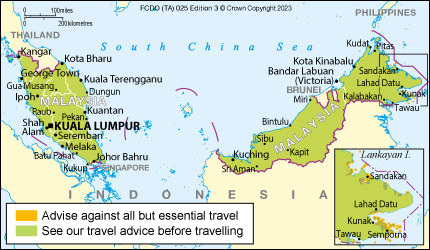
Foreign nationals have been kidnapped in the past in East Malaysia and we believe that this threat remains. Boats travelling to and from offshore islands and dive sites are possible targets. If you wish to visit resorts on, and islands off, Eastern Sabah, you should exercise extreme caution.
-
If you plan to travel over the border to Thailand you should be aware that there has been a resurgence of terrorism in southern Thailand, particularly in the far southern provinces of Pattani, Yala, Narathiwat and Songkhla. We advise against all but essential travel to these Thai provinces. See the travel advice for
Thailand
for more details.
-
You should not become involved with drugs of any kind: possession of even very small quantities can lead to imprisonment or the death penalty. See the Local Laws and Customs section of this advice for more details.
-
Around 250,000 British nationals visit Malaysia each year (Source: Immigration
Malaysia). Most visits are trouble-free. 80 British nationals required consular assistance in Malaysia in the period 01 April 2008 – 31 March 2009 for the following types of incident; deaths (29 cases); hospitalisations (10 cases); and arrests, for a variety of offences (15 cases). During this period assistance was also requested with regard to lost or stolen passports (200 cases).
-
Malaysia is a multicultural but predominantly Muslim country, and as such you should respect local social conventions at all times. See the Local Laws and Customs section of this advice for more details.
-
We recommend that you obtain comprehensive travel and medical insurance before travelling. You should check any exclusions, and that your policy covers you for the activities you want to undertake.
See the General (Insurance) section of this advice and our
Travel Insurance
page for more details.
Safety and security
Terrorism
There is a general threat from terrorism in Malaysia. Attacks could be indiscriminate, including in places frequented by expatriates and foreign travellers.
For more see our
Terrorism Abroad page.
In neighbouring Indonesia, Westerners were killed and injured following the terrorist attacks in Bali (October 2002 and October 2005) and Jakarta (August 2003 and September 2004).
Foreign tourists were kidnapped from the Malaysian island of Sipadan in 2000, and foreign workers from a resort near Lahad Datu in Eastern Sabah in 2003. On 12 April 2004, a Malaysian vessel was hijacked and three crew members taken hostage just outside Malaysian waters off the eastern coastline of Sabah. We believe that the threat from kidnapping remains. Boats travelling to and from offshore islands and dive sites are possible targets. If you wish to visit resorts on, and islands off, Eastern Sabah (from Kudat eastwards to Tawau), you should exercise extreme caution.
You should be aware that the long-standing policy of the British Government is not to make substantive concessions to hostage takers. The British Government considers that paying ransoms and releasing prisoners increases the risk of further hostage taking.
The Malaysian Government has put in place measures to combat terrorism and has arrested a number of terrorist suspects. In Sabah, the authorities have increased security, but there is a continuing risk of further incidents. If you wish to go to remote areas, you are advised to register your itinerary with the local police or your hotel/tour operator beforehand.
If you plan to travel over the border to Thailand you should be aware that since January 2004 there has been a resurgence of terrorism in southern Thailand, particularly in the far southern provinces of Pattani, Yala, Narathiwat and Songkhla. We recommend against all but essential travel to these four Thai provinces. Since January 2004, there have been almost daily attacks in the far south. These include arson, bombings and shootings. Over 2500 people have been killed and several thousand more injured. Tourist hotels and bars, shops, market places, transport infrastructure, in particular rail tracks and in trains, have all been targeted. No British nationals have been killed in these attacks, but some foreign citizens have been killed and injured.
For more read the Travel Advice for
Thailand.
Crime
You should be aware of the dangers of street crime, particularly bag snatching and pickpockets - and scams involving gambling or spiked drinks.
- Incidents of bag snatching are common. There have been many cases of bags being snatched by thieves on motorbikes. Deaths have occurred where victims held on to their bags. When going out, avoid carrying valuables you, and be aware of your surroundings.
- Take particular care of your belongings especially your passport, as visitors' passports have been stolen on aircraft, cafes, airport and railway terminals, and from hotel rooms.
- There have been a number of tourists taken in by gambling scams. This has usually involved being befriended by a stranger in an attempt to gain the victim’s confidence. Organised groups have used this approach as a ploy to take you back to their house where the victim has been encouraged to play cards, at the end of which they are intimidated into paying large sums of money, or making forced purchases of jewellery as payment of gambling debts. These groups are sometimes armed and are known to operate in major tourist areas, including shopping centres, food malls and around hostels/hotels.
- Be careful if offered a drink by a stranger, even in a reputable bar or restaurant. Such approaches can involve spiked drinks, and have resulted in cases of robbery and assault.
- Do not open your hotel room door to strangers, even those wearing hotel uniform, and especially late at night. This applies particularly to women travelling alone.
- Credit card and ATM fraud is widespread. Take great care when making payments by credit card and using ATMs. There have been many instances where cards have been duplicated and skimming devices added to ATMs.
For more general information see
Victims of Crime Abroad.
Political Situation
Malaysia Country Profile.
Police permission is required for certain kinds of public gatherings in Malaysia. Since October 2007 there have been demonstrations, which did not have the required police permission. Police have sometimes used tear gas and water cannons to control crowds. You should exercise caution and avoid any demonstrations or large gatherings of people, which might place you at risk.
Local Travel
Road Travel
A UK driving licence can be used in Malaysia for three months only. If you intend staying in Malaysia for longer than three months you should get either a Malaysian driving licence or an annually renewable International Driving Permit.
If you intend to hire cars, motorcycles or any motorised water sport equipment, talk to your travel insurer to check if it is covered by your insurance policy.
Road conditions in Peninsular Malaysia are generally good but less so in East Malaysia. Traffic (particularly motor cyclists) will not always stop at traffic lights or on pedestrian crossings. Visitors should take care when crossing the street to avoid accidents. If you are involved in a road accident you are obliged by law to remain at the scene until the police have attended. However, if a crowd should gather, it would be prudent to leave the scene and report to the nearest police station.
There have been a number of fatal bus crashes in Malaysia, particularly on overnight journeys. Choose a reputable operator for your journey.
If you rent a motorbike you should take the same safety precautions as in the UK. Malaysian law states that helmets must be worn.
Driving under the influence of alcohol is a serious offence in Malaysia and the traffic police regularly carry out breath tests. Anyone over the legal limit can face a heavy fine or a jail sentence.
For more general information see our
Driving Abroad page.
Sea and River Travel
Piracy in South East Asian waters is an ongoing problem. There have been a number of attacks against ships in and around Malaysian waters, particularly in the Strait of Malacca and in the waters between Sabah and the southern Philippines. Mariners should be vigilant and take appropriate precautions; reduce opportunities for theft; establish secure areas onboard; and report all incidents to the coastal and flag state authorities. Vessels which encounter problems at sea should contact the Maritime Rescue Co-ordinating Centre on the standard distress channel.
There have been instances of passenger boats sinking, usually due to overloading and/or poor maintenance. You should exercise care at all times when travelling by passenger ferry or speedboat and avoid travel on vessels that are clearly overloaded or in poor condition. You should also ensure that life jackets are available.
Water sports and scuba diving
If you choose to rent jet skis or any other type of water sports equipment, you should first consider the dangers involved and satisfy yourself that adequate safety precautions are in place. Once satisfied about this, rent only from reputable operators and insist on sufficient training before use. Also ensure that the operator is licensed and has adequate insurance cover.
The standards maintained by diving schools and rescue services are not always as high and comprehensive as they might be in the UK. Check a dive operator's credentials carefully before using them and ensure that your insurance covers you for all of the activities that you undertake. If you are an experienced diver you should purchase dive specific insurance and check that your qualifications and experience fall within the cover provided. You should contact your issuing authority if you are in any doubt (i.e. PADI or BSAC). If you have had no previous diving experience you should ask your dive operator to explain what cover they offer before signing up for a course; you should also be satisfied that sufficient safety equipment is available on the boat, particularly oxygen. You should also ask about contingency plans, which should include the ability to call for help whilst at sea and to evacuate divers to the nearest hyperbaric chamber if necessary.
The sites of HMS Repulse and HMS Prince of Wales, which lie in international waters off Kuantan, have been declared “Protected Places” under the Protection of Military Remains Act 1986. You should only dive there on a "look not touch" basis and should not attempt to penetrate the wrecks, which lie in deep water. You should also exercise extreme caution. One British diver recently died while diving on HMS Repulse. If you have evidence of any other type of activity on or near the wrecks, please report it to the British High Commission in Kuala Lumpur.
For more general information see
River and Sea Safety
Air Travel
Airport departure tax is included in the ticket price.
Local laws and customs
Malaysia is a multicultural but predominantly Muslim country. You should respect local traditions, customs, laws and religions at all times and be aware of your actions to ensure that they do not offend other cultures or religious beliefs, especially during the holy month of Ramadan or if you intend to visit religious areas. For more general information see
Travelling During Ramadan.
You should also dress modestly in conservative and rural areas, and when visiting places of worship. Homosexual acts are illegal.
If you are a Muslim you should be aware that you may also be subject to local Shari'a law.
There are severe penalties for all drug offences in Malaysia: trafficking (defined here as the possession of a certain quantity of drugs) incurs a mandatory death penalty; possession incurs a custodial sentence and possible whipping. This includes the possession of or trafficking in Amphetamine-type stimulants. You could be asked to take a urine test on arrival in Malaysia if you are suspected of having used drugs before your visit. Should the test prove positive, you could be referred for rehabilitation treatment or be deported.
The importation of unlicensed firearms and ammunition into Malaysia is prohibited. Possession can carry the death penalty.
For more general information for different types of travellers see our
Your trip page.
Entry requirements
Visas
British nationals do not need a visa to enter Malaysia as a visitor. You will normally be given permission to stay for three months on arrival. Visas for longer stays or for non-tourist purposes must be obtained from the nearest
Malaysian diplomatic mission before travel.
The Malaysian authorities are running a vigorous campaign against illegal immigration and are therefore inspecting immigration documents, such as work permits, very closely.
It is important that you neither overstay your visa, nor infringe the terms of entry. Persons doing so (even overstaying for just a few days) will incur a fine and possibly detention and deportation.
UK citizens travelling from Peninsular Malaysia to East Malaysia (sometimes known as Malaysian Borneo and comprising the states of Sabah and Sarawak) need to carry their passports to enter East Malaysia.
Passport validity
Entry to Malaysia is normally refused to visitors holding passports with less than six months' validity.
Dual nationals
Dual nationals should also be aware that Malaysia does not recognise dual nationality, so technically you can be refused entry if you are found to be holding two passports of different nationality. If you are a dual national it is advisable to enter Malaysia on the passport on which you exited your last country of departure.
Exchange control rules
Under current Malaysian exchange control rules, you may import or export up to 1,000 Malaysian Ringgit per person without prior approval. There are no limits on the amount of foreign currency (notes and or travellers' cheques) you may import. Non-residents may export foreign currency (notes and or travellers' cheques) up to the amount they previously imported, provided they have documentary evidence of the amount they imported. All travellers must complete travellers' declaration forms on entering Malaysia. Penalties for offences under the Exchange Control Act 1953 are a fine of up to 10,000 Malaysian Ringgit, three years' imprisonment or both.
Travelling with children
Single parents or other adults travelling alone with children should be aware that some countries require documentary evidence of parental responsibility before allowing lone parents to enter the country or, in some cases, before permitting the children to leave the country. They may want to see birth certificates, a letter of consent from the other parent or some evidence as to your responsibility for the child. Malaysian authorities do not normally require such evidence but if you have any concerns please check with
Malaysian representation in the UK.
Health
Emergency medical care in all hospitals is good. However standards of care in government hospitals can be variable. Both government and private hospitals charge for all services. Private care is expensive.
Malaysia has periodic problems with air quality reaching hazardous levels because of smoke haze. For more information on the air quality in Malaysia please visit the website of the
Malaysian Department of Environment.
Dengue, malaria and other mosquito borne illnesses (including chikungunya fever) occur in Malaysia. Dengue fever is prevalent in all states and serious outbreaks occur from time to time. We recommend that you take precautions against being bitten by mosquitoes, including using insect repellent at all times. There are no vaccinations against these diseases but there are preventative measures that you can take, as advised on the National Travel Health Network and Centre (
NaTHNaC) website. You should visit your GP to discuss malaria prevention tablets.
There are occasional outbreaks of Hand, Foot and Mouth Disease (HFMD) across Malaysia.
In the 2008 Report on the Global AIDS Epidemic the UNAIDS/WHO Working Group estimated that around 79,000 adults aged 15 or over in Malaysia were living with HIV; the prevalence rate was estimated at around 0.5% of the adult population. This compares to the prevalence rate in adults in the UK of around 0.2%. You should exercise normal precautions to avoid exposure to HIV/AIDS. For more general information on how to do this see
HIV and AIDS.
You should seek medical advice before travelling to Malaysia and ensure that all appropriate vaccinations are up-to-date. For further information on vaccination requirements, health outbreaks and general disease protection and prevention you should visit the websites of the National Travel Heath Network and Centre
(NaTHNaC) or
NHS Scotland's Fit For Travel or call NHS Direct on 0845 46 47.
Swine Flu (H1N1)
There are confirmed cases of Swine Flu (H1N1) in Malaysia. Passengers entering Malaysia from countries with confirmed cases of H1N1 will be thermally or manually screened for any increase in body temperature. Any passengers displaying flu-like symptoms, and passengers travelling on flights with confirmed cases, may be placed in quarantine.
The World Health Organisation (WHO) has raised its Pandemic Threat Alert Phase to Level 6. The
WHO website has further details. You should also monitor local media reports for any developments and advice. We also have dedicated
swine flu page. Guidance on Pandemic Flu can be obtained on the UK
Department of Health website.
For information about the situation in Malaysia please monitor the
Malaysian Ministry of Health website. The Ministry of Health have an operations room for the public to call, the numbers are 03 8881 0200 and 03 8881 0300.
Avian Influenza (Bird Flu)
There have been outbreaks of Avian Influenza (Bird Flu) in domestic poultry in Malaysia (most recently in June 2007). No human infections have been reported.
The risk to humans from Avian Influenza is believed to be very low. As a precaution, you should avoid visiting live animal markets, poultry farms and other places where you may come into close contact with domestic, caged or wild birds; and ensure poultry and egg dishes are thoroughly cooked.
Natural disasters
Between the months of October to February Malaysia is affected by seasonal storms, which occasionally result in heavy flooding.
General
Insurance
We strongly recommend that you obtain comprehensive travel and medical insurance before travelling. You should check any exclusions, and that your policy covers you for all the activities you want to undertake. See our
Travel Insurance page for more details.
If things do go wrong when you are overseas then this is our
how we can help page.
Consular Registration
Register with our
LOCATE service to tell us when and where you are travelling abroad or where you live abroad so our consular and crisis staff can provide better assistance to you in an emergency.
- More information about registering with LOCATE.