Advanced search
image
Travel & living abroad

Asia and Oceania

Laos

Flag of Laos
Still current at: 08 February 2012
Updated: 31 January 2012
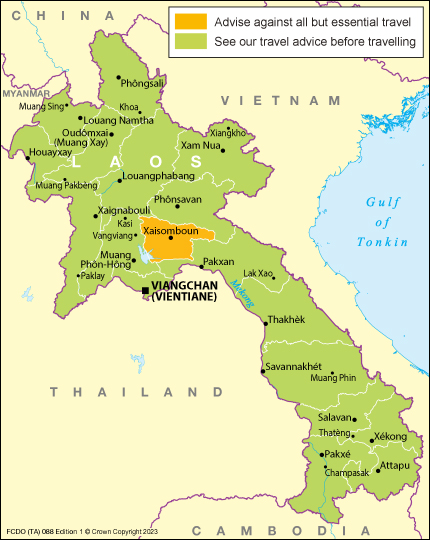
No restrictions in this travel advice Avoid all but essential travel to part(s) of country Avoid all but essential travel to whole country Avoid all travel to part(s) of country Avoid all travel to whole country


This advice has been reviewed and reissued with editorial amendments. The overall level of the advice has not changed; there are no travel restrictions in place in this travel advice for Laos.

(see travel advice legal disclaimer)

Travel advice for this country

  • Unexploded ordnance in rural areas is an ongoing danger. Exercise caution when travelling around Laos. See Safety and Security – Local Travel.

  • There is a low threat from terrorism. Attacks can be indiscriminate, including places frequented by expatriates and foreign travellers. See Safety and Security - Terrorism.

  • You should carry an ID document or passport at all times. You will be heavily fined if you do not present any documentation on request by the authorities.
     
  • Take out comprehensive travel and medical insurance before travelling. See the General -  Insurance.

  • Register with the FCO’s LOCATE service before travelling. Most visits to Laos are trouble free. See General - Consular Assistance Statistics.

Safety and Security - Terrorism
There have been small-scale skirmishes between anti-government groups and government troops in isolated areas along the Lao-Thai border. There is a danger you may inadvertently get caught up in unpredictable acts of violence. The local law enforcement agencies in Laos have limited capability to counter these threats.

See our terrorism abroad page.

Safety and Security - Crime
Exercise caution and monitor developments that might affect your safety in Laos due to the risk of criminal activity.  Pay close attention to your personal security and monitor the media for information about possible new safety or security risks.

Petty crime, including bag snatching occurs frequently.  In the lead up to local festivals, such as Lao New Year in April, there is a significant increase in theft and violent crime.

The theft of passports is a particular problem. Ensure your insurance covers for unexpected losses such as cancelled flights, stolen cash, cards, passports or luggage.

See our victims of crime abroad page. 

Safety and Security - Local Travel
Unexploded mines and ordnance are a continuing hazard in Laos. Particularly in Xieng Khouang Province (Plain of Jars), Luang Prabang Province (as a result of scrap metal collection) and areas of the Lao-Vietnamese border, formerly the Ho Chi Minh Trail. Mined areas are frequently unmarked.  Do not stray off main routes in rural areas.  

People travelling in Vientiane and elsewhere in Laos may be stopped by the police at any time, particularly in the evening. You may be asked to show identification papers before being allowed to travel on. Comply with requests to stop at checkpoints and roadblocks.

Safety and Security - Local Travel - Air Travel
No airlines from Laos operate to the UK or the EU, so it has not been possible assess their safety standards.

A departure tax is now included in the price of the air ticket and is no longer paid separately in cash.

Safety and Security - Local Travel - Road Travel
Roads in Laos are in poor condition. Travel should only be undertaken during daylight hours. Travel after dark significantly increases the risk of an accident as vehicles often do not have lights. Livestock also stray on to the roads causing accidents.

The numbers of road accidents and fatalities in Laos have risen sharply in recent years. If you are involved in a road accident you will be required to pay compensation for third party property damage and injury, even if you are not judged to be at fault. Lao insurers only meet a small proportion of the costs of an accident and will not cover this compensation.

See our driving abroad page.

Safety and Security - Local Travel - River Travel
Travel on the Mekong River by speedboat is dangerous especially when water levels are low. White water rafting, kayaking and tubing are also dangerous and incidents of drowning and serious injuries have been reported. Exercise extreme caution when undertaking any river-based activities and check your travel insurance policy to ensure that you are covered for these activities.

See our river and sea safety page.

If you plan to travel by road or river check with a travel company on arrival for an update on local conditions.

Be aware of and respect local laws at all times.

Do not get involved with drugs. There have been several deaths as a result of drug abuse among foreign nationals visiting Laos. Possession, trafficking and manufacture of drugs are serious offences in Laos. Those caught face lengthy prison sentences or the death penalty

There have been a number of incidents where tourists have had their drinks or food drugged. Some restaurants in popular tourist destinations offer drug-laced food and drink which has led to the victim being assaulted. These products can contain harmful substances and consuming them can result in serious injury or even death. Never leave food or drink unattended.

There have been incidents of drug related rapes reported by foreigners. Be careful about taking drinks from strangers and be wary at bars, clubs, restaurants and parties.

See our rape and sexual assault abroad page. 

The Lao Government prohibits sexual relationships between foreign and Lao nationals, except when the two parties have been married in accordance with Lao Family Law. Permission for marriage or engagement to a Lao national must be submitted in a formal application to the Lao authorities.  Penalties for engaging in prohibited sexual contact or failing to register a relationship range from US$500 to US$5,000 and may also involve imprisonment. It is not unknown for Lao authorities to demand entry into hotel rooms or guesthouses where they suspect this regulation is being broken.

Photographing or visiting military sites is prohibited and can result in arrest or detention.

See our your trip page.

Entry Requirements - Visas
Visa conditions change regularly. For the most up to date information, contact the nearest Laos Embassy or Consulate.

You can purchase a visa on arrival. Current cost is approximately US$35 or Thai Baht 1,500.00. If you are in the region official long-stay visas can be obtained from the Laos Embassy in Bangkok or Hanoi. If you are in the UK you can apply to the nearest Laos Embassy, which is in Paris.

When you enter Laos, make sure you get an entry stamp in your passport. Not having a legitimate entry stamp could lead to arrest or a large fine.

For further information on exactly what will be required at immigration, please check with your nearest Laos Embassy.

Entry Requirements - Passport

You must hold a valid passport to enter Laos. Your passport must be valid for a minimum period of six months from the date of entry into Laos.

If you require a new British passport, application forms can be downloaded from the Internet. Applications for replacement passports are processed by the British Consulate in Hong Kong and take approximately four weeks. First time applications and lost/stolen passports are processed by the British Embassy in Bangkok. Visit the British Embassy in Bangkok website for further information about how to apply, fees and what documentation is required.

In the event of an emergency (e.g. lost passport), the Australian Embassy in Vientiane can issue a Laissez Passer emergency travel document to allow you to enter Thailand. You will then need to apply in person at the British Embassy in Bangkok where it may be possible to issue you with an Emergency Travel Document. If you require an Emergency Travel Document you are advised to apply at least 48 hours before you are due to travel.

Make sure you keep a photocopy of the relevant pages of your passport, to avoid any complications.

Entry Requirements - Travelling with children

Single parents or other adults travelling alone with children should be aware that some countries require documentary evidence of parental responsibility before allowing lone parents to enter the country, or, in some cases, before permitting the children to leave the country.

If you have an unstable medical condition you should seriously consider not travelling to Laos. Medical care in Vientiane is extremely basic and outside the capital there are no reliable facilities to deal with medical emergencies. Medical evacuation is difficult to organise and very expensive.

Poor sanitation and eating contaminated food can increase the risk of cholera and other diarrhoeal illness. Drink or use only boiled or bottled water and avoid ice in drinks.  If you suffer from diarrhoea during a visit to Laos you should seek immediate medical attention.

Water borne, food borne and other infectious diseases are common and serious outbreaks occur from time to time. Exercise normal precautions to avoid exposure. 

In the 2010 Report on the Global AIDS Epidemic the UNAIDS/WHO Working Group estimated that 8,300 adults in Laos were living with HIV, the prevalence percentage was estimated at around 0.2% of the adult population compared to the prevalence percentage of adults in the UK of around 0.2%. Exercise normal precautions to avoid exposure to HIV/AIDS. See HIV and AIDS page.

Seek medical advice before travelling to Laos and ensure that all appropriate vaccinations are up-to-date. For further information on vaccination requirements, health outbreaks and general disease protection and prevention you should visit the websites of the National Travel Heath Network and Centre (NaTHNaC) or NHS Scotland's Fit For Travel or call NHS Direct on 0845 46 47.

See our travel health and eat and drink safely pages.

Health - Avian influenza (bird flu)
There have been outbreaks of avian influenza (also known as bird flu) in poultry in Laos.

The risk to humans from Avian Influenza is believed to be very low. However, as a precaution, you should avoid visiting live animal markets, poultry farms and other places where you may come into close contact with domestic, caged or wild birds. Ensure poultry and egg dishes are thoroughly cooked.

British nationals living in an Avian-Influenza affected region should take responsibility for their own safety in the event of a future pandemic, including considering their access to adequate healthcare and ensuring travel documents are up to date.

See our avian and pandemic influenza, which gives more detailed advice and information.

Natural Disasters - Monsoon Season
The rainy season in Laos normally runs from May/June to November, coinciding with the typhoon season in South East Asia. Mountain areas are particularly vulnerable to landslides in the rainy season and flooding may occur along the Mekong river basins and elsewhere. The Mekong River Commission, an international organisation posts official updates on the Mekong River on their website. Travel to some provinces can be seriously disrupted during this time. Monitor local news and weather reports, and international weather updates from the World Meteorological Organisation (WMO)

For more information visit the National Hurricane Centre for updates. See our tropical cyclones page.

General - Insurance
Take out comprehensive travel and medical insurance before travelling. Check any exclusions and ensure that your policy covers you for all activities. See our Travel Insurance page.

If things do go wrong, then see our When Things Go Wrong page.

General - Representation in Laos
There is no British consular representation in Laos. Urgent consular assistance to British nationals is provided by the Australian Embassy in Vientiane. The British Embassy in Bangkok is responsible for all routine consular matters.

Laos does not have an embassy in the United Kingdom. The Laos Embassy in Paris is accredited to the UK.

General - Consular - Registering your presence
Register with our LOCATE service to tell us when and where you are travelling or where you live so our consular and crisis staff can provide better assistance to you in an emergency.

If you are a British national and plan to stay for an extended period in Laos, register with the Australian Embassy in Vientiane upon arrival. The Australian Embassy in Vientiane can be contacted at: KM4, Thadeua Road, Watnak Village, Sisattanak District, Vientiane; (Tel: + 856 21 353 800; Fax: 856-21 353-801). Email: austemb.laos@dfat.gov.au

General - Consular Assistance Statistics

Two British nationals required consular assistance in Laos during the period 01 April 2010 - 31 March 2011 for the following types of incident: one death and one hospitalisation.

General - Money
The majority of international ATMs are generally reliable. There is a limit to the amount of money you are able to withdraw per day (1,000,000 LAK = approx £65).

Major credit cards are generally accepted at the larger international hotels and main tourist sites and travellers cheques can be cashed at most banks in Vientiane and major towns. Most transactions are conducted in cash; American Dollars, Thai Baht or Lao Kip (LAK).

Contacts

Thailand, Bangkok, British Embassy

Address:

14 Wireless Road
Lumpini, Pathumwan
Bangkok 10330

Telephone:

+66 (0) 2 305 8333 - Main Embassy line
(Please note this line is NOT for visa enquiries)

Fax:

+66 (0) 2 255 9278

Office hours:

Office hours (Local time):
Mon-Thurs: 08:00-12:00 / 12:45-16:30
Fri: 08:00-13:00

Website: http://ukinthailand.fco.gov.uk/

register
 
register
 
Facebook - British abroad


Overseas Business Risk