Advanced search
image
Travel & living abroad

Asia and Oceania

Korea, DPR (North Korea)

Flag of Korea, DPR (North Korea)
Still current at: 26 November 2009
Updated: 13 November 2009

This advice has been reviewed and reissued with amendments to the summary. The overall level of the advice has not changed.

(see travel advice legal disclaimer)


Travel advice for this country

Travel Summary

  • On 10 November 2009 a skirmish occurred between DPRK and ROK navel vessels in the West Sea near to the Northern Limit Line. There are no reports of further incidents and no evidence of increased risk or danger to those living in or travelling to North Korea.

  • On 25 May 2009 North Korea carried out an underground nuclear test. North Korea has also test-launched a number of short-range missiles. On 27 May North Korea said that it regarded South Korean membership of the US-led Proliferation Security Initiative as an act of aggression and would no longer be bound by the terms of the 1953 Armistice Agreement, although it has said this before. Tensions on and around the Korean Peninsula are heightened but there is no evidence of any increased risk or danger to those living in or travelling to North Korea as a result of these tests. Please see the political situation section of this travel advice for more information.

  • The World Health Organisation (WHO) has raised its pandemic threat alert phase to Level 6. The WHO website has further details. There is a dedicated swine flu page on this website. Guidance on pandemic flu can be obtained on the UK Department of Health website.

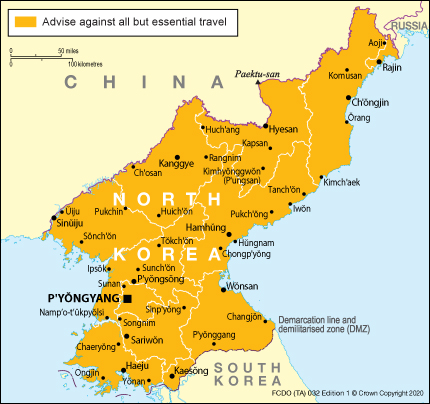
  • It is not possible to enter the Democratic People’s Republic of Korea (DPRK) (North Korea) from the Republic of Korea (ROK) (South Korea), unless making an official visit to the Kaesong Industrial Complex.

  • The threat from terrorism in North Korea is low, but you should be aware of the global risk of indiscriminate terrorist attacks, which could be against civilian targets, including places frequented by foreigners.
  • You should register with the British Embassy in Pyongyang prior to your arrival.  See the general (registering with the British Embassy) section of this advice for more details.

  • Travel within North Korea is severely restricted.

  • Due to avian influenza outbreaks in the region, you may be required by the North Korean authorities to provide recent travel itineraries as part of the visa application process. The North Korean authorities have said informally that visas may be denied to applicants who have recently visited areas affected by avian influenza but no further guidance has yet issued as to how this might be applied. 

  • Very few British nationals visit North Korea and those that do are usually part of an organised tour. Most visits are trouble-free. The main type of incident for which British nationals required consular assistance in North Korea in 2008 was for hospitalisations.

  • We recommend that you obtain comprehensive travel and medical insurance before travelling. You should check any exclusions, and that your policy covers you for all the activities you want to undertake. See the general (insurance) section of this advice and travel insurance for more details.

Safety and security

Terrorism


The threat from terrorism in the DPRK is low, but you should be aware of the global risk of indiscriminate terrorist attacks, which could be against civilian targets, including places frequented by foreigners. For further information see terrorism abroad.

Crime


Crime against foreigners in North Korea is unusual but not unheard of. You should still exercise normal safety precautions and ensure that valuables are secure.

For more general information see victims of crime abroad.
 

Political situation


North Korea country profile

Since the end of the Korean War in 1953, the Korean peninsula has been divided by a de-militarised zone separating North and South Korea. Peace has been maintained under an Armistice Agreement. Tensions rise and fall from time to time. Following the fatal shooting in July 2008 of a South Korean tourist who reportedly strayed into a restricted military area while visiting North Korea, we recommend that travellers take care to remain in permitted areas and move away immediately if asked to do so by North Korean officials. On 5 April 2009 North Korea launched a satellite using ballistic missile technology, in breach of United Nations Security Council Resolution 1718. Regional tensions were raised significantly following the announcement by North Korea on 25 May 2009 that it had carried out an underground nuclear test. There were also reports that North Korea had test-fired a number of short-range missiles. There is no evidence of any increased risk to those living or travelling in North Korea as a result, however you should check this travel advice regularly and follow developments closely.

Local travel


Tourists can normally only travel to North Korea as part of an organised tour. Solo travellers need a sponsor and permission from the Ministry for Foreign Affairs. This is normally only possible for business travellers.

Travel within North Korea is severely restricted. Whether you are visiting on business or as a tourist, you will almost always be accompanied by a guide and will only be allowed to go where your guide is content for you to go. However, it is sometimes possible to make short walks unaccompanied from some of the major hotels in Pyongyang. For travel outside Pyongyang, it is your guide's responsibility to obtain the necessary permissions. Military checkpoints, to be found at the entry and exit to all towns, usually require identity documents before allowing travel onward.

Foreigners resident in Pyongyang are usually able to travel freely within the city, but permission is often required for travel outside of Pyongyang.

It is not possible for you to travel direct to South Korea from North Korea, unless making an official visit to the Kaesong Industrial Complex.

Road travel


A limited number of taxis are sometimes available from hotels or outside department stores. However, they are reluctant to take you without a local guide/interpreter.

International driving licences are not valid in North Korea. Foreigners resident in North Korea must be in possession of a local licence, obtained by passing a local driving test.

It is possible to drive between Pyongyang and Sinuiju/Dandong (North Korean and Chinese border towns), although you will need to obtain permission and be accompanied by a North Korean guide or interpreter. Outside of major towns communications infrastructure is limited. In good weather this journey takes five or six hours. In bad weather roads can be treacherous, making the journey longer, and delays at the border are common. For safety reasons it is advisable to take at least two cars on such a trip. It is not possible to drive vehicles without Chinese number plates in China, but cars driven from Pyongyang can be left in the customs pound in Dandong for the duration of a visitor's stay.  

For further information see driving abroad.

Rail travel


Rail travel is possible in North Korea. However, the domestic network is small, the equipment is old and trains are subject to delays because of electricity shortages. There is a rail service between Pyongyang and Beijing via Sinuiju/Dandong (North Korean and Chinese border towns) four times a week, although delays are frequent and sanitation is limited. The advertised journey time is approximately 24 hours. There are three flights a week between Beijing and Dandong by Air Koryo (see air travel below), but flight and rail times are not co-ordinated. There is also a weekly rail service to Moscow that takes six and a half days.

Air travel


Most travellers enter North Korea on direct flights from Beijing to Pyongyang operated by Air China three times a week and Air Koryo, the North Korean national airline, three times a week. Air Koryo also operates regular international flights to Shenyang and Vladivostok and occasional flights to other, mostly domestic, destinations.

Air Koryo is included on the EU blacklist of airlines that are not permitted to operate services to the EU because they do not meet international safety standards. It is recommended that you avoid flying with Air Koryo if an acceptable alternative means of travel exists.

Air Koryo is still used by some members of Pyongyang’s international community, including businessmen, diplomats, NGOs and International Organisations. However, the Foreign and Commonwealth Office has explained the concerns about Air Koryo to its staff and advised them to use Air China for travel in and out of Pyongyang. We have also advised our staff not to use Air Koryo for personal travel. You should bear this in mind when making your travel plans. It is essential to reconfirm Air Koryo return bookings at least 72 hours before you travel. An issued air ticket does not guarantee a seat unless it has been confirmed and the ticket endorsed prior to travel. Departure tax, currently 10 Euros, needs to be paid before confirmation takes place. This will usually be done by your host organisation in North Korea.

Local laws and customs

Perceived insults to, or jokes about, the North Korean political system and its leadership are severely frowned upon. Foreigners have very occasionally found themselves caught up in criminal cases for not paying what was deemed to be a sufficient level of respect.

Foreign mobile phones and Global Positioning Systems have to be deposited with North Korean customs on entry into the country and collected on departure. It is also not advisable to bring books or other written material in the Korean language. These and any other literature deemed subversive or pornographic by the North Korean authorities risk being confiscated from travellers on arrival.

Tipping is officially frowned upon, but is increasingly expected by some hotel staff.

You should always carry some form of identification. Hotels will want passports for registration, but these can usually be reclaimed within the hour.

It is always advisable to ask permission before taking photographs. Photographs of Korean officials or guarded or protected buildings should be avoided.

For more general information for different types of travellers see your trip.

Entry requirements

Visas


Visas are required to enter North Korea. Contact the Embassy of the Democratic People's Republic of Korea, in London.

You may be required by the North Korean authorities to provide recent travel itineraries as part of the visa application process, and possibly on arrival. The authorities have said informally that visas may be denied to applicants who have recently visited areas affected by avian influenza, but no further guidance has yet been issued as to how this might be applied.

You must register with the Ministry of Foreign Affairs if your visit is for more than twenty-four hours. Most hotels will automatically complete this process on your behalf.

Passport validity


You must have a valid UK passport.
 

Travelling with children


Single parents or other adults travelling alone with children should be aware that some countries require documentary evidence of parental responsibility before allowing lone parents to enter the country, or in some cases, before permitting the children to leave the country. We do not currently allow our staff based in North Korea to be accompanied by their children because of the limited medical facilities within North Korea.

Health

Health facilities in North Korea are poor, even for foreigners. Standards of clinical hygiene in hospitals are poor. Anaesthetics are sometimes unavailable. Evacuation is necessary for serious illness/injury. Invasive surgery should be avoided if at all possible. Facilities for dental treatment are also poor.

You should ensure that you take sufficient supplies of any medication that you may require, as local purchase of most foreign-manufactured medicines is not possible and local medical supplies are severely limited.

Japanese encephalitis occurs in North Korea, especially during the summer. Cholera also occurs and all water is a potential health risk. You should drink or use only boiled or bottled water and avoid ice in drinks. If you suffer from diarrhoea during a visit to North Korea you should seek immediate medical attention.

You should exercise normal precautions to avoid exposure to HIV/AIDS. For more general information on how to do this see HIV and AIDS.

You should seek medical advice before travelling to DPRK and ensure that all appropriate vaccinations are up-to-date. For further information on vaccination requirements, health outbreaks and general disease protection and prevention you should visit the websites of the National Travel Heath Network and Centre (NaTHNaC) and or NHS Scotland's Fit For Travel or call NHS Direct on 0845 46 47.

For more general health information see travel health.

Avian influenza (bird flu)


There have been no confirmed cases of avian influenza (bird flu) in North Korea during the last series of outbreaks, but the World Health Organisation (WHO) has confirmed cases elsewhere in the region.

You should read this advice in conjunction with avian and pandemic influenza, which gives more detailed advice and information.

Natural disasters

Flooding is common in the rainy season (July to August). This can disrupt travel especially to rural areas. You are advised to check that routes are passable before setting out on long journeys.

General

Insurance

 
We recommend that you take out comprehensive medical and travel insurance before travelling to North Korea. You should also ensure that your insurance covers you for unexpected losses such as cancelled flights, theft of passport or luggage. You should check any exclusions, and that your policy covers you for all the activities you want to undertake. For more general information see travel insurance.
 
If things do go wrong when you are overseas then this is how we can help.

Registering with the British Embassy


We recommend that you register with the British Embassy as soon as possible after arrival. Alternatively, you can contact the Embassy in advance by email with your details. You may register with our LOCATE service to tell us when and where you are travelling abroad or where you live abroad so our consular and crisis staff can provide better assistance to you in an emergency.

Money


Cash is the most acceptable form of payment, and the Euro is the most widely recognised and accepted currency, although US dollars and Chinese RMB are also widely accepted. Local currency is the North Korean Won. The import and export of local currency is prohibited, and foreigners are not allowed to obtain it. The import and export of foreign currency is unrestricted, subject to declaration on arrival. Credit cards are very rarely accepted, and only at hotels. Travellers’ cheques are not accepted. Some hotels may insist on full payment in advance when checking in.

Share this with:

Contacts

Korea, DPR (North Korea), Pyongyang, British Embassy

Address:

British Embassy
Munsu-dong Diplomatic Compound
Pyongyang
Democratic People's Republic of Korea

Telephone:

(0) 2 382 7980 Local dialling
Duty Officer contact for out of hours emergencies - to contact us use international dialing
From Outside DPRK -
Office +850 2 381 7980
00 850 193 801 8250
From Inside DPRK - 193 801 8250

Fax:

+850 2 381 7985 International dialling

Email: postmaster.PYONX@fco.gov.uk

Office hours:

Monday - Thursday

GMT: 0000 - 0900
Local time: 0900 - 18.00

Friday

GMT: 0000 - 0400
Local time: 0900 - 1300

Sign-up for travel alerts

Subscribe to receive email alerts for the country of your choice


LOCATE: Register with us