Indonesia |
|
| Still current at: 09 September 2010
Updated: 01 September 2010 |
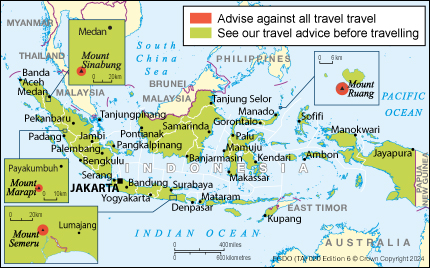
Volcanic eruption - Mount Sinabung, 60km (40 miles) south-west of Sumatra's main city Medan, erupted on 29 August 2010 after lying dormant for 400 years.
There is a high threat from terrorism throughout Indonesia. Terrorist groups continue to plan attacks and have the capacity and intent to carry out these attacks at any time and any where in the country. Attacks could be indiscriminate, including in places frequented by expatriates and foreign travellers. Terrorist attacks in Jakarta on 17 July 2009 and in Bali in October 2005 and October 2002 killed and injured a number of British nationals. See the Terrorism section of this Travel Advice.
You should exercise caution when travelling to Aceh, Central Sulawesi Province (especially Palu, Poso and Tentena), Maluku Province (especially Ambon) and Papua Province. On 24 January 2010 a number of people were injured in an armed attack on a vehicle travelling between Timika and Tembagapura in Papua. You should be alert to the potential for politically motivated violence. See the Local Travel section of this Travel Advice.
There is a high threat from terrorism throughout Indonesia. Terrorist groups continue to plan attacks and have the capacity and intent to carry out these attacks at any time and anywhere in the country. Attacks could be indiscriminate, including in places frequented by expatriates and foreign travellers.
Terrorists have shown that they have the means and motivation to carry out successful attacks in Indonesia. On 17 July 2009 suicide bombers carried out attacks against the Ritz Carlton and Marriott Hotels in Jakarta. Seven people were killed and 55 injured. Jemaah Islamiyah is believed to have been responsible for the Bali bombings in October 2002, which killed 202 people (including a number of British nationals), the Marriott Hotel bombing in Jakarta which killed 12 people in August 2003, and the Australian Embassy bombing in September 2004, which killed 11 people; and the Bali suicide bombings of 1 October 2005 which killed 20 people and injured a further 90.
These attacks underscore the ongoing terrorist threat in Indonesia. Venues known to be frequented by foreign visitors and expatriates, including beach resorts, bars and restaurants, hotels and shopping malls hosting major international brand outlets are potentially targets for such groups.
If you are visiting, or are resident in Indonesia, you should exercise caution at all times. We advise you to ensure that you are comfortable with, and regularly review, your and your family’s security arrangements. You should also be aware that on 14 May 2010, the Indonesian authorities announced that they had disrupted terrorist plans to carry out an attack on President Yudhoyono and unspecified international hotels in Jakarta.
You should be particularly vigilant during holiday periods such as Easter and Christmas, which can be a time of heightened tensions in Indonesia. In the past, attacks have occurred during holiday periods in Indonesia. In recent years, the Indonesian Police have announced tightened security in public places such as airports and major tourist areas over the Christmas and New Year period. You should exercise caution when visiting locations where large groups of people gather or which are known to be frequented by foreigners.
If you are planning to travel overland or by boat to Malaysia or the Philippines, you should be aware that Philippines based terrorist groups also pose a risk. We advise against all travel to Mindanao, in the Philippines because of ongoing terrorist activity. Foreign nationals have also been kidnapped in the past in East Malaysia and we believe that this threat remains. Please see the FCO Travel Advice for Philippines and Malaysia.
You should be aware that the long-standing policy of the British Government is not to make substantive concessions to hostage takers. The British Government considers that paying ransoms and releasing prisoners increases the risk of further hostage taking.
For further information see Terrorism abroad.
You should beware of street crime and pickpockets. Take personal security measures such as:
For more general information see Victims of Crime Abroad.
Whilst the overall political situation is stable, developments elsewhere, including the Middle East, resonate in Indonesia. You should follow news reports and be alert to any developments, which might trigger public protests or unrest.
You should avoid any demonstrations or large gatherings of people. If you become aware of any nearby violence you should leave the area immediately. You should keep yourself informed of developments, including by regularly checking this advice.
Indonesia Country Profile
You should ensure that you have the necessary permits when planning adventure trips in Indonesia. You should also ensure that you have a reliable and reputable guide in place for such a trip; failure to do so can lead to difficulties with local authorities should you need their help.
Flash floods and more widespread flooding occur regularly during the rainy season from November to April. Cities - especially Jakarta - are frequently subject to severe localised flooding which can result in major disruption, and occasionally fatalities. Previous floods in Jakarta have affected a main toll road to the Soekarno-Hatta International Airport. You should allow extra time for meeting flight connections in line with the prevailing weather conditions.
Our additional advice for British nationals in Indonesia who are travelling outside Jakarta is as follows:
Central Sulawesi Province
We advise you to exercise caution when travelling to Central Sulawesi Province, especially Palu, Poso and Tentena because of the unsettled political situation. You should be alert to the potential for politically motivated violence. Sectarian violence broke out in Central Sulawesi Province in 1998, which claimed almost 600 lives between 1998 and 2001. A peace deal signed in December 2001 dramatically reduced sectarian conflict in the region. From 2003-2006 violence continued in the form of bombings and assassinations, predominantly in the towns of Poso and Palu. Since 2007 the situation has been much calmer but sporadic incidents continue to occur.
Maluku Province
We advise you to exercise caution when travelling to Maluku Province, especially Ambon, including Haruku Island (Pulau Haruku), which was the scene of serious civil unrest between different religious and tribal groups between 1999 and 2002. The region has continued to experience sporadic unrest, which has resulted in a number of deaths and serious injuries.
Aceh
We advise you to exercise caution when travelling to Aceh, especially if travelling to remote areas. Aceh is emerging from a long period of internal conflict. You should remain alert to the risk of politically motivated violence. Although violence against foreigners is generally rare, there were three separate incidents in November 2009. On 5 November 2009 the Head of the German Red Cross was shot and wounded by unidentified men in Banda Aceh; on 16 November 2009 an incident took place involving suspected gunfire directed at the home of the resident EU representative; and on 23 November 2009 shots were allegedly fired at the house of two American lecturers at the Syiah Kuala University, also in Banda Aceh. There have also been cases of verbal and occasionally physical harassment of single foreign women.
If you are visiting Aceh, you should make sure that you are well informed about the local situation at the time of your visit. You should avoid large crowds, demonstrations or political rallies, as elsewhere in Indonesia.
We have in the past received reports of Shari'a (religious) police harassing foreigners in Aceh. You should therefore exercise caution and ensure that your behaviour does not offend local sensitivities.
If you are travelling to Aceh to engage in humanitarian or reconstruction work, you should do so in conjunction with a well-established and reputable organisation that has permission to operate in Indonesia.
You should ensure that your organisation has a security plan approved by the Indonesian authorities, and is actively linked to the local security advice of the UN Office for Crisis and Humanitarian Affairs in Banda Aceh. You should ensure that you comply with local immigration controls and register with the police. We have been informed that tourists arriving at the airport in Banda Aceh can now obtain visas on arrival but regulations regarding entry into and permission to remain in Aceh can change at any time. You should check with the Indonesian Embassy in London prior to travel to obtain the most recent information on entry requirements and registration procedures while in Aceh.
Papua and West Papua
We advise you to exercise caution when travelling to the province of Papua and to seek local advice on your travel plans. There is a heavy security presence in some areas, especially along the border with Papua New Guinea.
Political tensions in Papua have given rise to sporadic violence, including in Jayapura, Abepura, Wamena and Sentani. As elsewhere in Indonesia, you should avoid large crowds and demonstrations, which can turn violent. Papuan separatists have kidnapped foreigners in the past.
There has been increased tension since early 2009 in the area around Timika town in Papua province. On 24 January 2010 a number of people were injured in an armed attack on vehicles travelling between Timika and Tembagapura. In July 2009 there were a series of armed attacks on vehicles using the same road which resulted in at least three deaths and a number of injuries.
The situation in the province of West Papua is calmer although there remains the possibility of sporadic unrest. We advise you to monitor the situation and be alert to changing circumstances should you decide to travel to West Papua.
Permits are required to travel to both Papua and West Papua. Regulations for entry into and permission to remain in Papua can change at any time. You should seek the latest information on entry requirements and registration procedures from the Indonesian Embassy in London.
You cannot drive in Indonesia on a UK driving licence, but are permitted to use an International licence, which can be obtained in Indonesia. An International licence is obtained in the UK it may need to be endorsed by the Indonesian licensing office in Jakarta.
Traffic discipline is very poor; city streets are congested. Foreigners involved in even minor traffic violations or accidents may be vulnerable to exploitation. You should therefore consider employing a private driver or hiring a car with a driver. Some multinational companies refuse permission to their expatriate staff to drive in Indonesia.
British Embassy staff are advised to avoid driving themselves whenever possible.
Should you be involved in an accident or breakdown you should ensure someone remains with your vehicle. You may wish to consider leaving your driver, if you have one, in charge of your vehicle in such circumstances, if you have any concerns for your security and can move to another location safely. You should make yourself available for questioning by the police if requested to do so.
For further information see Driving abroad.
There have been a number of major aircraft crashes in Indonesia over the last ten years, for reasons including bad weather, poor maintenance and mechanical failure. An aircraft crashed on landing in Papua province on 13 April 2010 injuring many on board. On 20 May 2009 a military aircraft crashed in East Java province killing over 90 people.
With the exception of Garuda Airlines, Mandala Airlines, Airfast and Ekspres Transportasi Antarbenua (operating as PremiAir), Metro Batavia and Indonesia Air Asia, all Indonesian airlines are refused permission to operate services to the EU because Indonesia is unable to ensure that all its airlines meet international safety standards. We recommend that you avoid flying with Indonesian carriers subject to the EU operating ban.
List of carriers banned from the EU
If you already have a flight booked with an airline from Indonesia and it is part of a journey, which commenced in the EU you should consult your travel agent.
British Government employees are advised to use carriers, which are not subject to an operating ban or restrictions within the EU unless this is unavoidable. You should bear this in mind when making your travel plans.
From April 2010, all foreign nationals arriving on international flights at Jakarta, Yogyakarta and Solo airports may be required to provide their fingerprints at Immigration as well as have their photograph taken for immigration records. Plans are in place to extend this to other international airports within Indonesia.
When leaving the country by plane, departure tax varies by airport from 60,000 to 150,000 Rupiah. You will need to pay an Airport Tax of 150,000 Rupiah if departing through Jakarta International Airport, or from Bali International Airport.
Inter-island travel by small boats can be dangerous as storms appear quickly and navigational equipment is often limited. There have been attacks against ships in and around the waters of Indonesia. Mariners are advised to be vigilant; reduce opportunities for theft; establish secure areas onboard; and report all incidents to the coastal and flag state authorities.
There have been a number of instances of passenger boats sinking in Indonesia. On 22 November 2009 a passenger ferry carrying 291 passengers and crew capsized off the Riau islands. Reports indicate that 29 people were killed.
For more general information see River and sea safety
You should respect local traditions, customs, laws and religions at all times and be aware of your actions to ensure that they do not offend other cultures or religious beliefs, especially during the holy month of Ramadan or if you intend to visit religious areas. For more general information see Travelling during Ramadan.
You should be aware of offending Islamic sensitivities. Westerners have occasionally been harassed by fundamentalists in bars and nightclubs, particularly around major Islamic holidays such as Ramadan.
Do not get involved with illegal drugs. Possession, trafficking and manufacture of such drugs are serious offences in Indonesia. Those caught face lengthy prison sentences or the death penalty, usually after a protracted and expensive legal process. Police often raid locations (particularly in Bali) known to be frequented by foreigners, and may require an individual to take a urine or blood test where they have reasonable suspicion that drugs have been taken. Drug use or the possession of even small amounts of drugs such as marijuana or ecstasy can lead to prison sentences longer than four years. Convicted traffickers or users of hard drugs such as cocaine or heroin face the death penalty in Indonesia.
Gambling is illegal in Indonesia. There have been cases where tourists have fallen victim to organised gambling gangs, resulting in the loss of large amounts of money.
You must show evidence of your identity if it is requested by, for example, the Police. You should carry photocopies of the relevant pages of your passport and your arrival card to avoid losing the original, which should be kept in a safe place.
For more general information for different types of travellers see Your trip.
Visas are required for UK nationals entering Indonesia. Following changes implemented from 26 January 2010, British citizens visiting Indonesia are able to buy a 30 day visa upon arrival at a cost of US $ 25. Visas of this kind can be extended once for a maximum of 30 days by applying to Immigration offices within Indonesia. Seven day visas are no longer available. Some visitors may be able to use the on-board facility for purchasing visas before arrival. We understand that this service is currently restricted to a small number of flights, but is likely to be expanded in the future.
You should consult the Indonesian Embassy in London.
You should ensure that your passport is valid for a minimum period of six months upon arrival. Entry to Indonesia will be refused and airlines may not carry passengers holding passports with less than six months validity. You are required to retain you arrival card for presentation to Immigration upon your departure.
Overstaying without the proper authority is a serious matter and visitors can be held in detention or refused permission to leave the country until a fine of Rp. 200,000 per day is paid. After overstaying for 60 days, you will be detained and possibly imprisoned for between six months and two years.
If you stay in private accommodation in Indonesia (not a hotel) you must register your presence with the local police or you could face a fine of Rp 5 million (£290). If you stay in a hotel you will be registered automatically.
Single parents or other adults travelling alone with children should be aware that some countries require documentary evidence of parental responsibility before allowing lone parents to enter the country or, in some cases, before permitting the children to leave the country. They may want to see birth certificates, a letter of consent from the other parent or some evidence as to your responsibility for the child. Contact the Indonesian Representation in London for further information.
The standard of local medical care in Indonesia can be poor and some medical tests cannot be done reliably. Good medical care can be very expensive and in remote areas attention for serious injuries or illness is likely to be unobtainable. You may require expensive medical evacuation costing up to tens of thousands of pounds. Therefore you should ensure your policy covers you for medical evacuation by air ambulance.
Indonesia suffers from periodic problems with air quality reaching hazardous levels because of seasonal smoke haze from forest fires. You are advised to check news reports and follow local advice.
Dengue fever, chikungunya and malaria occur in Indonesia. These diseases are transmitted by mosquitoes. There are no vaccinations against these diseases, but there are preventative measures that you can take, as advised on the National Travel Health Network and Centre (NaTHNaC) website. You should visit your GP to discuss malaria prevention tablets. The number of cases of dengue fever increases rapidly during the rainy season. A significant increase has been reported in areas in Kalimantan and East Java at the beginning of 2010.
There is a risk of rabies throughout Indonesia, in particular in Bali. A small number of deaths, from rabies have been reported in 2009 and 2010. Sanglah Hospital in Bali has prepared a special area to treat people suspected of being exposed to the rabies virus and doctors in other clinics in Bali have been trained to care for potential victims. If bitten or scratched by an animal you should seek medical attention. For further information about rabies see the NaTHNaC website.
In the 2008 Report on the Global AIDS Epidemic the UNAIDS/WHO Working Group estimated that around 270,000 adults aged 15 or over in Indonesia were living with HIV; the prevalence rate was estimated at around 0.2% of the adult population. This compares to the prevalence rate in adults in the UK of around 0.2%. You should exercise normal precautions to avoid exposure to HIV/AIDS. For more general information on how to do this see our HIV and AIDS page.
Indonesia sits along a volatile seismic strip called the 'Ring of Fire' in the Pacific. Volcanic eruptions and earthquakes occur regularly in Indonesia which can, where the severity and conditions of the quake combine, present a potential threat of tsunamis within the region. The 'ring-of-fire' is a horse-shoe-shaped zone of frequent earthquakes and volcanic eruptions that surrounds the basin of the Pacific Ocean. It is 40,000km long and is associated with a nearly continuous series of oceanic trenches, island arcs, and volcanic mountain ranges and/or plate movements.
Earthquakes
It is understood that 90% of the world's earthquakes and 81% of the world's largest earthquakes occur along the Ring of Fire which is a direct consequence of plate tectonics and the movement of collisions of crustal plates.
On 9 May an earthquake occurred off the coast of Northern Sumatra measuring 7.4 on the Richter scale. On 6 April 2010, there was an earthquake in the same region measuring 7.7.
An earthquake measuring 7.6 on the Richter scale occurred offshore from the city of Padang on 30 September 2009. On 1 October 2009 an earthquake measuring 7.0 on the Richter scale occurred 200 km south of Padang.
An earthquake measuring approximately 7.4 on the Richter scale hit south of the island of Java on 2 September 2009.
On 16 November 2008 an earthquake struck off the northern coast of the island of Sulawesi causing fatalities and structural damage to a number of buildings.
The 26 December 2004 earthquake and tsunami caused massive devastation to coastal areas in Aceh and parts of North Sumatra.
Floods
Flash floods and more widespread flooding occur regularly during the rainy season from November to April. Cities - especially Jakarta - are frequently subject to severe localised flooding which can result in major disruption, and occasionally fatalities. The collapse of the dam at Lake Situ Gintung on the outskirts of Jakarta on 27 March 2009 resulted in 98 deaths Landslides occur in rural areas during the wet season.
Volcanoes
There are numerous volcanoes in Indonesia, any of which can erupt without warning. Since April 2008 Mount Soputan in North Sulawesi, Mount Egon on Flores Island, Nusa Tengarra, Mount Ibu in North Maluku and Anak Krakatoa in the Sunda Strait have shown significant increased volcanic activity.
Mount Sinabung, 60km (40 miles) south-west of Sumatra's main city Medan, erupted on 29 August 2010 after lying dormant for 400 years. Ash and acrid smoke from the volcano have blanketed villages and crops.
Local residents have been relocated from the surrounding areas. At least one person is reported to have died from breathing problems. The local authorities have evacuated everyone within a six-kilometre radius of the volcano. The status has now been revised from dormant to active and dangerous. Some flights out of Medan airport have been affected due to smoke from the volcano.
We advise you to exercise caution, check news reports and follow local advice before travelling to volcanic areas. The capacity of the Indonesian emergency and rescue services to deal with large natural disasters is limited.
For further information, you should visit the Indonesian Centre for Vulcanology's website.