Burma |
|
| Still current at: 11 February 2012
Updated: 06 February 2012 |
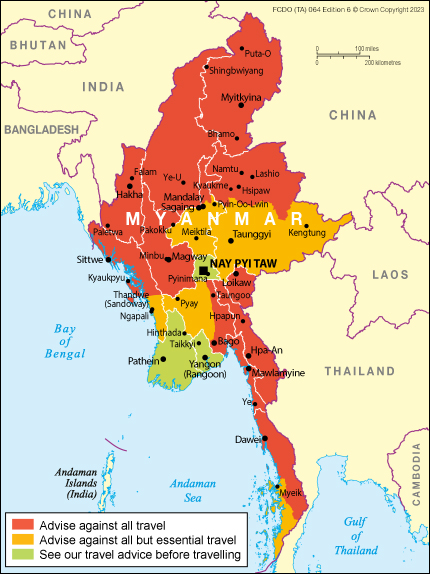
| No restrictions in this travel advice | Avoid all but essential travel to part(s) of country | Avoid all but essential travel to whole country | Avoid all travel to part(s) of country | Avoid all travel to whole country |
This advice has been reviewed and reissued with editorial amendments to the Travel Summary, Safety and Security - Terrorism, Local Travel, Air Travel, Road Travel and Political Situation sections and the Entry Requirements and General section). The overall level of the advice has not changed; there are no travel restrictions in place in this travel advice for Burma.
(see travel advice legal disclaimer)
Safety and Security - Terrorism
There is a general threat from terrorism. If you are visiting or are resident in Burma, you should exercise caution in public places. Attacks could be indiscriminate, including in places frequented by expatriates and foreign travellers.
Past targets have included commercial interests, public transport and places tourists may visit. On 15 April 2010, there were three bomb explosions during festivities at Kandawgyi Lake, in central Rangoon. At least 10 people were killed and 170 injured. (See Safety and Security - Local Travel).
Other recent incidents include:
See our terrorism abroad page.
Safety and Security - Crime
There are no accurate crime statistics, but anecdotal evidence suggests that muggings, burglaries and petty thefts in Rangoon have increased as the economic situation has deteriorated. Expatriate homes and hotels have been targeted in the past. You should take extra care of your belongings.
There have been occasional instances of violent crime against foreigners. Take sensible security precautions at all times.
See our victims of crime abroad page.
Safety and Security - Local travel
Exercise caution if travelling to border areas in Burma, particularly those referred to above. The Burmese government restricts travel to most border areas. There are a limited number of legal crossing points, but these could close without notice:
You must exit Burma at the same border crossing from which you entered, and Burmese immigration officers may request to hold your passport until your visit is complete. Do not attempt to cross any border illegally or enter restricted areas without the appropriate permissions from the Burmese authorities. The Ministry of Hotels, Tourism and Sport maintains a list of approved destinations. Tourists can visit Rangoon, Mandalay, Bago and Irrawaddy regions without restrictions. Other destinations are subject to limitations: access by air or train but not by road. Queries on permission should be directed to the Burmese authorities, not the British Embassy in Rangoon. See www.myanmartourism.org or call the Ministry of Tourism on +95 67 406129.
Be particularly vigilant if travelling to border areas. There is ongoing military activity close to borders with Thailand, Laos and China especially in Shan, Karen and Kachin States. There is ongoing conflict in parts of Kachin State and the far north of Shan State. Ten people were reported to have been killed in a bomb explosion in compound in Myitkyina on 13 November. Details around the incident remain unclear, but some reports suggest that this was an accidental explosion during a bomb-making demonstration. There has been no fighting within the town of Myitkyina itself, but town is experiencing occasional curfews as a result of the conflict. Take local advice before travelling outside Myitkyina within Kachin State, as the conflict situation remains fluid. There has also been low-level fighting in central Shan State and Karen State near the Thailand/Burma border in recent months..
Land mines also pose a threat in conflict areas.
You may only go to officially designated tourist areas. You need prior permission from the tourism authorities for treks to remote parts of the country. However, tourists have experienced difficulties with the authorities even after obtaining such permission.
Safety and Security - Local Travel - Air Travel
Evidence suggests that the domestic airline, Myanmar Airways, does not always comply with international safety standards. Foreign & Commonwealth Office (FCO) staff have been advised to avoid flying with Myanmar Airways.
The domestic airline Myanmar Airways should not be confused with Myanmar Airways International (MAI), which operates across South East Asia.
Local flight schedules are subject to change without warning and you should leave sufficient time in your travel itinerary to accommodate this. On occasion Burmese domestic airlines use aircraft from outside their own fleet, including those belonging to Myanmar Airways. Passengers are not advised in advance where this is the case.
The EU has published a list of air carriers that are subject to an operating ban or restrictions within the European Community. More information can be found on the European Commission website.
See airline security.
Safety and Security - Local Travel - Rail Travel
Railway equipment is decrepit; fatal rail crashes occur, although they may not always be reported.
Safety and Security - Local Travel - Road Travel
British or International Driving Licences are not recognised in Burma. You must apply for a Myanmar Driving License at the Department for Road Transport and Administration in Rangoon.
Many buses and taxis in Burma run on Compressed Natural Gas (CNG). There have been reports of injuries to passengers caused by exploding gas cylinders.
Overland travel can be hazardous, particularly in the rainy season (May to October). Roads can become impassable and bridges damaged. Travel by road between many areas outside the key destinations of Rangoon, Mandalay, Bago and Irrawaddy regions is restricted. Please check with your tour operator or the Ministry of Hotels, Tourism and Sport before travelling.
Under Burmese law, the driver of a car involved in an accident with a pedestrian is always at fault. Many vehicles, including taxis, are in a poor mechanical state. Although Burma drives on the right, the majority of cars are right hand drive, which can make driving hazardous.
See our driving abroad page.
Safety and Security - Local Travel - Sea and river travel
Ensure that you ask for and follow carefully local advice about where it is safe to swim or dive in the sea. River transport may not conform to internationally recognised safety standards. Be aware that search and rescue facilities are unlikely to meet international standards.
During the monsoon season (normally May to October), heavy rains can cause flooding. Check the weather before undertaking any river journey.
See our river and sea safety page.
Safety and Security - Political situation
Burma Country Profile
Burma’s first elections in 20 years took place on 7 November 2010. The military regime-backed party, the USDP, claimed a landslide victory. But there were reports of widespread electoral fraud and voter intimidation, and some opposition parties expressed anger at the process. An interim government handed over to a newly appointed government of the Republic of the Union of Myanmar on 30 March 2011, headed by President Thein Sein.
Burma’s pro-democracy leader Aung San Suu Kyi’s release on Saturday 13 November 2010, at the end of her latest period of house arrest drew large crowds of jubilant supporters.
However, the political situation remains unsettled and you should avoid all demonstrations and large gatherings. You should avoid taking photographs or videos of the military, the police or demonstrations. There are restrictions on any form of protest or assembly of people in Burma.
There are also stringent restrictions on freedom of speech, movement, religion, and political activity. Foreign nationals have been arrested, imprisoned and deported for distributing pro-democracy literature or criticising the regime in public. Attempts to visit the home of Daw Aung Sung Suu Kyi or the offices of her National League for Democracy party could attract unwelcome attention from the authorities. Do not take photographs of military installations or personnel.
In the past, there have been acts of politically motivated violence around public holidays such as Armed Forces Day (27 March) and Martyrs Day (19 July) as these have the potential to turn violent. These dates, and other anniversaries, such as that of the 8 August 1988 uprising against the government and the September 2007 protests usually see a significant increase in security forces in Rangoon and elsewhere in Burma.
Conflict between the Burmese Army and Kachin Independence Army broke out in June 2011 in Kachin state, with ongoing sporadic fighting reported across much of the state, but particularly east of Bhamo.
Fighting in Kachin State and the far north west of Shan State (Namkham) area continues between government and Kachin Independence Army forces (see Safety and Security-Local Travel above). There are occasional reported of low-level skirmishes in Kayin State near the Thai-Burma border.
Respect religious custom when visiting Buddhist religious sites – shorts and sleeveless tops will cause offence and shoes and socks should be removed before entering a pagoda or monastery.
Penalties for drug trafficking range from a minimum sentence of 15 years imprisonment and can include the death penalty.
Homosexuality is illegal in Burma. In June 2007, a European National was sentenced to seven years in prison for committing homosexual acts.
See our your trip page.
Entry Requirements - Visa Requirements
A visa is required to visit Burma. Visa on arrival is only available from select destinations. British nationals should apply for a visa at the nearest Burmese embassy or Consulate well in advance of travelling.
Any queries on entry requirements should be directed to the nearest Burmese Embassy not to the British Embassy in Rangoon.
Entry Requirements - Passport Validity
You must hold a valid passport to enter Burma. Your passport must be valid for a minimum period of six months from the date of entry into Burma.
Entry Requirements - Travelling with Children
Single parents or other adults travelling alone with children should be aware that some countries require documentary evidence of parental responsibility before allowing lone parents to enter the country or, in some cases, before permitting the children to leave the country. They may want to see birth certificates, a letter of consent from the other parent or some evidence as to your responsibility for the child. As far as we are aware the Burmese immigration authorities do not normally ask to see such evidence, but if you have concerns please check with the nearest Burmese Embassy.
Routine medical advice and treatment can be obtained in Rangoon and Mandalay, but elsewhere you should not assume that competent advice and treatment is available. Up-front cash payment is often required prior to receiving medical treatment in Burma. Intrusive examinations, including emergency dental work, should be avoided due to irregular hygiene standards and the danger of infection, particularly by hepatitis B and C and HIV/AIDS.
Dengue and malaria occur in Burma. There are no vaccinations against these diseases, but there are preventative measures that you can take, as advised on the National Travel Health Network and Centre (NaTHNaC) website. Visit your GP to discuss malaria prevention tablets.
Poor sanitation and eating contaminated food can increase the risk of diarrhoeal illnesses. Drink or use only boiled or bottled water and avoid ice in drinks. If you suffer from diarrhoea during a visit to Burma, seek immediate medical attention.
In the 2010 Report on the Global AIDS Epidemic the UNAIDS/WHO Working Group estimated that around 230,000 adults aged 15 or over in Burma were living with HIV; the prevalence percentage was estimated at around 0.6 of the adult population compared to the prevalence percentage rate in adults in the UK of around 0.2%. You should exercise normal precautions to avoid exposure to HIV/AIDS. For more general information on how to do this see HIV and AIDS.
Seek medical advice before travelling to Burma and ensure that all appropriate vaccinations are up-to-date. For further information on vaccination requirements, health outbreaks and general disease protection and prevention you should visit the websites of the National Travel Heath Network and Centre NaTHNaC and NHS Scotland's Fit For Travel or call NHS Direct on 0845 46 47.
See our travel health and eat and drink safely pages.
Health - Avian Influenza (Bird Flu)
There have been outbreaks of Avian Influenza (Bird Flu) in domestic poultry in Burma (most recently in February 2010). There have been no confirmed human deaths in Burma, but a case of Avian Influenza infecting a human was confirmed in December 2007.
The risk to humans from Avian Influenza is believed to be very low. As a precaution, you should avoid visiting live animal markets, poultry farms and other places where you may come into close contact with domestic, caged or wild birds; and ensure poultry and egg dishes are thoroughly cooked.
You should read this advice in conjunction with Avian and Pandemic Influenza, which gives more detailed advice and information.
Following heavy rains in July and August 2011, there have been isolated instances of flooding in a number of areas, including in Rakhine State, Mandalay and Bago Division. Tourists are advised to check local weather reports before travelling, particularly in coastal areas.
The cyclone season in Burma normally runs from April to October. Floods and landslides may occur. Cyclone Giri struck Burma on 22 October 2010, causing extensive damage in Burma’s Northern Rakhine state near Sittwe, with estimates of over 250,000 people being affected.
Cyclone Nargis, which struck Burma in May 2008, killed nearly 130,000 and the damage it caused still affects movement in the Irrawaddy Delta.
See our tropical cyclones page.
An earthquake of 6.8 magnitude occurred on the Thai/Burma/Laos border area on 24 March. The centre of the earthquake was in the Tachileik district in Eastern Shan State, Burma approximately 70 miles from the northern Thai city of Chiang Rai. Reports indicate that the earthquake affected more than 18,000 people, with damage to building and roads in Shan State. Official statistics put the number of casualties at 74 deaths and 125 injuries. UN agencies and humanitarian partners have mobilised resources and relief activities.
General -
Insurance
Take out comprehensive travel and medical insurance, which includes air evacuation by a recognised carrier before travelling. Check any exclusions, and that your policy covers you for all activities you want to undertake. See our travel insurance page.
If things do go wrong when you are overseas then see our When things go wrong page.
General - Replacement passports
The British Embassy in Rangoon does not issue passports. Before setting off, ensure that your passport has sufficient validity (over six months) and a plentiful supply of unused pages. Carry photocopies of your passport at all times.
Passports for British nationals in South East Asian countries are issued via the British Consulate-General in Hong Kong. For details visit http://ukinhongkong.fco.gov.uk.
In an emergency the Embassy can issue an Emergency Travel Document (ETD) upon receipt of the fee and mandatory supporting documents.
General - Registering with the British Embassy
If you intend to stay in Burma for over a month, register with our LOCATE service to tell us when and where you are travelling abroad or where you live abroad so our consular and crisis staff can provide better assistance to you in an emergency.
General - Mobile phones
International GSM roaming is not available in Burma.
General - Money
There are no ATMs in Burma. Credit cards, debit cards and travellers' cheques are rarely accepted (if at all). Check with your hotel and/or tour operator that they accept credit cards as a form of payment before you go. Ensure you have enough US Dollars, in pristine condition to fund your stay.
Because of concerns over counterfeit money, US Dollars with the letters AB and CB at the start of the serial number (top left-hand corner of note) are not always accepted. Notes with pen marks, folds or tears are also not accepted.
General - Convention on International Trade in Endangered Species (CITES)
Burma is a party to the CITES. Visitors should therefore be aware of the restrictions placed on the export of endangered species by CITES, particularly when deciding whether to buy exotic souvenirs such as those made from turtles. Over 800 species of animals and plants are currently banned from international trade and a further 30,000 are strictly controlled by CITES and EU legislation. Further information is available on the Convention on International Trade in Endangered Species (CITIES) website.
General - Consular Assistance Statistics
Around 7,300 British tourists visited Burma in 2010 (Burmese Central Statistical Organisation figures). Most visits are trouble-free. Three British nationals required advice and assistance in the period 01 April 2010 - 31 March 2011, including for one death.